In this article, we compare the 8 best Semrush alternatives for agencies in 2026. Each platform offers something different, from keyword research and backlink analysis to white-label client reporting, content optimization, PPC competitor research, and AI search visibility tracking.
So,without any further ado,let’s get started.
Quick Pick Criteria
-
Best for AI search visibility: RadarKit
-
Best for backlink research: Ahrefs
-
Best value all-in-one platform: SE Ranking
-
Best for client reports: AgencyAnalytics
-
Best for everyday SEO work: Moz Pro
-
Best for PPC competitor research: SpyFu
-
Best for market intelligence: Similarweb
-
Best for content optimization: Surfer SEO
| Tool | Best for | Starting price | Key focus |
|---|---|---|---|
| RadarKit | Agencies offering AI-search visibility services | $29/month | AI mentions, local Tracking, citations, prompts, and GEO |
| Ahrefs | Agencies doing deep organic and backlink research | $129/month | Backlinks, keywords, site audits, and competitors |
| SE Ranking | Agencies needing one platform for ongoing SEO work | $103.20/month | Rank tracking, audits, research, reporting, and GEO |
| AgencyAnalytics | Agencies that need client-facing reports | $25/month | Automated dashboards and white-label reporting |
| Moz Pro | Teams managing everyday SEO campaigns | $99/month | SEO research, site crawls, rank tracking, and AI visibility |
| SpyFu | Agencies researching PPC and organic competitors | $39/month | Ad history, competitor keywords, rankings, and reports |
| Similarweb | Agencies planning market and audience strategies | Custom pricing | Traffic intelligence, audience data, and market analysis |
| Surfer SEO | Agencies producing SEO content for clients | $49/month | Content optimization, audits, briefs, and AI visibility |
How We Chose These Semrush Alternatives
Core SEO Work
The first factor was whether a tool can help with the daily work behind an SEO campaign. We looked for useful features such as keyword research, rank tracking, site audits, backlink analysis, competitor research, content planning, and on-page checks.
Ahrefs, SE Ranking, and Moz Pro are closer to full SEO platforms because they cover several of these areas. SpyFu is more focused on competitor and paid-search research. Surfer SEO is built around content creation and content updates. Similarweb is more useful for market research than for technical SEO audits.
Multi-Client Management
Agencies need to keep client campaigns separate and organized. A useful platform should make it possible to create projects, add team members, track several websites, monitor different locations, and share relevant data without mixing accounts.
We looked at project limits, user seats, guest access, client portals, and white-label options. These details matter because an agency may outgrow a plan faster than expected after adding a few new clients.
SE Ranking includes project-based SEO management and offers an Agency Pack for teams that need white-label reporting, client-facing access, scheduled reports, and lead-generation features. RadarKit includes projects, client portals, branded reports, and team access based on the selected plan.
Client Reporting
Good reporting is a major part of agency retention. Clients need to see what has changed, what work was completed, what results are improving, and what actions come next.
We considered whether a tool supports dashboards, scheduled reports, branding, custom metrics, data integrations, and client access. AgencyAnalytics received a place on this list because it is built for reporting across multiple marketing channels, rather than only SEO.
Pricing and Limits
The best Semrush alternatives should offer reasonable value for the work they support. Instead of looking only at the first monthly price, we reviewed plan limits such as projects, tracked keywords, prompts, users, reports, crawl credits, and add-ons.
AI Search Visibility
AI-generated search results are now part of many client conversations. Businesses want to know whether ChatGPT, Perplexity, Gemini, Copilot, Google AI Mode, and Google AI Overviews mention their brand, cite their website, or recommend a competitor.
For this reason, we also considered AI tracking capabilities. RadarKit was placed first because its main focus is AI visibility. Ahrefs, SE Ranking, Moz Pro, AgencyAnalytics, SpyFu, Similarweb, and Surfer SEO also offer selected AI-related features, but their primary strengths are different.
Agencies need to keep client campaigns separate and organized. A useful platform should make it possible to create projects, add team members, track several websites, monitor different locations, and share relevant data without mixing accounts.
We looked at project limits, user seats, guest access, client portals, and white-label options. These details matter because an agency may outgrow a plan faster than expected after adding a few new clients.
8 Best Semrush Alternatives for Agencies in 2026
RadarKit: Best for AI Visibility and GEO Services
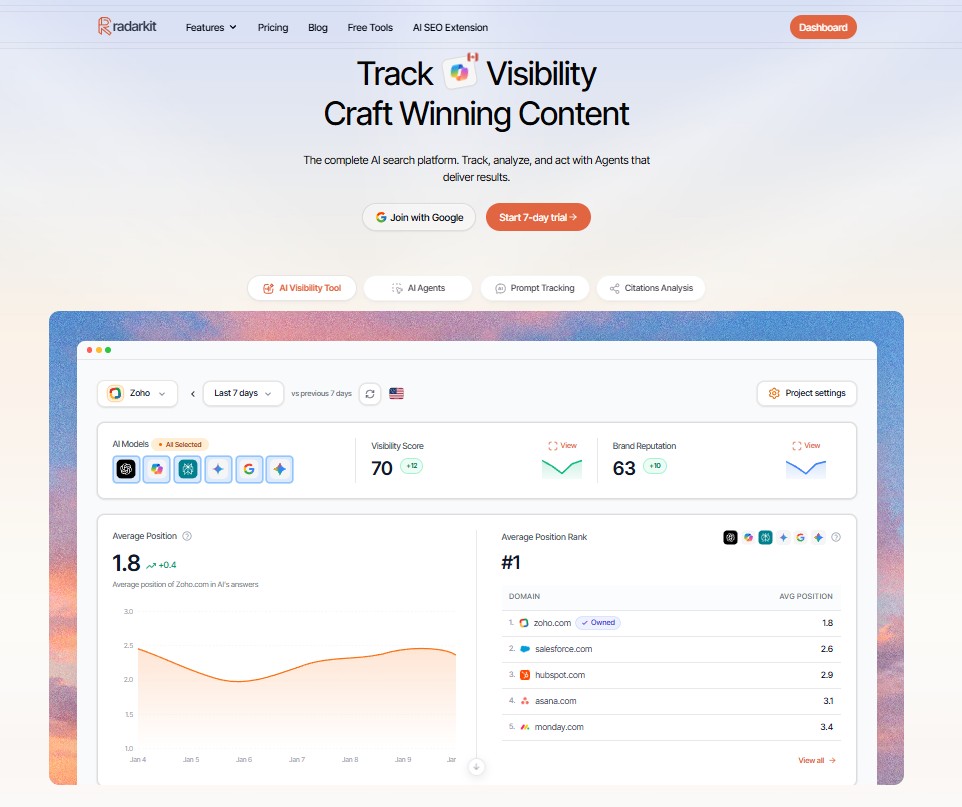
RadarKit is one of the most relevant Semrush alternatives for agencies that want to measure visibility inside AI-generated answers. It is built for teams that need to see how a client appears across ChatGPT, Google AI Mode, Google AI Overviews, Gemini, Perplexity, and Microsoft Copilot.
Traditional rank tracking still matters, but it does not show the full picture anymore. A client can be visible in an AI answer even when they do not hold a top organic position for a particular keyword. RadarKit helps agencies monitor that visibility at the prompt level.
Key Features
Multi-Model AI Visibility Tracking
RadarKit tracks how a client appears across ChatGPT, Perplexity, Gemini, Microsoft Copilot, Google AI Mode, and Google AI Overviews. This helps agencies monitor AI-search visibility from one dashboard instead of checking each platform manually.
Prompt Tracking
Agencies can create and track prompts based on a client’s services, products, locations, and important topics. The tool shows whether the client appears in the response and how often competitors are mentioned.
Inline Citations
RadarKit displays inline citations connected to AI-generated responses. This makes it easier to see which websites, pages, and domains AI platforms reference when answering prompts related to your client’s business.
For agencies, inline citations can support content planning, digital PR, link outreach, and authority-building campaigns. You can identify which external sources receive citations and look for realistic opportunities to improve a client’s presence in similar conversations.
Citation and Mention Analysis
The platform tracks brand mentions and citations across monitored prompts. Agencies can review whether a client is being cited directly, mentioned without a citation, or left out while competing brands appear.
This helps turn AI-search data into clear actions. For example, if competitors are regularly cited for a service-related question, the agency can review their cited pages and improve the client’s content coverage.
Competitor Monitoring
RadarKit lets agencies compare a client’s AI-search presence with competitors. You can monitor competitor mentions, visibility share, citation patterns, and performance across the same set of prompts.
This is useful for monthly reports because it gives clients context. Instead of only showing whether their brand appeared, you can show how that visibility compares with direct competitors.
GEO Writer
GEO Writer helps agencies create and optimize content for generative search engines. It can support content teams that want to produce pages designed to answer relevant user questions clearly and improve the chance of being included or cited in AI-generated answers.
Agencies can use GEO Writer when creating new service pages, comparison pages, blog posts, product pages, FAQs, and content refreshes. It is especially useful when the goal is to improve visibility in both traditional search and AI-search results.
Shopping Radar
Shopping Radar helps agencies monitor product-related visibility in AI-search and shopping queries. It is useful for ecommerce brands that want to understand whether their products appear when users ask AI tools for recommendations, comparisons, buying advice, or product alternatives.
This feature can help ecommerce agencies track product mentions, compare competitor visibility, and find opportunities to improve product pages, category pages, buying guides, and supporting content.
Local and Location-Based Tracking
RadarKit supports local tracking across more than 50 locations on standard plans. Enterprise users can access additional state-level and city-level locations.
This is helpful for local SEO agencies and multi-location businesses. A client may appear differently in AI answers depending on where the question is searched, so location-based tracking provides more useful insight than one general result.
AI Traffic Analytics
AI Traffic Analytics helps agencies review traffic connected to AI-search platforms. This gives a clearer view of whether AI visibility is contributing to real visits rather than only generating mentions.
MCP and API Access
RadarKit includes MCP access, which allows AI assistants and connected workflows to use RadarKit data more directly. It also provides API access for agencies that want to connect AI visibility data with internal dashboards, reporting systems, or custom client tools.
This can be useful for larger agencies that want to automate reporting or combine RadarKit data with information from other platforms.
Content, Outreach, Reddit, Chat, and Plan Agents
RadarKit includes AI agents for different workflow tasks. The Content Agent can help with content opportunities, while the Outreach Agent can support citation and promotional research. The Reddit Agent can help teams identify relevant discussions, and the Chat and Plan Agents can help turn platform data into next-step recommendations.
Google Search Console, Google Analytics, and WordPress Integrations
The platform supports Google Search Console, Google Analytics, and WordPress integrations. Agencies can connect AI visibility insights with search performance, website traffic, and content publishing workflows.
Client Portals and Branded Reports
RadarKit includes client portal access and branded PDF reports. This gives agencies a way to present AI visibility, citations, competitor data, prompt performance, and recommended actions under their own client-reporting workflow.
Best For
Agencies building AI-search visibility, GEO, citation-tracking, and AI content services.
Pricing
RadarKit offers four plans:
-
Lite: $29/month
-
Growth: $79/month
-
Pro: $139/month
-
Enterprise: Custom annual pricing
The Lite plan includes two projects, 15 tracked prompts, monitoring across six major AI platforms, competitor monitoring, local business tracking, shopping tracking, ads tracking, Google Search Console integration, MCP and API access, and two branded PDF reports.
The Growth plan increases the account to five projects and 50 tracked prompts. The Pro plan supports 10 projects and 100 prompts. Enterprise plans support unlimited projects, custom prompt tracking, 70+ locations, state and city tracking, unlimited seats, SSO, and a dedicated account manager.
Why Agencies May Choose RadarKit
RadarKit is a strong choice for agencies that want to add AI-search reporting to their current services. It gives you a way to show clients how they appear in AI answers, which competitors are appearing more often, and which citations may be worth pursuing.
Among Semrush alternatives, it is best viewed as a specialist platform. It can work alongside Ahrefs, SE Ranking, or Moz Pro when an agency needs both traditional SEO research and detailed AI visibility tracking.
2. Ahrefs: Best for Backlinks and Organic Competitor Research
Ahrefs is one of the most established Semrush alternatives for SEO agencies that need strong research tools. It is particularly useful for reviewing backlink profiles, finding content opportunities, analyzing organic competitors, and monitoring ranking performance.
Agencies often use Ahrefs at the research stage of a campaign. It can help you study a client’s site, compare it with competing domains, find pages that attract links, identify keywords competitors rank for, and build a content roadmap.
Key Features
Site Explorer
Site Explorer lets you review a website’s organic traffic, ranking keywords, top pages, backlinks, referring domains, paid keywords, and historical changes. It is useful for client audits and competitor research.
Keywords Explorer
Keywords Explorer helps agencies find keyword ideas, review search volume, understand ranking difficulty, check traffic potential, and study search intent. It also supports keyword clustering and AI suggestions on higher plans.
Rank Tracker
Rank Tracker monitors selected keywords across search engines. Ahrefs tracks keyword, traffic, and backlink changes so agencies can spot movement and investigate what changed.
Site Audit
Site Audit crawls websites and identifies technical SEO issues. It can help teams find broken links, crawlability issues, duplicate-content concerns, redirects, page errors, and other site problems.
Content Explorer
Content Explorer helps agencies find pages that have earned links, attracted social attention, or performed well around a topic. This can support content planning and outreach campaigns.
Competitive Analysis
Ahrefs includes domain comparison and competitor tools that can help you find keyword gaps, backlink gaps, and pages that perform well for competing sites.
Brand Radar
Brand Radar helps users research brand visibility across AI prompts and track selected AI prompts. It gives agencies another way to measure visibility beyond conventional search results.
Web Analytics
Ahrefs includes Web Analytics for teams that want a simple privacy-focused way to understand website traffic and user actions.
Best For
Agencies that rely on deep link intelligence and SEO competitor research.
Pricing
Ahrefs offers a $29/month Starter plan for basic research. Its full platform plans begin at:
-
Lite: $129/month
-
Standard: $249/month
-
Advanced: $449/month
-
Enterprise: $1,499/month with an annual commitment
The Lite plan includes five projects, 750 tracked keywords, 100,000 crawl credits, five tracked AI prompts, API access, MCP access, Site Explorer, Keywords Explorer, Brand Radar, Site Audit, Rank Tracker, Competitive Analysis, Web Analytics, and Report Builder access.
The Standard plan expands project limits, historical data, tracked keywords, crawl credits, AI prompts, and research features such as Content Explorer, Batch Analysis, keyword clusters, SERP comparison, and portfolio tools.
Why Agencies May Choose Ahrefs
Ahrefs is one of the strongest Semrush alternatives for agencies that sell link building, SEO strategy, technical audits, competitor research, and organic content planning. It gives your team detailed data to support recommendations instead of relying on guesswork.
For a small agency, the full Lite plan may be enough for a few active clients. For a busy SEO team, the Standard or Advanced plan is usually more realistic because of the higher project, keyword, crawl, and historical-data limits.
3. SE Ranking: Best All-in-One SEO Platform for Growing Agencies
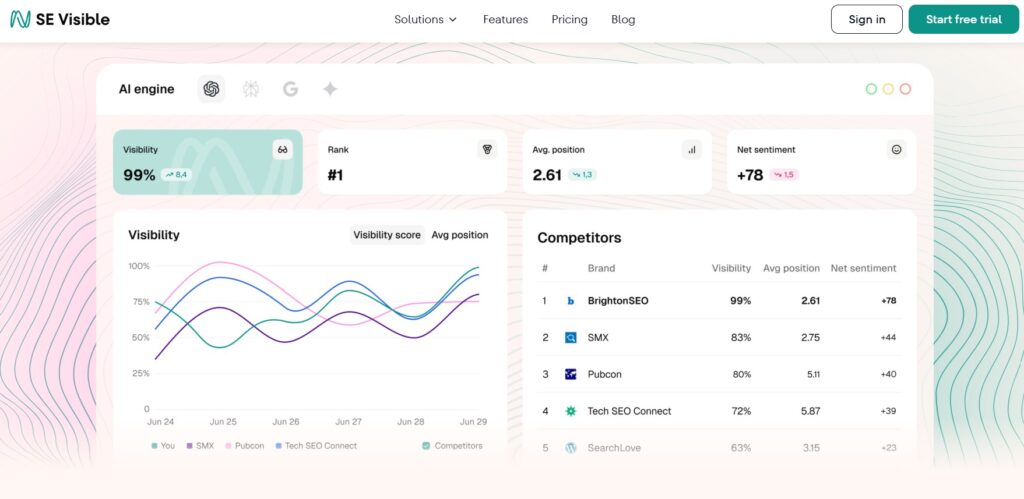
SE Ranking is a practical option for agencies that want one place to manage daily SEO work. It combines rank tracking, keyword research, competitor analysis, backlinks, audits, local SEO, content tools, reporting, and AI-search features.
The platform is a good fit for agencies that want to create repeatable client workflows. You can set up a project, add keywords, connect Google tools, run an audit, monitor competitors, build reports, and share results with clients.
Key Features
Daily Rank Tracking
SE Ranking tracks keyword rankings across major search engines. It also supports local and map rank tracking, which is helpful for agencies managing local business clients.
Keyword Research
The platform includes keyword research, keyword suggestions, search-volume data, keyword difficulty, and keyword-grouping tools. Users can also research competitor keywords.
Website Audit
SE Ranking runs technical audits that identify errors, warnings, crawl issues, page-level problems, and improvement opportunities.
Backlink Research and Monitoring
The platform includes backlink research and backlink monitoring. Agencies can review referring domains, analyze backlink profiles, compare competitors, and keep track of new or lost links.
On-Page SEO Checker and SERP Analyzer
The On-Page SEO Checker helps identify page-level optimization ideas. The SERP Analyzer gives agencies a clearer picture of ranking pages and search-result patterns.
AI Results Tracker
SE Ranking includes AI tracking for Google AI Overviews, Google AI Mode, Perplexity, and ChatGPT. Agencies can monitor brand mentions, citations, sentiment, prompts, and AI competitors.
Automated Reports
The Report Builder supports automated reporting. Agencies can use it to create regular client updates without building every report from scratch.
Google, Matomo, and Data Studio Integrations
SE Ranking connects with Google Analytics, Google Search Console, Matomo, and Data Studio. This helps agencies bring SEO performance into their wider reporting process.
Agency Pack
The Agency Pack is an optional add-on for agencies. It includes white-label platform access, white-label reporting, 30 client seats, unlimited scheduled reports, AI summaries, a lead generator, and agency catalog placement.
Best For
Growing agencies that want one cost-efficient SEO workspace.
Pricing
SE Ranking offers three main options:
-
Core: $129/month, or $103.20/month on annual billing
-
Growth: $279/month, or $223.20/month on annual billing
-
Enterprise: Custom pricing
The Core plan includes 10 projects, one manager seat, 2,000 daily tracked keywords, 100 daily AI prompts, 250,000 monthly audit pages, unlimited keyword research, unlimited competitor research, unlimited backlink research, and key integrations.
The Growth plan includes 30 projects, three manager seats, 5,000 daily tracked keywords, 250 daily AI prompts, two million audit pages each month, unlimited historical project data, guest links, page-change monitoring, and dedicated support.
The Agency Pack costs an additional $69 per month on annual billing. The AI Search add-on costs an additional $71.20 per month on annual billing.
Why Agencies May Choose SE Ranking
SE Ranking is one of the most balanced Semrush alternatives for agencies that need a broad SEO platform. It works well for teams that do not want separate subscriptions for rank tracking, audits, competitor research, reporting, local SEO, and basic AI tracking.
It is also a good option when you need to create a simple, repeatable process for every client. Agencies can use the same project setup, reporting format, and audit workflow across different accounts.
4. AgencyAnalytics: Best for White-Label Client Reporting
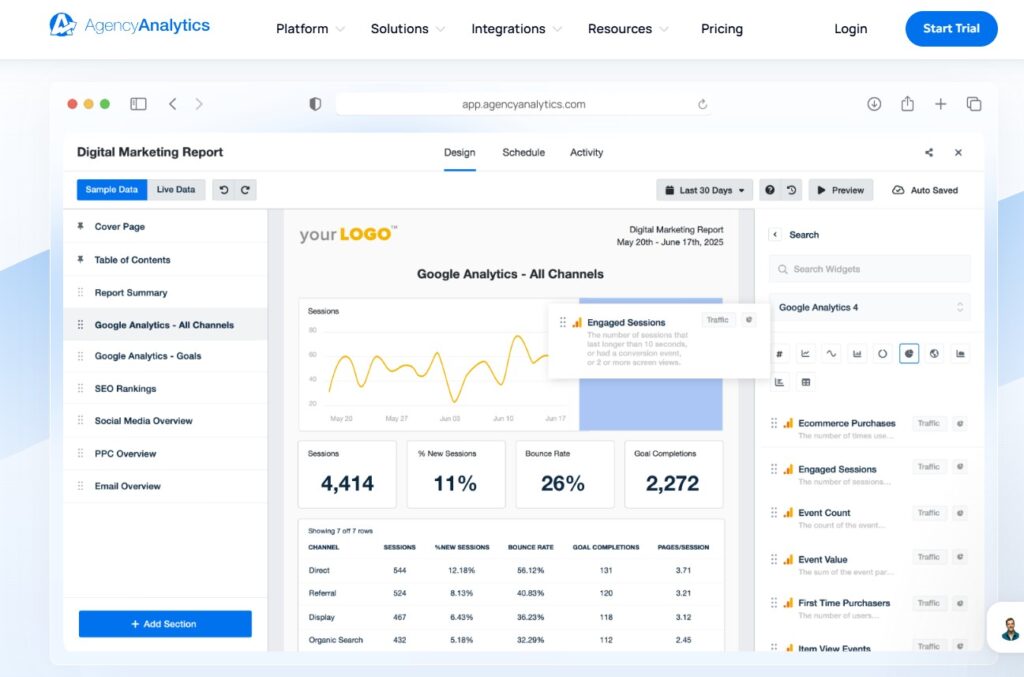
AgencyAnalytics is not a direct replacement for a full SEO research platform. Instead, it is one of the best Semrush alternatives for agencies that want to improve reporting, client communication, and dashboard management.
The platform brings data from SEO, paid media, social media, email marketing, analytics, ecommerce, call tracking, and other sources into one place. This helps agencies create reports that show the full picture of a campaign.
Key Features
White-Label Dashboards
AgencyAnalytics lets agencies create branded dashboards with their own logo, colors, and custom domain. This gives clients a more consistent experience.
Scheduled Reports
You can schedule reports to send automatically. This is useful for weekly, monthly, or quarterly client reporting.
Client Portal
Clients can access dashboards through a branded portal. Agencies can decide whether to provide read-only links, portal access, or scheduled reports.
85+ Integrations
The platform connects with more than 85 marketing tools and data sources. This includes Google Analytics, Google Ads, SEO tools, social platforms, ecommerce tools, and call-tracking systems.
Drag-and-Drop Report Builder
The report builder lets teams add widgets, custom metrics, images, text blocks, and data from connected platforms. This makes it easier to create reports for different service packages.
Goal and Budget Tracking
Agencies can set targets for key metrics and show progress through visual tracking widgets. This can help clients understand how campaign performance relates to agreed goals.
Roll-Up Reporting
Roll-up reports can combine data across multiple clients or locations. This is useful for agencies managing franchises, multi-location businesses, or large client portfolios.
AI Reporting Tools
AgencyAnalytics includes AI-powered tools that help teams identify important changes and prepare client-ready performance summaries.
AI Tracker Add-On
The AI Tracker add-on monitors brand visibility, positions, sentiment, and citations across AI engines such as ChatGPT, Google AI Overview, Google AI Mode, Claude, and others.
Rank Tracker Add-On
The Rank Tracker add-on supports weekly desktop and mobile rank tracking across Google and Bing, including local and multilingual campaigns.
Best For
Agencies delivering polished, automated client performance reports.
Pricing
AgencyAnalytics pricing starts at $25 per month. Pricing changes based on the number of clients, selected plan, and additional services.
The platform offers a 14-day free trial. Its AI Tracker add-on starts at $20.83 per month per 250 credits with annual billing. The Rank Tracker add-on starts at $41.67 per month per 500 keywords with annual billing.
Why Agencies May Choose AgencyAnalytics
AgencyAnalytics is one of the better Semrush alternatives when reporting is your biggest challenge. If your team already uses tools such as Ahrefs, SE Ranking, Google Ads, Google Analytics, or social media platforms, AgencyAnalytics can bring their data into one client-ready view.
It is especially useful for agencies that want to reduce manual reporting work. Instead of exporting screenshots and updating spreadsheets every month, your team can build reusable templates and focus more on analysis.
5. Moz Pro: Best for Everyday SEO Campaign Management
Moz Pro is a solid option for agencies that want a simpler approach to SEO research and campaign management. It includes keyword research, rank tracking, site crawling, link analysis, on-page optimization, reporting, and AI visibility features.
Moz is often a good fit for teams that want clear metrics and an interface that newer SEO specialists can learn quickly. It also gives agencies a way to explain authority, rankings, backlinks, and site issues in a client-friendly format.
Key Features
Keyword Explorer
Keyword Explorer helps agencies find keyword ideas, check search volume, assess difficulty, study SERPs, and organize keywords into lists.
Rank Tracker
Moz Pro tracks keyword positions for desktop and mobile results. Agencies can monitor rankings across campaigns and compare performance over time.
Site Crawl
Site Crawl checks a website for technical SEO issues. It can identify site errors, redirects, missing metadata, duplicate content, crawl concerns, and other problems that may need attention.
Link Explorer
Link Explorer helps teams review backlink profiles, referring domains, link opportunities, and competitor link data.
Domain Authority and Page Authority
Moz provides Domain Authority and Page Authority metrics. These scores are commonly used for comparing websites and evaluating relative link strength.
On-Page Grader
The On-Page Grader gives page-level suggestions based on target keywords. It can support content refreshes and optimization tasks.
AI Visibility Dashboard
Moz Pro includes an AI Visibility Dashboard on Standard plans and above. Agencies can track visibility across GPT, Gemini, Google AI Mode, and Perplexity.
AI Prompt Tracking
The Standard plan supports 50 tracked AI prompts. The Medium plan supports 100 prompts, while the Large plan supports 200 prompts.
AI Citation and Sentiment Data
The AI visibility feature includes citation data and sentiment analysis. This gives agencies more context about how a brand appears in AI-generated answers.
AI Content Briefs
Moz Pro includes AI content briefs. The Standard plan includes two briefs per month, the Medium plan includes 10, and the Large plan includes 50.
Best For
Teams that prefer straightforward tools for everyday SEO management.
Pricing
Moz Pro has an entry-level plan for $49 per month for individuals managing one website. Its agency-relevant plans include:
-
Standard: $99/month, or $79/month on annual billing
-
Medium: $179/month, or $143/month on annual billing
-
Large: $299/month, or $239/month on annual billing
The Standard plan includes three tracked sites, 300 tracked keywords, 400,000 crawled pages per month, one AI Visibility Dashboard, 50 tracked prompts, four AI models, AI prompt suggestions, and two AI content briefs.
The Medium plan increases coverage to 10 sites, 1,500 keywords, two million crawled pages, two AI dashboards, 100 prompts, and 10 AI content briefs.
Why Agencies May Choose Moz Pro
Moz Pro is one of the most approachable Semrush alternatives for teams that want an established SEO platform without an overly complicated workflow. It is useful for agencies managing standard SEO campaigns that involve audits, rankings, keywords, links, and content improvements.
Its AI visibility tools also make it more relevant for agencies that want basic AI-search tracking without adopting a separate specialist tool immediately.
6. SpyFu: Best for PPC Competitor Research
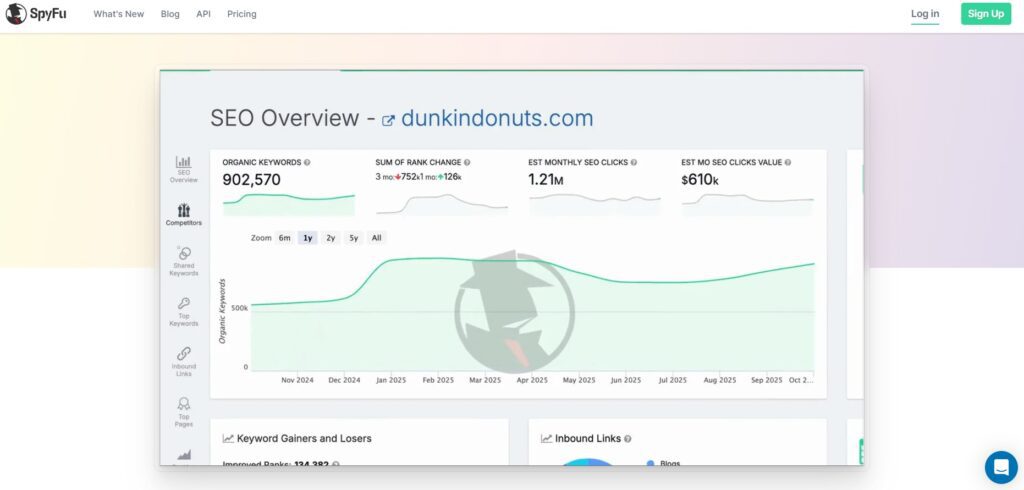
SpyFu is a useful choice for agencies that spend a lot of time researching paid-search competitors. It helps teams study competitor keywords, ad history, organic rankings, backlinks, keyword groups, and Google Ads campaigns.
The platform is valuable during client onboarding. Before building a PPC strategy, an agency can use SpyFu to examine which keywords competitors have targeted, what their ads have looked like, and how their paid-search activity has changed over time.
Key Features
PPC Keyword Research
SpyFu shows keywords that competitors appear to target through paid search. Agencies can use this information to build research lists and identify potential campaign themes.
Ad History
The platform includes more than 10 years of ad history. This can help teams study how competitor messaging, keyword targeting, and advertising activity have changed.
Kombat Domain Comparison
Kombat lets users compare domains and identify shared and unique keywords. It is useful for finding keyword gaps between a client and competing sites.
Organic Ranking History
SpyFu shows historical organic ranking data, helping agencies review how a domain’s visibility has changed over time.
Backlink Research
The platform includes backlink search tools. Agencies can use them for basic competitor research and link opportunity discovery.
Weekly Keyword Rank Tracking
SpyFu supports weekly rank tracking. The Basic plan includes 5,000 weekly tracked rankings, the Pro + AI plan includes 15,000, and the Team / Agency plan includes 50,000.
Automated Reports
The platform supports automated reports. Basic includes 10 automated reports, Pro + AI includes 100, and Team / Agency includes unlimited automated reports.
White-Label Reporting
SpyFu includes white-label reporting, which is useful for agencies sending data directly to clients.
Google Search Console Integration
The platform connects with Google Search Console so agencies can combine SpyFu data with a client’s first-party search data.
AI Brand Monitoring and ChatGPT Integration
SpyFu includes AI brand monitoring and ChatGPT integration. Users can access SpyFu data inside ChatGPT based on their selected plan.
Best For
Agencies uncovering competitors’ paid-search and keyword strategies.
Pricing
SpyFu offers three main plans:
-
Basic: $39/month, or $29/month on annual billing
-
Pro + AI: $119/month, or $89/month on annual billing
-
Team / Agency: $249/month, or $187/month on annual billing
The Team / Agency plan includes unlimited live site tracking projects, unlimited search results, unlimited data exports, 50,000 weekly tracked keyword rankings, unlimited automated reports, five user seats, white-label reporting, API access, Google Search Console integration, AI brand monitoring, and access to RivalFlow for five sites.
Why Agencies May Choose SpyFu
SpyFu is one of the strongest Semrush alternatives for PPC agencies and mixed SEO-PPC teams. Its long-term ad history and competitor data can save time during campaign research.
It is also useful for agencies that want to turn competitor research into client recommendations. You can use the data to identify potential keyword gaps, ad-message ideas, and areas where a competitor appears to invest heavily.
7. Similarweb: Best for Market and Audience Intelligence
Similarweb is different from most Semrush alternatives because it focuses on broader digital intelligence. It helps agencies understand estimated traffic, traffic channels, audience behavior, market trends, competitors, and online demand.
This makes Similarweb useful for strategy presentations, client pitches, market research, competitor reviews, and quarterly planning. It can help agencies answer bigger questions, such as where a competitor’s traffic comes from, which channels are growing, and how a market is changing.
Key Features
Competitive Intelligence Suite
Similarweb’s Competitive Intelligence Suite helps agencies review competitors, traffic share, market movement, and growth patterns.
Traffic and Channel Analysis
The platform estimates website traffic and breaks it down by channels such as direct, organic search, paid search, referral, social, email, and display.
Audience Insights
Agencies can study audience interests, engagement patterns, country-level behavior, and related websites. This can support messaging, targeting, and content planning.
Strategic SEO Suite
Similarweb includes keyword research, keyword gap analysis, rank tracking, and SERP analysis for SEO teams.
Ads Intelligence Suite
The Ads Intelligence Suite includes publisher analysis, search-ad analysis, display-ad analysis, and cross-channel visibility insights.
Gen AI Intelligence Suite
The Gen AI Intelligence Suite includes AI traffic trends, AI brand visibility, top landing pages, prompt analysis, and historical data.
AI Studio
AI Studio supports natural-language queries, AI-generated dashboards, and detailed market research reports. This can be useful when agencies need to turn large datasets into client-ready insights.
Country-Level Data
Similarweb supports insights across more than 100 countries. This makes it useful for agencies working with international clients.
Custom Dashboards and Reporting
Business plans include custom dashboards, advanced reporting, and data connections based on the selected package.
APIs, Data Feeds, and MCP
Similarweb provides APIs, data feeds, BI tool integrations, and MCP options for teams that want to connect digital intelligence data with internal systems.
Best For
Agencies researching audiences, traffic sources, and market opportunities.
Pricing
Similarweb offers limited free data on its website. Paid packages for businesses and enterprises are customized based on the products, countries, data access, and features required.
The platform offers self-service options for individuals, entrepreneurs, and smaller teams. Agencies that need advanced reporting, full market intelligence, APIs, data feeds, country-level coverage, or enterprise support should request a custom quote.
Why Agencies May Choose Similarweb
Similarweb is one of the best Semrush alternatives for agencies that need a market-level view of performance. It is especially useful when a client asks questions that go beyond keyword rankings, such as where competitors get traffic, which audience segments they reach, or which channels appear to drive growth.
It should not replace Google Analytics or other first-party client data. Instead, it provides estimated external intelligence that can help with competitive research and planning.
8. Surfer SEO: Best for Content Optimization
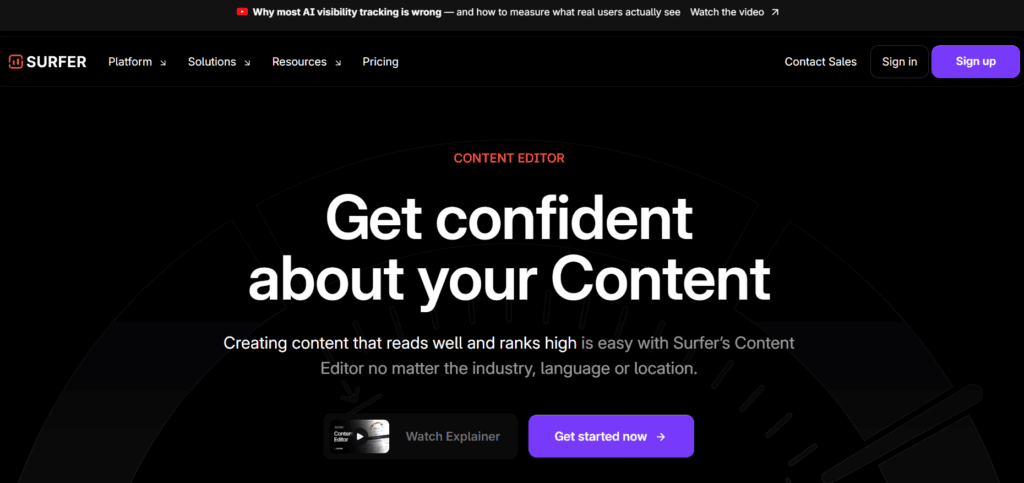
Surfer SEO is designed for agencies that create, update, and manage content at scale. It helps content teams plan articles, optimize drafts, audit older pages, identify topic gaps, monitor rankings, and track visibility across Google and AI search tools.
Many agencies use Surfer SEO as part of a broader content workflow. A strategist can create a brief, a writer can work inside the Content Editor, an editor can review optimization recommendations, and an SEO manager can monitor the content after publication.
Key Features
Content Editor
The Content Editor provides live optimization guidance while you write. It can help teams improve headings, terms, structure, content score, and topical coverage.
AI SEO Optimization
Surfer uses AI-based optimization guidance to help writers and editors improve content for conventional search and AI-driven results.
Surfy AI Writing Assistant
Surfy is Surfer’s AI writing assistant. It can help with drafting, editing, and improving content inside the platform.
Content Score
Content Score gives each document an optimization score. Agencies can use it as one input when reviewing whether a draft covers a topic well.
Content Audit
Content Audit reviews existing pages and identifies pages that may need updates. It combines Google Search Console data with SERP analysis to surface potential quick wins.
Rank Drop Detection
The platform can identify ranking drops, giving agencies an early signal that a page may need a refresh.
Topical Map
Topical Map helps teams plan content clusters and find coverage gaps. This is useful for agencies building topic authority for clients over time.
Internal Linking
Surfer includes one-click internal linking suggestions. This can help agencies improve site structure and connect related content more efficiently.
Cannibalization Report
The Cannibalization Report helps teams find pages that may be competing with each other for similar search terms or topics.
AI Visibility Tracking
Surfer tracks brand visibility across ChatGPT, Perplexity, Google AI Mode, Google AI Overviews, and Google Gemini. It includes mention gaps, brand sentiment, and prompt tracking based on the selected plan.
Integrations and Collaboration
Surfer supports integrations with WordPress, Google Docs, Contentful, and Zapier. It also includes content collaboration, comments, folders, external sharing links, and version history.
Best For
Content-led agencies improving briefs, drafts, and existing pages.
Pricing
Surfer SEO offers several plans:
-
Discovery: $49/month
-
AI Search Analytics: $82/month
-
Standard: $99/month
-
Pro: $182/month
-
Peace of Mind: $299/month
-
Enterprise: $999/month
The Discovery plan includes 120 documents, tracking for 10 pages, AI SEO optimization guidelines, Surfy, and Humanizer features.
The Standard plan includes 360 documents, 25 AI prompts refreshed weekly, one brand workspace, content optimization, plagiarism checking, rank-drop detection, integrations, and collaboration tools.
The Pro plan includes 50 AI prompts refreshed daily, five brand spaces, internal linking, content ideas, coverage-gap analysis, custom templates, custom voices, and a cannibalization report.
How to Choose Between Semrush Alternatives
The best choice depends on what your agency delivers each month. Before purchasing another platform, look at the work that currently takes the most time or causes the most friction.
- Choose RadarKit if your agency wants to offer AI visibility, local tracking, citation tracking, AI-search audits, and GEO services. It is a good fit if clients are asking how they appear in AI-generated answers.
- Choose Ahrefs if backlink research, competitor analysis, content gaps, and organic SEO planning are central to your service. It is especially helpful for teams working on authority-building campaigns.
- Choose SE Ranking if you need a balanced SEO platform for managing many clients without creating a large collection of separate subscriptions. It is one of the most practical Semrush alternatives for agencies that want a broad feature set.
- Choose AgencyAnalytics if reporting is taking too much time. It is ideal for agencies that want branded dashboards, scheduled reports, and a clearer view of results across multiple marketing channels.
- Choose Moz Pro if your team wants an accessible platform for core SEO work. It works well for agencies that prefer straightforward dashboards and easy-to-explain client metrics.
- Choose SpyFu if paid-search strategy is a major part of your service. It gives PPC teams useful competitor context before they build or refresh campaigns.
- Choose Similarweb if your agency needs traffic trends, audience insights, and market-level competitor analysis. It is particularly useful for strategic planning and sales presentations.
- Choose Surfer SEO if content production is one of your largest services. It helps agencies create better briefs, improve drafts, and keep content work more consistent across accounts.
Frequently Asked Questions
What are the best Semrush alternatives for agencies?
The best Semrush alternatives for agencies depend on the work you do. RadarKit is a strong option for AI-search visibility, Ahrefs is excellent for backlink and competitor research, SE Ranking offers an all-in-one SEO setup, and AgencyAnalytics is built for client reporting.
Is Ahrefs a good alternative to Semrush?
Ahrefs is a good alternative for agencies that spend a lot of time on backlinks, organic competitor research, keyword opportunities, and content planning. It also includes site audits and rank tracking, making it useful beyond link analysis.
Which Semrush alternative is best for reporting?
AgencyAnalytics is the best choice for reporting because it is designed for agencies that need white-label dashboards, scheduled reports, and data from several marketing platforms in one place.
Which Semrush alternatives support AI visibility tracking?
RadarKit focuses on AI visibility tracking across major AI platforms. Moz Pro, SE Ranking, Ahrefs, and Similarweb also offer AI-related features, but RadarKit is the most direct choice for agencies that want client-ready AI mention, citation, prompt, and competitor tracking.
Is SE Ranking cheaper than Semrush?
SE Ranking is often a more budget-friendly option for agencies that want keyword research, rank tracking, auditing, backlinks, competitor analysis, and reporting in one platform. Your actual cost will depend on the number of projects, tracked keywords, users, and add-ons your agency needs.
Can an agency use more than one Semrush alternative?
Yes. In fact, many agencies get better results from combining tools. For example, you might use SE Ranking for daily SEO work, AgencyAnalytics for client reports, RadarKit for AI visibility tracking, and Surfer SEO for content optimization.
Final Thoughts: Semrush Alternatives
There is no single answer for every agency searching for Semrush alternatives. The right platform depends on whether your team needs better backlink research, lower-cost SEO management, automated reporting, PPC intelligence, content workflows, or AI-search tracking.
RadarKit is the top choice for agencies that want to help clients improve visibility in AI-generated answers. Ahrefs is a strong pick for research-heavy SEO work, while SE Ranking gives growing agencies a practical all-in-one platform. AgencyAnalytics, SpyFu, Similarweb, Moz Pro, and Surfer SEO each add value for more specialized needs.
The smartest approach is to choose Semrush alternatives based on your agency’s actual workflow. When your tools match the services you sell, your team can spend less time switching between dashboards and more time delivering clear, useful results for clients.