In this article, you will see five of the best Screaming Frog alternatives for different SEO needs. Screaming Frog is great for technical audits, but some teams want stronger competitor research, clearer reporting, AI visibility tracking, or help with JavaScript rendering.
So, without any further ado, let’s get started.
Comparison Table: Best Screaming Frog Alternatives
| Tool | Best for | Starting price | Technical SEO and crawling | AI visibility and content capabilities | Best reason to choose it |
|---|---|---|---|---|---|
| Radarkit AI | Agencies, SaaS brands, and content teams focused on AI search | $29/month | Not a traditional website crawler. It focuses on AI search performance instead of identifying broken links, redirects, and crawl errors. | Tracks visibility across ChatGPT, Perplexity, Gemini, Copilot, Google AI Overviews, and Google AI Mode. Includes citation analysis, competitor share of voice, query fan-outs, AI traffic analytics, Local Radar and content, outreach, Reddit, Chat, and planning agents. | Choose it to see whether AI platforms mention, recommend, and cite your brand, then turn the findings into practical content and outreach actions. |
| Ahrefs | SEO professionals who need research depth | $129/month | Includes Site Audit for technical monitoring, crawl issue checks, rendered HTML data, and ongoing website health tracking. | Includes Brand Radar, custom AI prompts, AI citation and sentiment tracking, Content Explorer, keyword research, backlink data, competitor analysis, and AI content tools. | Choose it when you need technical auditing alongside backlink research, keyword data, content research, and competitor insights. |
| Semrush | Full-service marketing teams and agencies | $139/month | Includes Site Audit, technical issue checks, AI Search Site Audit, on-page SEO recommendations, position tracking, and website health monitoring. | Includes AI Visibility Toolkit, AI share of voice, brand sentiment, prompt tracking, cited-source analysis, content tools, AI PR features, and competitor insights. | Choose it if you manage technical SEO along with content, PPC, local SEO, social media, reporting, or digital PR. |
| Prerender.io | JavaScript-heavy websites and development teams | $59/month | Does not work as a conventional crawler. It renders JavaScript pages and caches crawler-ready HTML snapshots for search, AI, social, and SEO crawlers. | Includes AI crawler access, rendering analytics, technical SEO scoring, sitemap monitoring, cache controls, Open Graph testing, problematic-page detection, and API controls. | Choose it when JavaScript makes website content difficult for crawlers to access and you need a production-level solution. |
| Sitebulb | Consultants, agencies, and technical SEO specialists | F$18/month | Dedicated crawler with 300+ SEO Hints, JavaScript crawling, raw versus rendered HTML checks, crawl maps, audit comparison, scheduling, custom reports, and cloud crawling. | Focuses mainly on technical SEO, but MCP access can connect crawl data with compatible AI tools. It is more focused on website auditing than AI citation tracking. | Choose it when you want detailed technical audits with clearer visuals, prioritized recommendations, and client-friendly reporting. |
What Is Screaming Frog?
Screaming Frog SEO Spider is a desktop website crawler for Windows, macOS, and Linux. You enter a domain, and the tool crawls pages much like a search engine bot would. It then collects technical, on-page, and crawl data so you can find issues before they affect organic traffic.
Among Screaming Frog alternatives, Screaming Frog itself still stands out for hands-on technical investigations. It is popular with SEO consultants, agencies, developers, and in-house teams because it lets users inspect a site at URL level rather than only relying on dashboard summaries.
The free version can crawl up to 500 URLs. The paid version removes that cap and includes advanced features for larger sites, custom extractions, JavaScript rendering, integrations, scheduled crawls, and crawl comparisons.
Key Features of Screaming Frog
-
Broken link and error detection: Finds 4XX errors, 5XX server errors, broken images, and pages that do not respond correctly.
-
Redirect analysis: Identifies 301 redirects, temporary redirects, redirect chains, loops, and JavaScript redirects.
-
Metadata auditing: Reviews page titles, meta descriptions, H1s, H2s, canonical tags, robots directives, and word counts.
-
Duplicate-content checks: Finds duplicate titles, duplicate descriptions, duplicate pages, and near-duplicate content.
-
Internal-link analysis: Shows which URLs link to a page, which pages it links out to, the anchor text used, and how deeply a page sits within the site structure.
-
JavaScript rendering: Uses Chromium rendering to inspect pages that rely on JavaScript for content, navigation, or important elements.
-
XML sitemap generation and validation: Helps create sitemaps and compare sitemap URLs against crawl data.
-
Structured-data checks: Audits schema markup and identifies validation concerns.
-
Custom extraction: Pulls data from pages using XPath, CSS selectors, or regex patterns.
-
Google integrations: Connects with Google Analytics, Google Search Console, and PageSpeed Insights.
-
Accessibility checks: Helps identify accessibility issues during an SEO crawl.
-
AI support: Lets users work with OpenAI and Gemini through custom prompts and crawl data
Why Look for a Screaming Frog Alternative?
The right Screaming Frog alternatives depend on the problem you are trying to solve. A technical crawl is important, but it is only one part of a complete SEO program.
You Need More Than Technical Crawl Data
Screaming Frog can show that a page has a missing title, a broken link, or a noindex tag. What it does not do by itself is show the keyword opportunity, competitor gap, backlink profile, paid search activity, or content demand behind that page.
This is where broader Screaming Frog alternatives like Ahrefs and Semrush become useful. They combine technical audit data with keyword research, traffic estimates, content planning, competitor tracking, and backlink analysis.
You Want AI Search Visibility and Citation Tracking
Traditional rankings do not tell the whole story anymore. A potential customer may ask ChatGPT, Perplexity, Gemini, Copilot, or Google AI Mode for product suggestions before they ever click a standard Google result.
Some Screaming Frog alternatives help you track whether your brand appears in those answers. They can also show which competitors receive mentions, which domains get cited, and what content formats show up most often.
You Need Better Competitor, Backlink, or Keyword Research
Screaming Frog gives you detailed data about your own website. It does not work like a full competitor intelligence platform.
If you want to study a competitor’s top pages, backlink profile, organic keywords, traffic trends, referring domains, paid search activity, or content gaps, Ahrefs and Semrush are stronger Screaming Frog alternatives.
Your JavaScript Pages Need a Production-Level Rendering Fix
Screaming Frog can identify JavaScript rendering issues during an audit. But finding a rendering problem and fixing it in production are two separate tasks.
Prerender.io is one of the most specialized Screaming Frog alternatives for this situation. It helps JavaScript-heavy websites serve crawler-ready HTML to search engines, AI bots, and social platforms.
You Want More Visual, Client-Friendly SEO Audit Reports
Raw crawl data can be difficult to explain to clients, managers, and developers. A spreadsheet with thousands of URLs is valuable to an SEO specialist, but it may not help a stakeholder understand what needs to be fixed first.
Sitebulb is one of the best Screaming Frog alternatives for visual audits. It turns crawl findings into prioritized Hints, visual charts, crawl maps, and customizable reports that are easier to present.
5 Best Screaming Frog Alternatives for Agencies, Marketers, and SEO Teams
1. Radarkit AI: Best for AI Search Visibility
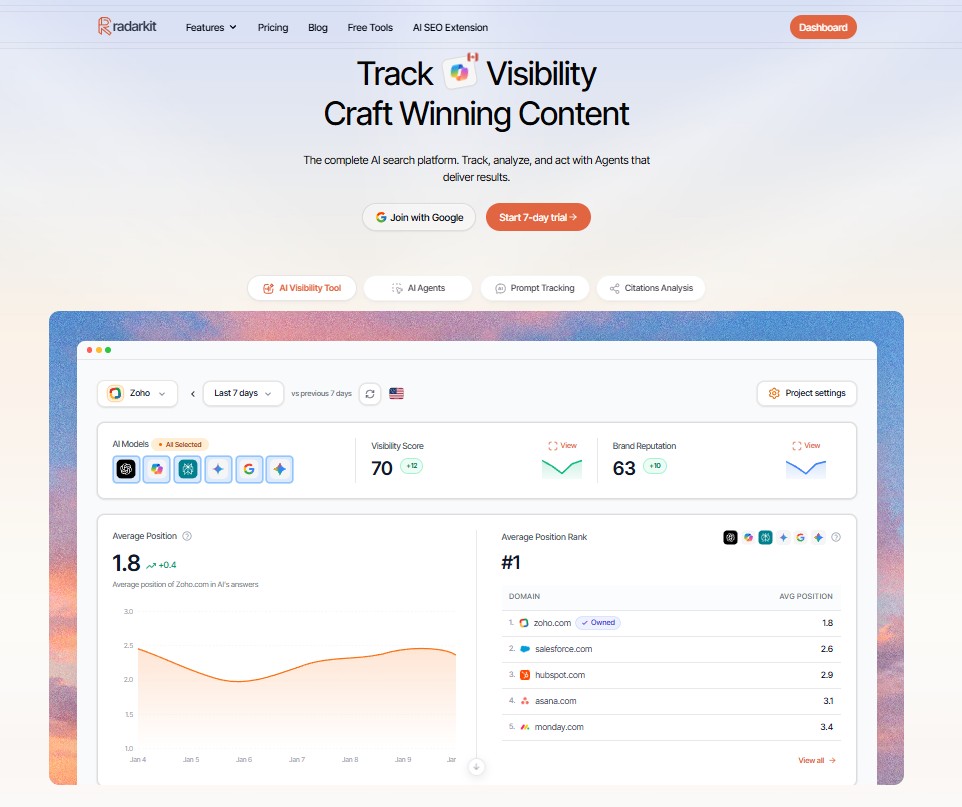
Radarkit AI is an AI search visibility platform for brands, agencies, and content teams that want to understand how they appear in AI-generated answers. It is not a traditional website crawler, which makes it different from most Screaming Frog alternatives on this list.
Instead of checking whether a page has a broken link or missing H1, Radarkit AI helps answer questions such as:
-
Does ChatGPT recommend my company for relevant buyer queries?
-
Which competitors appear more often in Perplexity answers?
-
Which sites are being cited by Google AI Overviews?
-
What types of pages are AI tools using as sources?
-
Which prompts should we track for our category?
-
What content or outreach opportunities can improve our AI visibility?
Radarkit AI tracks visibility across ChatGPT, Google AI Mode, Google AI Overviews, Microsoft Copilot, Perplexity, and Gemini. It also supports location-level tracking, which matters when AI responses vary by country or market.
Key Radarkit AI Features
-
AI visibility tracking: Monitor whether a brand appears in AI responses across ChatGPT, Perplexity, Gemini, Copilot, Google AI Mode, and Google AI Overviews.
-
Prompt tracking: Add commercial, informational, comparison, local, product, and category prompts that matter to your business.
-
Competitor share of voice: Compare how often your brand and competing brands appear across tracked prompts.
-
Citation analysis: Identify domains and URLs cited by AI answers, then study the pages earning those mentions.
-
Citation-type analysis: Review whether AI tools cite listicles, reviews, guides, forums, product pages, communities, or other content types.
-
Query fan-out data: See related searches and follow-up query patterns that appear around AI prompts.
-
Local and country tracking: Monitor AI visibility in more than 50 locations on standard plans, with broader state and city tracking for enterprise users.
-
AI traffic analytics: Connect AI visibility work with traffic patterns and performance data.
-
Content Agent: Generate article ideas, content briefs, improvements, and optimization suggestions based on visibility findings.
-
Outreach Agent: Find citation, backlink, and publisher opportunities connected to competitor and source analysis.
-
Reddit Agent: Support Reddit-focused research and participation workflows where community discussions affect AI visibility.
-
Chat Agent: Ask questions about tracked data and explore opportunities without manually sorting through reports.
-
Google Search Console integration: Connect search performance data with AI visibility research.
-
Google Analytics integration: Review traffic performance alongside AI search monitoring.
-
WordPress integration: Connect content workflows with publishing processes.
-
Client Portal: Give clients access to relevant reporting without exposing the entire internal workspace.
-
Branded PDF reporting: Create agency-ready reports with plan-based report allowances.
-
MCP and API access: Use Radarkit data in custom workflows, reports, dashboards, and compatible AI tools.
Where Radarkit AI Beats Screaming Frog
Radarkit AI is one of the best Screaming Frog alternatives if your main concern is brand discovery inside AI search results.
Screaming Frog can tell you if your page is crawlable and whether your metadata is present. Radarkit AI can show whether that content is actually helping your business appear in AI-generated recommendations, comparisons, and category answers.
It is especially useful for SaaS companies, agencies, ecommerce brands, local businesses, B2B companies, and publishers that want to move beyond standard ranking reports. A team can track prompts such as “best CRM for small businesses,” “best AI rank tracker,” or “best project management tool for remote teams,” then compare brand mentions, sources, sentiment, and competitor visibility.
The agent layer is another important difference. Rather than only presenting data, Radarkit AI can help turn a citation gap into a content brief, a source opportunity into an outreach task, or a competitor pattern into an actionable research workflow.
Radarkit AI Limitations
Radarkit AI does not try to replace a detailed crawler. It will not be your main tool for finding broken internal links, redirect loops, orphan-page candidates, sitemap conflicts, duplicate title tags, or canonical issues.
For technical SEO, pairing Radarkit AI with Screaming Frog can make sense. Use Screaming Frog to make sure important content is technically accessible, then use Radarkit AI to measure whether that content earns visibility in AI answers.
Radarkit AI Pricing
Radarkit AI offers a 7-day free trial. Its self-serve plans include:
All standard plans include tracking across major AI models, competitor monitoring, local business tracking, shopping tracking, ad tracking, AI agents, GSC integration, GA integration, WordPress integration, client portals, historical data, and MCP/API access.
Who Should Choose Radarkit AI?
Choose Radarkit AI if you want Screaming Frog alternatives that focus on:
-
AI search visibility rather than only technical SEO
-
Brand mentions and competitor share of voice
-
AI citations and source opportunities
-
Content planning for AI search
-
Multi-location AI tracking
-
AI-focused client reporting
-
Agency workflows around GEO and AEO
2. Ahrefs: Best All-in-One SEO Alternative
Ahrefs is an all-in-one SEO platform with tools for technical audits, backlinks, keyword research, content research, rank tracking, competitor analysis, website analytics, AI visibility, and reporting.
Among all Screaming Frog alternatives, Ahrefs is one of the strongest choices for SEO teams that want technical audits and market intelligence in the same platform. It is especially useful when you need to understand both your own website and the websites competing for the same audience.
Ahrefs uses a large web index and its own crawler to collect information about pages, links, keywords, and domains. Its platform includes familiar tools such as Site Explorer, Keywords Explorer, Rank Tracker, Site Audit, Content Explorer, Brand Radar, and Web Analytics.
Key Ahrefs Features
-
Site Audit: Crawls your website and identifies technical SEO issues, including broken links, redirect issues, metadata problems, indexability concerns, and internal-link findings.
-
Always-on audit monitoring: Monitors verified projects regularly so teams can catch technical changes without running every audit manually.
-
Site Explorer: Research any domain’s estimated traffic, organic keywords, backlinks, referring domains, top pages, competing domains, and paid-search activity.
-
Keywords Explorer: Find keyword ideas, review keyword difficulty, study search intent, identify parent topics, and analyze ranking pages.
-
Keyword clustering: Group related keywords into topic clusters for content planning and topical coverage.
-
Rank Tracker: Monitor keyword rankings and follow visibility trends for selected projects.
-
Competitor analysis: Compare sites to find missing keywords, overlapping rankings, content gaps, and domain-level opportunities.
-
Backlink analysis: Research referring domains, new links, lost links, broken backlinks, anchors, and competitor link profiles.
-
Content Explorer: Search for popular pages, publishers, authors, and content topics using Ahrefs data.
-
Brand Radar: Track brand mentions, citations, and sentiment in AI responses, as well as visibility across other discovery channels.
-
Custom Prompts: Track AI prompts that matter to your business and measure performance through daily checks.
-
Bot Analytics: Review crawler activity and study how good and bad bots interact with your website.
-
Web Analytics: Monitor website performance without relying entirely on traditional analytics platforms.
-
AI Content Helper: Support content improvement with intent, topic, and competitive page insights.
-
AI Content Grader: Review how well a page covers important topics compared with competing search results.
-
Report Builder: Build scheduled reports to show progress across SEO, content, rankings, and visibility.
-
Google Business Profile monitoring: Manage and monitor local profiles at scale.
-
API and MCP access: Pull Ahrefs data into internal systems, dashboards, automations, and AI-assisted workflows.
Where Ahrefs Beats Screaming Frog
Ahrefs is one of the most complete Screaming Frog alternatives for businesses that need research depth alongside technical SEO.
A Screaming Frog crawl can identify a page with a thin title tag. Ahrefs can help you discover keyword opportunities, analyze the pages ranking above you, find competitors receiving links, review search intent, study backlink gaps, and monitor rankings after the page is improved.
Ahrefs is also better for off-page SEO. Its backlink and referring-domain data can help with link building, digital PR, competitor research, content promotion, and authority analysis. For content teams, this is a major advantage because technical fixes alone do not always create growth.
The inclusion of Brand Radar and custom AI prompts also makes Ahrefs more relevant for teams working on AI visibility. It can bring traditional SEO data and AI-answer visibility into the same operating system.
Ahrefs Limitations
Ahrefs is broader than Screaming Frog, which can be useful but may also be more than a small site needs. If your only goal is to crawl a website, inspect every URL, and export technical findings, Screaming Frog can be a more focused choice.
Ahrefs also uses crawl credits and plan limits for Site Audit. Teams managing very large sites should review crawl allowances before choosing a plan.
Ahrefs Pricing
Ahrefs also offers Brand Radar as a standalone product from $199/month and custom prompt packages from $50/month.
Who Should Choose Ahrefs?
Choose Ahrefs if you need Screaming Frog alternatives that combine:
-
Technical SEO audits
-
Backlink research
-
Keyword research
-
Competitor intelligence
-
Content planning
-
Rank tracking
-
AI visibility monitoring
-
SEO reporting and API access
3. Semrush: Best for Full-Service Marketing Teams
Semrush is a broad digital marketing platform for SEO, paid advertising, content marketing, local SEO, social media, competitive research, digital PR, reporting, and AI visibility.
Compared with other Screaming Frog alternatives, Semrush is a good fit for teams that want to manage several marketing channels from one workspace. It is not only built for technical SEO specialists. Content marketers, PPC teams, local businesses, social teams, and agencies can all use different parts of the platform.
Its SEO toolkit includes technical audits, keyword research, rank tracking, backlink analysis, competitive research, content optimization, and reporting. Semrush also offers an AI Visibility Toolkit for tracking brand presence in AI-generated answers
Key Semrush Features
-
Site Audit: Crawls websites and identifies technical SEO issues related to crawlability, HTTPS, internal linking, page speed, metadata, structured data, redirects, and more.
-
AI Search Site Audit: Highlights technical issues that may affect AI crawler access and visibility in AI-generated answers.
-
Keyword Magic Tool: Finds keyword ideas, question keywords, related terms, and search volume data.
-
Keyword Strategy Builder: Helps organize keywords into clusters, themes, and content plans.
-
Position Tracking: Tracks rankings by keyword, device, location, and competitor.
-
Domain Overview: Provides a high-level view of organic search, paid search, backlinks, traffic, and authority signals.
-
Organic Research: Studies a domain’s estimated organic keywords, pages, competitors, ranking changes, and search trends.
-
Traffic Analytics: Compares website traffic estimates, channels, audience behavior, and competitor patterns.
-
Backlink Analytics: Reviews referring domains, new links, lost links, authority signals, anchors, and backlink gaps.
-
Link Building Tool: Organizes outreach prospects and link-building tasks in one workspace.
-
Content Toolkit: Supports content research, SEO writing, content optimization, topic discovery, and performance tracking.
-
SEO Writing Assistant: Helps writers improve readability, SEO coverage, tone, and originality while drafting content.
-
On Page SEO Checker: Suggests page-level improvements based on competing pages and ranking factors.
-
AI Visibility Toolkit: Tracks brand visibility, AI share of voice, cited sources, brand sentiment, competitors, and custom prompts across AI platforms.
-
Brand Performance: Helps teams understand how AI platforms present their brand and which narratives show up in answers.
-
AI PR tools: Support digital PR research by identifying publications, sources, and media opportunities that may influence AI visibility.
-
Local SEO toolkit: Supports Google Business Profile management, listings, local rankings, and reputation workflows.
-
Advertising toolkit: Helps research Google Ads, competitor ads, paid keywords, and campaign opportunities.
-
Social toolkit: Supports social publishing, monitoring, reporting, and competitor analysis.
-
My Reports: Creates scheduled, customizable reports for internal teams and clients.
Where Semrush Beats Screaming Frog
Semrush is one of the best Screaming Frog alternatives for teams that need more than technical SEO.
For example, an agency can use Semrush to audit a client site, identify keyword gaps, monitor rankings, compare competitors, study backlinks, build content plans, manage local SEO, report on PPC campaigns, and track AI visibility. Doing all of that with Screaming Frog alone would require several additional platforms.
Semrush is also useful for cross-team work. A technical SEO can use Site Audit, a content writer can use the Content Toolkit, a PPC specialist can use advertising data, and an account manager can build reports for clients.
Its AI Visibility Toolkit is valuable for teams that want to measure how their brand performs beyond blue links. It can track visibility, share of voice, sentiment, prompts, competitors, and source pages across AI search experiences.
Semrush Limitations
Semrush has a large feature set, so beginners may need time to learn which tools matter for their daily workflow. It can also become costly when teams add AI visibility, extra users, larger limits, or specialized toolkits.
For a pure technical crawl, Screaming Frog remains more direct. Semrush is stronger when technical audits are one part of a wider marketing strategy.
Semrush Pricing
The AI Visibility Toolkit also has its own pricing options for businesses that want to focus mainly on AI search monitoring.
Who Should Choose Semrush?
Choose Semrush if you want Screaming Frog alternatives for:
-
Full-service SEO management
-
Keyword and competitor research
-
PPC and paid-search research
-
Content planning and optimization
-
Backlink analysis and link-building workflows
-
Local SEO and reputation management
-
Social media management
-
AI visibility reporting
-
Agency reporting across several marketing services
4. Prerender.io: Best for JavaScript SEO and AI Crawler Access
Prerender.io is different from the other tools in this guide. It is not an all-in-one SEO suite, and it is not a desktop crawler.
Unlike Screaming Frog, Prerender.io does not just report JavaScript rendering problems; it renders and caches HTML snapshots for search, AI, and social crawlers.
This makes Prerender.io one of the most useful Screaming Frog alternatives for websites built with JavaScript frameworks. It is designed for sites where important content, metadata, links, product details, category pages, or navigation elements depend on client-side JavaScript.
A technical crawl may reveal that search bots cannot consistently access important content. Prerender.io helps address that production-level challenge by preparing rendered HTML versions for crawlers.
How Prerender.io Works
A JavaScript-heavy page may not contain its complete content in the initial HTML response. Instead, the browser must load scripts, fetch data, build page elements, and render the final page.
Prerender.io uses rendering infrastructure to load the page, execute its JavaScript, and create a fully rendered HTML snapshot. That snapshot is then cached and delivered to supported crawlers.
This can help search engines, AI crawlers, social platforms, and SEO tools access page content more efficiently. It can also help social platforms fetch useful metadata for link previews.
The cache system is important because a page does not need to be fully rendered for every crawler request. The cached version can be served until it is time to refresh the page based on selected cache settings.
Key Prerender.io Features
-
JavaScript rendering: Creates crawler-ready HTML from JavaScript-heavy web pages.
-
Cached page snapshots: Stores rendered pages so crawlers can receive a ready version without waiting for full client-side rendering.
-
Search crawler support: Helps make content accessible to search-engine crawlers.
-
AI crawler support: Supports visibility workflows for AI and LLM crawlers that need readable page content.
-
Social crawler support: Helps social platforms read metadata and build better link previews.
-
Unlimited domains on standard plans: Lets teams manage more than one site without buying a separate plan for every domain.
-
Sitemap Monitor: Reviews sitemap URLs and helps manage rendering refreshes.
-
404 Checker: Identifies pages that return not-found errors.
-
Indexing Performance Analytics: Provides data related to rendering and indexing performance.
-
CDN analytics: Helps monitor delivery and cache behavior.
-
Technical SEO scoring: Adds a quality score to cached pages based on technical SEO checks.
-
Problematic page detection: Flags pages that need review during rendering and caching workflows.
-
Open Graph testing: Helps check whether pages provide usable social metadata.
-
Cache manager: Controls how long rendered pages remain fresh before they are rendered again.
-
Location optimization: Supports location-specific rendering for sites where content changes by region.
-
Mobile-optimized renders: Supports pages that need separate rendering considerations for mobile crawlers.
-
API control: Gives developers programmatic control over rendering and cache workflows.
-
Historical usage tracking: Helps teams understand render consumption and plan usage.
-
Multi-user access: Available on higher plans for collaborative teams.
-
Security and enterprise options: Includes options such as MFA, SSO, audit logs, and account support at higher service levels.
Where Prerender.io Beats Screaming Frog
Prerender.io is one of the strongest Screaming Frog alternatives when JavaScript accessibility is the actual problem, not simply the thing you need to audit.
Screaming Frog can render pages during a crawl and show the difference between raw HTML and rendered content. That is valuable for identifying issues. Prerender.io goes further by helping the live website serve fully rendered content to crawlers.
This can be particularly helpful for:
-
React websites
-
Angular applications
-
Vue websites
-
Single-page applications
-
Ecommerce sites with JavaScript product pages
-
Marketplaces with dynamic filters and listings
-
SaaS sites with interactive content
-
Large content sites using client-side rendering
-
Websites that need reliable social media previews
-
Businesses trying to improve access for search and AI crawlers
Prerender.io Limitations
Prerender.io is not a full replacement for a technical SEO crawler. It will not give you the same URL-level audit flexibility that Screaming Frog provides.
You would still use a crawler to inspect redirect chains, crawl depth, internal linking, canonicals, hreflang implementation, duplicate metadata, content extraction, sitemap mismatches, and large URL inventories.
Prerender.io also requires implementation work. Your SEO and development teams need to decide which pages should be rendered, how cache freshness should work, and how rendering fits into the current architecture.
Prerender.io Pricing
| Plan | Monthly price | Renders included | Domains | Best for |
|---|---|---|---|---|
| Starter | $59/month | 30,000 | Unlimited | Small teams and early-stage websites |
| Growth | $169/month | 100,000 | Unlimited | Growing teams that want to scale visibility |
| Pro | $419/month | 500,000 | Unlimited | High-volume businesses that want to own their category |
| Enterprise Plus | Custom | Custom | Unlimited | Global teams that need advanced scale, custom integrations, and dedicated support |
Who Should Choose Prerender.io?
Choose Prerender.io if you need Screaming Frog alternatives that focus on:
-
JavaScript SEO
-
Production-level rendering support
-
Better crawler access to dynamic content
-
Search, AI, and social crawler accessibility
-
Cached HTML snapshots
-
Rendering and cache-performance monitoring
-
Large React, Angular, Vue, or SPA websites
5. Sitebulb: Best Direct Screaming Frog Alternative
Sitebulb is the closest direct technical-crawler alternative in this guide. Like Screaming Frog, it crawls websites and identifies SEO issues. The major difference is its focus on visual reporting, prioritized recommendations, easier issue explanations, and client communication.
Among the most direct Screaming Frog alternatives, Sitebulb is ideal for consultants, agencies, and technical SEOs who want detailed audits without presenting stakeholders with raw crawl data first.
Sitebulb is available as Desktop and Cloud. Desktop runs locally on a Windows or Mac computer, while Cloud supports browser-based access, collaboration, and larger crawl capacity.
Key Sitebulb Features
-
Prioritized Hints: Groups and prioritizes technical issues so users can focus on important work before less urgent cleanup tasks.
-
Issue explanations: Explains what each issue means, why it matters, and what can be done to improve it.
-
300+ SEO Hints on Pro: Provides extensive coverage across technical SEO, content, performance, indexing, and site structure.
-
JavaScript crawling: Uses an Evergreen Chromium rendering engine to inspect rendered HTML in a way that closely reflects how modern browsers process pages.
-
Raw HTML versus rendered HTML checks: Helps users compare source code with what JavaScript produces after rendering.
-
No extra charge for JavaScript crawling: Includes JavaScript crawling across plans rather than treating it as a separate add-on.
-
Crawl maps: Visualizes site architecture, URL relationships, and crawl paths.
-
Interactive visualizations: Includes pie charts, bar graphs, timelines, and other formats that make audit data easier to explain.
-
Audit comparison: Compares audit results over time so teams can show what improved, what changed, and where new issues appeared.
-
Scheduled audits: Lets Pro and Cloud users automate recurring crawl schedules.
-
Custom PDF reporting: Creates different report versions for developers, executives, prospects, and clients.
-
Google Analytics integration: Adds useful traffic context to crawl data.
-
Google Search Console integration: Connects search performance and indexation data with technical findings.
-
Google Sheets integration: Sends selected audit data into spreadsheet workflows.
-
Looker Studio support: Helps teams build customized reporting dashboards.
-
Duplicate content analysis: Reviews duplicate and similar pages across a crawl.
-
Custom URL Explorer: Lets users choose columns, filters, sorting, and URL-level data views.
-
Desktop crawling: Supports up to 500,000 URLs per audit by default on Pro, depending on machine capacity.
-
Cloud crawling: Supports up to 10 million URLs per audit with collaboration features and no project limits.
-
Real-time collaboration: Lets teams work from the same cloud crawl data.
-
MCP access: Connects Sitebulb audit data with Claude and compatible AI tools.
Where Sitebulb Beats Screaming Frog
Sitebulb is one of the best Screaming Frog alternatives for making technical SEO easier to explain and act on.
Its Hints system is especially valuable for client work. Instead of only handing a developer a spreadsheet of errors, an SEO can show what the issue is, why it matters, how it changed over time, and which actions should be prioritized.
Sitebulb also has a strong reporting advantage. A consultant can create a high-level PDF for an executive, a prioritized task list for a developer, and a more detailed crawl export for their own analysis.
For teams that work remotely or need very large crawls, Sitebulb Cloud offers benefits that local desktop crawlers cannot always match. The cloud version removes reliance on a single computer and allows colleagues to review the same crawl data together.
Sitebulb Limitations
Sitebulb is very close to Screaming Frog in purpose, so choosing between them often comes down to workflow preference.
Screaming Frog remains a great choice for SEO professionals who want highly flexible custom extractions, custom configurations, regex-based workflows, and direct control over crawl data. Sitebulb is often easier for guided audits and stakeholder reporting, while Screaming Frog can feel more flexible for advanced, custom technical investigations.
Sitebulb Cloud is built for scale and collaboration, but it costs more than desktop plans. Smaller teams may find the Desktop version more than sufficient.
Sitebulb Pricing
Who Should Choose Sitebulb?
Choose Sitebulb if you want Screaming Frog alternatives that offer:
-
A direct replacement for technical crawling
-
More visual audit reports
-
Prioritized technical recommendations
-
Easier explanations for clients and developers
-
Built-in charts and crawl maps
-
Scheduled technical audits
-
Cloud crawling and team collaboration
-
Custom PDF reporting
Can You Use Screaming Frog With These Tools?
Yes. The best Screaming Frog alternatives do not always need to replace Screaming Frog. In many cases, they work best alongside it because they solve different parts of the SEO workflow.
Screaming Frog + Radarkit AI
Use Screaming Frog to check crawlability, indexation, internal links, metadata, canonicals, redirects, and structured data. Then use Radarkit AI to track AI mentions, citations, competitors, prompt visibility, and content opportunities.
This pairing works well for brands that want both technical confidence and AI-search growth. One tool checks whether content is accessible, while the other tracks whether the brand earns visibility in AI answers.
Screaming Frog + Ahrefs
Use Screaming Frog for deep technical crawling and custom URL-level analysis. Use Ahrefs for backlinks, referring domains, keyword opportunities, rankings, competitors, top pages, content research, and AI visibility.
This is a strong combination for SEO consultants and in-house teams. It gives you detailed site diagnostics and a wider view of the competitive search landscape.
Screaming Frog + Semrush
Use Screaming Frog when you need a detailed crawl, migration audit, redirect check, custom extraction, or internal-link investigation. Use Semrush for keyword research, content planning, PPC research, local SEO, social workflows, reporting, and broader AI visibility analysis.
This combination suits agencies offering multiple marketing services. It also works well when technical SEO needs to be connected with content, paid media, and client reporting.
Screaming Frog + Prerender.io
Use Screaming Frog to identify JavaScript rendering gaps and inspect whether key content appears in rendered HTML. Use Prerender.io to help solve the production delivery issue by rendering and caching crawler-ready HTML.
This setup is useful for websites built with JavaScript frameworks. It gives teams a way to diagnose problems and then improve how crawlers receive page content.
Screaming Frog + Sitebulb
Using two desktop crawlers is not necessary for every team. But it can make sense when you want Screaming Frog’s flexible custom extraction and Sitebulb’s visual reporting, issue prioritization, and stakeholder communication.
For example, an SEO specialist may use Screaming Frog for detailed investigation, then use Sitebulb reports to explain the main actions to a client or development team.
Frequently Asked Questions
What Is the Best Alternative to Screaming Frog?
The best alternative depends on what you need. Sitebulb is the closest option for technical crawling and website audits. Ahrefs is better for combining technical SEO with backlinks, keywords, and competitor research. Semrush is ideal for wider marketing workflows, while Radarkit AI is best for AI visibility tracking. Prerender.io is the specialist choice for JavaScript rendering and crawler accessibility.
Is Sitebulb Better Than Screaming Frog?
Sitebulb is not automatically better, but it can be a better fit for agencies and consultants who want visual reports, prioritized Hints, issue explanations, crawl maps, and client-friendly PDFs.
Screaming Frog can be a better fit for advanced users who need highly flexible custom extractions, granular crawl settings, and direct control over crawl data. Both are strong technical SEO tools.
Can Ahrefs Replace Screaming Frog?
Ahrefs can replace Screaming Frog for some everyday technical monitoring needs, especially if you already use Ahrefs for backlinks, keywords, content research, rankings, and competitors.
However, Screaming Frog is still useful for deep technical investigations, custom extractions, migration audits, and highly specific crawl configurations. Many SEO professionals use both tools.
Can Semrush Replace Screaming Frog?
Semrush can replace Screaming Frog for teams that need a standard technical audit alongside keyword research, content tools, advertising insights, local SEO, reporting, and AI visibility.
For very detailed crawl work, Screaming Frog can still be the more practical tool. Semrush is broader, while Screaming Frog is more specialized around crawling and technical analysis.
Does Prerender.io Replace Screaming Frog?
Prerender.io does not fully replace Screaming Frog because it has a different role. Screaming Frog identifies technical SEO and rendering issues during a crawl. Prerender.io helps JavaScript-heavy websites serve rendered HTML to search, AI, and social crawlers.
Use Screaming Frog to diagnose the issue and Prerender.io when you need a production-level rendering solution.
What Is the Best Screaming Frog Alternative for AI Search Visibility?
Radarkit AI is the best option in this list for AI search visibility because it focuses on brand mentions, citations, competitor share of voice, prompt tracking, AI traffic analytics, and action-focused agents.
Ahrefs and Semrush also offer AI visibility capabilities, but Radarkit AI is built around the daily work of monitoring and improving visibility across AI search platforms.
Is There a Free Alternative to Screaming Frog?
Yes. Screaming Frog itself has a free version that can crawl up to 500 URLs. Ahrefs offers limited free access for verified site owners. Prerender.io offers a free plan with 1,000 renders per month, and Sitebulb offers a 14-day free trial.
The best free option depends on your goal. For a small technical crawl, Screaming Frog’s free version is a practical starting point.