Scrunch AI vs RadarKit for Local Business Tracking comes down to one question: should your AI visibility tool think like a web engineer or like a customer standing in your neighborhood? Scrunch AI and RadarKit answer it in opposite ways, and for a local business the difference decides whether you learn something useful.
Scrunch studies how AI agents crawl a domain and prepares content for them. RadarKit asks the assistants the questions local customers ask, from the city those customers live in, and records which nearby businesses come back.
So, without any further ado, let’s get started.
Quick Pick: Scrunch AI vs RadarKit for Local Business Tracking
- RadarKit: Best for clinics, restaurants, salons, hotels, law firms and multi-branch brands that want city-level answers, named local rivals and agents that fix the gaps.
- Scrunch AI: Best for larger brands and agencies with technical teams that want agent-traffic analytics, domain audits and an agent-ready version of their content.
Scrunch AI vs RadarKit for Local Business Tracking: Comparison Table
| Tool | Starting price | Location depth | AI platforms tracked | Local competitor data | Free trial | Features Provided |
|---|---|---|---|---|---|---|
| RadarKit | $29 a month | City-level, from residential IPs in 50-plus countries | Six on every plan | Recommended businesses with category, rating, reviews, rank and appearance rate | 7 days, plus a 48-hour refund window | Local, shopping and ads radars, five agents, client portal, branded PDFs, API and MCP |
| Scrunch AI | $250 a month | One country on Core, unlimited on Enterprise | Four on Core, nine on Enterprise | Five competitors on Core, brand-level share | 7 days on Core | Agent traffic, domain audits, insights, shopping, trends, agent-ready content delivery |
What Local Customers Ask AI, and Why Location Matters
A parent asks for a pediatric dentist near the office. A traveler asks where to eat tonight. A homeowner asks who fixes a boiler this week. Each assistant names a few businesses, and the answer depends on where the person is.
That makes place the most important variable in Scrunch AI vs RadarKit for Local Business Tracking. A tool that blends every city into one score is unable to tell a strong branch from a missing one, so the useful comparison is how each product treats location.
Numbers matter too. Before building a local report, check 6 AI Search Visibility Metrics You Can’t Ignore in 2026 for the figures worth tracking.
RadarKit Overview
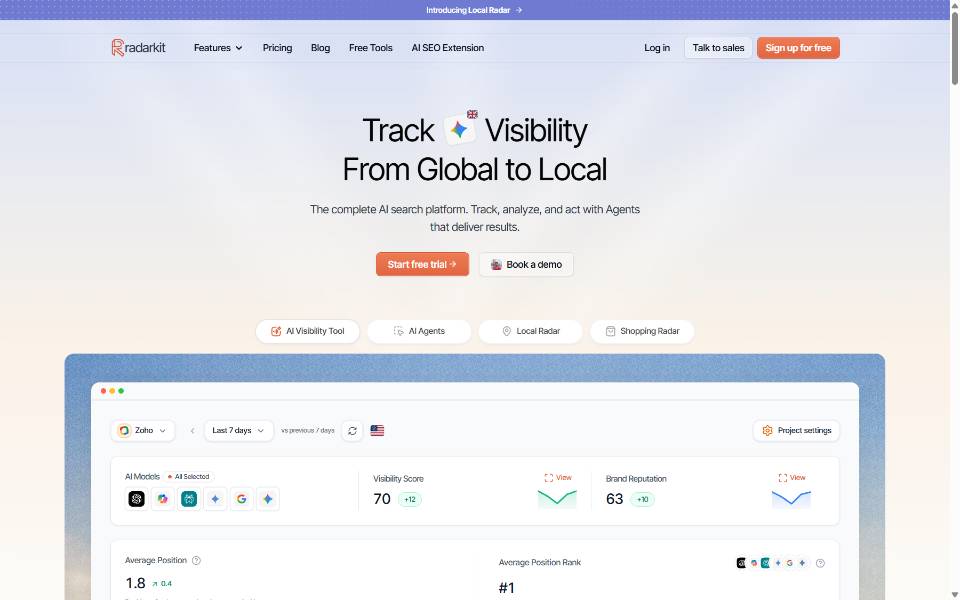
RadarKit sees search the way a shopper does. It captures the answers AI gives to people in a specific city and pairs them with agents that follow up, so using it feels like working with a compact operations team rather than reading a chart.
Prompts go into live ChatGPT, Gemini, Copilot, Perplexity and Google AI screens (never an API) from a residential IP in your chosen city. Each answer is kept whole, with every business and brand it names.
Local questions are what this product is built for, which is why it leads Scrunch AI vs RadarKit for Local Business Tracking. A three-way view with two enterprise platforms is in our RadarKit vs Peec AI vs Profound: Which AI Search Visibility Tool Is Better?.
RadarKit’s Key Features
- Live Interface Capture: Every prompt runs in a genuine chat screen or browser session, so stored answers match what a person reads.
- Platform Choice: Each plan covers six assistants (ChatGPT, AI Mode, AI Overviews, Copilot, Perplexity, Gemini), and projects decide which to run.
- Test From Any City: Pick the city and a local residential IP does the asking, then repeat the prompt elsewhere to compare.
- Local Radar: See every nearby business AI names, with its category, stars and review count, alongside how often you appear (for instance 3 of 9 answers), your typical rank and a month of trend.
- Clean Percentages: Answers unrelated to the local prompt are removed before any rate is calculated.
- Brand Scoreboard: Visibility, brand reputation, average position and sentiment arrive with a seven-day comparison.
- Sentiment Phrases: Language AI keeps using about a brand (for example “gentle cleanings”) is counted and grouped.
- Share of Voice: Your business and chosen rivals are measured on identical prompts.
- Source Leaderboard: The directories, review domains and outlets AI leans on are ranked by average position.
- Query Fanout: Extra searches that a model fires behind the scenes are caught as they happen, ready for export or content planning.
- Shopping Radar: The product carousel is saved with seller, price, stars and rank, and prompts where your products are absent get flagged.
- Ads Radar: Paid placements inside AI answers are logged with who paid, the headline, the landing link and the first date seen, plus the top bidder and how many answers had ads.
- Plan Agent: It reads Search Console beside citation data and drafts a to-do sheet for the other agents.
- Outreach Agent: Contacts at domains that cite rivals are found, emails go out through your Gmail and follow-ups respect a price ceiling you set.
- Reddit Agent: Threads AI quotes are opened with their comments, rival names are noted and communities that forbid brand posts are marked.
- Content Agent: Articles are written or reworked around entities, gaps and citations, then delivered to WordPress.
- Chat Agent: Plain-English questions about any project get answers, and a text file of up to 1,000 words can be attached.
- Quick Tasks: Single clicks suggest prompts from Search Console, profile a rival, kick off a backlinks campaign or optimize an article.
- Connected Accounts: Search Console, Analytics and WordPress connect on every tier.
- AI Visits: Visits coming from AI assistants are counted, so visibility links to real traffic.
- Client Delivery: Clients receive their own portal logins and branded PDFs, projects are kept apart and history is never cut.
- REST and MCP: Developers query projects, prompts, responses, sources, share of voice and fanout, and the MCP server states the credits each call uses.
- Free Tools: Three extras cost nothing: an LLMs.txt checker, an LLMs.txt generator and an AI SEO extension for Chrome.
RadarKit Pricing
- Lite: $29 monthly buys 2 projects, 15 prompts re-run every three days and 900 responses.
- Growth: $79 monthly buys 5 projects, 50 prompts re-run daily, 9,000 responses and 2 more seats.
- Pro: $139 monthly buys 10 projects, 100 prompts re-run daily, 18,000 responses, 5 more seats and priority support.
- Enterprise: A yearly contract that lifts the project limit, covers 70-plus locations with state and city tracking and adds single sign-on, unlimited seats and a named manager.
- Agent Allowances: Higher tiers unlock more work each month. Content articles go 6, 19, 32. Outreach and Reddit share credits of 10, 20, 40. Chat messages go 15, 25, 50. Branded PDFs go 2, 10, 20.
- On Every Plan: Rival monitoring, local, shopping and ad tracking, the portal, history, API and MCP.
- Trial: The first week is free and needs no payment, and a refund can be requested for 48 hours after the first charge.
RadarKit Pros and Cons
Pros
- Local Depth: City-level runs and a table of recommended local businesses answer the question owners actually ask.
- Entry Price: $29 a month is a fraction of what an enterprise AI platform costs.
- Action Built In: Agents write, email and analyze so reports end with finished work.
- No Gating: Radars, portal, API and MCP are on every plan.
Cons
- No Domain Audits: RadarKit tracks AI answers rather than auditing how crawlers read a domain.
- Map Grids: Neighborhood rank grids belong to map tools.
A Dentist’s First Month in RadarKit
Take a dental clinic as an example. First, enter prompts such as “emergency dentist near Midtown” and “teeth whitening in Manhattan”. Second, open the Local Radar table to see which clinics AI favors. Third, give the Plan Agent’s task sheet to the Outreach and Content agents. Last, mail the owner a branded PDF. That loop is what makes RadarKit practical for Scrunch AI vs RadarKit for Local Business Tracking.
Which Local Businesses RadarKit Is Good For
- Single-Location Shops: Clinics, salons, restaurants and repair firms get a local rival table for a few dollars a week.
- Multi-Branch Brands: Franchises compare appearance rates city by city inside one project.
- Local Agencies: Teams serving many small clients use ten projects on Pro and the client portal for reporting.
- Retail and Paid Teams: Stores and advertisers add Shopping and Ads Radar.
Scrunch AI Overview
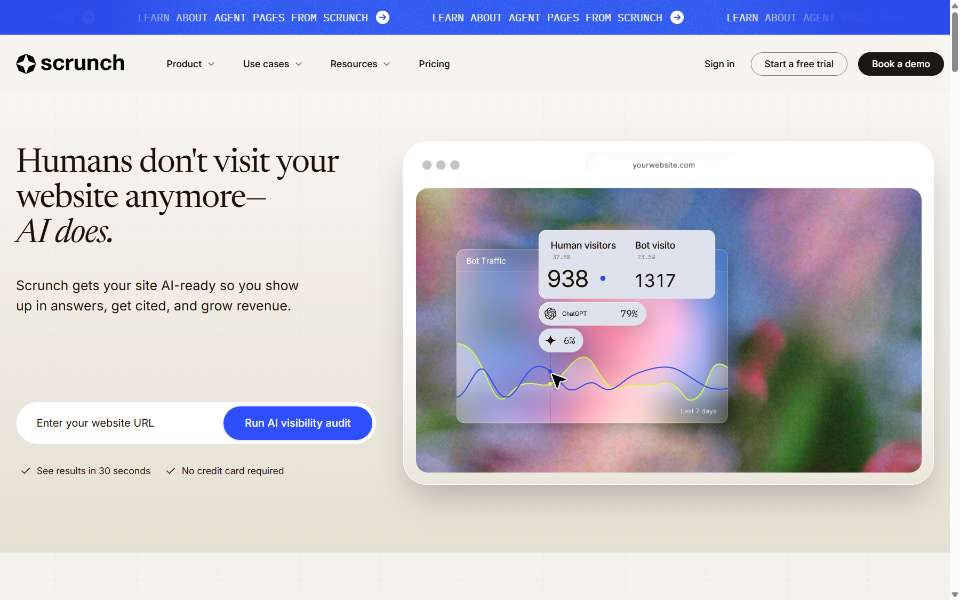
Scrunch AI is a platform for the agent-driven web. It watches how AI crawlers use a domain, scores how readable the content is to them and can deliver an agent-friendly version without changing what human visitors see. It feels like an engineering-led product for teams that manage a large domain.
More than 500 brands and agencies use it. Monitoring covers ChatGPT, Perplexity, Google AI Overviews and Copilot on the Core plan, and the Enterprise plan reaches nine platforms.
Technical and brand-level is how it fits Scrunch AI vs RadarKit for Local Business Tracking. Our Scrunch AI Review: Is it Worth the Investment? weighs it further.
Scrunch AI’s Key Features
- Agent Experience Platform: AXP observes what AI agents say and do on a domain and delivers an optimized version of content to them, leaving the human experience untouched.
- Monitoring and Citations: Brand presence, competitive presence and citation sources are tracked over time, with an Explorer BI layer that can also be queried through MCP.
- Insights: A current issue sits beside a recommended change, for example adding a missing comparison.
- Agent Traffic: Bot visits from ChatGPT, Claude, Perplexity and others are split from human ones.
- Domain Diagnostics: A map of URLs carries traffic and an audit score for each one, so low scorers are easy to rank.
- Shopping: AI performance is tracked at product level, with share against competitors and the prompts that decide sales.
- AI Search Trends: Estimated prompt volume and momentum reveal what people are asking AI about a category.
- Prompt Controls: Funnel stages, personas, sentiment and prompt management come with the monitoring layer.
- Content Generation: Basic generation and URL optimizations are included on Core, with more on Enterprise.
- Agency Tools: API-first delivery, white-label output, demo environments for prospects, multi-client workspaces and permission controls serve agencies.
- Enterprise Access: Looker Studio, query API, MCP, CLI, SAML and OIDC single sign-on and a dedicated account team arrive on the custom plan.
Scrunch AI Pricing
- Core: $250 a month: 125 unique prompts, 5,000 responses, 5 domain audits, 25 mapped URLs, 1 brand workspace, 5 licenses and 4 platforms (ChatGPT, Perplexity, Google AIO, Copilot).
- Core Limits: 1 country, 1 persona, 1 language, 5 competitors, 3 trend topics, limited query fan-out and 1 URL optimization a month.
- Enterprise: Custom prompts, responses, workspaces and licenses, nine platforms (adding Claude, Gemini, Meta AI, AI Mode and Grok), unlimited countries, AXP, API, SSO and Slack support.
- Trial: Seven free days on Core.
Scrunch AI Pros and Cons
Pros
- Agent Visibility: Few tools explain how AI bots treat a domain as clearly.
- Agency Features: White-label output, prospect environments and multi-client workspaces suit agencies.
- Enterprise Depth: Nine platforms, API, MCP and CLI are available on the custom plan.
Cons
- One Country on Core: Branches in different cities share a single score.
- No Local Rival Table: Businesses AI recommends instead of you are not named.
- Starting Price: $250 a month is steep for one location.
A Retail Brand With a Large Domain
For Scrunch AI vs RadarKit for Local Business Tracking, a retail brand with thousands of product URLs can see which ones AI bots read most, spot low-scoring URLs and use AXP to serve a cleaner version to agents.
Which Local Businesses Scrunch AI Is Good For
- Large Chains: Brands with a central web team and a big domain get the most from agent analytics.
- Technical Agencies: Agencies that sell AI readiness audits can white-label the output.
- Ecommerce Operators: Product-level shopping data helps online stores.
Scrunch AI vs RadarKit for Local Business Tracking: Head-to-Head
How Each Tool Reads a Place
In Scrunch AI vs RadarKit for Local Business Tracking, RadarKit reads a place the way a customer does, with a residential IP from the chosen city. Scrunch Core reads one country, so a business with branches in two cities are unable to compare them.
Who Appears Next to You
Among Scrunch AI vs RadarKit for Local Business Tracking, RadarKit saves every recommended local business with rating and review count, which answers who to beat. Scrunch tracks five competitors at brand level on Core.
Platform Reach
For Scrunch AI vs RadarKit for Local Business Tracking, RadarKit tracks six platforms on every plan. Scrunch tracks four on Core and nine on Enterprise.
Turning Data Into Work
In Scrunch AI vs RadarKit for Local Business Tracking, RadarKit’s agents plan, email, write and analyze. Scrunch’s strength is technical: audits, agent traffic and agent-ready delivery for the domain itself.
Client and Agency Delivery
For agencies in Scrunch AI vs RadarKit for Local Business Tracking, RadarKit includes a client portal and branded PDFs on every plan. Scrunch offers white-label output and multi-client workspaces for agencies, with API-first delivery.
Developer Access
Under Scrunch AI vs RadarKit for Local Business Tracking, RadarKit includes API and MCP on all plans. Scrunch reserves API, MCP, CLI and Looker Studio for its custom plan.
What Local Owners Should Check Before Choosing
- Place Detail: Decide whether you need a country, a city or a neighborhood view, because Scrunch AI vs RadarKit for Local Business Tracking differ most here.
- Named Rivals: Look for a table of nearby recommended businesses, not only brand-level share.
- Platform Fit: Make sure the assistants your customers use are covered.
- Cost Per Location: Divide the plan price by the number of branches it can hold.
- Next Steps: Choose a tool that helps you act, for example with outreach, content or review work.
Looking beyond these two? 10 Best Local AI Rank Trackers for Local Businesses compares ten more.
Pricing for a Local Business With Five Branches
To price Scrunch AI vs RadarKit for Local Business Tracking, picture five branches with five prompts each, which is 25 prompts.
- RadarKit: Lite at $29 holds 15 prompts, so Growth at $79 with 50 prompts and daily scans covers the full set, and each city runs from its own IP.
- Scrunch AI: Core at $250 gives 125 prompts, so capacity is not the issue, but all five branches share one country and one competitor set.
- Annual Gap: Over twelve months Growth costs $948 and Core costs $3,000, a difference of $2,052 for a local business.
Final Thoughts: Scrunch AI vs RadarKit for Local Business Tracking
Scrunch AI is the right fit for large brands and agencies that need agent analytics, domain audits and an agent-ready version of their content. Its one-country entry plan and $250 starting price work against small local operators.
RadarKit is the best overall pick. It starts at $29 a month and records what AI tells a customer in one specific city, stores each recommended local business with stars and review counts, adds shopping and ad radars and gives five agents the gaps to close. Local businesses weighing Scrunch AI vs RadarKit for Local Business Tracking get a clear winner. A large, technical domain may add a separate audit tool.
FAQs: Scrunch AI vs RadarKit for Local Business Tracking
Can Scrunch AI track a single city?
In Scrunch AI vs RadarKit for Local Business Tracking, Core tracks one country, so a single city can be monitored but separate cities are not comparable, and city-level detail is not part of the plan.
Which tool names nearby competitors?
RadarKit’s Local Radar saves every business AI recommends with category, rating and reviews. Scrunch compares five competitors at brand level on Core.
What is the cheapest way to start?
In Scrunch AI vs RadarKit for Local Business Tracking, RadarKit starts at $29 a month with a seven-day trial. Scrunch Core starts at $250 with a seven-day trial.
Does either tool help agencies?
Yes, in Scrunch AI vs RadarKit for Local Business Tracking. RadarKit offers a client portal and ten projects on Pro, while Scrunch offers white-label output, prospect environments and multi-client workspaces.
Can a business use both?
Yes, in Scrunch AI vs RadarKit for Local Business Tracking. A large brand can use RadarKit for city-level answers and Scrunch for agent traffic and domain audits. For other options, read our 8 Best Scrunch AI Alternatives for 2026(Tried and Tested).