In this AccuRanker review, I’ll explain what the platform does, who can benefit from it, how its plans are priced, and we will also look at a better option for teams focused on AI search visibility.
So, without any further ado, let’s get started.
Quick Capability Rating
-
Keyword rank tracking: 3.8/5
-
SERP analysis: 3.7/5
-
Keyword organization: 3.6/5
-
AI search visibility: 3.7/5
-
Organic site analysis: 3.5/5
-
SEO reporting: 3.6/5
-
API and integrations: 3.7/5
-
Pricing value: 3.3/5
-
Overall rating: 3.6/5
What Is AccuRanker?
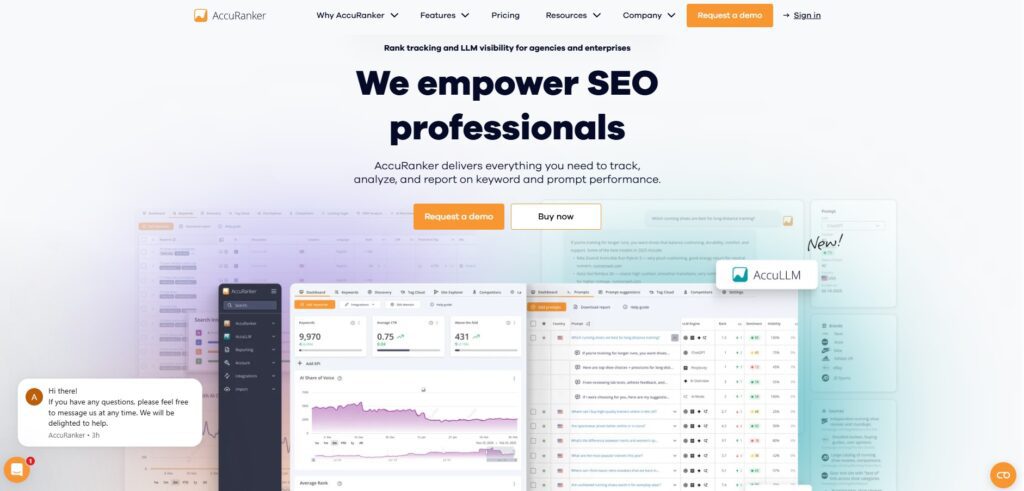
AccuRanker is an SEO platform designed to track keyword rankings and help teams understand how their websites perform in organic search. It gives users a place to monitor ranking positions, competitor movement, landing pages, keyword groups, search-result features, and reporting data.
The platform is mainly aimed at people who need more than a basic keyword tracker. Agencies can use it to manage client campaigns, while in-house SEO teams can monitor large keyword sets across locations, devices, and search engines.
A major part of this AccuRanker review is its emphasis on accurate, regularly refreshed ranking data. The platform supports daily rank updates, on-demand keyword checks, local tracking, keyword tagging, and visibility metrics that make large SEO campaigns easier to manage.
AccuRanker has also expanded into AI search monitoring. Its AccuLLM feature helps users track brand mentions, citations, prompt performance, and visibility across AI-driven search experiences.
Who Needs AccuRanker?
AccuRanker is most useful for professionals who manage a serious SEO workload. It may be a good match if rankings, client reporting, content performance, or competitor visibility are important parts of your work.
SEO Agencies
SEO agencies can use AccuRanker to keep client keywords organized, create reports, monitor changes, and separate campaigns through tags and folders. Its reporting tools are particularly useful for agencies that need consistent updates without building every report manually.
In-House SEO Teams
Marketing teams working with large websites can use AccuRanker to track important keyword groups across different pages, products, markets, and locations. This makes it easier to spot ranking drops, missed keyword opportunities, and pages that need more attention.
Content Teams and Publishers
Content teams can use the platform to see which articles are bringing visibility and which pages are competing for similar keywords. This is helpful when updating old content, planning topic clusters, or finding pages that need better optimization.
Businesses Focused on AI Search
Brands that want to appear in ChatGPT, Perplexity, Google AI Overviews, and other AI-powered results can use AccuLLM. It gives a clearer view of whether a brand is being mentioned or cited when users ask relevant questions.
Data-Focused SEO Professionals
This AccuRanker review also makes sense for teams that rely on dashboards, exports, APIs, and custom reporting. The platform connects with tools such as Google Search Console, Google Analytics, Looker Studio, Google Sheets, and other reporting platforms.
AccuRanker Review: Core Capabilities
AccuRanker MCP
AccuRanker MCP gives users a way to access SEO data inside compatible AI tools. It connects rank tracking and AI visibility information with AI-assisted workflows, which can save time when reviewing ranking trends or preparing SEO insights.
For example, an SEO manager could use an AI assistant to review keyword movement, identify visibility losses, or summarize performance by tag. This feature is particularly useful for teams that already use AI tools in their daily research and reporting work.
AccuLLM
AccuLLM is AccuRanker’s AI search visibility feature. It tracks how a brand appears in AI-generated responses across platforms such as ChatGPT, Perplexity, Google AI Overviews, and Google AI Mode.
It can help users monitor brand mentions, cited domains, average rank, sentiment, share of mentions, and share of citations. This provides useful direction for businesses publishing comparison articles, product pages, service pages, or thought-leadership content.
For content creators, AccuLLM can show whether a website is becoming part of AI-driven recommendations. It also helps reveal which competitor domains receive citations for important prompts.
Rank Tracking
Rank tracking is the heart of AccuRanker. Users can track important keywords by device, location, and search engine, then review daily ranking movement from a central dashboard.
The platform also supports on-demand updates for individual keywords. This is useful after publishing new content, updating an existing page, fixing a technical issue, or making major on-page SEO changes.
This AccuRanker review found that rank tracking is more useful when it is viewed alongside SERP context. A keyword position can look strong at first, but ads, maps, AI results, featured snippets, images, or shopping blocks can reduce the amount of visibility it actually receives.
Tagging
Tagging helps users sort keywords into meaningful groups. You can organize tracked terms by topic, client, service, country, search intent, product category, or funnel stage.
For instance, an agency could create tags for “local SEO,” “SaaS reviews,” “comparison keywords,” and “commercial pages.” This helps turn a long keyword list into smaller groups that are easier to review and report on.
AccuRanker also supports dynamic tags, which can automatically group keywords based on chosen rules. That can be valuable for large accounts where manually sorting every keyword would take too much time.
Organic Site Explorer
Organic Site Explorer helps users look at SEO performance page by page. Instead of focusing only on individual keywords, it gives a broader view of landing pages, the terms associated with those pages, and competing domains.
This feature can be useful during a content audit. You can review which pages attract rankings, which pages have more room to grow, and where competitors are performing strongly.
It also helps identify content overlap. If several pages rank for similar terms, you may need to improve internal linking, clarify page intent, merge similar content, or strengthen the page that best matches the search query.
Reporting
Reporting is one of the strongest practical parts of AccuRanker. Users can prepare SEO reports for clients, managers, or marketing teams without manually collecting every data point.
Reports can focus on ranking movement, keyword groups, visibility, landing pages, competitors, and other campaign metrics. This makes the feature useful for monthly performance updates and ongoing client communication.
For agencies, reports can reduce repetitive tasks. Instead of spending hours preparing the same data every month, the team can create a reporting structure and focus more on explaining what the results mean.
AccuRanker Review: Plan and Pricing
Professional Plan
The Professional plan starts at $249 per month and is built for freelancers, consultants, smaller agencies, and businesses that manage a focused keyword set.
It includes daily updates, keyword research tools, search-intent data, tagging, filters, reports, exports, and integrations with Google Search Console and Google Analytics. This plan is a practical starting point for users who mainly need advanced rank tracking and reporting.
Expert Plan
The Expert plan starts at $849 per month and is designed for growing agencies and established SEO teams with larger data requirements.
It adds AI CTR, AI Search Volume, dynamic tagging, Tag Cloud, Looker Studio integration, and unlimited read API access. This plan may suit teams that build detailed dashboards, manage several websites, or need more advanced keyword segmentation.
Enterprise Plan
The Enterprise plan is designed for large organizations that need to track more than 25,000 keywords. Pricing is custom, so businesses need to request a quote based on their requirements.
It includes BigQuery support, unlimited write API access, raw SERP HTML, faster refresh options, unlimited users and domains, and dedicated customer success support. This plan is a better fit for large agencies, enterprise brands, and international SEO programs.
LLM Plans
AccuRanker also offers separate AccuLLM plans for businesses that want to track brand visibility across AI search platforms. Each tracked prompt is monitored across ChatGPT, Perplexity, Google AI Overviews, and Google AI Mode.
| Plan | Price | Prompts | Brands | Key features |
|---|---|---|---|---|
| LLM Lite | $206 per month | 100 | 1 | Unlimited seats, all-time history, daily tracking, live chat support |
| LLM Pro | $521 per month | 300 | 5 | Unlimited seats, API access, all-time history, daily tracking, live chat support |
| LLM Enterprise | Contact for pricing | 500+ | 5+ | Unlimited seats, API access, all-time history, daily tracking, dedicated CSM, product influence |
- LLM Lite costs $206 per month and is suitable for freelancers, consultants, and small agencies. It includes 100 tracked prompts and one brand, making it a practical choice for teams that want to monitor their main AI search queries without managing a large prompt list.
- LLM Pro costs $521 per month and is designed for growing agencies and mid-sized in-house teams. It includes 300 prompts, tracking for up to five brands, and API access. This plan is useful for teams that manage multiple clients, products, services, or locations.
- LLM Enterprise uses custom pricing and is built for larger organizations managing several brands across different markets. It includes 500 or more prompts, tracking for five or more brands, API access, dedicated customer success support, and product influence opportunities.
AccuRanker vs a Better Alternative
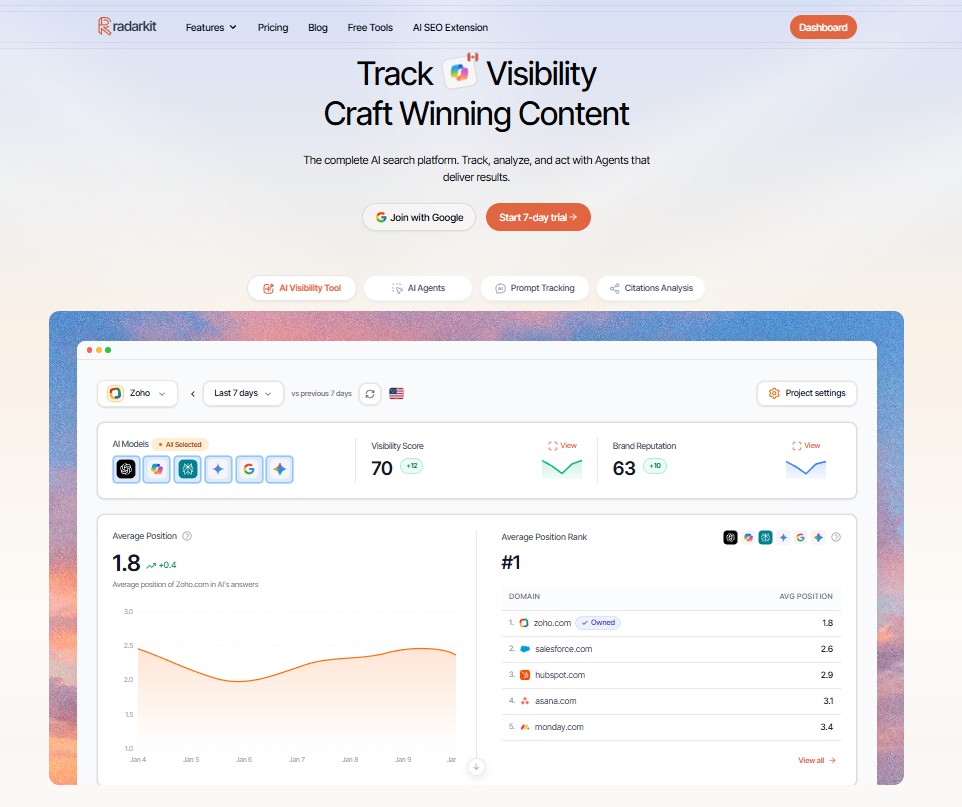
RadarKit.ai is the better alternative for businesses that want to improve how their brand appears in AI-powered search results. It brings AI visibility tracking, citation analysis, local visibility monitoring, competitor insights, AI traffic analytics, and action-focused AI agents into one platform.
The platform monitors brand visibility across ChatGPT, Perplexity, Gemini, Microsoft Copilot, Google AI Mode, and Google AI Overviews. It uses real chat interfaces to track prompts, making the data more useful for teams that want to understand how customers may discover brands through AI search.
RadarKit.ai does more than show whether a brand was mentioned. It helps users see citation sources, content types receiving citations, competitor visibility, average position, sentiment, and share of voice. This gives marketers a clearer starting point for improving content and earning more visibility in AI-generated answers.
One of its best capabilities is the set of AI agents built into the platform. The Content Agent helps create and improve content using AI citation and search data. The Outreach Agent supports promotion opportunities, while the Reddit Agent and Chat Agent help teams turn AI search insights into practical actions.
RadarKit.ai also supports local AI visibility tracking across more than 50 locations on Lite, Growth, and Pro plans. This is valuable for local businesses, agencies, and service providers that want to know whether AI platforms recommend them for city-based or regional queries.
Pricing
The pricing also makes RadarKit.ai accessible for smaller teams. The Lite plan starts at $29 per month and includes two projects, 15 tracked prompts, AI visibility tracking across major AI models, 50+ locations, Google Search Console integration, AI traffic analytics, and access to the platform’s AI agents.
For more active campaigns, the Growth plan costs $79 per month and includes five projects, 50 prompts, daily tracking, two additional seats, and more AI agent capacity. The Pro plan costs $139 per month and includes 10 projects, 100 prompts, daily refreshes, five additional seats, priority support, and increased reporting and agent limits.
Best for
RadarKit.ai is a strong choice for agencies, content teams, SaaS brands, local businesses, and marketers who want to turn AI search insights into content, outreach, and visibility growth. Its combination of tracking, citation analysis, local monitoring, reporting, integrations, and AI agents makes it a complete platform for building a stronger presence in AI search
FAQs: AccuRanker review
Is AccuRanker good for SEO agencies?
Yes, AccuRanker is well suited to SEO agencies because it supports keyword tagging, reporting, client-focused workflows, competitor monitoring, exports, integrations, and large keyword sets. Agencies can use it to manage separate campaigns while keeping client data organized.
Does AccuRanker track local keyword rankings?
Yes, AccuRanker supports location-based keyword tracking. This is useful for businesses that target cities, regions, or multiple service locations and need to see how rankings differ by area.
Can AccuRanker track AI search visibility?
Yes, AccuRanker includes AccuLLM, which tracks brand mentions, citations, average position, sentiment, and prompt performance across selected AI search experiences.
Does AccuRanker offer a free trial?
AccuRanker provides a free trial option for users who want to explore the platform before choosing a paid plan. Trial availability and plan details can change, so it is best to confirm the current offer before signing up.
Is AccuRanker better for small businesses or large SEO teams?
AccuRanker can work for both, but it is more suitable for agencies, established businesses, and SEO teams that need detailed rank tracking and reporting. Smaller businesses with fewer keywords may find it most useful when ranking data plays a major role in their marketing strategy.
Final Thoughts
This AccuRanker review shows that the platform is a strong option for agencies, professional SEO teams, and businesses that need detailed keyword tracking. Its main value comes from daily updates, SERP analysis, tagging, reporting, page-level insights, and AI visibility monitoring.
It is best suited to users who see rank tracking as an ongoing business activity rather than a simple monthly check. The platform gives enough depth to monitor large keyword sets, build reports, identify content opportunities, and understand where a website stands against competitors.
For teams focused mainly on traditional organic SEO, AccuRanker can be a valuable choice. For those who want a lower-cost tool centered on AI search visibility, RadarKit.ai is worth considering alongside it.