
This article delves into the 9 Best Profound AI Alternatives for 2026, offering insights into how these alternatives can help you monitor your brand’s presence across AI platforms and optimize your AI search performance.
So, without any further ado, let’s get started.
Quick Pick Criteria
- Radarkit AI – Best overall Profound AI alternative for agencies and SEO teams.
- Peec AI – Best for prompt‑level AI search analytics and source targeting for marketing teams.
- LLMrefs – Best for keyword‑driven AI visibility tracking that feels like classic rank tracking.
- SE Ranking AI Search / AI Overviews Tracker – Best for Google‑first SEO teams that want AI Overviews tracking inside a full SEO suite.
- ZipTie – Best for visual, answer‑level auditing across AI Overviews, ChatGPT, and Perplexity.
- Surfer AI Tracker – Best for content‑focused SEOs who want AI visibility tied directly to Surfer’s on‑page workflows.
- Ahrefs Brand Radar – Best for Ahrefs users who want serious AI visibility and brand monitoring in the same ecosystem as their SEO data.
- Otterly – Best for brand and PR teams that prioritize AI brand monitoring, sentiment, and alerts.
- AthenaHQ – Best for enterprises that need a full GEO platform with AI visibility, automation, and revenue attribution.
Quick Comparison Table of Profound AI Alternatives
| Tool name | Best for | Pricing | What it offers |
|---|---|---|---|
| Radarkit AI | Best overall. | From $29/mo | Real‑browser multi‑engine tracking, AI visibility and share of voice, competitor monitoring, citation data, GA4‑style traffic analytics, and AI‑assisted content workflows. |
| Peec AI | Prompt‑level analytics. | From €89/mo | Prompt‑level AI visibility across major assistants, multi‑country tracking, competitor benchmarking, citation/source analysis, and sentiment on AI answers. |
| LLMrefs | Keyword‑first AI tracking. | From $79/mo | Turns keyword lists into prompts, tracks AI visibility, share of voice, and average AI “rank” across multiple engines, with exportable reports and SOV dashboards. |
| SE Ranking AI Search / AI Overviews Tracker | Google AI Overviews. | From $129/mo | Shows which keywords trigger AIO, if you are cited, your position in AIO, historic snippets, and competitor presence, integrated with SE Ranking’s SEO suite. |
| ZipTie | Visual AI answers. | From $69/ mo. | Tracking for Google AIO, ChatGPT, Perplexity with full answer text/screenshots, mentions, citations, sentiment, share of voice, and an AI Success Score. |
| Surfer AI Tracker | Surfer users. | From $99/mo. | AI visibility for brands/topics across Google AIO/AI Mode, ChatGPT, Perplexity, with mentions, share of voice, cited pages, and trends inside Surfer. |
| Ahrefs Brand Radar | Ahrefs users. | From $129/mo | AI visibility and brand monitoring across six AI platforms plus YouTube and Reddit, with visibility scores, impressions, SOV, and historical trends linked to Ahrefs data. |
| Otterly | Brand monitoring. | From $29/mo | AI search monitoring across Google AIO, ChatGPT, Perplexity, with alerts, brand mentions, sentiment breakdown, and citation/link insights. |
| AthenaHQ | Enterprise GEO. | From $295/mo | Cross‑platform AI visibility on 8+ LLMs, GEO action center, content and authority recommendations, GA4 + LLM traffic analytics, and multi‑team enterprise dashboards. |
Why Seek Profound AI Alternatives?
While Profound AI aims to address the need for AI visibility tracking, there are several reasons why businesses might seek the best Profound AI alternatives.
Profound AI Is Not a Perfect Fit for Every Team
Profound is built to help brands understand and improve how often they are mentioned in AI-generated answers across major platforms.
That makes it powerful, but also means it can feel like too much tool for teams that only need basic visibility checks or occasional monitoring instead of a full AI search optimization stack.
When You Need Broader Multi‑Engine AI Coverage
A common reason to explore Profound AI alternatives is the need for strong coverage across the specific AI platforms your audience actually uses.
Profound focuses on tracking mentions and visibility in engines like ChatGPT, Perplexity, Google AI Overviews, and Microsoft Copilot, but some tools go deeper into a single ecosystem or add different channels on top.
If your strategy is heavily tied to one AI assistant or a niche use case, a more specialized tracker might be a better match.
Looking for Simpler Dashboards and Workflows
Profound surfaces detailed metrics such as visibility scores, share of voice in AI answers, and how often your brand appears by topic or query type.
For some marketers, that depth is ideal, but others prefer a lighter interface that focuses on a few core KPIs they can check quickly.
If you mainly want a quick read on “are we showing up more or less in AI answers,” a leaner Profound AI alternatives can feel easier to adopt day to day.
When Pricing, Plans, or Trials Do Not Match Your Budget
Profound uses a tiered model with Starter and Growth plans, plus custom Enterprise pricing, aimed primarily at organizations ready to invest in AI visibility long-term.
Smaller teams or solo SEOs sometimes prefer alternatives with lower entry-level pricing, monthly self-serve subscriptions, or longer free trials to validate ROI before committing.
Lightweight Brand Monitoring vs Deep AI Analytics Needs
Some businesses only need to know whether their brand is mentioned at all in AI answers and whether those mentions are generally positive or negative.
Others want in‑depth analytics around share of voice, sentiment, topic clusters, and trends over time to guide content and product decisions.
- If you fall into the first group, a simpler AI brand monitoring Profound AI alternatives, such as Radarkit.ai, can be enough.
- If you are in the second stage, you may compare Profound with other enterprise‑grade platforms to see which analytics model fits best.
9 Best Profound AI Alternatives for 2026
The 9 best profound AI alternatives listed below offer a range of features designed to help you monitor your AI search performance, optimize your AI search visibility, and ensure your brand is prominently featured in the AI answer landscape.
Radarkit AI (Best Overall)
Radarkit AI stands out as one of the best Profound AI alternatives if you want a mix of deep AI visibility tracking and practical optimization workflows.
It is built to show how your brand appears across major AI assistants and LLMs like ChatGPT, Perplexity, Gemini, Google AI Overviews, and Microsoft Copilot, so you are not guessing where you show up in answers.
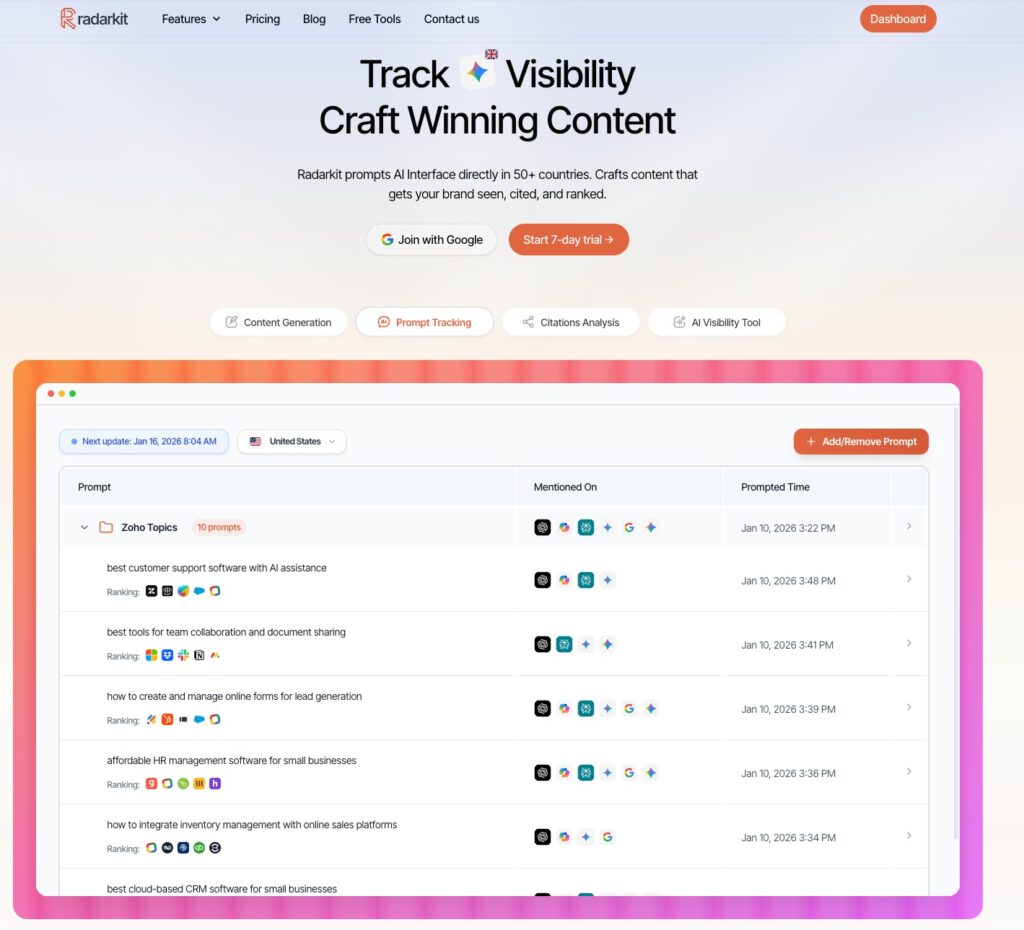
Instead of relying on APIs, Radarkit prompts LLM chat interfaces directly using real browsers and proxies, which keeps the data close to what real users see.
Every paid plan includes AI traffic analytics via GA4, citation data, and competitor monitoring, and you can start with a 7‑day free trial before committing.
Beyond basic tracking, Radarkit focuses on actionable AI visibility insights. You can measure brand and competitor share of voice across AI platforms, see sentiment trends, and pinpoint which competitors dominate specific prompts or topics.
Radarkit.ai (part of the Alpha startup at Web Summit Qatar) is the best AI search tracker in the market right now.
What makes Radarkit different is its accuracy and the fact that it uses real browser tracking instead of APIs to get actual AI responses from 40+ countries.
Notable Features
- AI Share of Voice: Identify exactly which sites AI Chatbots trust most for your query vs. competitors
- Location-Based Tracking: Simulate real-time queries from 40+ countries using residential proxies to catch local citations and geo-specific data
- NLP & Fact-Based Content: Create content using the specific NLP terms and entities found in most cited sources to rank in AI search engines
- 1-Click GEO Content Writer: Generates optimized content that ranks in LLMs in 5 minutes without needing Google Search Console
- Query Fanouts Tracking: Tracks how AI models break one question into multiple angles and turn them into content sections
- AI Traffic Monitoring: See which AI platforms (ChatGPT, Perplexity, Gemini, Copilot) send actual visitors to your site
Why is it better than Profound
If you want a Profound‑style AI visibility view but with more hands‑on features for spying on competitors and planning outreach, Radarkit is easier to adopt and experiment with.
The ability to see which competitors are mentioned, how they are framed, and which domains AI assistants trust most gives you very tactical next steps instead of just high‑level dashboards.
Ideal for
Radarkit AI is a great fit for SEO agencies, in‑house SEO teams, and SaaS or content‑heavy brands that want to actively improve how they show up in AI answers, not just monitor it.
It works especially well if you care about both AI visibility and classic SEO, since it ties AI search insights to GA4 traffic and link‑building opportunities.
Cons
Radarkit is still a specialist tool, so it does not replace a full traditional SEO suite for things like technical audits or rank tracking in Google SERPs.
Because it runs real LLM sessions through browsers and proxies, you also need to be comfortable with a more “technical” style of tracking than basic keyword tools.
Pricing
Radarkit offers plans starting at $29 with a 7‑day free trial on all paid plans, so you can test AI visibility tracking before committing.
Plans scale by the number of prompts, brands, and projects you monitor, making it accessible for smaller teams while still offering higher limits for agencies and larger companies.
Peec AI
Peec AI is one of the strongest Profound AI alternatives. It is an AI search analytics platform that shows how your brand and competitors appear in answers from tools like ChatGPT, Perplexity, Google AI Overviews, etc.
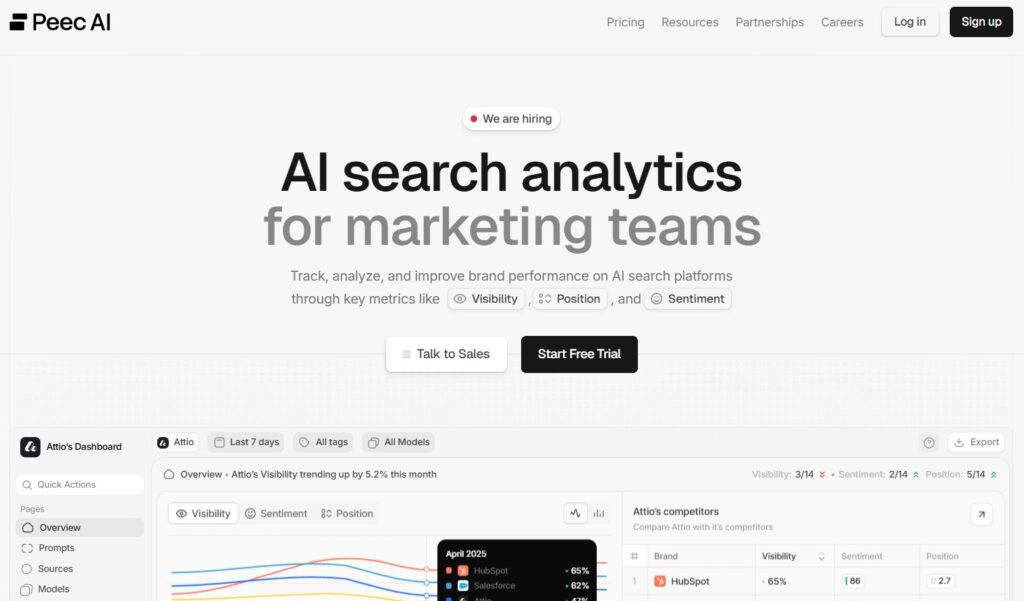
It runs real prompts in browser sessions instead of using APIs, so the visibility data reflects what users actually see.
Peec then turns these runs into clear metrics for visibility, citations, and sentiment, helping you understand how AI models describe and recommend your brand.
It also reveals which sources AI models quote most often and groups them by type (editorial sites, UGC, competitors, etc.), so you can focus PR, content, and link building on the domains AI already trusts.
Notable features
Peec offers prompt libraries, multi‑engine tracking (ChatGPT, Perplexity, Gemini, Claude, Google AIO), citation breakdowns by source type, and basic sentiment scoring on AI answers. It also supports multi‑country tracking and competitor benchmarking so you can compare your AI presence across markets and brands.
Why is it better than Profound
Peec can be a better fit than Profound if you care most about prompt‑level insights and source targeting rather than a broad enterprise GEO suite.
It is very focused on helping marketers see which prompts they win, which citations they lack, and how sentiment shifts over time.
Ideal for
Peec AI is ideal for growth‑stage SaaS, in‑house marketing teams, and agencies that already use classic SEO tools and now need dedicated AI search analytics.
It is especially useful when you have clear campaigns or themes and want to track, across models and countries, whether AI assistants recommend you or your competitors.
Cons
Peec focuses on AI answer engines and does not replace a full SEO platform for technical SEO or traditional SERP rank tracking. Some elements, like the inner workings of sentiment scoring and programmatic access, are less transparent publicly, which can frustrate very technical teams.
Pricing
Peec AI offers tiered pricing, where lower plans start at €89/month with limited prompts and countries, and higher plans with more prompts, geos, and workspaces, all with a 7‑day free trial.
That makes it easier to test and scale than many “contact sales” GEO tools aimed purely at enterprises.
LLMrefs
Profound AI alternatives, LLMrefs is an AI search visibility and LLM SEO tracker that turns your keyword lists into automated prompts to see how often you appear in AI answers.
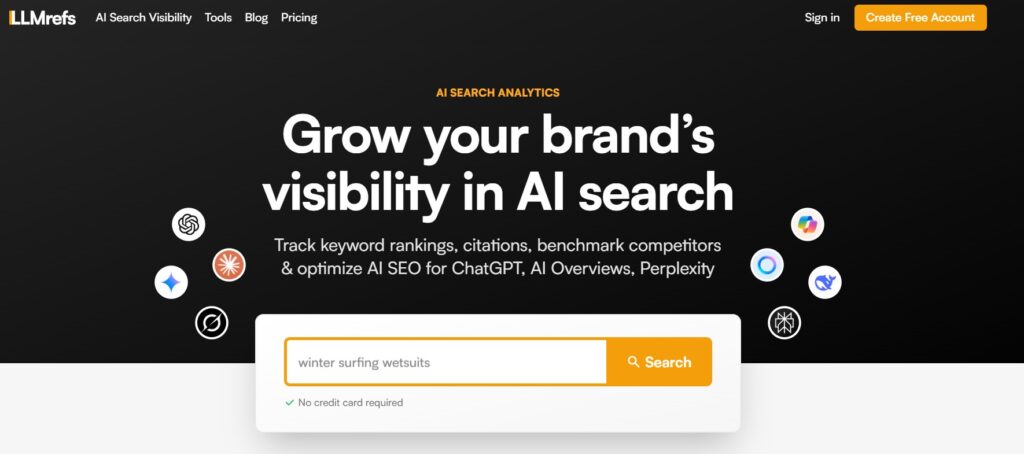
It monitors how brands and competitors are mentioned across AI engines, and it then aggregates that into AI visibility, share of voice, and average position metrics.
The platform is built to feel like a rank tracker for AI answers, so SEOs can slot it into existing keyword‑driven workflows.
LLMrefs also offers detailed share‑of‑voice reporting, showing how much of the “answer real estate” your brand owns versus competitors for specific topics or keyword groups.
Notable features
Key features include keyword‑driven AI visibility tracking, multi‑engine monitoring (ChatGPT, Gemini, Perplexity, Claude, Google AIO, and more), share‑of‑voice dashboards, and average AI “rank” per keyword group.
It also supports exporting reports, building topic clusters, and using share‑of‑voice reports to prioritize where you are under‑represented in AI answers.
Why choose it over Profound
Choose LLMrefs over Profound when you want a tool that plugs directly into an SEO team’s existing workflow and reporting stack.
It is easier to align with keyword research, existing dashboards, and client reporting, especially if you already track organic rankings and now need the same view for AI answers.
Ideal for
LLMrefs is ideal for SEO agencies, in‑house SEO teams, and performance marketers who care about AI search as an extension of their current keyword strategy.
It works particularly well for teams managing large keyword sets who need exportable, data‑heavy reports on AI visibility and competitor share of voice.
Cons
LLMrefs focuses on visibility, rankings, and share of voice, with less emphasis on rich sentiment analysis or built‑in content recommendations compared with some GEO platforms.
It also does not try to replace technical SEO tools, so you still need a separate stack for crawling, auditing, and traditional SERP tracking.
Pricing
LLMrefs positions itself as one of the more affordable AI search visibility tools, with plans that undercut many enterprise GEO suites while still including multi‑engine tracking and statistically significant sampling.
It only has one “All-in-One” plan starting at $79/month.
SE Ranking AI Search / AI Overviews Tracker
SE Ranking’s AI Results / AI Overviews Tracker is one of the best Profound AI alternatives if you care specifically about how your site appears inside Google’s AI Overviews.
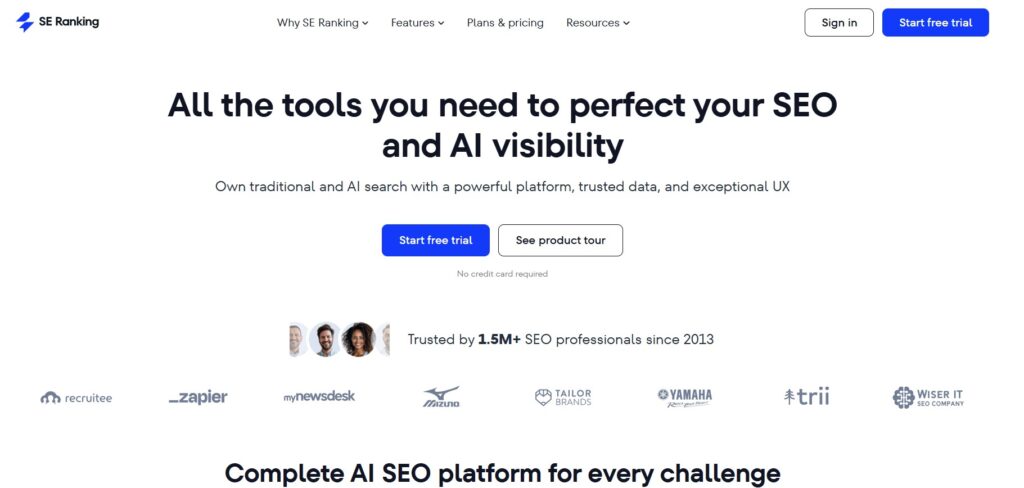
Instead of tracking classic blue‑link rankings only, it shows which of your keywords trigger AI Overviews, whether your site is cited in those AI snippets, and what position your pages hold within the links that appear inside the AI box.
You can also see competitor presence and historical AI snippet content, so you can review exactly what users saw on a given day.
Notable features
- AI Overview presence detection and ranking per keyword.
- Cached AI snippet content with historical snapshots.
- Competitor tracking inside AI snippets and top‑20 organic results.
- Integrated with SE Ranking’s wider SEO suite (rank tracker, SERP analyzer, site audit, etc.).
Why is it better than Profound
SE Ranking can be a better choice than Profound if you mainly care about Google AI Overviews and want AI tracking baked into a full SEO platform.
You get AI snippet visibility plus classic keyword rankings, audits, and on‑page tools in one place, rather than adding a separate GEO‑only tool.
Why choose it over Profound
Choose SE Ranking over Profound when you want to keep your stack simple and avoid another standalone subscription just for AI visibility.
For many SMBs and agencies, “SEO + AI Overviews tracking” inside one tool is enough to answer client questions about AI search without going full enterprise GEO.
Ideal for
SE Ranking’s AI tracker is ideal for SEO teams and agencies already using SE Ranking for traditional SEO who now need to watch how AI Overviews impact their visibility and traffic.
It fits especially well when Google is your main channel, and you want to see how AIOs are affecting click‑through and competitive position.
Cons
SE Ranking’s AI module focuses on Google AI Overviews first, with only limited early tracking of other AI engines like ChatGPT, compared to dedicated multi‑engine GEO tools.
If you need deep visibility across Perplexity, Gemini, or many assistants at once, you may find it narrower than Profound or specialist trackers.
Pricing
AI Overviews / AI Search tracking is included or an add‑on within SE Ranking’s Pro‑level plans, which typically sit in the mid‑market price band (roughly around 90–140 USD/month, depending on configuration), making it cheaper than many standalone AI visibility platforms.
ZipTie
ZipTie is an AI search visibility platform focused on showing exactly how your brand appears inside AI‑generated answers across Google AI Overviews, ChatGPT, and Perplexity.
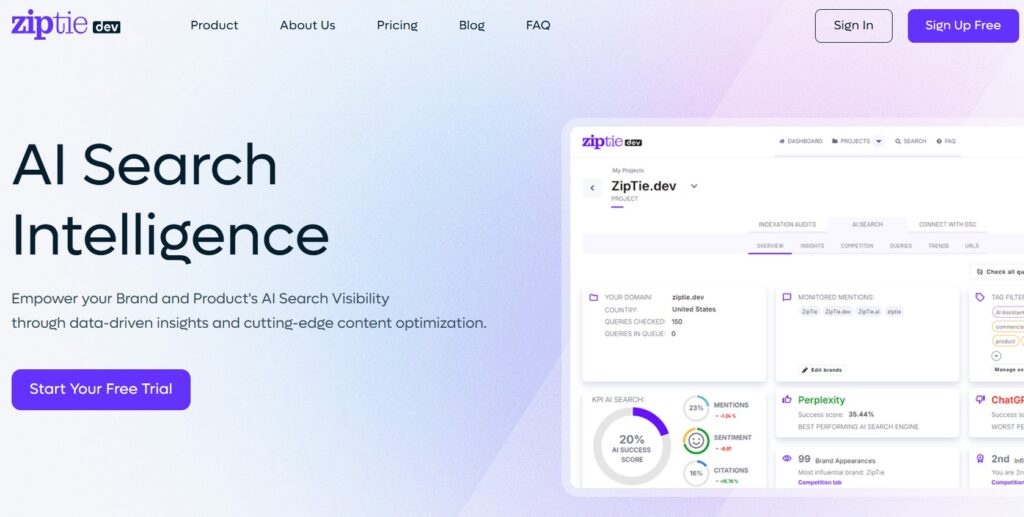
It captures live AI Overview results with the full answer text and screenshots, plus chat‑style answers from ChatGPT and Perplexity, so you can audit what users actually see.
ZipTie then organizes this into dashboards showing mentions, sentiment, share of voice, and which pages and domains are being cited most often.
Notable features
- AI search monitoring across Google AI Overviews, ChatGPT, and Perplexity.
- Answer‑level analytics with mentions, citations, sentiment, and share of voice.
- AI Success Score to prioritize queries based on mentions, links, and sentiment.
- Query generation helper (from URLs, GSC import, or manual input).
Why is it better than Profound
ZipTie can be better than Profound AI alternatives if you want very visual, answer‑level auditing of AI Overviews and chat answers rather than a heavier enterprise suite.
The combination of screenshots, exact text, and simple scores makes it easier for non‑technical stakeholders to understand what is happening in AI search.
Why choose it over Profound
Choose ZipTie over Profound when you want a focused AI search tracker with clear, guided workflows instead of a broad GEO platform built for large enterprises.
ZipTie is designed to “assist and guide you on your path to AI search success,” with prioritization scores and simple steps that tell you which queries to work on first.
Ideal for
ZipTie is ideal for SEO teams and agencies that need to show clients concrete evidence of how AI Overviews, ChatGPT, and Perplexity are treating their brand.
It works especially well if you want to review specific AI answers, identify missed citations, and prioritize optimization in a more visual, report‑friendly way.
Cons
ZipTie is tightly focused on AI search and does not include broader SEO features like technical audits or classic rank tracking, so you need other tools for the rest of your SEO stack.
Its analytics are deep for the engines it supports, but coverage is currently centered on AI Overviews, ChatGPT, and Perplexity, so you may still need separate tracking for other assistants.
Pricing
ZipTie offers tiered monthly plans with a 14‑day free trial, positioned as a mid‑range AI visibility tool rather than an enterprise‑priced platform.
Pricing starts at $69 / mo. and then scales with the number of queries and tracked engines, making it accessible for smaller teams while still supporting agencies that need higher limits.
Surfer AI Tracker
Surfer AI Tracker is an add‑on inside Surfer that shows how often, where, and how AI assistants mention your brand, products, or topics.
It currently tracks Google AI Overviews and AI Mode, ChatGPT, and Perplexity by scraping real answers rather than using APIs, so you see what users actually see.
For each prompt set, it reports mentions, share of voice, and which pages are cited, helping you understand how AI search presents your brand and where you are losing ground to competitors.
Notable features
- Multi‑engine tracking (Google AI Overviews/AI Mode, ChatGPT, Perplexity).
- Daily re‑checks with multiple runs per model to smooth volatility.
- Brand, product, and topic monitoring with share‑of‑voice and visibility trends.
- Shows cited pages feeding each AI answer, so you can see which content models trust.
Why is it better than Profound
Surfer AI Tracker can be a better fit than Profound if you want AI visibility tightly integrated with day‑to‑day SEO work.
You get AI search tracking and Surfer’s content and SERP tools in one place instead of adding a separate enterprise GEO platform.
Why choose it over Profound
Choose Surfer AI Tracker over Profound when your primary goal is to connect AI visibility directly to content optimization. Surfer makes it easy to go from “here’s what AI says about us” to “here are the pages and on‑page changes that can earn more citations.”
Ideal for
Surfer AI Tracker is ideal for content‑focused SEO teams, agencies, and SaaS marketers already using Surfer for on‑page optimization. It is especially useful if Google is your main channel and you want one workflow that covers both classic SEO and AI search visibility.
Cons
Surfer’s AI Tracker is narrower than Profound AI alternatives on AI surfaces and does not position itself as a full GEO or PR analytics suite. You still need other tools for broader brand monitoring, technical SEO, and non‑search channels.
Pricing
AI Tracker is sold as a paid add‑on to Surfer, with pricing layered on top of existing Surfer plans starting at $99/month.
Ahrefs’ Brand Radar
Ahrefs’ Brand Radar is a Profound‑style AI visibility and brand monitoring tool that shows how any brand appears across AI answers, YouTube, and Reddit.
It tracks visibility across six AI platforms, including Google AI Overviews, Google AI Mode, ChatGPT, Perplexity, Gemini, and Copilot, using a large library of “search‑backed” prompts rather than synthetic queries.
The tool produces brand visibility scores, AI share of voice, impressions, and coverage metrics over time, with historical data many competitors still lack.
Notable features
- Monitoring across six AI platforms plus YouTube and Reddit.
- Brand visibility scores, impressions, and AI share‑of‑voice reporting.
- Historical trend data for demand, mentions, and coverage.
- Tight integration with Ahrefs’ backlink, keyword, and site audit datasets.
Why choose it over Profound
Choose Ahrefs’ Brand Radar over Profound AI alternatives when you want to avoid another standalone platform and instead extend a tool your team already uses daily.
You can compare AI visibility, search demand, and web visibility together, then act using Ahrefs’ existing SEO workflows.
Ideal for
Brand Radar is ideal for mid‑market and enterprise teams that already rely on Ahrefs for SEO and now need serious AI visibility reporting. It works particularly well for brands managing multiple markets or products and needing share‑of‑voice and competitor dashboards that executives can understand.
Cons
Brand Radar is still evolving and, like Profound, is more analytics‑heavy than prescriptive, so you may need internal processes to turn insights into content changes.
It is also primarily attractive if you are already paying for, or willing to pay for, the broader Ahrefs stack.
Pricing
Brand Radar is available as a separate tool for all free and paid Ahrefs users, with beta indexes often included for paid subscribers at no additional cost.
Exact pricing depends on usage and plan, but it generally sits in the same “serious marketing team” budget range as Ahrefs’ core products rather than in the low‑cost tier.
Otterly
Otterly is an AI search monitoring and brand sentiment tool that tracks how your brand appears in AI‑powered search results across Google AI Overviews, ChatGPT, and Perplexity.
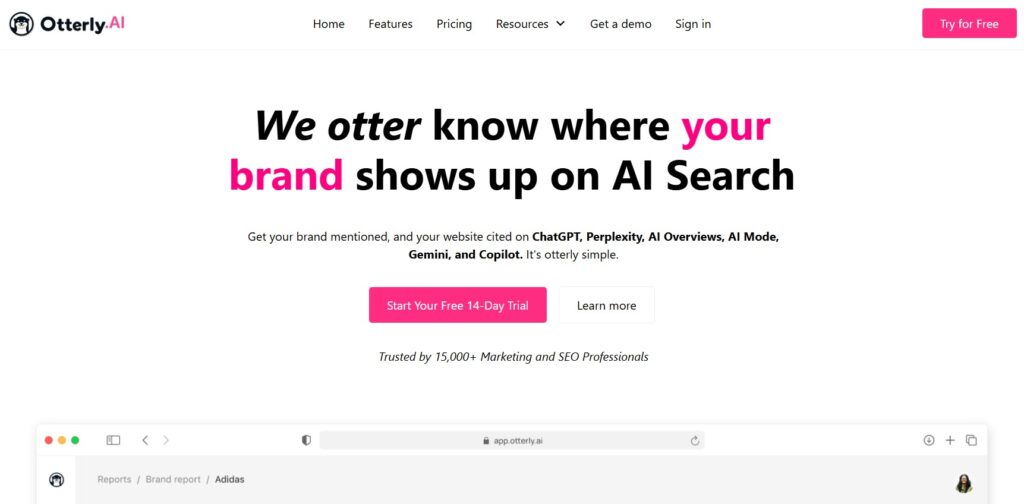
It runs prompts you care about across multiple AI platforms, then surfaces the text responses, which brands are mentioned, how often your URLs are cited, and how your brand ranks over time.
On top of visibility, it adds sentiment analysis so you can see whether AI mentions are positive, neutral, or negative.
Notable features
- AI search monitoring across Google AI Overviews, ChatGPT, and Perplexity.
- Brand monitoring with sentiment breakdown (positive, neutral, negative).
- Link citation analysis to see which URLs AI tools use.
- Prompt and keyword discovery, plus automatic updates and alerts.
Why is it better than Profound
Otterly can be a better fit than Profound if your main priority is brand monitoring and sentiment rather than deep GEO or content workflows. It emphasizes alerts, reputation, and link citations over complex dashboards.
Why choose it over Profound
Choose Otterly as a Profound AI alternatives when you want a lighter, more reputation‑oriented tool that helps you respond quickly to shifts in how AI describes your brand.
The combination of real‑time‑style monitoring, sentiment, and alerts is useful for comms, PR, and brand teams who may not need full SEO suites.
Ideal for
Otterly is ideal for marketing, PR, and brand teams that care about protecting and improving brand perception in AI answers.
It works well if you want to know “what is AI saying about us right now?” and be notified when sentiment or visibility changes.
Cons
Otterly is not a full SEO tool and offers less depth on technical SEO, keyword research, or advanced GEO features than platforms like Profound or Surfer.
Its focus on sentiment and monitoring may feel limited if you need heavy analytical or content‑recommendation workflows.
Pricing
Otterly starts at a $29 monthly subscription with tiers based on prompts and tracked brands.
That makes it relatively easy to trial, but costs can stack if you are also paying for a separate core SEO tool.
AthenaHQ
AthenaHQ is an enterprise‑grade Profound AI alternatives built as a full Generative Engine Optimization (GEO) platform rather than just a simple tracker.
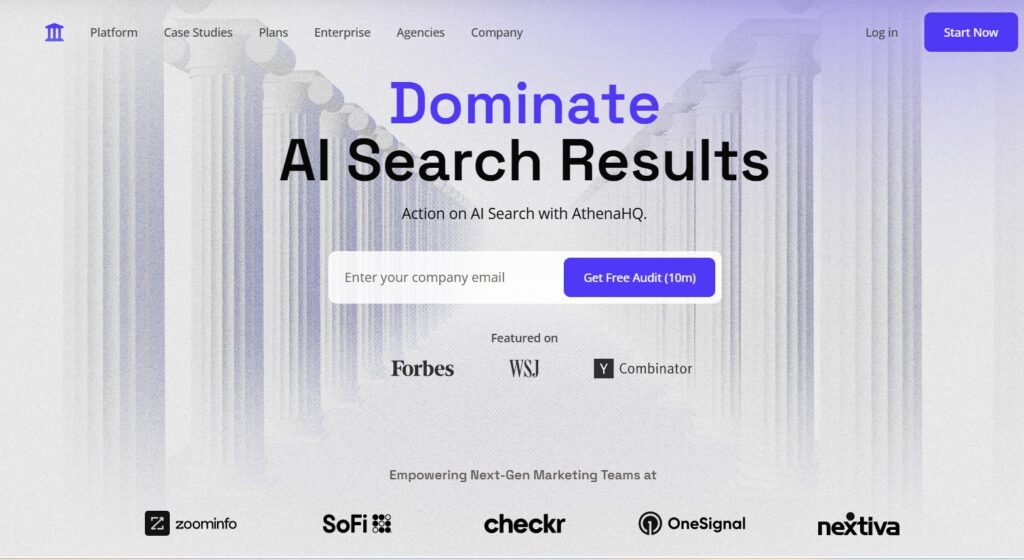
It monitors your brand’s visibility across 8+ major LLMs and AI search surfaces, including ChatGPT, Perplexity, Google AI Overviews and AI Mode, Gemini, Claude, Copilot, Grok, and more, then centralizes that data in a single GEO “command center.”
On top of raw visibility, AthenaHQ layers automated content optimization recommendations, citation source analysis, and link‑building guidance so teams can move from insights to concrete actions.
Notable features
- Cross‑platform AI visibility tracking across 8+ LLMs and AI search surfaces.
- On‑ and off‑page GEO recommendations plus an AI‑driven “Action Center.”
- Citation and authority intelligence to see which domains AI models trust and reference.
- LLM traffic analytics, GA4 integration, and revenue attribution from AI engines.
Why it’s better than Profound
AthenaHQ can outperform Profound for enterprises that want a more complete “action layer” on top of AI visibility. It leans heavily into automation (content agents, outreach suggestions, predictive analytics) and traffic attribution, not just reporting on mentions and share of voice.
Why choose it over Profound
Choose AthenaHQ over Profound AI alternatives if you want a platform that does not stop at dashboards but helps execute GEO work: creating or improving content, planning outreach, and forecasting the impact of AI model changes.
For teams already investing serious budget into AI search, it can consolidate multiple tools (visibility, analytics, and content ops) into one system.
Ideal for
AthenaHQ is ideal for enterprises, large brands, and big agencies that need multi‑stakeholder access, advanced reporting, and clear links between AI visibility and business outcomes. It fits best when you have dedicated SEO/GEO owners and enough search volume to justify deep analytics and automation.
Cons
AthenaHQ clearly targets the premium end of the market, with Starter plans around 295–295+ USD/month and Growth plans around 545–595+ USD/month, and no free trial. The credit‑based model and enterprise positioning make it overkill or too expensive for small teams and solo marketers.
Pricing
AthenaHQ pricing currently starts at roughly 295 USD/month for Starter (3,500 credits, AI visibility on major LLMs, unlimited seats, competitor monitoring, and LLM traffic analytics) and around 545–595 USD/month for Growth (more credits, GA4 integration, deeper content and authority intelligence).
How We Evaluated These Profound AI Alternatives
When assessing the 9 best profound AI alternatives to Profound AI, our evaluation process was thorough and multifaceted.
We Focused on Real AI Visibility Use Cases
We started by asking a simple question: Does this tool actually help you understand how visible your brand is inside AI answers, not just in classic search results?
Only platforms that treat AI visibility as a first‑class problem, rather than a side feature, made it onto the list.
Core Features for AI Search Monitoring
Next, we looked at how well each Profound AI alternatives tracks mentions and citations across key AI platforms like Google AI Overviews, ChatGPT, and other popular assistants. We gave extra weight to tools that can monitor multiple engines at once, so you get a unified view of where your brand appears.
Depth and Actionability of Insights
It is not enough to just count mentions, so we evaluated how deeply each tool reports on visibility scores, share of voice, sentiment, and trends over time. We prioritized platforms that turn this data into clear, actionable insights you can use to improve AI search performance.
Usability and Everyday Workflow Fit
We then assessed how intuitive each tool feels in real use: onboarding, navigation, dashboard design, and how quickly you can answer basic visibility questions. Tools that required heavy setup or felt cluttered fell down the list in favor of platforms that are easier to live in every day.
Pricing, Trials, and Scalability
Finally, we reviewed pricing structures, free trial availability, and how well each Profound AI alternatives scales from small teams to larger organizations.
The 9 Profound AI alternatives we selected all offer transparent plans or trial options so you can test fit and grow into more advanced tiers as your AI visibility needs expand.
FAQs
What makes Radarkit one of the best Profound AI alternatives?
Radarkit runs real‑browser checks with proxies across ChatGPT, Perplexity, Gemini, Google AI Overviews, and Copilot, then records full answers, citations, and locations, so you see exactly what real users see instead of sanitized API data.
Do you need a full GEO suite, or is a lighter AI tracker enough?
If you mainly want to know where you appear in AI answers and how you compare to competitors, lighter tools like Peec AI, ZipTie, Surfer AI Tracker, or Radarkit can be enough, while AthenaHQ or Profound make more sense when you need enterprise‑grade automation and governance.
Which Profound alternatives are best for classic SEOs who live in rank trackers?
Radarkit, SE Ranking’s AI Overviews Tracker, and LLMrefs work well for rank‑tracker‑style workflows: they turn prompts or keyword sets into dashboards showing AI visibility, share of voice, and trends in a format SEOs already understand.
Can smaller teams realistically afford AI visibility tracking?
Yes, tools like Radarkit, Peec AI, LLMrefs, and Otterly all offer entry plans in the $29/month range, often with free trials, so you can start monitoring AI visibility without committing to enterprise pricing.
Conclusion
Choosing the right Profound AI alternatives comes down to your goals, stack, and budget, not hype.
The tools we covered, from Radarkit AI to AthenaHQ, give you different mixes of AI visibility tracking, brand monitoring, and traffic or revenue insights across engines like ChatGPT, Perplexity, and Google AI Overviews.
Start with a clear use case, test a couple of platforms with free trials where available, and keep the one that makes it easiest to see how AI talks about your brand and what to do next.