In this Semrush AI Visibility Toolkit Review, you will learn what the platform does, how it collects data, which AI platforms it covers, its key features, plan details, and the types of teams that can benefit most from it.
So, without any further ado, let’s get started.
Quick Capability Rating
-
AI visibility tracking: 4.5/5
-
Competitor research: 4.5/5
-
Prompt research: 4/5
-
AI citation analysis: 4/5
-
Brand sentiment tracking: 4/5
-
AI prompt tracking: 4/5
-
AI technical audit: 4/5
-
Agency reporting potential: 4/5
-
Value for existing Semrush users: 4.5/5
-
Value for small businesses: 3.5/5
What Is Semrush AI Visibility Toolkit?
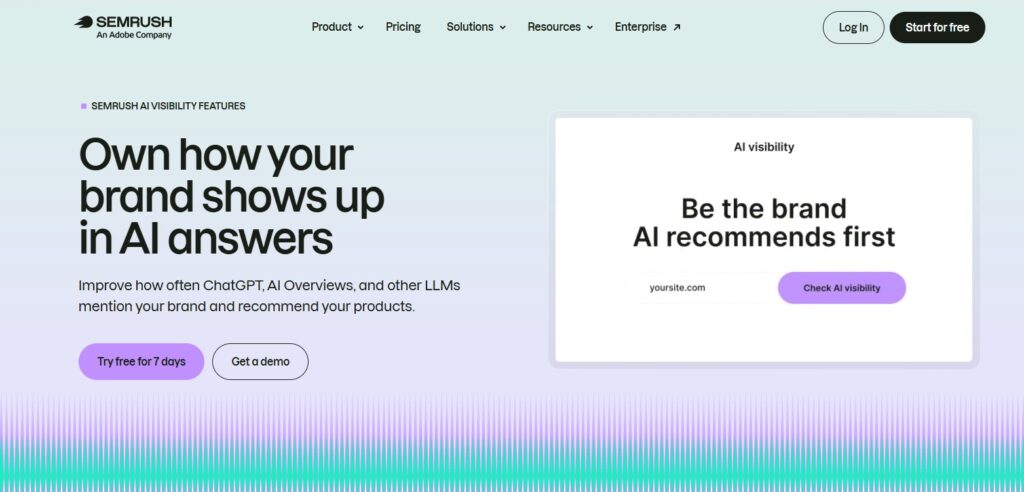
The Semrush AI Visibility Toolkit is an AI search monitoring platform inside the Semrush product ecosystem. It helps businesses see how their brand appears in AI-generated responses across platforms such as ChatGPT, Google AI Overviews, Google AI Mode, Gemini, and Perplexity.
Traditional SEO tools focus on keyword rankings, backlinks, organic traffic, and technical issues. The Semrush AI Visibility Toolkit adds another layer by showing whether AI systems are mentioning your business, citing pages from your website, and recommending your products for relevant prompts.
For example, a user may ask an AI platform, “What is the best SEO tool for agencies?” or “Which AI visibility tools are best for SaaS companies?” The answer may include several brands, citations, comparison points, and external sources. The Semrush AI Visibility Toolkit helps you understand whether your brand appears in these answers and how it compares with other brands.
The platform is useful for SEO professionals, content marketers, digital agencies, SaaS companies, enterprise teams, and brands that want to improve their presence in AI-driven discovery channels.
The biggest value of the Semrush AI Visibility Toolkit is that it does more than track mentions. It also helps you find topics, prompts, competitors, cited sources, brand perception patterns, and technical actions that can support stronger visibility over time.
How Semrush AI Visibility Toolkit Works
Semrush uses a large database of AI-related prompts and AI-generated responses to analyze brand visibility. These prompts are grouped into topics so users can see broader patterns instead of looking at one isolated question at a time.
The platform identifies brands mentioned in AI-generated answers and connects those mentions with topics, sources, citations, competitors, and response patterns. This helps businesses understand where their brand is already visible and where opportunities may exist.
The Semrush AI Visibility Toolkit also analyzes citations. If an AI answer links to or references a website, Semrush can show the domain and, in some cases, the specific pages that are being cited. This is useful because it gives content teams a clearer idea of the type of information AI platforms prefer to include in answers.
For brands, this creates a more practical workflow. Instead of guessing why competitors appear in AI answers, teams can study the prompts, cited domains, topics, and pages connected with those mentions.
Which AI Platforms Does Semrush Track?
The Semrush AI Visibility Toolkit covers several major AI search and AI assistant platforms. Coverage can vary depending on the report you use, but the toolkit is built around platforms that influence modern search behavior.
Key platforms include:
-
ChatGPT
-
Google AI Overviews
-
Google AI Mode
-
Gemini
-
Perplexity
This cross-platform approach matters because each AI platform can produce different recommendations. A brand might be mentioned frequently in Google AI Overviews but receive fewer mentions in ChatGPT or Gemini. Looking at multiple platforms helps teams avoid relying on one narrow view of AI search visibility.
The Semrush AI Visibility Toolkit also supports location-based analysis in many areas. This is helpful for businesses targeting specific markets, countries, regions, or cities. AI answers can vary based on location, language, local relevance, and the type of prompt a user enters.
What Is the Semrush AI Visibility Score?
The Semrush AI Visibility Score is a metric that helps users understand their brand’s presence in AI-generated answers. It gives a quick view of how visible a brand is compared with competitors across relevant topics and prompts.
The score is based on factors such as topic coverage and mention consistency. Topic coverage shows how often a brand appears across relevant AI topics. Mention consistency looks at how regularly the brand is included within those topics.
A higher score can indicate that a brand appears more often across its important topic areas. However, the score is most useful when compared with competitors and reviewed alongside mentions, citations, sentiment, and tracked prompts.
For example, a business may have a decent AI Visibility Score but still be missing from high-conversion comparison prompts. Another business may have fewer overall mentions but appear often in highly valuable prompts such as “best project management software for agencies” or “best CRM for small businesses.”
The Semrush AI Visibility Score gives teams a starting point. The deeper reports help explain what is happening behind that number.
Semrush AI Visibility Toolkit Review: Key Features
1. AI Visibility Overview
The AI Visibility Overview is the main starting point in the Semrush AI Visibility Toolkit. It provides a high-level look at how a brand appears in AI search results and AI-generated answers.
Users can enter their domain and see important visibility data, including AI Visibility Score, brand mentions, citations, cited pages, competitor information, topic performance, and source insights. This makes it easier to understand the overall AI search presence of a business.
The overview report is especially useful when you want to answer questions such as:
-
How often does AI mention my brand?
-
Which competitors receive more AI visibility?
-
Which topics drive brand mentions?
-
Which pages from my website receive citations?
-
Which third-party sites appear in AI responses?
-
Where does my brand have room to grow?
One helpful part of this feature is the ability to review topic opportunities. These are areas where competitors may appear in AI answers while your brand has limited visibility. A content team can use this data to prioritize new articles, product pages, comparison content, help center resources, case studies, and digital PR efforts.
The AI Visibility Overview is a useful first step for anyone using the Semrush AI Visibility Toolkit because it turns broad AI search activity into a more understandable brand visibility report.
2. AI Competitor Research
AI Competitor Research helps users compare their brand with competing companies in AI-generated answers. This feature is valuable because AI search is often recommendation-driven. When an AI platform answers a buying question, it may list multiple products, services, or businesses together.
With the Semrush AI Visibility Toolkit, users can compare their domain with selected competitors and see differences in mentions, citations, topics, prompts, and sources. This helps teams identify where competitors are receiving attention and where their own brand can improve its coverage.
For example, if a competitor is regularly mentioned in AI answers for “best email marketing tools” and “best automation software for ecommerce,” you can study those topics in more detail. You can then explore the content types, cited sources, product positioning, and helpful information connected with those answers.
The feature can uncover several practical opportunities:
-
Topics where competitors appear more often
-
Prompts where your brand is not yet included
-
Sources cited for competitors
-
Content themes linked with AI recommendations
-
Areas where your brand already has strong visibility
-
Shared sources that mention multiple competing brands
This feature is especially helpful for comparison content. If your business competes in a crowded category, competitor research can help you understand the language and topic areas where AI platforms are already making recommendations.
Rather than creating random content, teams can focus on useful pages that answer the same customer questions AI platforms are already receiving.
3. AI Prompt Research
AI Prompt Research helps users discover the questions and topic areas people use in AI search. It works similarly to keyword research, but it focuses on AI prompts and grouped topic ideas.
Traditional keyword research often starts with short phrases such as “best CRM software” or “AI SEO tools.” AI prompts can be longer, more detailed, and more specific. A person may ask, “Which AI visibility tool is best for a small SaaS company that needs citation tracking?” That type of question carries a lot of context.
The Semrush AI Visibility Toolkit helps users research related prompts, review topic demand, understand difficulty, and see which brands show up in AI-generated answers. This gives marketers a stronger foundation for planning AI-friendly content.
Prompt Research can help with:
-
Finding relevant AI topics
-
Discovering commercial comparison prompts
-
Identifying buyer-focused questions
-
Reviewing brands mentioned in AI answers
-
Studying AI topic volume
-
Understanding topic difficulty
-
Sending useful prompts into ongoing tracking
For content teams, this is one of the most valuable areas of the Semrush AI Visibility Toolkit. It helps turn AI search data into article ideas, landing page improvements, FAQ topics, comparison pages, and product education content.
A good workflow is to search for a category-level topic, review the related AI prompts, identify the prompts with strong commercial value, and create useful content that answers those questions clearly. This can include product comparisons, pricing pages, use-case articles, feature explainers, customer proof, and detailed FAQs.
4. Brand Performance and AI Sentiment Analysis
Brand Performance gives users a closer look at how AI platforms describe and position their business. Being mentioned in an AI answer is valuable, but the wording around that mention also matters.
An AI system may describe a brand as affordable, enterprise-focused, beginner-friendly, feature-rich, specialized, or suitable for a certain type of customer. Brand Performance helps users understand these patterns through visibility, sentiment, Share of Voice, questions, narrative themes, and competitor comparison.
The Semrush AI Visibility Toolkit can show how often your brand is mentioned compared with competitors. It can also help identify the themes that appear around your brand in AI-generated responses.
This gives marketing teams useful information for messaging and positioning. If AI responses regularly associate a product with one specific use case, the company can decide whether to strengthen that position or expand content around additional use cases.
Brand Performance is particularly helpful for SaaS companies, ecommerce brands, agencies, and businesses with a strong online reputation focus. It supports a better understanding of how AI systems frame the business when users ask comparison, recommendation, and category-related questions.
The feature can support several activities:
-
Brand positioning research
-
AI reputation monitoring
-
Competitor messaging research
-
Content planning
-
Product marketing strategy
-
Review and citation outreach
-
Customer education planning
5. AI Prompt Tracking
AI Prompt Tracking allows users to monitor a selected group of prompts over time. This is important because broad AI visibility reports are useful for discovery, but businesses also need a way to watch the exact questions that matter most to their goals.
With the Semrush AI Visibility Toolkit, teams can add custom prompts and track whether their brand appears in AI-generated answers. They can monitor visibility across supported AI platforms and review how performance changes over time.
For example, a marketing agency may want to track prompts such as:
-
Best SEO agency for SaaS companies
-
Best content marketing agency in India
-
Best AI visibility tracking tool
-
Best GEO tools for agencies
-
Best local SEO service for small businesses
A SaaS business may choose prompts related to its category, pricing, use cases, integrations, and top competitors. This makes the tracking more connected with real business priorities.
AI Prompt Tracking helps users focus on high-value questions rather than treating every AI prompt as equally important. It can also support monthly reporting, client reporting, content prioritization, and competitor monitoring.
A practical approach is to choose a balanced set of prompts that includes brand terms, non-branded category terms, comparison terms, product use cases, location-based prompts, and buying-intent questions.
6. AI Search Site Audit
AI Search Site Audit focuses on technical readiness for AI search crawlers. Content quality and brand authority are important, but technical accessibility also plays a role in whether AI systems can access and understand website content.
The Semrush AI Visibility Toolkit includes AI-focused audit checks that can help identify issues related to crawler access, technical configuration, structured data, and AI readiness.
The audit can help teams review whether important AI-related bots have access to website pages. It can also support checks around website structure and content accessibility.
This feature is useful because some businesses may have technical settings that reduce crawler access without realizing it. A quick review can help developers, SEO teams, and site owners spot areas worth improving.
The AI Search Site Audit works well alongside the other reports. You can first find visibility gaps, then research relevant prompts and competitors, create better content, and make sure the site is technically ready for AI search discovery.
For larger websites, this feature can be especially useful because technical issues often affect many pages at once.
Semrush AI Visibility Toolkit Review: Plan and Pricing
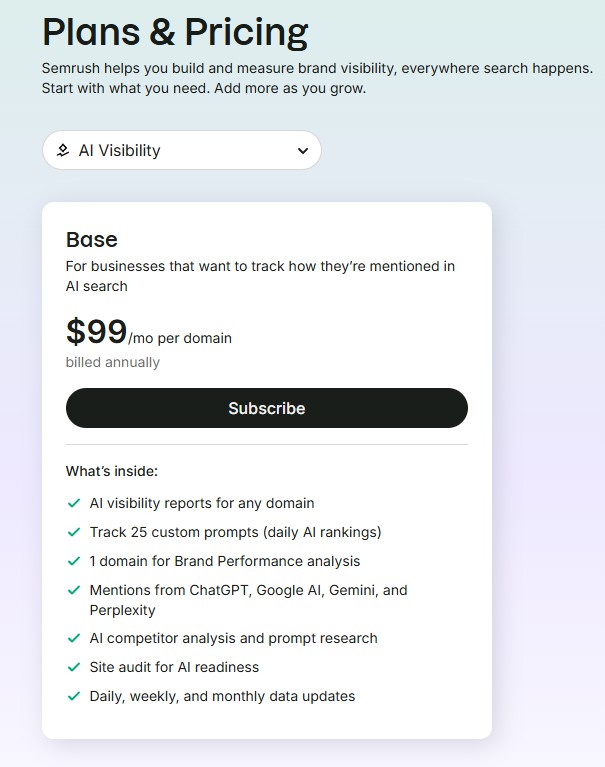
The Semrush AI Visibility Toolkit is offered as a focused add-on for businesses that want to monitor their brand in AI search. The main plan is the Base plan, which is priced at $99 per month per domain when billed annually.
This plan is built for teams that want AI visibility reports, competitor analysis, prompt research, brand performance tracking, AI prompt tracking, and AI readiness checks inside the Semrush platform.
The Base plan includes:
-
AI visibility reports for any domain
-
Tracking for 25 custom prompts with daily AI rankings
-
One domain for Brand Performance analysis
-
Brand mentions from ChatGPT, Google AI, Gemini, and Perplexity
-
AI competitor analysis and prompt research
-
Site audit for AI readiness
-
Daily, weekly, and monthly data updates
-
300 AI Analysis queries per day
For teams that need more capacity, Semrush offers add-ons that can expand the toolkit. Additional users can be added starting at $45 per month. This allows colleagues to collaborate inside the same Semrush account with individual logins.
Who Should Use Semrush AI Visibility Toolkit?
Best for Existing Semrush Users
The Semrush AI Visibility Toolkit is a strong fit for businesses already using Semrush for SEO. Existing users can keep keyword research, position tracking, site auditing, competitor analysis, and AI visibility work close together.
This can make planning easier for SEO teams. Instead of switching between several platforms for every task, they can connect their organic search research with AI search visibility data.
It is also useful for teams that want to expand their existing SEO reports. AI visibility can become another part of monthly reporting alongside traffic, keyword rankings, backlinks, conversions, and technical performance.
Best for Enterprise SEO and Content Teams
Enterprise teams often manage large websites, multiple categories, several competitors, and complex content programs. The Semrush AI Visibility Toolkit can support this work by providing a broader picture of how AI platforms mention a brand across topics.
Brand Performance, competitor analysis, AI prompt tracking, and cited source research can all support larger marketing programs. Teams can use the data to guide content briefs, editorial calendars, product messaging, digital PR, and reputation-focused campaigns.
Enterprise businesses can also benefit from combining AI visibility data with their established SEO workflow. This is useful when many departments are involved, including SEO, content, product marketing, communications, web development, and leadership.
Best for Agencies Managing AI Visibility Clients
Agencies can use the Semrush AI Visibility Toolkit to add AI search monitoring to client services. Many clients already understand Google rankings, but they may not know whether their brand appears in AI-generated answers.
The toolkit provides agencies with useful reporting areas such as AI mentions, competitor visibility, citation patterns, prompt opportunities, and brand sentiment. These insights can support SEO retainers, content strategy services, local SEO services, digital PR work, and GEO-focused campaigns.
For agencies, prompt tracking can be especially useful. They can build a list of priority prompts for each client and show how visibility changes over time.
The platform is a good option for agencies that already use Semrush as part of their daily SEO process and want to introduce AI visibility reporting without changing their whole tool stack.
Who Should Avoid Semrush AI Visibility Toolkit?
The Semrush AI Visibility Toolkit may not be the first choice for every type of user. A business that only needs a small number of AI prompt checks may prefer a simpler platform built mainly for lightweight AI monitoring.
It may also be more than necessary for people who do not need SEO research, competitor data, site audits, or broader digital marketing tools. In that case, a dedicated AI visibility platform with a lower starting price and focused workflows may be a better fit.
Small businesses should first decide whether AI search visibility is a current priority. If the business has limited content, little search traffic, or no clear product positioning, it may be useful to strengthen core website content and SEO foundations alongside AI visibility monitoring.
Semrush AI Visibility Toolkit vs Better Alternative
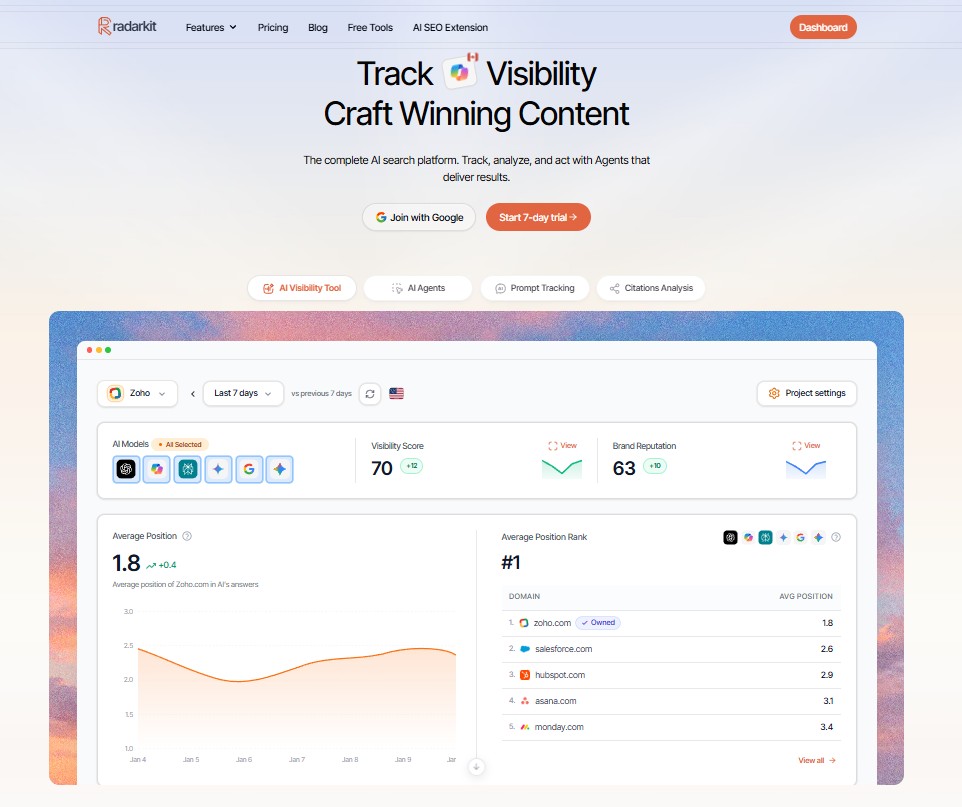
The Semrush AI Visibility Toolkit is a strong option for teams that already use Semrush for SEO. It brings AI visibility into a familiar environment and connects AI search data with keyword research, competitor analysis, site audits, and position tracking.
However, some businesses may prefer a dedicated AI visibility platform that focuses only on AI search, AI citations, and GEO execution. RadarKit AI is one of the best Semrush AI Visibility Toolkit alternatives for teams that want a lower starting price, deeper AI visibility tracking, and a workflow built specifically for AI search.
RadarKit AI is a dedicated AI visibility and GEO platform designed for brands that want to track, analyze, and improve their presence across AI search engines. It supports AI visibility tracking, citation analysis, competitor research, prompt tracking, local AI visibility, query fanout research, and GEO-focused actions.
RadarKit AI is especially useful for:
-
SaaS companies that want to monitor AI visibility across multiple AI platforms
-
Agencies that need AI visibility reporting for multiple clients
-
Local businesses that want to track AI visibility by city or region
-
Content teams that want to turn AI visibility data into concrete GEO actions
Key Features
-
AI Share of Voice: Compare your brand’s presence with competing domains to see which websites AI assistants reference most often for your tracked prompts.
-
Location-Based Tracking: Run the same prompt from 50+ countries through residential IPs. This helps you identify market-specific citations, brand mentions, competitor visibility, and variations in AI-generated results.
-
NLP and Citation-Led Content: Identify the entities, terms, facts, and information patterns used in AI-cited sources, then use those insights to create more complete content for AI search.
-
GEO Writer: Create new or refresh existing AI-search content using citation patterns, NLP terms, query fanouts, and competitor context. It can also be used when Google Search Console data is unavailable.
-
Query Fanout Tracking: See the related questions, subtopics, and follow-up queries AI platforms connect to a main prompt. This gives writers a clearer idea of the sections, entities, and information a page may need.
-
AI Traffic Monitoring: Track which AI platforms send visitors to your website, helping you separate real referral traffic from simple brand mentions or citations.
-
Shopping Radar: Monitor how your brand, products, and competitors appear in AI shopping results. Track product recommendations, retailer citations, comparison prompts, and shopping-related visibility across AI platforms.
-
Inline Citations: View the exact domains, pages, and sources AI assistants cite in their responses. This helps you understand which websites influence AI answers and identify potential citation opportunities for your brand.
-
AI Agents: Radarkit includes agents for strategy, content work, outreach, Reddit research, shopping visibility, and in-platform assistance. Each agent uses your brand kit and Radarkit data to keep tasks relevant to your visibility goals.
-
Plan Agent: Reviews Search Console and AI citation data, identifies visibility gaps, creates a strategy sheet, and routes each recommended action to the appropriate agent.
-
Outreach Agent: Finds authority websites that AI answers cite for competing brands, searches for contact details, drafts brand-aligned emails, and can send outreach through Gmail.
-
Reddit Agent: Reviews AI-cited Reddit threads in your category, identifies where competitors are discussed instead of your brand, and surfaces relevant conversations so you can assess participation opportunities.
-
Content Agent: Connects an existing article to a tracked prompt, extracts important entities, adds relevant query fanouts, and prepares an optimized version in the editor.
-
Chat Agent: Provides chat-based help inside Radarkit for day-to-day questions, research, and tasks, with monthly message limits that vary by plan.
-
MCP: Use Model Context Protocol (MCP) to connect Radarkit data and workflows with compatible AI tools. This allows teams to bring tracked prompts, citation insights, visibility data, and content recommendations into their existing AI workflows.
Radarkit Plan and Pricing
| Plan | Price | Projects | Tracked Prompts | Refresh Cycle | Locations | AI Agents | Integrations | Client Portal | Branded PDF Reports | Seats | Support |
|---|---|---|---|---|---|---|---|---|---|---|---|
| Lite | $29/month | 2 | 15 | 72-hour | 50+ | Content, Outreach, Reddit, Chat | GSC, GA, WordPress | Yes | 2 | 1 | Human support |
| Growth | $79/month | 5 | 50 | Daily | 50+ | Higher limits (19 Content articles, 20 Outreach/Reddit credits, 25 Chat messages) | GSC, GA, WordPress | Yes | 10 | 3 (1 + 2 extra) | Human support |
| Pro | $139/month | 10 | 100 | Daily | 50+ | Even higher limits (32 Content articles, 40 Outreach/Reddit credits, 50 Chat messages) | GSC, GA, WordPress | Yes | 20 | 6 (1 + 5 extra) | Priority support |
| Enterprise | Custom (annual) | Unlimited | Custom | Custom | 70+ | Custom agent limits | API access, SSO, custom integrations | Yes | Custom | Unlimited | Dedicated manager, priority support, custom contract terms |
Final Verdict: Should You Buy Semrush AI Visibility Toolkit?
The Semrush AI Visibility Toolkit is a useful platform for businesses that want to understand how their brand appears in AI-generated answers. It brings together AI visibility scoring, competitor research, prompt discovery, citation analysis, brand performance, prompt tracking, and AI technical checks.
The platform is particularly valuable for existing Semrush users. It adds AI search monitoring to a familiar SEO workflow and helps teams connect AI visibility with content planning, competitor research, technical SEO, and ongoing performance tracking.
The Semrush AI Visibility Toolkit is also a good choice for agencies and larger SEO teams that want a more complete view of how brands show up across AI platforms. The ability to research prompts, review citation sources, study competitors, and monitor brand perception gives the platform practical value beyond simple mention tracking.
For smaller businesses or teams focused only on AI visibility, dedicated alternatives may offer a more focused starting point. Still, the Semrush AI Visibility Toolkit remains a capable choice for brands that want to include AI search in their broader SEO strategy.
FAQs: Semrush AI Visibility Toolkit Review
What is Semrush AI Visibility Toolkit?
Semrush AI Visibility Toolkit is an AI search monitoring platform that helps businesses track brand mentions, citations, competitors, prompts, sentiment, and AI visibility across major AI search platforms.
Does Semrush track ChatGPT visibility?
Yes, the Semrush AI Visibility Toolkit can track brand visibility related to ChatGPT. It helps users see whether their brand appears in relevant AI-generated responses and supports prompt tracking for selected terms.
Can Semrush track Google AI Overviews?
Yes, Semrush can monitor visibility connected with Google AI Overviews. This helps users understand whether their brand or website appears in AI-generated results related to relevant topics and prompts.
Does Semrush show which websites AI platforms cite?
Yes, the Semrush AI Visibility Toolkit can show cited sources and cited pages connected with AI-generated answers. This helps businesses study the websites, pages, and information sources that appear around relevant AI topics.
What is the Semrush AI Visibility Score?
The Semrush AI Visibility Score is a metric that measures how visible a brand is in AI-generated answers compared with competitors. It considers factors such as topic coverage and how consistently the brand appears across relevant AI topics.
Is Semrush AI Visibility Toolkit included in a regular Semrush subscription?
The Semrush AI Visibility Toolkit can be available as a separate paid toolkit or as part of selected Semrush bundles. The available features, prompt limits, and AI reporting access can vary depending on the subscription type.
How much does Semrush AI Visibility Toolkit cost?
The Semrush AI Visibility Toolkit has been listed from $99 per month per domain when billed annually. Additional costs may apply for extra domains, more tracked prompts, or expanded plan limits.