AI assistants like ChatGPT, Gemini, Claude, and Perplexity are quickly becoming the new front door for discovery, which makes AI search visibility and finding the best Wellows alternatives just as important as traditional SEO.
Wellows helps brands track how they show up in these AI-generated answers, but it is not the only option, and it may not be the best fit for every budget, workflow, or use case.
In this guide, you will explore the best 5 Wellows Alternatives, see how they differ in pricing and capabilities, and learn how to choose the right AI visibility stack for your team.
Quick Pick Criteria
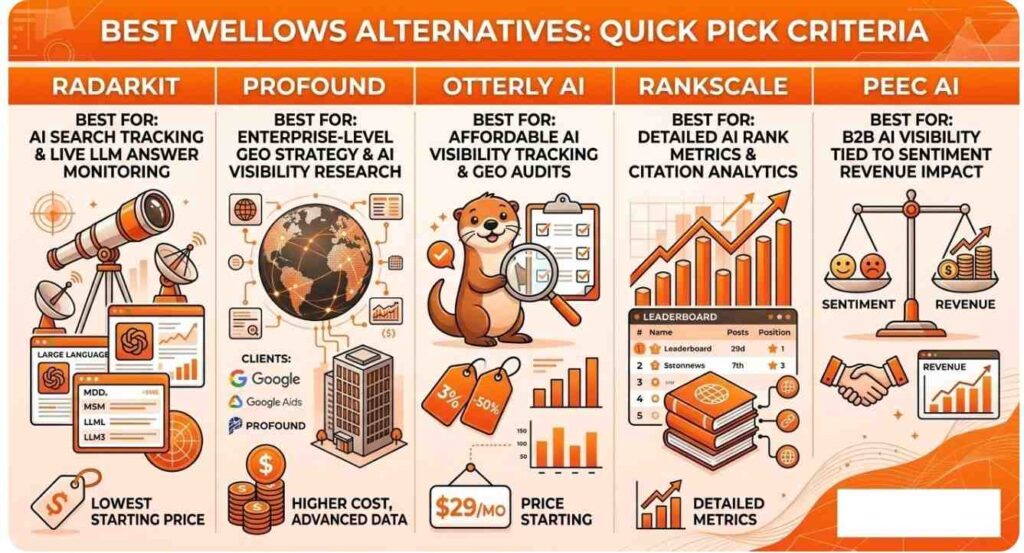
- RadarKit – Best for AI search tracking and live LLM answer monitoring.
- Profound – Best for enterprise‑level GEO strategy and AI visibility research.
- Otterly AI – Best for affordable AI visibility tracking and GEO audits.
- Rankscale – Best for detailed AI rank metrics and citation analytics.
- Peec AI – Best for B2B AI visibility tied to sentiment and revenue impact.
Quick Comparison Table of 5 Wellow Alternatives
| Tool | Best for | Pricing (entry) | Core Capabilities |
|---|---|---|---|
| RadarKit | AI search tracking and GEO content actions | From $29/month | Live AI assistant tracking, multi‑location prompts, citation data, competitor monitoring, AI traffic analytics, AI‑assisted content. |
| Profound | Enterprise GEO intelligence and AI demand data | From $399/month | Large‑scale AI visibility data, prompt volumes, Profound Index, enterprise GEO workflows, shopping and vertical analysis. |
| Otterly AI | Affordable AI visibility and GEO audits | From$29/month | AI search monitoring, multi‑engine tracking, share of voice, visibility index, GEO audit reports, citation insights. |
| Rankscale | Detailed AI rank metrics and citation analytics | From €20/month | AI visibility dashboards, visibility score, average position, page/domain citations, competitor monitoring, web audits, exports. |
| Peec AI | B2B AI visibility tied to revenue and sentiment | From $89/month | AI search analytics, prompt‑level visibility, sentiment and narrative analysis, revenue and pipeline reporting, GEO playbooks. |
What is Wellows and Why Seek its Alternatives?
Wellows AI is an AI-powered visibility platform that helps businesses track how their brand is mentioned, cited, and perceived across AI search engines and large language models like ChatGPT, Gemini, Perplexity, Google AI Overviews, and AI Mode.
It monitors AI visibility scores, citations (explicit and implicit), and sentiment so teams can understand how generative engines describe their brand and where competitors are winning instead.
Using this data, marketers and SEO teams can optimize content and outreach for generative engine optimization (GEO) and improve their presence in AI-generated answers.
However, despite these capabilities, some users may still seek alternatives to Wellows due to budget constraints, limits on tracked prompts or engines, or the need for broader features such as full-service SEO suites, content production at scale, or different UX preferences, which can prompt teams to evaluate other tools.
Others may prioritize direct content-generation platforms such as ChatGPT, Gemini, or Claude, or want specialized GEO/AI visibility tools with different pricing, integrations, or reporting styles.
Best 5 Wellows Alternatives
Radarkit
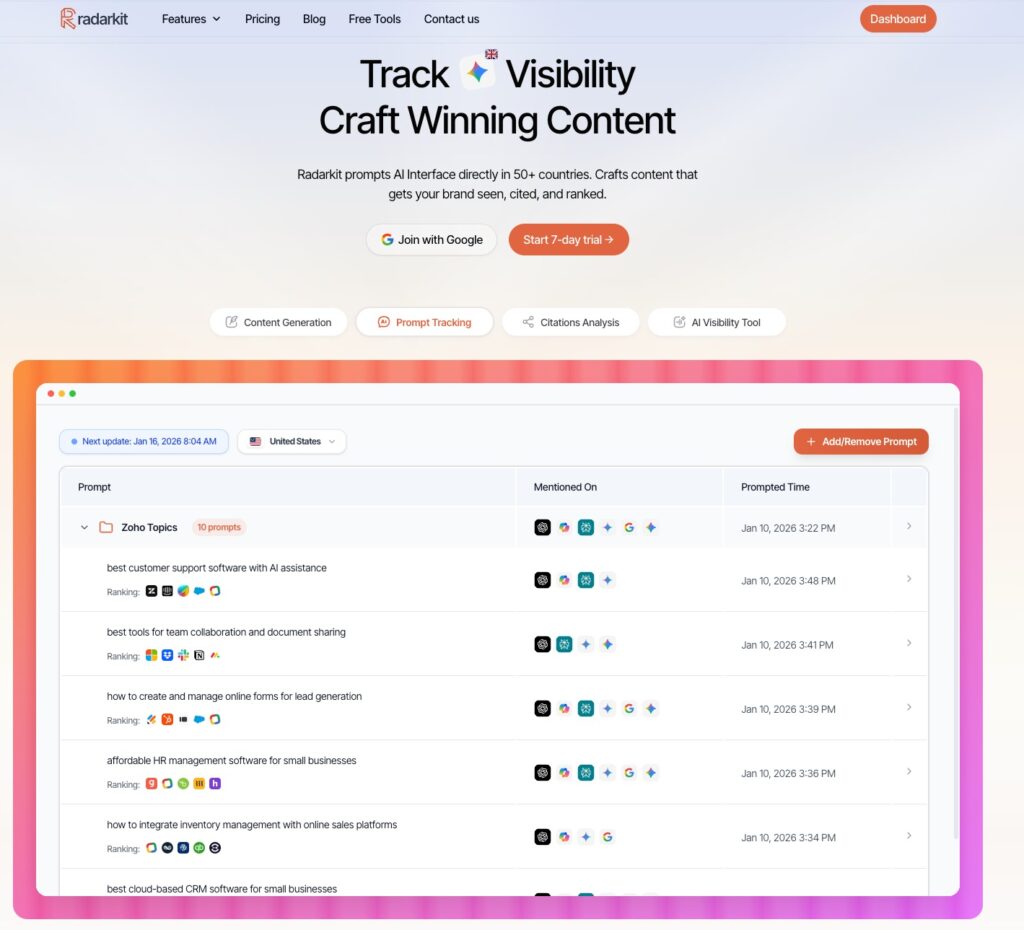
RadarKit stands out as one of the most powerful Wellows Alternatives, especially for businesses focused on mastering AI search visibility.
This AI-driven tool prompts real chat interfaces like ChatGPT, Gemini, Perplexity, Google AI Overviews, Microsoft Copilot, and others using live browser sessions, emulating real user interactions to show how assistants actually describe your brand.
It tracks prompts and brand mentions across models and locations, then surfaces actionable insights that feel like an “AI rank tracker for answers and sources” rather than traditional blue-link positions.
RadarKit offers a 7‑day free trial and starter pricing from around $29 per month, making it accessible for solo marketers, agencies, and growing brands that want to start measuring AI visibility without a big upfront commitment.
It goes beyond simple brand checks by capturing full answers, page-level citations, and competitor visibility, so teams can see who owns the conversation within AI-generated responses and where they are losing ground.
By highlighting the sources and pages that win citations, RadarKit helps marketers prioritize the exact URLs and topics that need content, technical, or link improvements to strengthen AI search performance.
When connected with tools like GA4, brands can compare visibility data against traffic and conversions to understand which AI exposure lines up with real business outcomes.
Radarkit Standout Features
Radarkit.ai (part of the Alpha startup at Web Summit Qatar) is the best AI search tracker in the market right now.
What makes Radarkit different is its accuracy and the fact that it uses real browser tracking rather than APIs to deliver AI responses from 40+ countries.
- AI Share of Voice: Identify exactly which sites AI Chatbots trust most for your query vs. competitors
- Location-Based Tracking: Simulate real-time queries from 40+ countries using residential proxies to catch local citations and geo-specific data
- NLP & Fact-Based Content: Create content using the specific NLP terms and entities found in most cited sources to rank in AI search engines
- 1-Click GEO Content Writer: Generates optimized content that ranks in LLMs in 5 minutes without needing Google Search Console
- Query Fanouts Tracking: Tracks how AI models break one question into multiple angles and turn them into content sections
- AI Traffic Monitoring: See which AI platforms (ChatGPT, Perplexity, Gemini, Copilot) send actual visitors to your site
Why It’s a Good Fit
- Strong focus on LLM visibility across multiple assistants (ChatGPT, Gemini, Perplexity, AI Overviews, Copilot), similar to Wellows’ multi-engine coverage.
- Uses real browser sessions and live prompts, which makes results feel close to what actual users see in chat interfaces.
- Captures full answers and citations at the page level, helping you understand which URLs and competitors are winning in AI-generated responses.
- Lower starting price and a 7‑day free trial make it easier to test alongside or instead of Wellows, especially for smaller teams.
Limitations of Radarkit
- Focuses heavily on tracking and analysis; it does not yet offer as deep in‑platform content workflows and campaign-style outreach as some broader GEO/SEO platforms.
- Reporting is focused on AI visibility and citations, rather than a full SEO suite that includes keyword research, technical audits, and a link-building CRM.
- Requires connecting external analytics tools, such as GA4, to tie AI visibility to traffic and conversions, which adds a setup step for some teams.
Profound
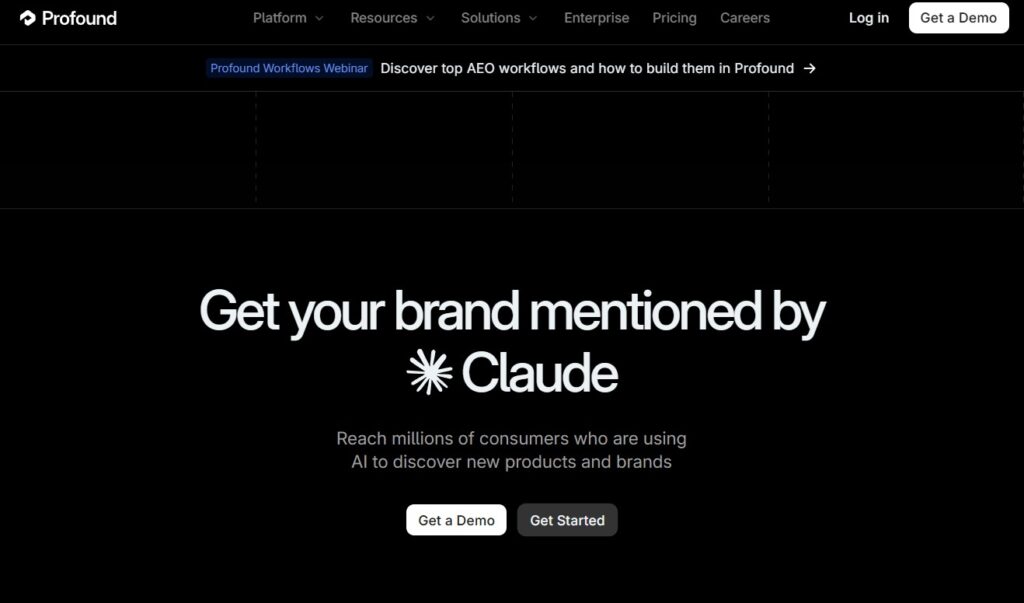
Profound represents another one of compelling Wellows Alternatives, offering an enterprise-grade GenAI marketing intelligence platform focused on AI visibility and generative engine optimization rather than traditional web search.
While Wellows helps brands track citations, sentiment, and visibility across AI assistants, Profound goes deeper by analyzing how often brands, products, and topics appear in AI-generated responses and conversations across platforms such as ChatGPT, Google AI Overviews, Perplexity, Gemini, Claude, and others.
Its models process millions of prompts, citations, and crawler visits to reveal AI search demand, conversation patterns, and competitive gaps that shape how buyers discover brands in the zero-click, AI-first world.
The platform’s strength lies in its ability to aggregate and synthesize AI interaction data at scale, from prompt volumes and conversation topics to brand visibility scores and sentiment, giving marketing and SEO teams a comprehensive view of how they show up across the GenAI ecosystem.
Profound adds workflow features on top of this intelligence, such as AI search marketing workflows, content briefs, and optimization tools that help teams turn insights into GEO-focused content and campaigns.
With plans starting in the high three to four figures per month and no free trial, it is priced for serious growth-stage and enterprise brands, but the depth of its data and advanced analytics makes it a strong investment for organizations that want to lead in AI-driven discovery.
Why It’s a Good Fit
- Deep, enterprise-focused AI visibility analytics across many AI assistants, with robust tracking of prompts, visibility scores, citations, and sentiment.
- Powerful datasets like Prompt Volumes and the Profound Index reveal real AI search demand and how often brands appear in conversations, going beyond simple brand checks.
- Built-in workflows and AI content capabilities help teams act on insights, from researching winning pages to creating and optimizing content for AI engines.
- Proven adoption among large brands and enterprise marketing teams that want strategic guidance for AI-first marketing and GEO.
Limitations of Profound
- Premium pricing with no free plan and no typical “quick trial,” which can make it less accessible for small teams or early-stage startups compared to tools like Wellows or RadarKit.
- Designed primarily for enterprise use cases, so the platform can feel complex if you only need light tracking or a simple GEO snapshot.
- Focuses on AI visibility and GEO workflows rather than providing a full traditional SEO stack (technical audits, classic keyword rank tracking, link-building CRM), so many teams will still pair it with other SEO tools.
Otterly AI
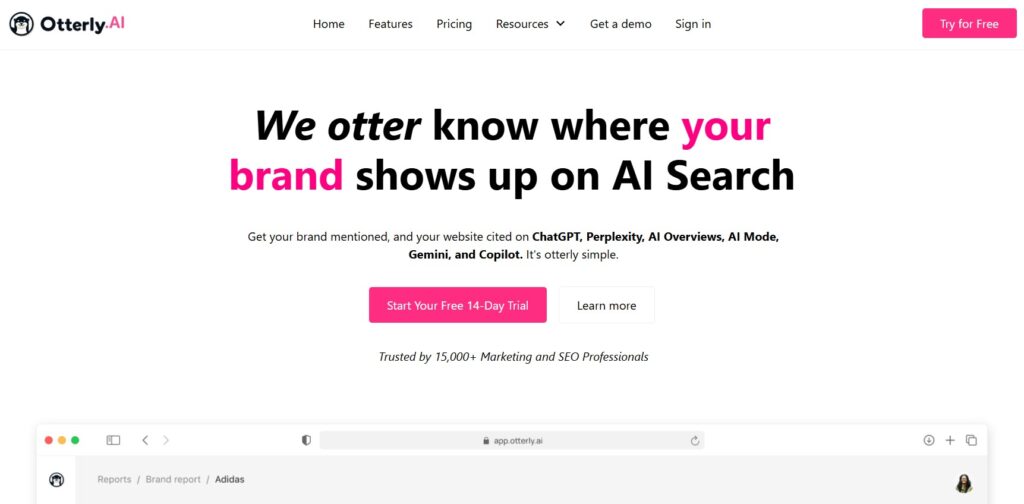
Unlike Wellows, which blends AI visibility with sentiment tracking and outreach-style workflows, Otterly AI is built as a dedicated AI visibility toolkit that automatically runs defined search prompts across platforms like ChatGPT, Perplexity, Google AI Overviews, Google AI Mode, Gemini, and Microsoft Copilot.
It then analyzes brand mentions, competitor mentions, citations, and sentiment, organizing the results into structured Brand Reports and GEO audits that show how your brand is represented in AI-generated responses.
This tool is particularly useful for companies that want an accessible, visibility-first GEO solution with clear metrics such as share of voice, average brand position, brand coverage, domain citations, and a Brand Visibility Index they can track over time.
Otterly AI also includes a GEO Audit tool and AI keyword research features that translate monitoring data into concrete optimization checklists, helping teams understand why they are not cited and what to improve in their content and technical setup.
With a Lite plan starting around $29 per month and a generous free option, Otterly AI is one of the most budget-friendly ways to start tracking AI visibility and applying generative engine optimization in day-to-day SEO workflows.
Why It’s a Good Fit
- Designed specifically as an AI search monitoring and GEO platform, with automated tracking across multiple AI assistants (ChatGPT, Perplexity, AI Overviews, AI Mode, Gemini, Copilot) in one dashboard.
- Clear, standardized metrics (share of voice, visibility index, domain citations, brand coverage) make it easy to benchmark your brand and competitors across prompts and countries.
- GEO Audit and citation intelligence reports turn raw monitoring into practical checklists and opportunities, so teams know which pages and signals to improve for better AI citations.
- Lower starting price and a free tier make it appealing for startups and smaller agencies that find Wellows or enterprise tools out of budget.
Limitations of Otterly AI
- Focuses on monitoring, audits, and GEO checks; it does not function as a full-fledged AI content-writing suite, so teams still need separate tools for content production at scale.
- While the GEO Audit offers strong diagnostics, it often assumes users can implement fixes themselves, which may feel light on hand-holding for non-technical marketers.
- Reporting centers on AI visibility rather than offering a complete SEO stack (technical SEO, classic SERP rank tracking, deep link management), so many teams pair it with traditional SEO platforms
Rankscale
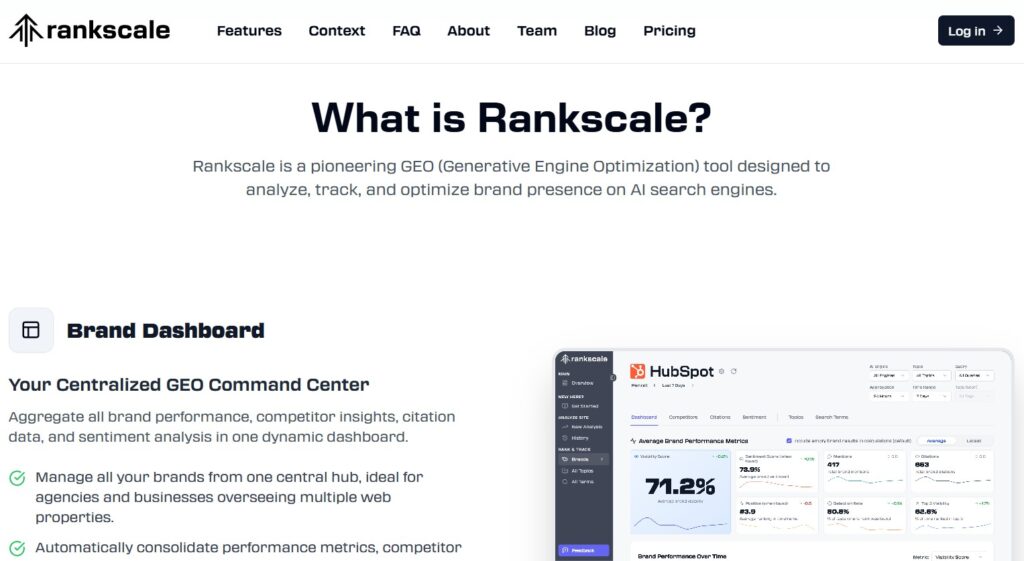
Rankscale offers a specialized Wellows Alternatives for teams that want to track and improve visibility in AI search engines rather than just classic SERP rankings.
Instead of focusing on generic web sentiment or traditional keyword rankings, Rankscale measures how often your brand, pages, and competitors appear in AI-generated answers across assistants like ChatGPT, Claude, Perplexity, Google AI Overviews, Gemini, and others.
It provides AI rank-tracking style KPIs such as Visibility Score, Average Position, page-level citation counts, sentiment, and share-of-model analytics so you can see exactly where you stand inside AI responses.
The platform’s strength lies in its detailed analytics and dashboarding for AI visibility: it offers brand dashboards, performance tracking by topic and engine, citation analysis at page and domain level, competitor benchmarking, and options like Looker Studio integration for deeper BI reporting.
Rankscale is positioned as an affordable, data-heavy GEO tool, with pricing starting around €20 per month and scaling with usage, making it attractive for agencies, in‑house SEO teams, and brands that want to measure AI search performance without committing to enterprise-level pricing.
While Wellows leans more into workflows, outreach, and combined sentiment/visibility, Rankscale focuses on monitoring and analytics, giving you numbers and trends you can plug into your existing SEO and content workflows.
Why It’s a Good Fit
- Strong AI visibility and AI rank-tracking focus, with clear KPIs like Visibility Score, Average Position, and share-of-model that mirror what SEOs expect from rank trackers.
- Page-level citation tracking and sentiment views help you see which URLs are being cited in AI answers and how assistants describe your brand.
- Multi-engine coverage (ChatGPT, Claude, Perplexity, AI Overviews, Gemini, and more) makes it comparable to Wellows’ cross-engine visibility approach.
- Budget-friendly entry pricing and features like public dashboard sharing and Looker Studio integration make it appealing for agencies and teams that want flexible reporting.
Limitations of Rankscale
- Primarily focused on monitoring and analytics, it does not provide deep in‑platform content ideation, writing, or outreach workflows, so you will typically pair it with separate SEO/content tools.
- Emphasizes visibility metrics and sentiment more than technical SEO audits (site health, crawl errors, detailed on-page checks), which traditional SEO suites cover better.
- Some reviewers note that insights can require manual interpretation and external processes to turn visibility gaps into concrete content or link actions.
Peec AI
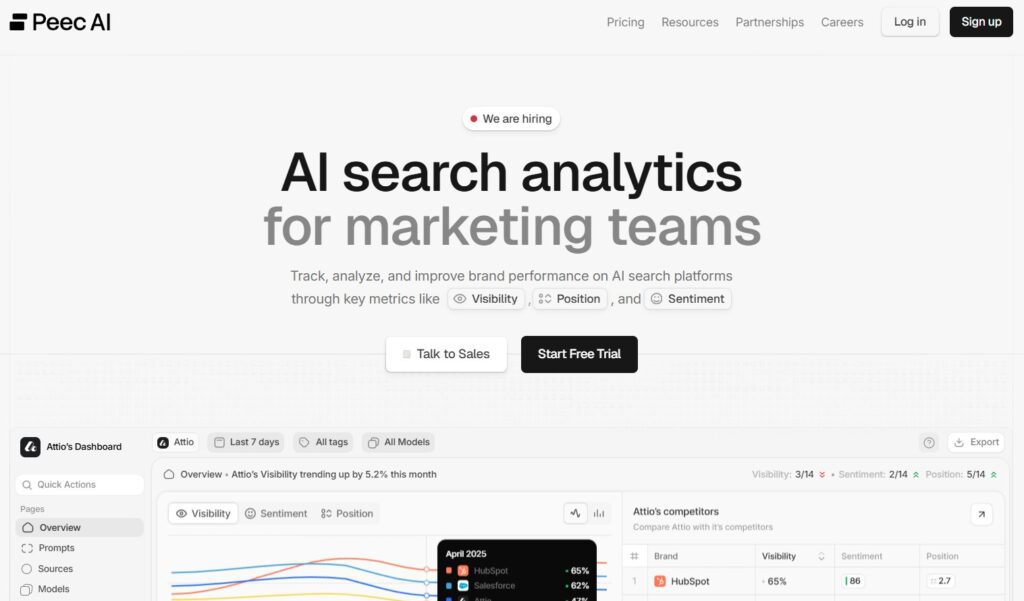
While Wellows alternatives focus on AI visibility, citations, and outreach workflows, Peec AI zeroes in on how often your brand is mentioned in AI-generated answers across platforms like ChatGPT, Perplexity, Google AI Overviews, Gemini, and Claude, and what tone those answers use.
It lets you track prompt-level visibility, competitive share of voice, source URLs, and sentiment so you can understand both how visible you are in AI search and how AI systems frame your brand.
Instead of working at the level of individual customer profiles, Peec AI analyzes AI search behavior and answer patterns: you define buyer-style prompts, Peec runs them across multiple AI platforms, and then aggregates results into visibility percentages, citation patterns, and sentiment trends.
Its dashboards and GEO playbooks help teams connect AI visibility with revenue metrics by segmenting LLM traffic in analytics and tracking how visibility and sentiment shifts impact pipeline and deals over time.
Pricing starts around €89 per month on the Starter plan (with a free trial) and scales with the number of tracked prompts, making it a mid-to-upper tier option aimed at B2B marketing leaders, CMOs, and growth teams.
Why It’s a Good Fit
- Built specifically for AI search visibility and GEO, with strong coverage of ChatGPT, Perplexity, Google AI Overviews, Gemini, Claude, and more.
- Excellent prompt-level workflows for competitive benchmarking, showing visibility percentage, share of voice, and which competitors win for each buyer-intent question.
- Deep source and citation analysis (domain and URL level, owned vs competitor, editorial vs UGC vs reference, etc.) turns monitoring into concrete targeting for PR, content, and link building.
- Heavy emphasis on sentiment and narrative analysis in AI answers, which aligns closely with Wellows’ brand-perception angle while still giving advanced GEO guidance.
Limitations of Peec AI
- Geared toward B2B and enterprise marketing teams, pricing and depth can be overkill for very small businesses that just want lightweight monitoring.
- Focuses on AI search analytics and GEO strategy rather than 1:1 customer journey personalization or full traditional SEO (technical audits, classic SERP rank tracking).
- Requires thoughtful prompt design and ongoing GEO processes; teams looking for a “set and forget” visibility snapshot may find the strategic workflows more involved than simpler tools.
How To Choose the Best Wellows Alternatives
Start With Your Needs and Pain Points
Begin by listing what you liked and disliked about Wellows: AI platform coverage, sentiment accuracy, reporting depth, or pricing.
Clarifying these pain points will show whether you need a lighter, cheaper Wellows Alternatives, a deeper enterprise platform, or a broader SEO suite that goes beyond AI visibility.
Align Features With Your Budget
Set a realistic budget, then shortlist tools that deliver the AI visibility, GEO, and reporting features you actually need at that price point. Check how plans scale with tracked prompts, AI engines, domains, and users so you do not outgrow the platform too quickly.
Match the Tool to Your Skill Level
Consider your technical expertise and internal resources. Some Wellows alternatives feel like plug‑and‑play dashboards, while others assume you have analysts or SEO specialists who can interpret complex GEO and visibility data.
Evaluate Support and Onboarding
Look closely at the quality of customer support: onboarding calls, documentation, office hours, and response times. Responsive, knowledgeable support is especially important with Wellows Alternatives, where best practices and workflows are still evolving.
Check AI Model and Platform Coverage
Make sure the alternative tracks the AI platforms that matter most to you, such as ChatGPT, Gemini, Claude, Perplexity, Google AI Overviews, and AI Mode. Ask whether they use current models, how often they refresh runs, and whether you get model‑by‑model reporting for side‑by‑side comparison.
Define Your Reporting and Analysis Requirements
Decide what level of reporting you actually need from an AI-driven solution. For example, your team might prioritize in‑depth sentiment analysis, competitive brand tracking across AI platforms, or detailed SEO and GEO diagnostics tied to content and entities.
Review Case Studies, Results, and Integrations
Study case studies, testimonials, and independent reviews to see how each platform has helped other businesses improve visibility, traffic, or revenue. Also, check integrations with your existing stack, analytics, CRM, SEO tools, and reporting platforms, so data flows into the systems you already use.
Map to Your Channels and GEO Use Cases
If social, PR, or content marketing are core to your strategy, confirm that Wellows Alternatives can track the channels and surfaces that matter (AI assistants, search overviews, and, where relevant, social or web mentions).
For GEO-focused use cases, look for features like citation tracking, answer snapshots, entity and content analysis, and recommendations that map directly to content or schema updates.
Always Ask for a Demo or Trial
Before committing, request a live demo or trial so you can see actual prompts, dashboards, and reports using scenarios close to your own. Use that session to test workflows, ask about methodology, and confirm the platform can answer the exact AI visibility and GEO questions your team cares about.
FAQs: Wellow Alternatives
Which Wellows alternatives is best for hands-on AI search tracking?
For teams that want to actually see live AI answers and track how visibility changes across prompts, locations, and engines, one of the best options is a tool that runs real browser-based tests in ChatGPT, Perplexity, Gemini, and Google AI Overviews, then turns those answers into GEO insights and content actions.
This is exactly where Radarkit stands out; it combines multi-engine coverage, location controls, and page-level citation analysis with accessible pricing, making it ideal if you want a practical, “SEO-style rank tracker” for AI responses rather than an abstract analytics-only platform.
Are there budget-friendly Wellows alternatives for smaller teams?
Yes, several AI visibility tools now offer entry plans around the $20–$30 per month mark or even free tiers, which can be a better fit for startups, solo SEOs, and small agencies. Look for platforms that still give you multi-engine tracking and basic share-of-voice or visibility scores at lower tiers, so you don’t sacrifice core GEO value just to save on cost.
Which alternative is best if I care about turning AI visibility into content actions quickly?
If your priority is using AI visibility data to directly drive new briefs, content updates, and optimization sprints, choose a platform built with SEOs in mind that surfaces answer snapshots, citations, and gaps and then feeds those into practical GEO-ready task lists.
Radarkit is particularly strong here because it pairs monitoring with content-oriented insights without the complexity or price of heavier enterprise suites. This kind of tool helps you move from “we know our visibility is low” to “here are the exact pages, entities, and prompts we should fix next” in a way that plugs nicely into existing SEO workflows.
Do I need a full SEO suite or a dedicated AI visibility tool?
If you mainly need technical SEO audits, backlink analysis, and classic rank tracking, a full SEO suite may be enough, and you can combine it with light GEO checks.
But if your strategy revolves around winning citations and positive coverage inside AI answers, a dedicated AI visibility platform with strong GEO features like cross-engine prompt tracking, citation source analysis, and sentiment will give you more precise, actionable insights than a general SEO tool alone.
Conclusion
Wellows is a strong AI visibility platform, but Wellows alternatives like RadarKit, Profound, Otterly AI, Rankscale, and Peec AI may fit better depending on your goals, budget, and workflows.
RadarKit is ideal for hands‑on AI search tracking, Profound targets enterprise‑level GEO intelligence, Otterly AI focuses on accessible AI visibility and GEO audits, Rankscale excels at detailed AI rank-style analytics, and Peec AI connects AI visibility with sentiment and revenue-focused KPIs.
Compare features, pricing, reporting, and integrations, then use demos or free trials to see which tool aligns best with your team’s skills and visibility strategy. With the right AI visibility stack, you can systematically improve how AI assistants talk about your brand and turn that presence into measurable business growth.