

WriterZen alternatives are in high demand because agencies and content teams want better results without being locked into a single workflow.
WriterZen is still a solid SEO content platform, especially for topic discovery and keyword research, but SEO is moving fast, and different teams need different strengths from their stack.
This guide breaks down the best WriterZen alternatives for SEO content optimization, focusing on features, ease of use, and how reliable the data is when you are making content decisions.
You will see tools that match WriterZen’s core workflow, such as SERP-based topic discovery, keyword clustering, and content planning, along with options that go further with deeper optimization, stronger competitor intelligence, or more modern AI-driven workflows.
The goal is simple. Pick the tool that fits your process, helps you create better content faster, and improves your chances of ranking in competitive search results.
Quick Pick Criteria
- Radarkit.ai: Best overall for Agencies and Content Teams.
- Surfer SEO: Best for polishing drafts with a strict, SERP-based content score in the editor.
- Frase: Best for building SEO briefs and outlines fast from competitor SERPs.
- Clearscope: Best for quick content refreshes using clean keyword and topic coverage guidance.
- MarketMuse: Best for planning a site-wide topical authority strategy, not just one article.
- Scalenut: Best for generating long-form SEO blog drafts quickly with guided AI workflows.
- NeuronWriter: Best for affordable on-page optimization with competitor term suggestions.
- Semrush SEO Writing Assistant: Best for real-time readability, tone, and originality checks while you write.
- Ahrefs: Best for finding keywords and link opportunities using deep competitor backlink data.
- Outranking: Best for turning detailed SEO briefs into publish-ready drafts with AI assistance.
Quick Comparison Table of WriterZen Alternatives
| Tool | Best for | Price (starting) | Engine covered | Features |
|---|---|---|---|---|
| Radarkit.ai | Best overall for Agencies and Content Teams. | $29/month (Lite) | ChatGPT, Perplexity, Gemini, Copilot, Google AI surfaces | AI visibility tracking, citation insights, competitor share of voice, GEO Writer, 50+ countries |
| Surfer SEO | Best for in-editor on-page optimization and content scoring | From $79/mo | Google (SERP-based) | Content Editor, audits, keyword guidance, content scoring |
| Frase | Best for fast SERP-based briefs and outlines | $98/mo | Google (SERP-based) | Content briefs, topic gaps, content editor, AI writing |
| Clearscope | Best for clean content grading and refresh workflows | From $129/mo | Google (SERP-based) | Content grading, term suggestions, optimization editor |
| MarketMuse | Best for topical authority and site-wide content planning | From ~$149/mo | Google (SERP-based) | Topic authority, inventory analysis, Optimize/Compete/Research apps, briefs |
| Scalenut | Best for scaling long-form SEO drafts with AI workflows | $59/month | Google (SERP-based) | AI writer, Cruise Mode, keyword planning, content optimization |
| NeuronWriter | Best for budget-friendly SEO optimization (often via lifetime deal) | From $19/mo | Google (SERP-based) | SERP analysis, NLP terms, content scoring, AI writing |
| Semrush SEO Writing Assistant | Best for real-time SEO, tone, and readability checks in WordPress | Included with Semrush plans ($199/mo) | Google (SERP-based) | Readability, recommended keywords, tone of voice, plagiarism check, and overall score |
| Ahrefs | Best for deep keyword and backlink research | $129/month (Lite) | Google (SERP-based) | Keywords Explorer, Site Explorer, backlink analysis, Site Audit |
| Outranking | Best for SEO briefs plus AI-assisted long-form drafts | $ 79/mo | Google (SERP-based) | SEO content briefs, AI writing, optimization workflow |
What we looked at in WriterZen Alternatives (and why it matters)
When evaluating WriterZen alternatives, we focused on the factors that most directly affect day‑to‑day workflow and real SEO outcomes.
Because WriterZen itself is built around an end-to-end flow from keyword research and topic discovery to planning and writing.
In-depth Keyword Research and Competitor Analysis
We prioritized WriterZen alternatives that can uncover low-competition opportunities, map SERP intent, and show what’s already working for competitors, so content decisions are based on evidence—not guesswork.
Generative AI for Drafting and Optimization
We looked for practical AI features that speed up briefs, outlines, and drafts while still keeping the content aligned with real SERP patterns and topical coverage.
UI and Ease of Use
A cleaner interface matters because it lowers the learning curve for writers and editors, reduces time spent switching tools, and helps teams publish consistently.
Data Quality andReliability
We weighed WriterZen alternatives that provide stable, explainable metrics (keyword difficulty, SERP/competitor benchmarks, optimization guidance), since accurate data is the foundation for making the right calls in SEO.
The goal was to shortlist tools that can genuinely replace WriterZen’s core value—or beat it in specific areas, such as deeper optimization, broader SEO intelligence, or faster AI-assisted production.
10 Best Writerzen Alternatives for Agencies and Content Teams
Here are the 10 best Writerzen Alternatives for Agencies and Content Teams.
Radarkit
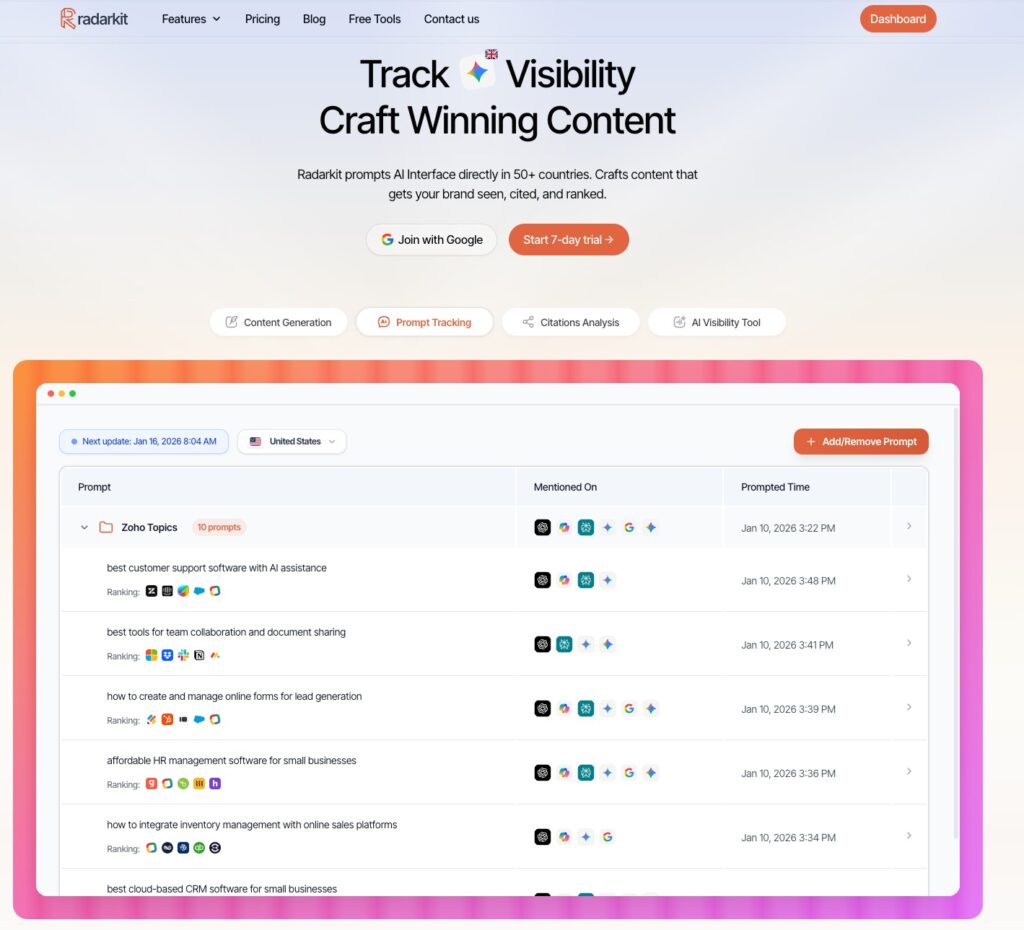
Radarkit stands out among WriterZen alternatives as an AI/LLM visibility tracker and AI search analytics tool, giving you deep insight into how your brand shows up across major AI assistants like ChatGPT, Perplexity, Gemini, Microsoft Copilot, and Google AI surfaces.
What really rounds out Radarkit as a WriterZen alternative is its new GEO Writer, which turns all that AI and SERP data into actionable content drafts.
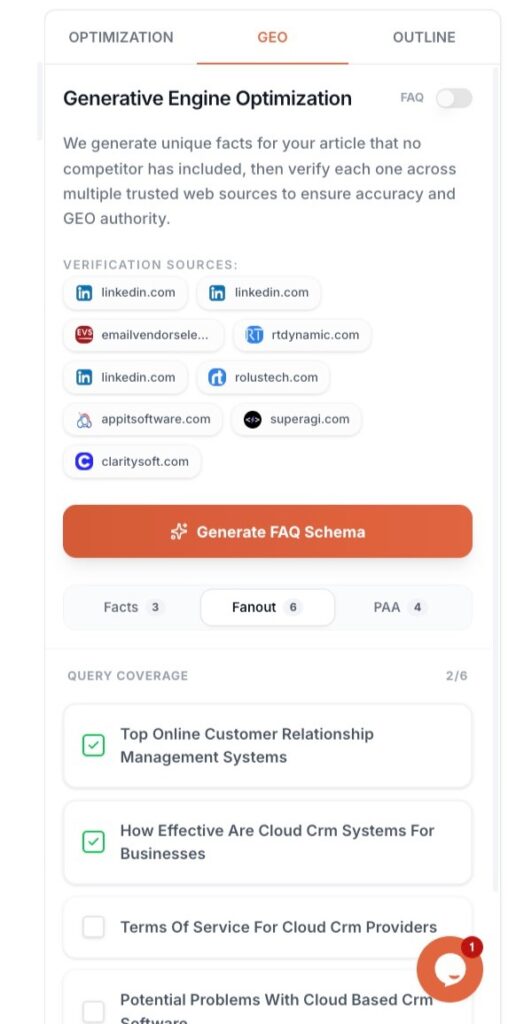
Instead of writing in a vacuum, GEO Writer pulls in Google SERP results, AI citation data, and query fanout insights, then uses NLP to generate articles packed with the facts, PAAs, and semantic terms competitors already win with, so your content is pre-optimized for both traditional search and LLM answers.
This makes it especially useful if you still want WriterZen-style content production but also care about crafting GEO‑friendly pages that AI assistants are more likely to read, understand, and cite.
Instead of focusing on classic keyword positions in Google, Radarkit tracks how often your brand is mentioned, which pages get cited, and what those answers actually say about you across AI ecosystems.
It lets you monitor a brand’s presence across major AI assistants, track target keywords, and see how your domain performs for those keywords in AI-generated answers, complete with visibility scores, sentiment, and competitor share‑of‑voice leaderboards.
If you’re trying to get your brand mentioned by AI, Radarkit helps you track current visibility, spot gaps, and then optimize your AI SEO strategy using its citation insights and “link opportunity” reports that highlight the most cited sources you should target for outreach.
Radarkit also offers entry‑level pricing with a 7‑day trial, so you can test its tracking and analytics before fully committing.
Where it improves on WriterZen (Pros)
- Stronger AI/LLM visibility tracking (mentions, citations, share of voice) across assistants, which WriterZen isn’t primarily built for.
- GEO execution layer (e.g., GEO Writer + free GEO utilities like the LLMs.txt validator), so you can go from “insight” to “publish/update” faster.
Cons
- Less of a classic “keyword research + clustering” suite compared to WriterZen’s Topic Discovery/Keyword tools, so you may still need a traditional SEO research tool alongside it.
Surfer SEO

Surfer SEO presents a robust suite of features aimed at enhancing content quality and improving search visibility, making it a compelling alternative to WriterZen if your focus is on on-page optimization.
Its keyword research, SERP Analyzer, and Content Planner help you uncover high-potential keywords, understand how competitive a query is, and plan topics around what already works in your niche.
The standout, though, is the Content Editor, which gives real-time, data-backed recommendations on word count, structure, semantic terms, and internal links so you can align your drafts with what currently ranks.
I’ve found its competitor analysis and auditing tools especially useful when you want to refresh existing content instead of starting from scratch.
Surfer breaks down the top pages for your target keyword, shows how your content compares, and then suggests concrete adjustments for keyword usage, headings, and depth, which simplifies optimization into a clear checklist.
If you’re aiming for high-quality, data-driven SEO results and want stronger guidance inside the editor itself, Surfer SEO is one of the strongest WriterZen alternatives to consider.
Where it improves on WriterZen (Pros)
- Deeper, more specialized on-page optimization workflow (semantic terms, content scoring, SERP benchmarking) inside the Content Editor.
Cons
- More focused on optimization than full end-to-end topic discovery + keyword clustering workflows, so it may not replace WriterZen’s planning/research stack for some teams.
Frase
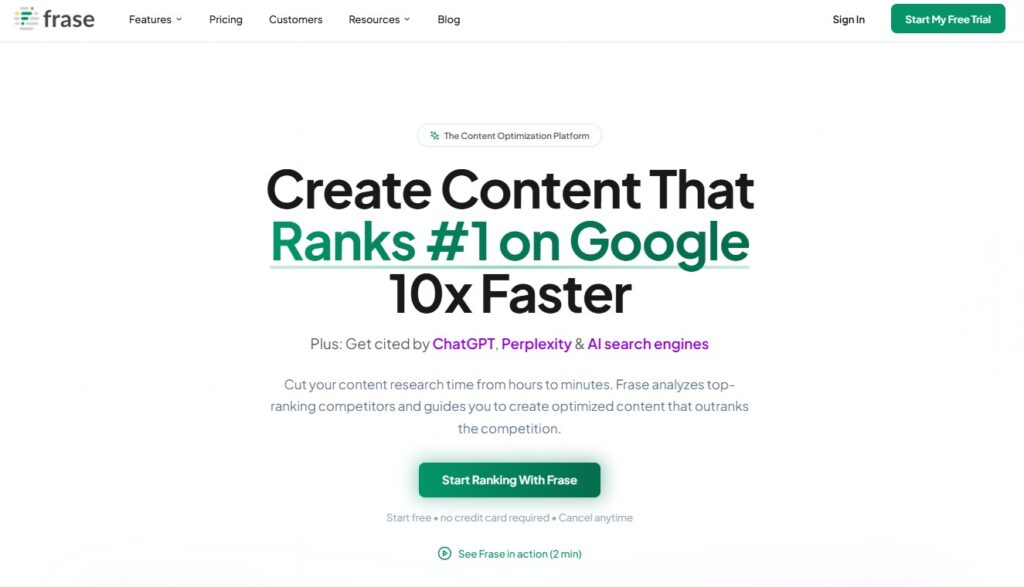
Frase emerges as one of the most powerful WriterZen alternatives thanks to its mix of content intelligence, SERP analysis, and workflow automation.
The platform uses generative AI plus live SERP data to help you quickly create high-quality, search-focused content, automatically spotting opportunities to improve rankings and drive more organic traffic.
One of its standout features is data-driven content briefs: Frase analyzes top-ranking pages, pulls out common headings, questions, and related keywords, and turns them into structured briefs you can write from.
In my experience, Frase is particularly effective at streamlining the entire content creation process from research to optimization in a single workspace.
Its AI-driven tools assist with researching competitors, generating outlines and drafts, and then optimizing your content using on-page recommendations and topic gap insights, which saves a significant amount of time compared to manual work.
If you want a more efficient, data-backed way to produce SEO content while maintaining quality, Frase is well worth considering among WriterZen alternatives, especially for teams that rely heavily on briefs and topic modeling.
Frase offers a 7‑day free trial and the option to book a personalized demo, so you can test its content intelligence and AI workflows before committing to a paid plan.
Where it improves on WriterZen (Pros)
- Faster brief creation and SERP-based content intelligence for outlining and updating content, especially if your workflow starts with briefs and Q&A coverage.
Cons
- If you rely heavily on advanced keyword clustering and topic discovery, you may find WriterZen’s research/planning workflow more “all-in-one.”
Clearscope

Clearscope is renowned for its focus on content optimization and its ability to provide actionable insights for improving organic visibility, making it a notable WriterZen alternative if you care most about on-page quality.
It analyzes the top-ranking pages for your target keyword, surfaces the terms, questions, and subtopics they cover, and highlights content gaps so you can build more complete, intent-matched articles instead of guessing.
Inside its text editor, you get live recommendations for keyword inclusion, content grade, word count, and readability, helping you craft content that’s both engaging and structured to perform well in search.
From my experience, Clearscope’s interface is clean and intuitive, which makes it easy for writers and editors to adopt without a steep learning curve.
Detailed reports and Content Inventory dashboards give a clear view of which pages are underperforming, where content is decaying, and which “striking distance” keywords are worth targeting, so you can make informed decisions about refreshes and new pieces.
If you want a data-driven approach to SEO that pairs semantic depth with a user-friendly workflow, Clearscope is an excellent choice among WriterZen alternatives.
Where it improves on WriterZen (Pros)
- Very writer-friendly, clean content grading workflow focused on topical coverage and term inclusion, great for editors and refresh cycles.
Cons
- Primarily a content optimizer; it’s not meant to be a complete keyword research + clustering platform like WriterZen’s research tools
MarketMuse

MarketMuse is a sophisticated WriterZen alternative that leans heavily into content planning, topical authority, and deep optimization rather than just basic keyword targeting.
It analyzes your entire content inventory, measures topic authority, and highlights high‑value topics, gaps, and overlapping pages so you can prioritize what to create or update for the best ranking potential.
Its core apps—Research, Compete, Optimize, and AI‑generated content briefs—pull insights from thousands of pages and top SERP results to show you which subtopics, questions, and internal links you need for comprehensive, expert‑level coverage.
What I like about MarketMuse is its holistic view of your entire content ecosystem instead of just looking at single articles in isolation.
Topic authority scores, inventory dashboards, and prioritization metrics help you decide which pages deserve attention next, while Optimize and Compete give in‑editor guidance on topical depth, structure, and competitive gaps.
If you want WriterZen alternatives that not only help individual pages rank but also systematically build your site’s overall authority on key topics, MarketMuse is a strong option to consider.
Where it improves on WriterZen (Pros)
- Stronger “site-wide” content strategy layer (inventory analysis, topic authority modeling, prioritization), not just page-by-page optimization.
Cons
- Can feel heavier and more enterprise/strategy-oriented than WriterZen, which many creators use for a simpler research-to-writing flow.
Scalenut

Scalenut is a comprehensive SEO and content marketing platform that works well as a WriterZen alternative if you want keyword research, content planning, AI writing, and on‑page optimization in one place.
Its Keyword Planner, topic clustering, and SERP‑driven reports make it easier to find ranking opportunities, while Cruise Mode and the AI Article Writer help you turn those insights into long‑form, SEO‑optimized drafts quickly.
The built‑in Content Optimizer then scores your pages with GEO/NLP terms, suggests keyword usage and structure improvements, and guides you toward content that can perform in both traditional search and AI answer engines.
From my experience, Scalenut’s interface feels approachable enough for beginners but still flexible for more advanced SEO workflows.
You can manage research, outlines, drafting, and optimization in a single editor, with live recommendations on keyword density, headings, readability, and SEO score, which cuts down on tool‑hopping and makes the whole process more efficient.
If you’re looking for WriterZen alternatives that combine AI content generation with practical SEO guidance and a smooth UX, Scalenut is well worth testing through its free trial.
Where it improves on WriterZen (Pros)
-
More AI-first long-form drafting workflows (e.g., Cruise Mode) combined with built-in SEO guidance, which can speed up production for content teams.
Cons
-
AI draft quality and optimization scoring can still require hands-on editing and validation against the SERP, so it’s not a “publish without review” tool.
NeuronWriter
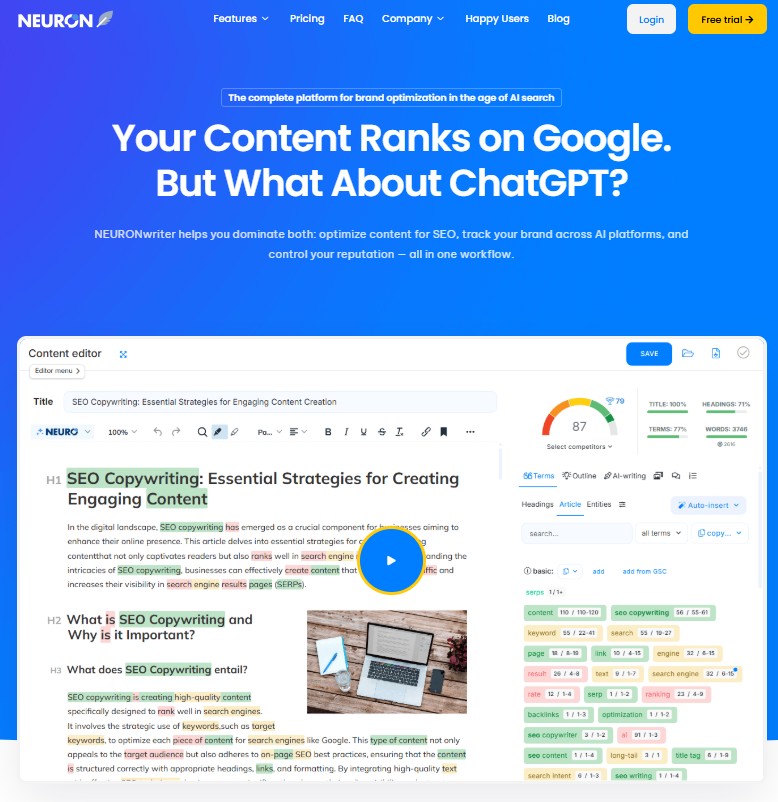
NeuronWriter is a notable WriterZen alternative that focuses on SEO content optimization with a mix of SERP analysis and AI writing.
It analyzes top-ranking competitors for your target keyword, surfaces related terms, questions, and headings, and then guides you toward more complete, search‑friendly content with optimization scores and missing‑topic suggestions.
This data-driven approach helps you craft content that’s engaging for readers while also aligned with ranking factors, keyword opportunities, and your competitors’ strategies so you can spot chances to outrank them.
From my experience, NeuronWriter’s interface is modern and generally intuitive, though some beginners may find the number of options a bit overwhelming at first.
Real-time scoring, color‑coded term usage, and detailed optimization reports make it easier to see what’s working and what isn’t in a draft, so you can adjust structure, coverage, and keywords with more confidence.
If you want WriterZen alternatives that blend AI writing with granular on‑page recommendations, NeuronWriter offers a very similar feature set focused squarely on Google‑first SEO content.
Where it improves on WriterZen (Pros)
- Strong value-for-money option for SERP-based content optimization + AI writing, often chosen by smaller teams for budget-friendly optimization workflows.
Cons
- It’s closer to an “optimizer + AI writer” than a full research suite, so it may not fully replace WriterZen’s topic discovery and clustering workflows.
Semrush SEO Writing Assistant

The Semrush SEO Writing Assistant is 0ne of the most valuable WriterZen alternatives if you already work inside the Semrush ecosystem and want real‑time guidance while you write.
It plugs into Google Docs, WordPress, and the Semrush interface to provide live feedback on readability, SEO, tone of voice, and originality based on your target keywords and location.
By tying its checks to data from Semrush’s main platform—like target keywords and competitors—it helps you align content with SEO best practices and identify opportunities to improve rankings and traffic as you draft.
In my experience, the SEO Writing Assistant works best as a layer on top of your existing process rather than a standalone research tool.
It scores your text, flags issues like missing target keywords, weak readability, or inconsistent tone, and then offers specific suggestions so you can refine sections before publishing.
If you are already using Semrush for keyword research and audits, adding the SEO Writing Assistant gives you a smooth, in‑editor way to keep new content on track as a WriterZen alternative.
Where it improves on WriterZen (Pros)
- Seamless in-editor checks (SEO, readability, tone, originality) inside the broader Semrush ecosystem—useful if your team already lives in Semrush.
Cons
- It’s not a standalone replacement for WriterZen’s keyword research + topic discovery; it works best as an add-on, not the whole workflow.
Ahrefs
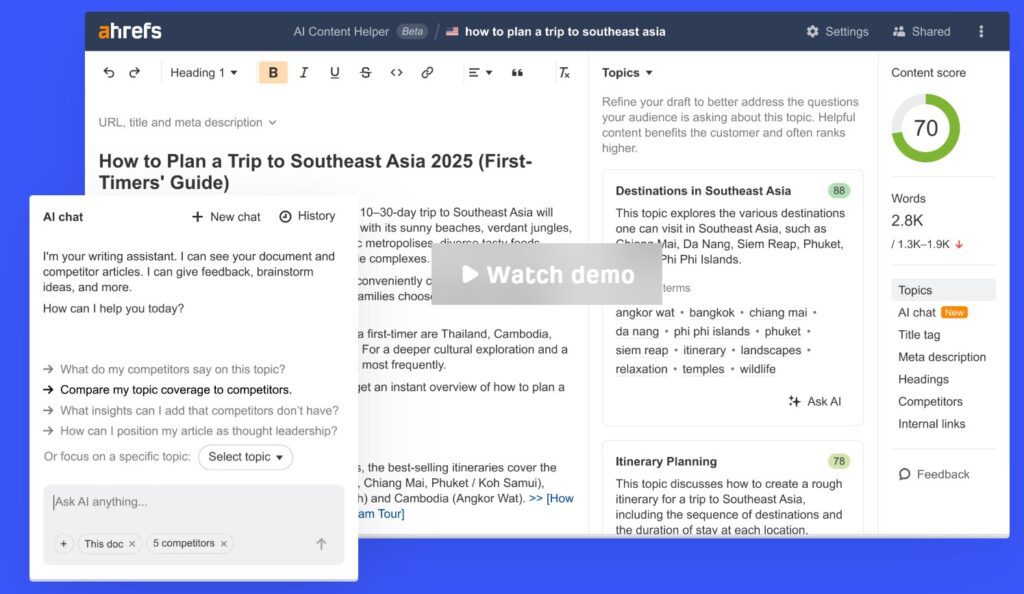
Ahrefs is a leading SEO platform and robust WriterZen alternative when your priority is deep keyword research, backlink data, and technical/competitive insights rather than in‑editor writing help.
Its core tools—Site Explorer, Keywords Explorer, Site Audit, and Content Explorer—give you in‑depth data on backlinks, organic keywords, ranking positions, and top pages so you can uncover content opportunities and monitor performance.
You can quickly find valuable keywords, analyze SERPs, and see how competitors earn traffic and links, then feed those insights into whatever content workflow you use.
I’ve found Ahrefs especially strong for competitor analysis and link‑driven strategy. Site Explorer and Backlinks reports show which pages attract the most links, where your competitors are building authority, and where you might win similar or better links, while Site Audit highlights technical issues that could hold rankings back.
If you’re looking for WriterZen alternatives that anchor your content planning in rich keyword and backlink data, Ahrefs is one of the best options on the market.
Where it improves on WriterZen (Pros)
- Much stronger backlink + competitor intelligence and deep keyword data (Keywords Explorer, Site Explorer), which can upgrade your content strategy and link planning.
Cons
- Not built as a content brief/writing/optimization editor in the same way as WriterZen, you’ll typically pair Ahrefs with a dedicated content optimization tool.
Outranking
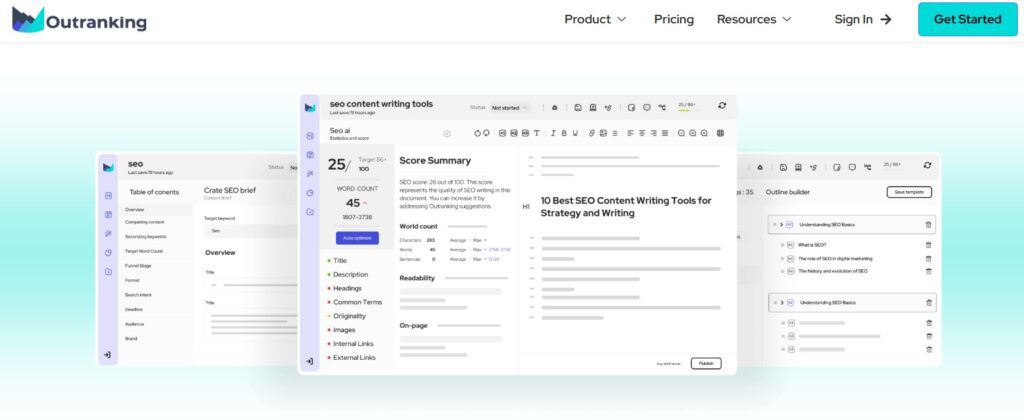
Outranking is a sophisticated WriterZen alternatives that emphasizes data‑driven content creation, detailed SEO briefs, and AI‑assisted drafting.
It starts with deep SERP analysis and entity research to build comprehensive content briefs, and then it is completed with titles, outlines, questions, and optimization goals
Then it uses AI to help you produce first drafts and refine them toward predictable ranking outcomes.
Its focus on combining intent analysis, entities, and real‑time SERP data makes it particularly strong when you want to systematically outrank specific competitors on important topics.
What I appreciate about Outranking is how it connects individual articles to a broader, structured content strategy.
You can standardize briefs, share them with teams, and use its optimization workflow to ensure each piece fits into a larger plan for topic coverage and authority, rather than treating every article as a one‑off.
If you’re looking for WriterZen alternatives that bring serious process to briefs, outlines, and AI drafting, Outranking is a strong candidate for building a more holistic, data‑driven content program.
Where it improves on WriterZen (Pros)
- Stronger “brief-to-draft” process with structured SEO content briefs and AI-assisted writing designed around SERP intent and competitive outlines.
Cons
- Can feel process-heavy if you just want quick keyword research + clustering + a lightweight editor (which is where WriterZen often fits).
When should you look for WriterZen alternatives?
Exploring WriterZen alternatives makes sense anytime WriterZen’s workflow (topic discovery + keyword research + content creation) no longer matches what you actually need to grow.
If your strategy demands deeper competitive intelligence, broader SEO reporting, or more advanced optimization workflows than WriterZen provides, switching (or pairing it with another tool) can lead to better decisions and faster results.
You should also consider WriterZen alternatives when:
- You need a different approach to keyword research and planning (for example, heavier SERP analysis, more advanced competitor benchmarking, or stronger link-based research).
- You want generative AI features that fit your writing process better—whether that’s stronger briefing, faster drafting, or more structured optimization inside the editor.
- You prefer a more user-friendly interface for your team, especially if writers and editors struggle with adoption or your workflow requires tighter collaboration and task management.
- Pricing or usage limits don’t fit your scale (credits, briefs, seats, or whether you want a one-time/lifetime option vs a monthly subscription).
How to choose the right WriterZen alternatives
Choosing right WriterZen alternatives is mostly about matching the tool to your workflow—not just picking the most popular option.
Start by getting clear on what you actually need help with (research, briefs, writing, optimization, or reporting), then short-list tools that are strongest in that area.
Define your must-have features
Begin by listing the non-negotiables for your use case—like in-depth keyword research, competitor/SERP analysis, content briefs, generative AI, or an editor with real-time optimization. This prevents you from buying a “suite” that looks impressive but doesn’t solve your specific bottleneck.
Validate data quality (not just features)
Look for WriterZen alternatives that give consistent, explainable recommendations (SERP benchmarks, topical terms, content scoring, competitor comparisons) so you can trust the insights you’re acting on. If the data feels noisy or the guidance is generic, it will slow you down and lead to weak content decisions.
Check workflow fit and ease of use
A more intuitive UI matters because it reduces the learning curve and helps writers/editors move faster without constant oversight. Also consider integrations—Google Docs, WordPress, and team collaboration features can make or break adoption.
Compare pricing and value at your scale
Evaluate pricing based on your actual usage: number of articles per month, seats, brief limits, credits, and whether you want monthly subscriptions or lifetime-style access. A cheaper tool can become expensive if you constantly hit limits, while a pricier one can be worth it if it replaces multiple tools.
Use Free Trials or Demos
Take advantage of free WriterZen alternatives, trials/demos, and run a small “pilot”: optimize one existing article and create one new brief from scratch to see if the tool fits your process.
The right alternative is the one that helps you produce better-optimized content with less friction—and makes ranking improvements more repeatable over time.
Best WriterZen Alternatives: Our Recommendation(Radarkit.ai)
If you want the most future-proof “WriterZen alternatives” for 2026, Radarkit.ai is our winner because it solves the biggest gap most content teams have right now: measuring and improving how your brand shows up inside AI answers, not just traditional Google rankings.
While WriterZen is built for a classic SEO workflow (keyword research, topic discovery, and content creation), Radarkit adds the missing AI layer—tracking mentions, citations, and share of voice across assistants like ChatGPT, Gemini, Perplexity, Copilot, and Google AI Overviews using real-browser checks.
What pushed Radarkit ahead is how directly it connects AI visibility to action. It highlights which sources and domains AI assistants cite most often for your target topics, surfaces competitor comparisons, and supports GEO execution.
With tools like its GEO Writer and free technical utilities (for example, an LLMs.txt validator), you can turn insights into content and outreach faster.
And with a startup-friendly entry price and a 7‑day trial, it’s also one of the easiest tools to test without heavy commitment.
Radarkit’s Unbeatable Features
Query Fanouts
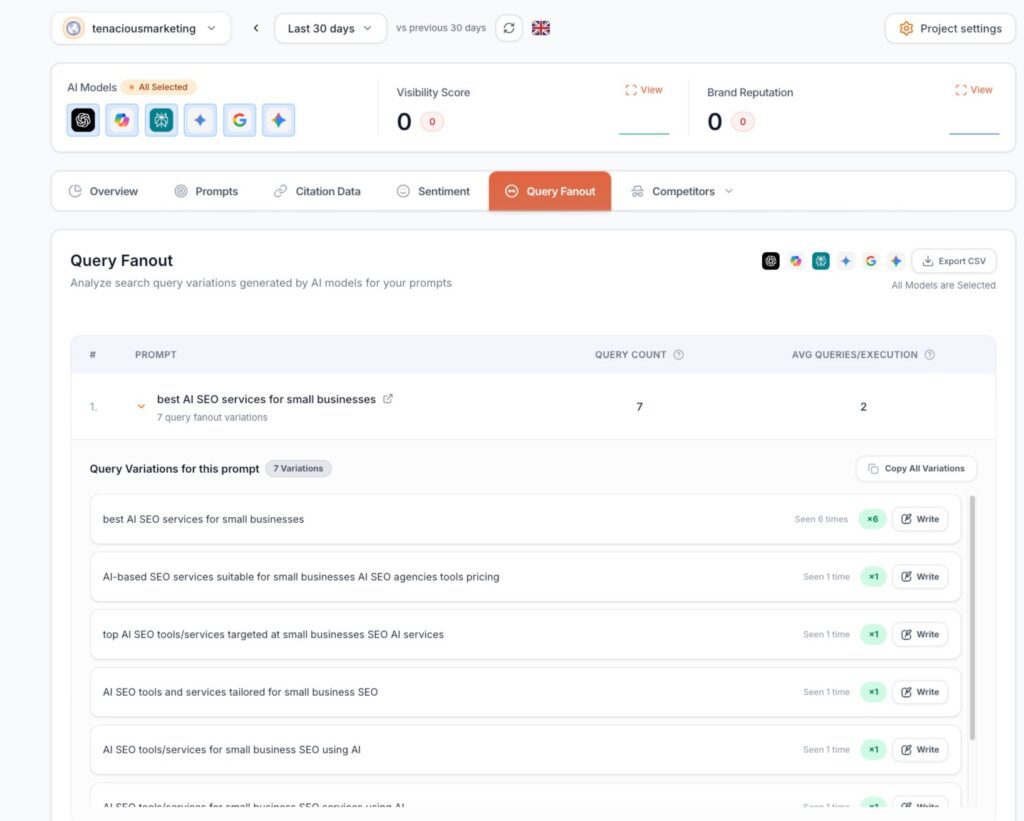
When you enter the prompt affordable CRM for Startups for tracking in Radarkit.ai, you can see all the other data that an LLM like ChatGPT or Perplexity searches for in the background aka Fanouts.
You can then utilise this data to craft content that will increase your visibility in LLMs.
GEO Writer
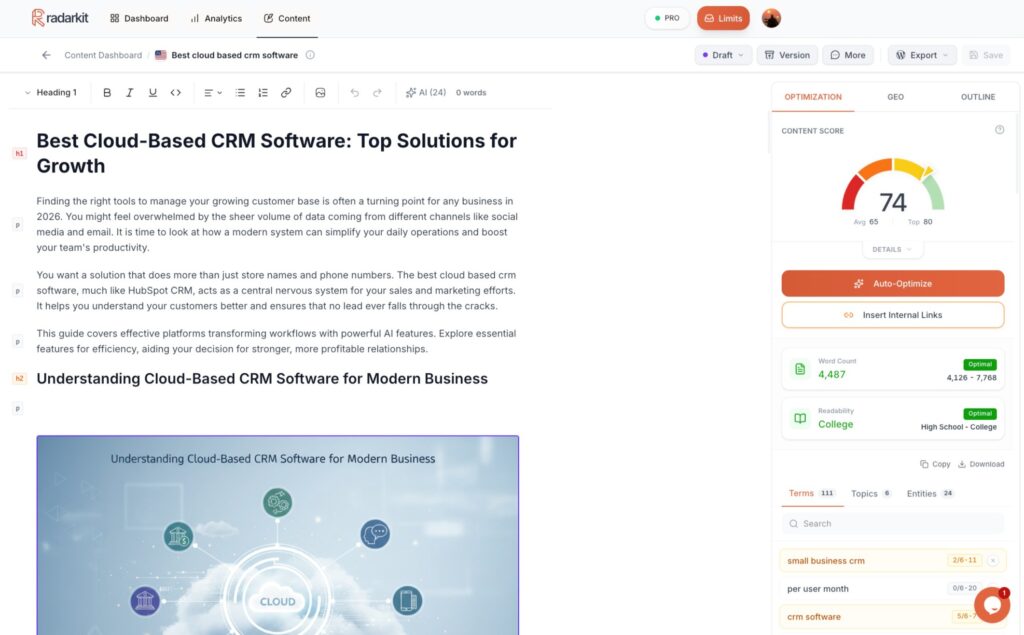
Radarkit’s GEO Writer uses NLP and citation data based on your competitors to create an optimised article with Facts, PAA, NLP terms that is optimised for both SERP and LLMs.
UI Based Tracking from 50+ Countries
Radarkit used residential IPs from 40+ countries to get real‑time responses from the LLMs based on IP.
FAQs
Are WriterZen alternatives worth it if WriterZen already does keyword research?
Yes—if your bottleneck isn’t finding keywords, but optimizing content depth, improving briefs, or tracking performance in places WriterZen doesn’t cover (like AI answers and citations).
Which WriterZen alternative is best for AI search / GEO visibility?
If your goal is to get cited and recommended inside AI assistants (not just rank on Google), Radarkit.ai is one of the strongest picks because it tracks brand visibility across assistants and surfaces citation-driven “link opportunities” you can act on.
What’s the biggest mistake people make when choosing WriterZen alternatives?
Picking a tool based on feature lists instead of workflow fit—e.g., buying an optimizer when you really need better research/briefing, or buying an AI writer when you mainly need SERP-driven scoring and updates.
Can I use two tools together instead of replacing WriterZen completely?
Yes, and it’s often the best approach: pair a research-heavy tool with a strong optimizer, or keep your content workflow tool and add an AI visibility tracker on top for GEO monitoring and competitor share-of-voice.
Why did you pick Radarkit.ai as the “winner” in your recommendations?
Because it’s built for the shift toward AI discovery, Radarkit doesn’t just show a score; it shows the underlying prompts, answers, sentiment, and cited domains, plus it points you to the sources you should target to earn more citations