The way people search is changing fast, and AI Search Visibility Metrics are now just as important as traditional SEO.
As AI-powered answers from tools like Google’s AI Overviews, ChatGPT, Gemini, and Perplexity sit above the classic blue links, you need to know how often your brand actually shows up inside those responses.
In 2026, ranking on page one is no longer the full story. You also have to measure how visible you are in AI-generated answers, how frequently you’re cited as a source, and whether those mentions are helping or hurting your brand.
This article breaks down the key AI Search Visibility Metrics to track and shows you how to use them to shape a smarter search strategy in the age of AI.
So, without any further ado, let’s get started.
What is AI Visibility?

AI visibility refers to how prominently your brand appears in AI search results, including AI overviews and AI-generated answers.
It’s not just about showing up, but about how influential your brand is inside those responses and how often AI tools choose you when they explain or recommend something in your space.
This goes beyond traditional rankings and looks at how frequently you’re mentioned in AI-generated content, the context around those mentions, and the overall impact on how people see your brand.
Think of it this way: if someone asks an AI tool, “What are the best CRM platforms for small businesses?”, AI visibility is about whether your brand appears in that answer, how it’s described, and whether it’s listed as a top pick or just a passing mention.
If you’re invisible in those moments, you’re missing out on a big chunk of your potential audience, even if your SEO rankings look strong.
To measure AI visibility effectively, you need to understand how different AI models interpret, rank, and present information about your brand and industry.
That means tracking metrics like how often you appear in AI-driven summaries, the sentiment and tone of those mentions, and the AI referral traffic or assisted visits they drive to your site.
Why AI Visibility Matters in 2026?
Traditional SEO metrics such as rankings and organic traffic remain important, but they no longer tell the full story in an AI-driven search landscape.
Multiple industry forecasts suggest that by 2028, AI-powered search experiences and assistants could handle as much or more discovery as classic search results, with some analyses warning of organic traffic drops of 30–50% as users shift to AI answers.
That’s why understanding and optimizing for AI visibility is now critical, not optional.
- AI overviews and AI answers are becoming the first touchpoint when people look for information, products, and recommendations.
- If your brand doesn’t show up prominently in those AI responses, competitors who invest in AI visibility will capture that demand instead of you.
- In 2026, brands need dedicated tools and workflows to measure AI search visibility across major AI platforms, not just classic SERPs.
- Ignoring AI visibility metrics means risking a meaningful drop in traffic, leads, and revenue as more queries are answered directly by AI.
- Tracking and improving AI visibility supports your overall search strategy, helping you stay competitive across both traditional results and AI-driven experiences.
6 AI Search Visibility Metrics You Can’t Ignore in 2026
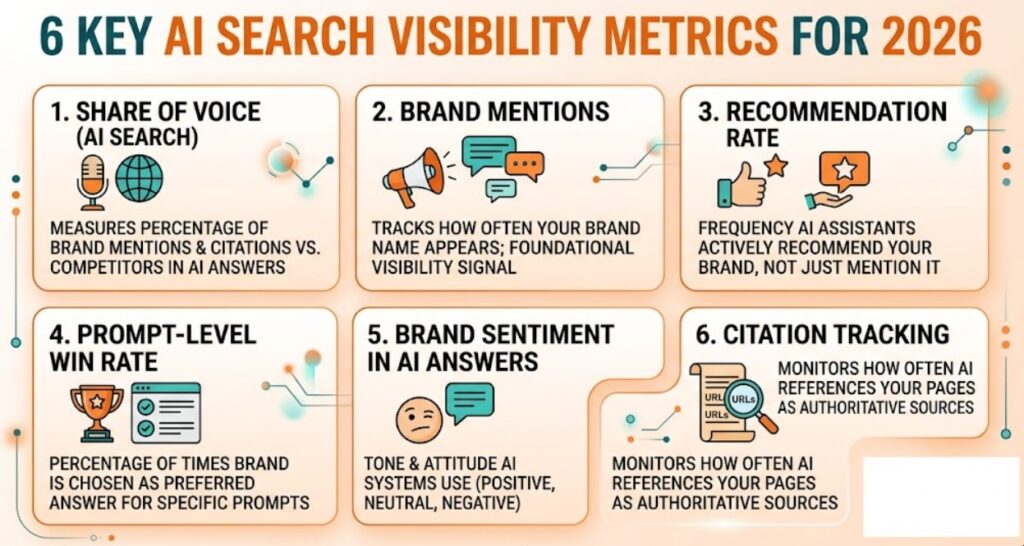
Share of Voice (AI Search)
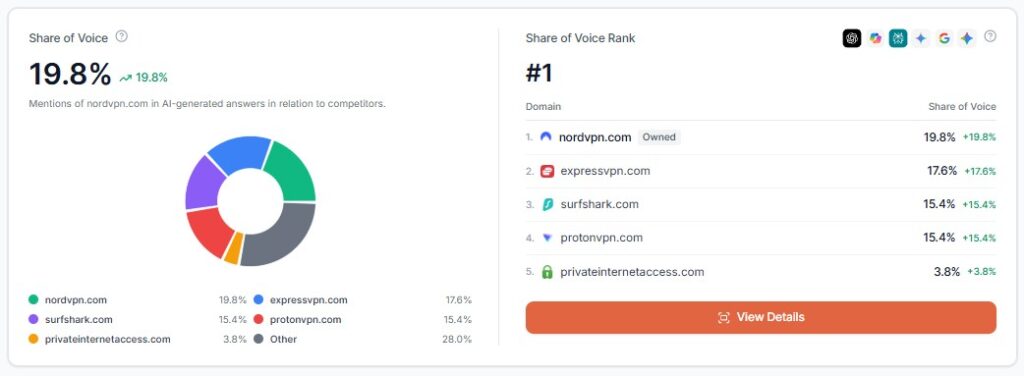
In AI search, share of voice is one of the key AI visibility metrics to understand your brand’s performance against competitors.
It measures the percentage of brand mentions or citations your company receives in AI-generated answers compared with all other brands mentioned for the same prompts.
By 2026, AI share of voice is becoming a core way to assess how strong your presence really is inside AI assistants and AI search experiences, not just on traditional SERPs.
To measure it properly, you need to track how often you’re mentioned across multiple AI platforms and how that compares to the total “conversation” in your category.
Tools like RadarKit and others are already highlighting competitor-style share-of-voice monitoring plus citation insights, which help you see not just if a rival appears, but why they keep getting picked by AI.
Brand Mentions
Brand mentions in AI answers and AI overviews are one of the strongest signals of your AI visibility.
Tracking how often your brand name appears in AI responses across different prompts and platforms helps you understand whether AI models actually recognize and recall your brand when it matters.
These mentions often feed into an overall AI visibility score or mention rate, making them a foundational metric rather than a vanity number.
To get value from brand mentions, you can’t just count them; you also need to look at the context.
That means checking whether AI is describing your brand accurately, whether the sentiment is positive or negative, and whether you’re being recommended alongside the right competitors.
By monitoring how AI systems talk about you over time, you can spot gaps in your content, strengthen your positioning, and improve both your AI presence and overall brand visibility.
Recommendation Rate
Recommendation rate measures how often AI assistants and AI tools actively recommend your brand or product in response to relevant user queries, not just mention it in passing.
It reflects how strongly the AI sees your brand as a good answer for high‑intent questions, so a higher recommendation rate usually means more qualified traffic and stronger perceived authority.
To increase this metric, you need content that clearly matches user intent, answers questions in depth, and is easy for AI models to quote or endorse as a reliable solution.
Regularly tracking how often you’re recommended versus simply mentioned gives you actionable insight into whether AI systems just “know” your brand or actually trust it enough to promote.
Prompt-Level Win Rate
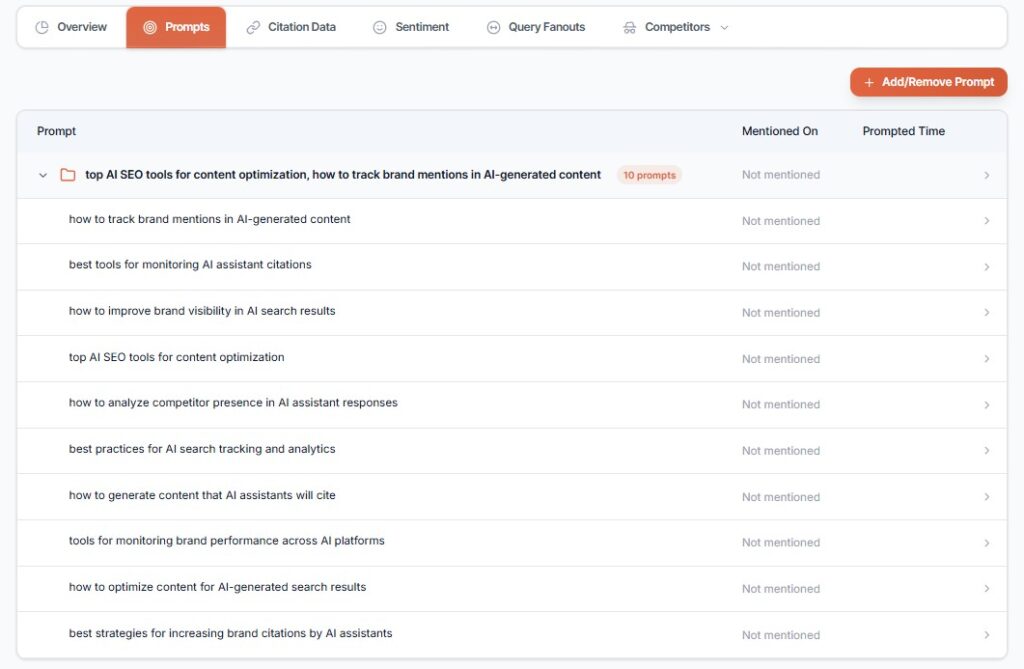
Prompt-level win rate is the percentage of times your brand is chosen or featured as the preferred answer when AI assistants respond to a specific prompt or question.
It gives you a granular view of AI visibility by showing how well your content lines up with real user intents, not just generic keywords.
By tracking this metric, you can quickly see which prompts you consistently “win” and where you’re losing out or not appearing at all.
Improving prompt-level win rate usually means tightening your content around clear questions, offering direct, well-structured answers, and making sure your pages are easy for AI models to interpret and cite.
When you focus on lifting win rates across a core set of high-intent prompts, you’re effectively increasing the number of AI answers where your brand shows up as the go-to choice.
Brand Sentiment in AI Answers
Brand sentiment in AI answers is about the tone and attitude AI systems use when they talk about your brand in their responses.
It helps you see not just how often you’re mentioned, but whether those mentions are positive, neutral, or negative, and how you’re positioned next to competitors.
Tools like RadarKit and other LLM visibility platforms now combine mention tracking with sentiment and positioning insights so you can understand why certain competitors get praised or recommended more often than you do.
Positive sentiment in AI answers can lift your credibility and make users more likely to trust and choose your brand, while negative or inaccurate descriptions are early warning signs you need to fix content or reputation issues.
By regularly monitoring both brand search visibility and sentiment across AI outputs, you can keep your AI presence aligned with your broader brand goals and step in quickly when the tone starts to shift in the wrong direction.
Citation Tracking
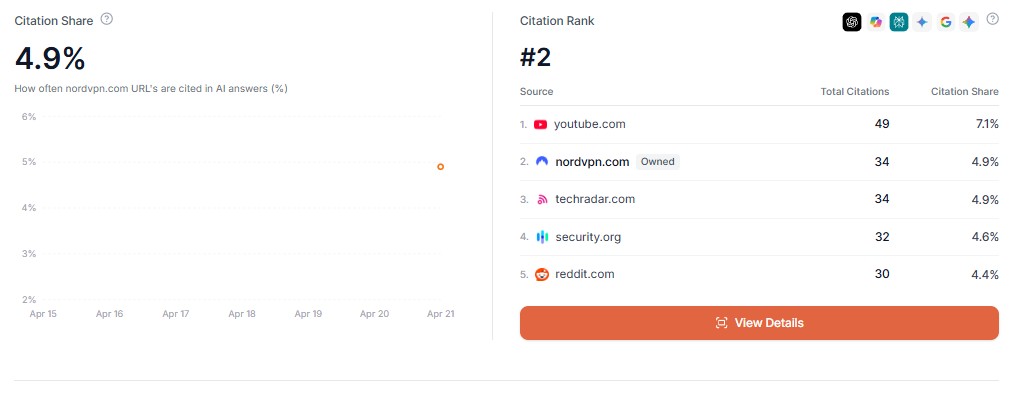
In AI search, citation tracking means monitoring how often AI assistants and AI search engines reference your pages as sources in their answers.
This matters because most AI models lean on a relatively small set of trusted URLs when generating responses, so being cited is a strong signal that your content is seen as authoritative.
Tools like RadarKit and other GEO platforms now surface which domains and pages are cited most often, making it easier to spot the content that shapes AI answers and to find backlink or partnership opportunities.
By tracking AI citations over time across ChatGPT, Perplexity, Google AI Overviews, Gemini, and more.
You can see which assets consistently earn citations, then double down on similar topics, formats, and structures to increase your AI visibility.
Which Is the Best AI Visibility Tracking Tool in 2026?
As we move into 2026, having a reliable AI visibility-tracking tool has gone from “nice to have” to essential. There are now several serious platforms in this space.
Still, RadarKit consistently shows up as a top pick, especially for teams that care about accurate, real-browser checks across multiple AI engines.
RadarKit is more than a basic AI visibility tracker; it acts as an AI search analytics layer that shows how your brand appears inside answers across ChatGPT, Perplexity, Gemini, Copilot, Google AI Overviews/AI Mode, and more.
It records full responses, citations, and context, so you can see which prompts you win, which URLs are being cited, how your share of voice compares to competitors, and how that visibility ties back to traffic via GA4.
While other tools like SE Visible, Profound, Peec AI, and LLMClicks also rank highly in independent roundups, RadarKit stands out for its balance of multi-engine coverage, competitor benchmarking, sentiment and citation data, and accessible pricing that starts around $29 per month.
In a fast-changing AI search landscape, using a tool like RadarKit gives you a practical way to monitor how often you’re mentioned, cited, and recommended in AI answers and to turn those insights into concrete content and SEO decisions.
Notable Radarkit AI features
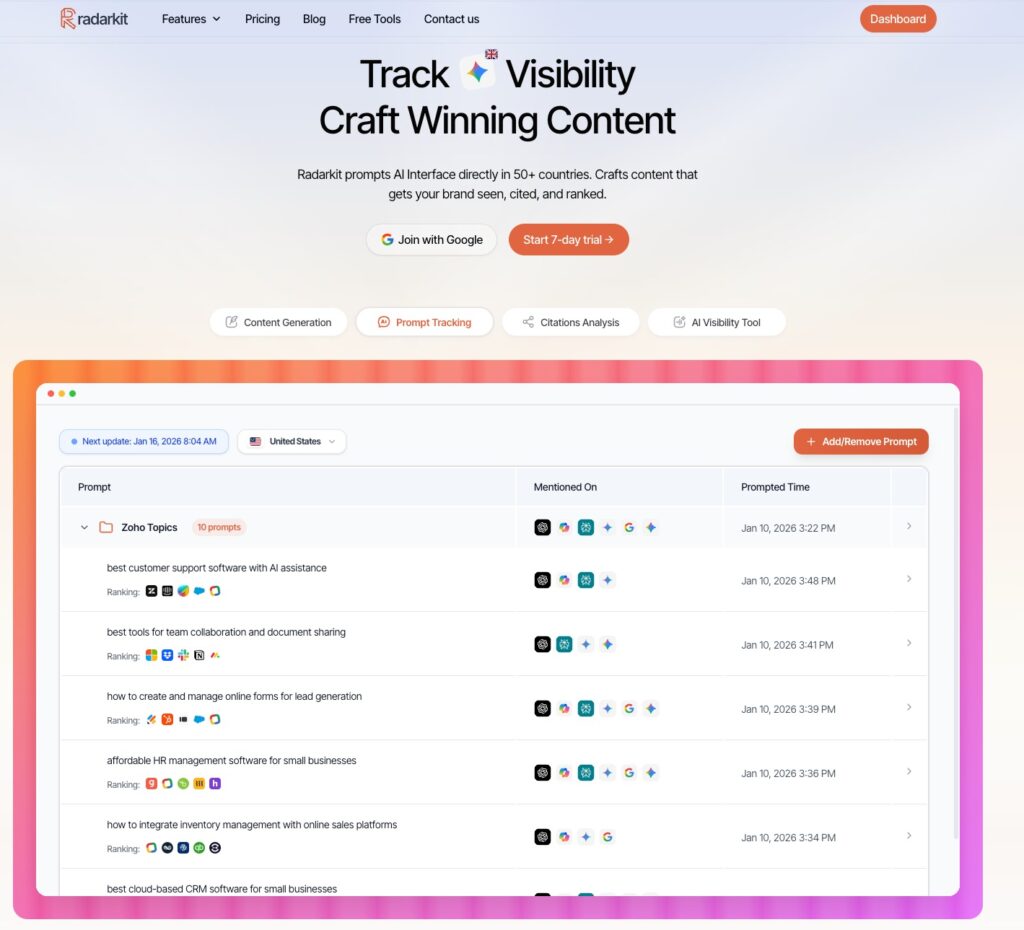
Radarkit.ai (part of the Alpha startup at Web Summit Qatar) is currently one of the most focused AI search trackers on the market.
What really sets it apart is the accuracy of its results and the way it uses real browser tracking instead of APIs to collect live AI answers from 40+ countries.
- AI Share of Voice: Identify exactly which sites AI Chatbots trust most for your query vs. competitors
- Location-Based Tracking: Simulate real-time queries from 40+ countries using residential proxies to catch local citations and geo-specific data
- NLP & Fact-Based Content: Create content using the specific NLP terms and entities found in most cited sources to rank in AI search engines
- 1-Click GEO Content Writer: Generates optimized content that ranks in LLMs in 5 minutes without needing Google Search Console
- Query Fanouts Tracking: Tracks how AI models break one question into multiple angles and turn them into content sections
- AI Traffic Monitoring: See which AI platforms (ChatGPT, Perplexity, Gemini, Copilot) send actual visitors to your site.
How to Choose the Best AI Visibility Tracking Tool
Here is how to choose the Best AI Visibility Tracking Tool
Define your goals and key metrics
Choosing the best AI visibility tracking tool starts with being clear about what you want it to do for your business.
You should first connect your goals to specific metrics: are you mainly trying to track AI share of voice, brand mentions, citations in AI answers, recommendation rate, AI referral traffic, or a mix of these?
If your focus is brand and reputation, you will want strong tracking of mentions, sentiment, and context. If you care more about performance, you need a tool that ties AI visibility to traffic, leads, and revenue instead of treating it as a vanity metric.
Check which AI platforms the tool tracks
Once your goals are clear, look at where each tool can actually track you.
The better AI visibility platforms monitor how your brand appears across multiple assistants, typically ChatGPT, Perplexity, Google AI Overviews or AI Mode, Gemini, Claude, and sometimes Copilot or Grok, so you get a realistic picture of your visibility across the ecosystem your audience uses.
Tools like RadarKit focus heavily on this multi-engine coverage and record full AI responses so you can review context, not just counts. If a tool only supports one engine, you risk missing how customers discover you in other AI environments.
Review the depth and quality of reporting
It is not enough for a tool to give you a single visibility score.
Strong platforms let you slice results by prompt, topic, URL, country, and competitor so you can see where you are winning, where you are invisible and which specific pages or assets drive most of your AI presence.
RadarKit, for example, surfaces prompt-level win rates, competitor share of voice, and which URLs are being cited inside answers, which makes it easier to decide what to fix, expand or promote next.
Look for useful analysis and insights (not just numbers)
You should also pay attention to how actionable the insights feel when you watch a demo or try a trial.
The best tools combine metrics like sentiment, citations, share of voice, and prompt level win rate with clear guidance on what to do next, for example, which prompts you are losing, which topics have weak coverage or which pages repeatedly earn citations and should be built out further.
RadarKit leans into this type of analysis by showing why competitors appear in AI answers and where they are gaining an edge, so you can respond with concrete content and SEO changes.
If a tool only shows charts without telling you what to change, it will be hard to turn AI visibility data into real improvements.
Consider workflow, UX, and integrations
Workflow and integrations matter just as much as raw features.
Setup should feel straightforward, dashboards should be easy for your team to read, and creating or updating prompt lists should not be a chore.
It also helps if the tool connects to GA4, your reporting stack, or your CRM so you can tie AI visibility to business outcomes like pipeline and revenue, instead of leaving it as a disconnected SEO report.
RadarKit, for instance, supports export and GA4-friendly reporting so you can fold AI visibility straight into your regular performance reviews.
Larger software providers with built-in AI search optimization tools are also a good idea here. They enable you to embed AI optimization into your current workflows and cross-reference results with campaigns across multiple other channels.
Case in point: HubSpot AEO includes the option to use the platform alongside HubSpot’s omnichannel marketing automation solution, Marketing Hub. This allows you to gauge your overall online presence by tracking AI optimization results next to SEO, social media, and other channel-specific metrics within unified dashboards.
Match pricing and complexity to your stage
You should match the tool’s pricing and complexity to where you are as a company.
Smaller teams are usually better off starting with lighter or more affordable platforms and upgrading as AI visibility becomes a bigger channel, while larger or enterprise brands may need stronger data retention, SLAs, and security, even though that comes with a higher price tag.
RadarKit positions itself in the mid-market with entry plans that make it accessible for smaller teams, while still offering advanced tracking features used by agencies and larger brands.
Test shortlisted tools with your own prompts before deciding
If you can, narrow your options to two tools and run them in parallel for a few weeks using the same prompt set.
Comparing coverage, accuracy, and ease of use on your own data is the fastest way to see which platform actually helps you improve how often and how favorably your brand appears in AI answers.
Include RadarKit in that shortlist if you care about multi-engine tracking, citation and sentiment insights, and competitor analysis. Then, pick the tool that not only measures your AI visibility but also makes it clear what to do next to grow it.
What Should You Do With AI Visibility Tracking Data?
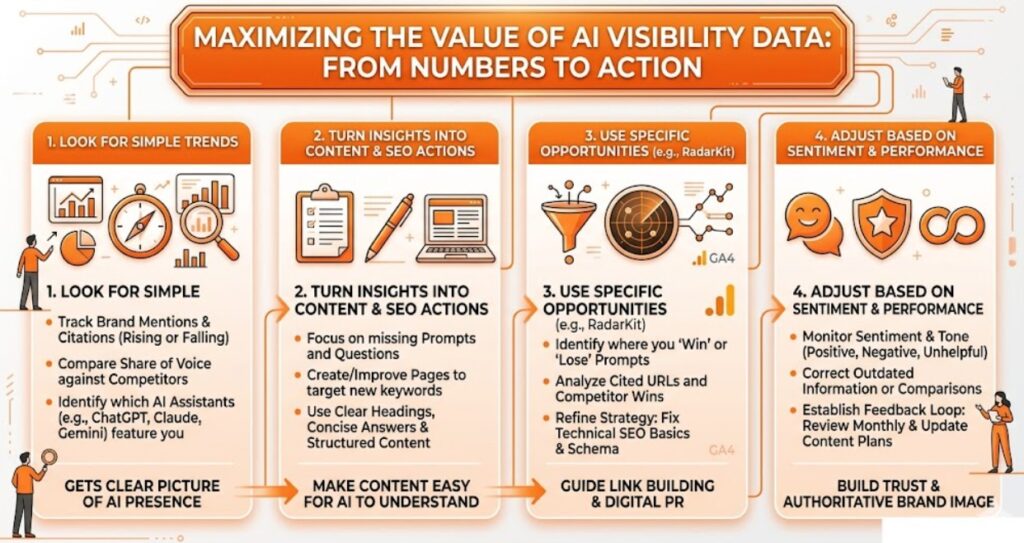
Once you have AI visibility data from your tracking tools, the real value comes from what you do with it.
The numbers on their own do not mean much unless you use them to change how you create content and how you optimise for AI search.
Start By Looking For Simple Trends
Check whether your brand mentions and citations are rising or falling, how your share of voice compares to key competitors, and which AI assistants or AI search engines feature your brand most often.
This gives you a clear picture of your current AI presence and quickly shows you where you are strong and where you need to improve.
Turn Insights Into Content And SEO Actions
Once you understand the patterns, turn those insights into concrete actions.
Focus on creating or improving pages that target the prompts and questions where you rarely appear today.
Use clear headings, concise answers and structured content so AI systems can easily understand and reuse your information in their responses.
Prioritise high-quality, trustworthy content that matches real user intent, because AI models are more likely to recommend and cite pages that are accurate, complete, and easy to parse.
Your goal is to make your content the natural source an AI system chooses when it needs to answer a question in your niche.
Use RadarKit To Find Specific Opportunities
Platforms like RadarKit help you move from data to decisions by showing exactly where you win and where you lose.
RadarKit highlights which prompts you win, which URLs are cited, how often competitors are chosen instead of you and how this visibility connects back to traffic in GA4.
Use those insights to refine your SEO strategy. Strengthen pages that already earn citations, fill content gaps where you do not appear at all and fix technical basics like internal links and schema so AI models can interpret your site correctly.
You can also use citation and share of voice reports to guide link building and digital PR, putting more effort into pages and topics that AI already favours to increase the chances they keep being mentioned.
Keep Adjusting Based On Sentiment And Performance
Finally, do not just track how often you are mentioned; also, pay attention to how AI systems talk about you.
If AI answers start to show negative tone, outdated information or unhelpful comparisons, that is a signal to improve your on-site content, reviews or brand messaging so future responses move in a more positive direction.
Treat AI visibility reports as an ongoing feedback loop. Review your key metrics each month, such as brand search performance, brand mentions, share of voice, recommendation rate, and sentiment, then update your content and SEO plans based on what you see.
Over time, this steady adjustment is what helps your brand show up more often in AI outputs and be perceived as a trusted, authoritative choice that drives real traffic and revenue from AI channels.
FAQs: AI Search Visibility Metrics
What is “coverage breadth” in AI visibility?
Coverage breadth is the number of important prompts or questions in your niche where your brand appears in AI answers, and it matters because even a high share of voice on a few prompts cannot compensate for being completely absent from most of the questions your audience actually asks.
How is AI visibility different from traditional SEO rankings in a zero-click world?
AI visibility focuses on whether and how your brand shows up inside AI-generated answers, while traditional SEO looks at rankings and clicks, and in a zero-click world, users often get what they need from the AI summary itself, so mention frequency, prominence, and branded search uplift become just as important as classic organic traffic.
How can I link AI visibility metrics to real business results?
You can connect AI visibility to business outcomes by tracking changes in metrics like AI share of voice and citations alongside trends in branded search, direct traffic, and conversions over time, then watching for consistent patterns where gains in AI visibility are followed by increases in demand or revenue.
Do I need technical changes on my site specifically for AI visibility?
You do not need a separate tech stack, but using clear structure, fast pages, solid internal linking, and schema for things like FAQs, products, and reviews helps AI systems crawl and interpret your content more accurately, which raises the chances that your pages are selected as trusted sources in AI answers.
How often should I refresh content to stay visible in AI answers?
High-value pages should usually be reviewed and updated every 6 to 12 months, and more often in fast-changing industries, because regular updates that add new data and address fresh questions signal to AI systems that your content is current and reliable, which helps you hold or grow visibility over time.
Conclusion
AI search is quickly reshaping how people discover brands, and by 2026 the real question will be whether AI chooses you as an answer, not just where you rank in traditional results.
To stay visible, you need to treat AI visibility as a core part of your search strategy and keep an eye on metrics like share of voice, brand mentions, citations, recommendation rate, prompt level win rate and sentiment in AI answers.
Tools like RadarKit make this practical by showing how often you appear across major AI assistants, which pages are cited and how your presence stacks up against competitors, so you can keep improving instead of guessing.
Brands that lean into this now, track their AI visibility and adapt their content around what the data shows, will be the ones users see, trust and choose in the new AI first search landscape.