In this Profound AI review, I’ll dig into how Profound works, who it’s really for, and where it shines or falls short so you can decide whether you need a dedicated AI visibility platform, or if your current stack (plus some manual ChatGPT checks) is enough for now.
So, without any further ado, let’s get started.
Quick Profound AI Capabilities Ratings
- AI visibility tracking – 4.8/5
- Prompt & topic intelligence (Prompt Volumes) – 4.7/5
- AEO/GEO optimization workflows – 4.5/5
- Shopping & local/geo insights – 4.3/5
- Integrations & data exports – 4.2/5
- UX & ease of onboarding – 4.0/5
- Pricing accessibility for smaller teams – 3.2/5
- Overall rating – 4.5/5
What is Profound AI?
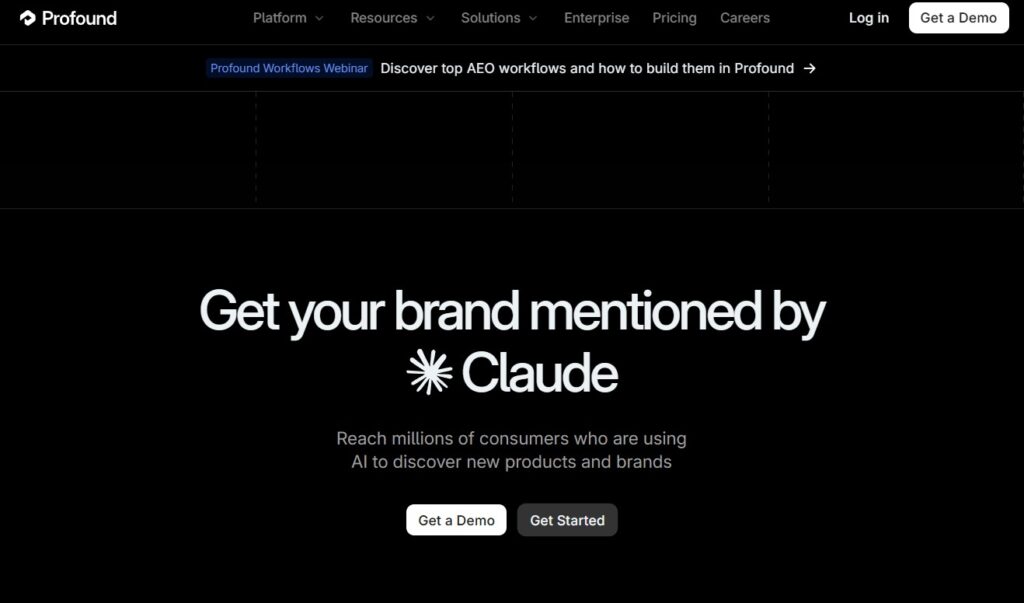
Profound AI (branded as Profound) is an enterprise‑grade AI visibility and marketing intelligence platform that helps brands monitor, analyze, and optimize how they appear in AI‑powered search and answer engines such as ChatGPT, Perplexity, Gemini, Copilot, Meta AI, Grok, and Google AI Overviews.
It tracks when and how a brand is mentioned, cited, and positioned in AI‑generated answers, providing visibility scores, sentiment analysis, and competitive share‑of‑voice across topics and geographies.
The platform also offers AI‑driven optimization workflows, including prompt discovery, content‑recommendation tools, and agent‑based orchestration, enabling brands to proactively shape how they are represented in the generative AI landscape rather than simply reacting to what AI surfaces.
Backed by a recent 96M USD Series C at a 1B valuation, Profound has quickly become one of the default tools for companies that treat AI search as seriously as they treat organic search.
Who Benefits From Using Profound AI
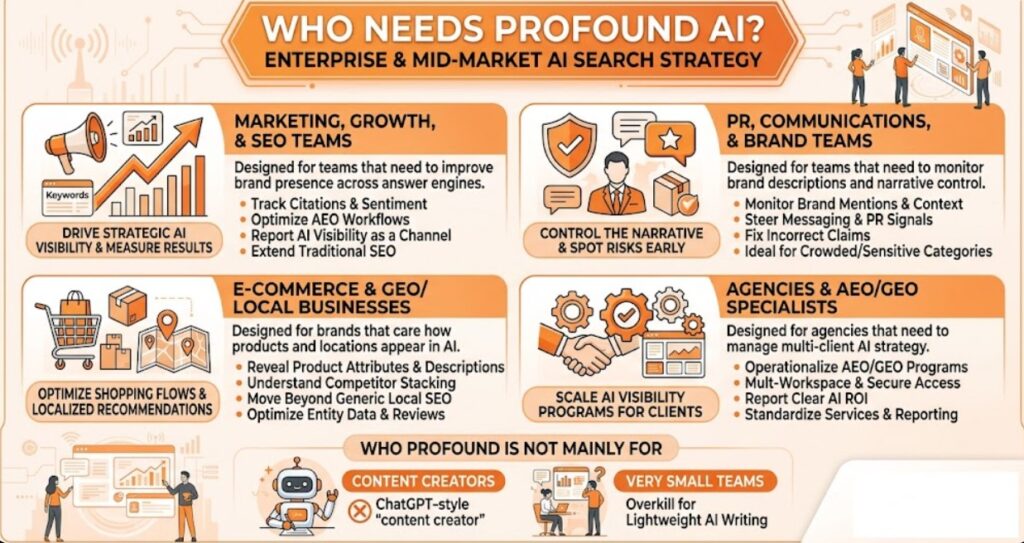
Profound AI is explicitly built for enterprise and mid‑market teams that treat AI search visibility as a strategic channel, not just an experiment.
Marketing, Growth, and SEO Teams
Profound AI is designed for growth, SEO, and marketing teams that need to understand and improve how their brand shows up across answer engines.
These teams use Profound to track citations, share of voice, and sentiment, then turn those insights into concrete AEO/SEO actions and content workflows.
Rather than replacing traditional SEO, Profound extends it into answer engine optimization (AEO) by showing which prompts, topics, and URLs actually drive inclusion in AI answers, something standard SEO tools do not measure.
This makes it especially valuable for performance‑focused marketers who need to report on and improve AI search visibility as a real channel, not a black box.
PR, Communications, and Brand Teams
PR and brand teams use Profound to control their narrative in AI by monitoring how AI systems describe their company, executives, and products, and how that compares to competitors.
The platform surfaces brand mentions, tone, and context across answer engines so comms teams can spot reputation risks, incorrect claims, or missing messages early.
Profound’s sentiment and conversation insights help these teams steer messaging, press, and thought‑leadership toward the signals AI models actually pick up and reuse.
For brands operating in crowded or sensitive categories (finance, health, B2B SaaS), this level of AI‑specific reputation tracking is particularly important.
E‑commerce and Geo/Local Businesses
Profound’s Shopping and ecommerce tracking makes it a fit for brands that care how their products appear in AI shopping flows or localized recommendations (for example, “best dentist in Austin” or “top CRM for small agencies”).
It reveals how products and locations are described, what competitors are stacked beside them, and which attributes seem to influence AI choices.
For geo‑focused and local businesses, this means you can move beyond generic local SEO and start optimizing your entity data, reviews, and content for the specific prompts and attributes AI engines use when recommending providers in a region.
Agencies and AEO/GEO Specialists
Digital agencies and AEO/GEO specialists use Profound AI Review as an analytics and execution layer to run AI visibility programs for multiple clients.
The platform’s modules, monitoring, prompt research, Agent Analytics, content workflows, and ecommerce tracking—map well to agency retainers, reporting, and packaged services.
Because Profound offers enterprise‑grade security, multi‑workspace support, and customizable dashboards, agencies can standardize how they report AI visibility, show ROI, and operationalize answer‑engine optimization at scale.
Who Profound Is Not Mainly For
Profound is not positioned as a generic ChatGPT‑style “content creator” for small businesses or casual users. Its AI Agents and Workflows are there to operationalize AEO and AI search programs, not just to generate ad‑hoc copy.
For very small teams that only need a lightweight AI writing tool, the platform is likely overkill.
Profound AI Review: Key Features
Here are the key features of Profound AI.
Answer Engine Insights (AI visibility & Citations)
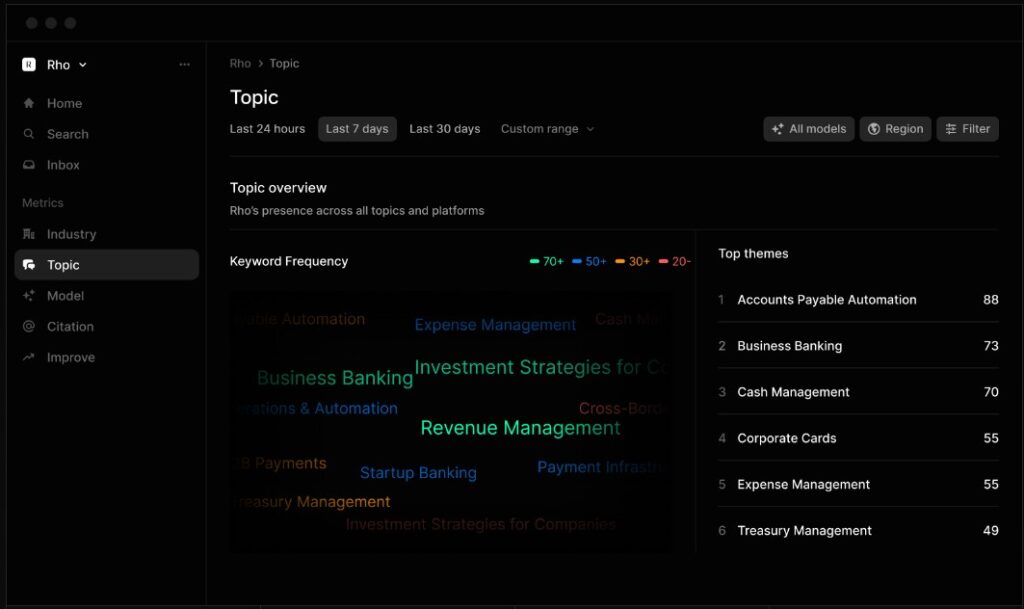
Profound shows exactly how your brand appears across more than ten major answer engines, including ChatGPT, Perplexity, Claude, Gemini, Copilot, Grok, DeepSeek, Meta AI, and Google AI Overviews.
It tracks mentions, citations, ranking position, sentiment, and supporting sources, so you can measure AI search visibility and share of voice instead of guessing.
Prompt Volumes and Real AI Search Demand
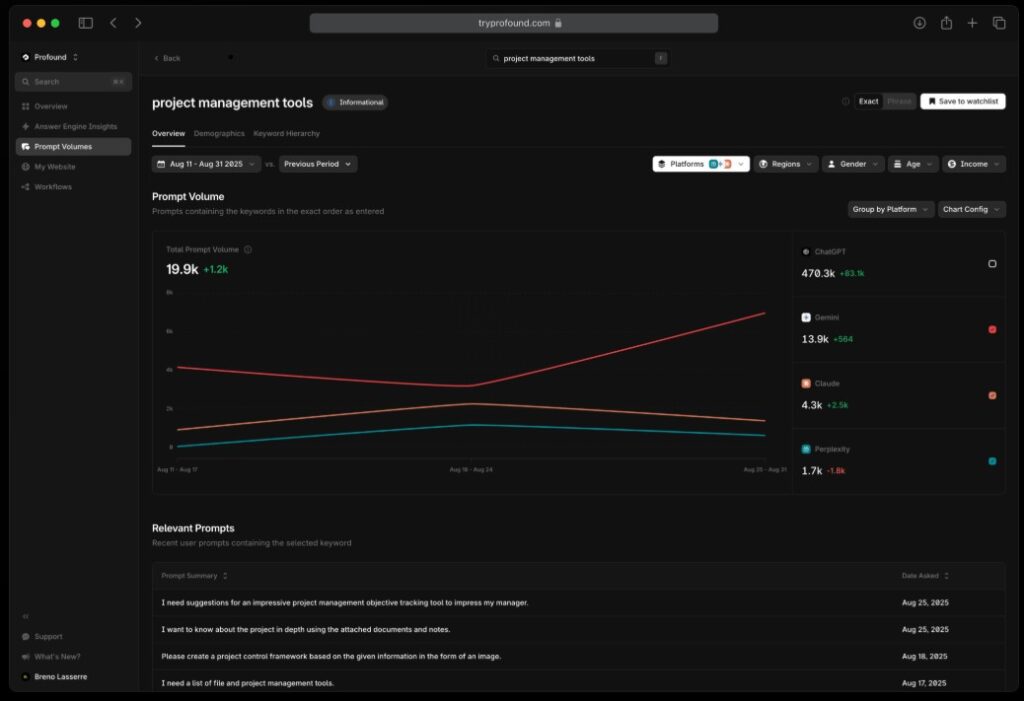
Prompt Volumes in Profound AI Review reveals what people are actually asking AI every day by clustering billions of prompts into clear, commercially relevant topics.
This helps you understand real “AI search demand,” prioritize the questions that matter in your category, and spot gaps where your brand should be appearing but currently does not.
AI Agents for Marketing Teams
Profound includes specialized AI Agents task‑focused “AI employees” for demand generation, brand, content, and AEO/SEO.
These Agents research prompts, generate and optimize content, run analyses, and execute workflows so non‑technical teams can scale AI visibility work without building custom tools.
Agent Analytics and Crawler Behavior Insights
Agent Analytics shows how AI crawlers such as GPTBot, ClaudeBot, Gemini, and PerplexityBot access, render, and interpret your site.
It then connects this crawler behavior to the AI answers where you are—or are not—being cited, highlighting which technical and content changes will have the biggest impact.
Read/write Optimization
Profound is not just a passive tracker; it functions as a “read/write” marketing layer on top of AI engines.
It offers AI‑powered content creation tools that generate SEO‑ and AEO‑optimized pages, product descriptions, and category‑level copy specifically tuned to perform well when AI crawlers index and reference them.
Teams can then tweak messaging in real time based on how AI answers change, enabling continuous optimization of content and brand positioning.
Multi‑Platform Coverage
One great thing I notice while writing Profound AI Review is that this platform delivers visibility insights across over 10 major answer engines, including ChatGPT, Claude, Perplexity, Gemini, Copilot, DeepSeek, Grok, Meta AI, and Google’s AI Overviews / AI Mode.
Query Fanouts
The Query Fanouts feature reveals how answer engines expand a single user question into multiple underlying search queries. By seeing these machine‑generated variants and modifiers, you can optimize pages for the exact queries AI actually uses behind the scenes, not just the surface‑level prompt.
Shopping and AI‑commerce visibility
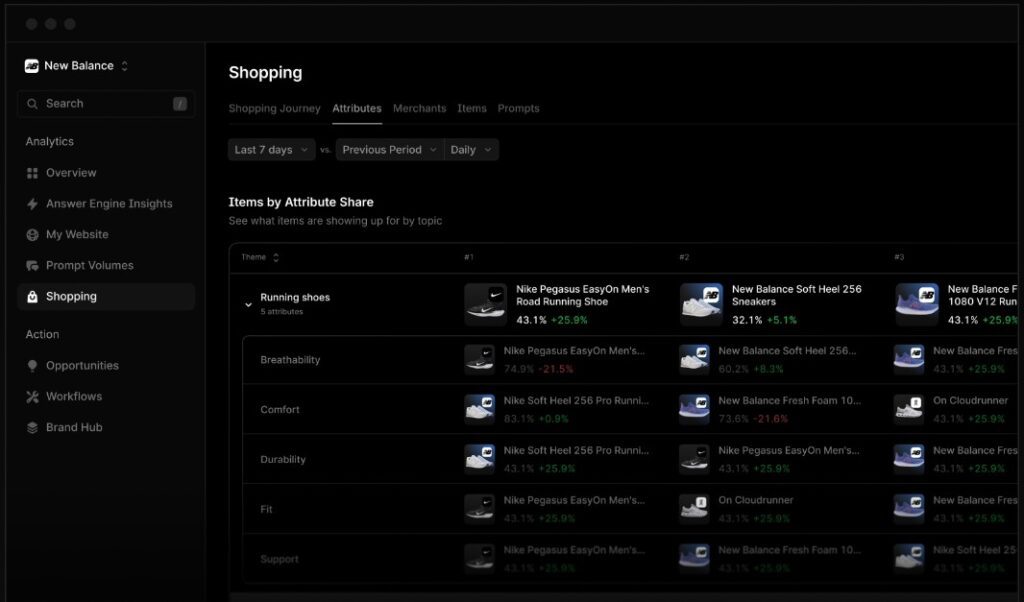
In this Profound AI Review, Shopping capabilities show how your products are described, ranked, and recommended inside AI‑driven shopping experiences. You can see which competitors appear alongside you, which attributes and assets are emphasized, and how that affects AI‑driven purchase recommendations.
Conversation Explorer
Conversation‑level views let you see how often your brand and competitors come up in AI conversations and in what context. This helps you catch emerging topics, shifts in user intent, and new angles for content before they become obvious in traditional SEO data.
Profound Index
The Profound Index is a public leaderboard that ranks brands by how frequently they appear in AI answers for real commercial questions. It gives you an external benchmark of AI visibility in your category and helps you see which competitors currently dominate key topics.
Integration
Profound is built for enterprises, with SOC‑grade security, role‑based access control, and auditability suitable for regulated industries.
It integrates with GA4, BI tools, CDP/CRM, and data‑warehouse stacks, as well as infrastructure like Vercel, Cloudflare, Fastly, Netlify, and AWS, so AI visibility data fits cleanly into your broader analytics and reporting.
Custom dashboards, reporting, and prompt control
Teams can customize dashboards, reports, and prompt sets to match their own KPIs, campaigns, and brand strategy. You can edit, disable, and add prompts, ensuring that the tracking and insights reflect your real priorities instead of a fixed black‑box configuration.
Profound AI Plan and Pricing
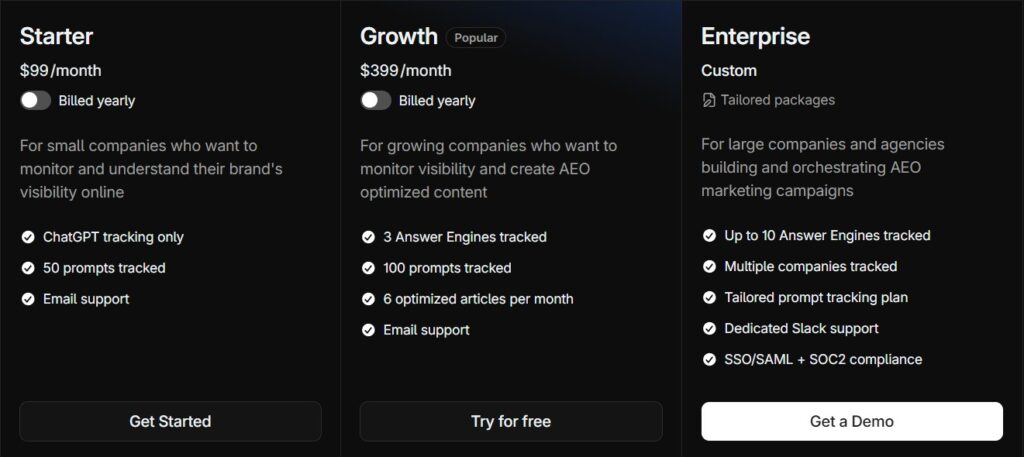
Here are the 3 plans offered by Profound AI.
Starter Plan at $99/mo
The Starter plan is aimed at small teams that just want a low‑friction way to see how they show up in AI answers. It’s priced at 99 USD per month on annual billing and focuses entirely on ChatGPT visibility with a modest quota of 50 tracked prompts and up to 1,500 analyzed responses per month.
You get daily tracking for a single language and region, basic Agent credits for light content or optimization tasks, unlimited domains for Agent Analytics, and email‑only support, but no access to Prompt Volumes searches, exports, API, SSO, or multi‑engine coverage.
Growth Plan at $399/mo
The Growth plan is designed for companies that are actively working on AEO and want to pair monitoring with hands‑on content production. At 399 USD per month on annual billing, it expands coverage to three answer engines (ChatGPT plus two others from the supported list, such as Perplexity or Google AI Overviews) and doubles the allowance to 100 tracked prompts and up to 9,000 monthly responses.
This tier adds six optimized articles per month, more generous Agent credits, CSV/JSON exports, relevant‑keyword support in Prompt Volumes, up to three seats, and keeps email support, but still excludes API access, SSO, Sheets‑based bulk Agent runs, and the fully custom configuration available to Enterprise.
Enterprise Plan
The Enterprise plan is a custom‑priced package built for large brands and agencies that want Profound at the center of their AI visibility operations.
It can cover up to 10 answer engines (including ChatGPT, Perplexity, Google AI Mode/Overviews, Gemini, Copilot, Meta AI, Grok, DeepSeek, and Claude), supports multiple companies within one account, and uses a tailored prompt‑tracking setup with custom regions, languages, response volumes, and Prompt Volumes access. Enterprise unlocks Profound Sheets for running Agents at scale, full data exports and API access, unlimited seats, SSO/SAML with SOC 2‑aligned security, and premium support via dedicated Slack channels and a named specialist with a defined SLA, making it the plan for teams that need deep integration, governance, and cross‑team collaboration around AEO.
Profound AI Review Pros and Cons
| Pros | Cons |
|---|---|
| One of the deepest AI visibility analytics platforms on the market; tracks brand mentions, citations, sentiment, and share of voice across 10+ answer engines (ChatGPT, Perplexity, Google AI Overviews, Claude, Gemini, Copilot, etc.). | Lower‑tier plans (Starter/Growth/Lite) offer reduced coverage, limited prompts, and shorter data history, so you do not get the full experience without paying for Enterprise. |
| Unique Prompt Volumes and conversation data show what people are actually asking AI, helping teams find visibility gaps that traditional SEO tools miss. | Insights can feel overwhelming without clear internal ownership; smaller teams may struggle to turn the volume of data into action without solid processes and AEO know‑how. |
| Profound Actions, Workflows, and AI Agents help convert insights into content changes and optimization projects, supporting AEO, GEO, PR, and product marketing workflows. | You still need other tools and internal resources for keyword research, technical SEO fixes, and implementation; Profound is an intelligence and operations layer, not a complete SEO suite. |
| Shopping Visibility and local/geo tracking cover product recommendations and “best in [location]” prompts that many AEO tools ignore, giving an edge to ecommerce and location‑based brands. | Geo performance depends on how many relevant prompts and markets you track; if prompt sets are too narrow or a region is under‑represented, insights can be patchy. |
| SOC‑grade security, enterprise plans with unlimited seats, long data history, API access, and strong support (including dedicated strategist and Slack support on higher tiers) make it suitable for large brands and agencies. | Pricing is significantly above the AEO market average; serious coverage plus Prompt Volumes and API typically require Enterprise, often in the low‑to‑mid four figures per month. |
| Users often praise the interface, quality of insights, and responsive customer support once onboarded, especially on enterprise and agency plans. | Steep learning curve and setup complexity; it takes time, experimentation, and cross‑team coordination (SEO, content, dev) to fully leverage everything. |
| Multiple plans (Starter, Growth, Enterprise, Agency) let brands and agencies start smaller and scale into deeper visibility tracking as needs grow. | No true free trial and relatively constrained lower tiers (limited prompts, platforms, data history, and no API) make it harder to evaluate long‑term value without committing budget. |
| Differentiated vs generic LLMs and many alternatives, with modules like Prompt Volumes, Profound Index, Shopping Visibility, and Agent Analytics that you do not get from using ChatGPT/Perplexity alone. | For very small teams or very narrow use cases, a simpler or cheaper AEO tool—or just basic tracking plus manual checks in Perplexity/ChatGPT—may be more cost‑effective than a full Profound deployment. |
Profound AI Customer Reviews
From customer feedback and G2 data, Profound AI is generally seen as a powerful but “serious” platform that rewards teams willing to invest time and budget.
Users like how it makes AI visibility tangible, showing exactly which prompts surface their brand, which competitors dominate, and which sources AI trusts most.
Reviewers often highlight robust data, competitive insights, and responsive customer success as standout strengths, especially once workflows are set up and teams build AEO muscle.
On the flip side, many customers mention a learning curve and note that Profound works best when there is a clear owner (SEO/AEO lead or agency partner) who can turn insights into action.
Pricing is another recurring theme: most reviewers feel the value is there for mid‑market and enterprise brands, but smaller teams sometimes find it hard to justify without a strong AI search business case.
Overall, Profound sits in the “leader” bucket on G2 with around 4.6/5 stars, but it is clearly designed for organizations ready to treat AI visibility as a core channel, not a side experiment.
Profound AI Alternative – Our Recommendation (Radarkit)
If you like the idea of AI visibility tracking but want something more accessible and tactically focused, Radarkit is a strong Profound AI alternative to put at the top of your shortlist.
Radarkit tracks how brands appear across major AI assistants—ChatGPT, Perplexity, Gemini, Google AI Overviews/AI Mode, Copilot, and more by running prompts through real browser sessions with proxies, so the data stays close to what users see in different countries.
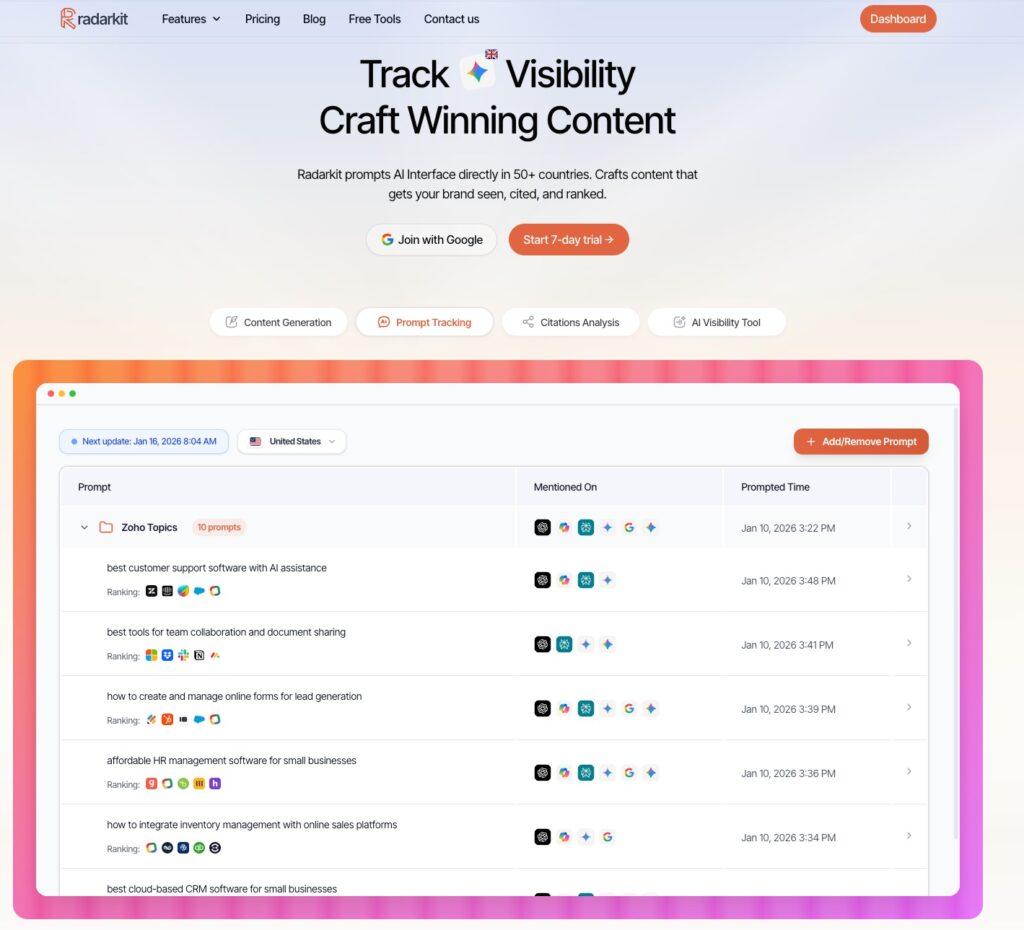
It layers in share‑of‑voice metrics, citation context, GA4‑based traffic analytics, and competitor comparisons, making it feel familiar to SEO and growth teams who are used to rank tracking and attribution.
Where Profound leans into enterprise‑grade breadth and predictive AI search insights, Radarkit focuses on practical workflows and easier experimentation: starter plans begin at a much lower price point, there is a 7‑day trial, and you can roll it into existing SEO/content processes without rebuilding your stack.
For teams that want to prove the impact of AI visibility on traffic and revenue first, and only then consider a heavier platform, Radarkit often makes more sense as a starting point or even as a long‑term core tool.
FAQs: Profound AI Review
How does Profound AI actually get its AI conversation data?
Profound combines its own prompt runs with large‑scale, opt‑in clickstream and conversation data from third‑party providers, giving it access to millions of real user interactions with tools like ChatGPT. According to the company, this data is gathered with user consent and is processed to remain GDPR‑ and CCPA‑compliant.
How long does it typically take to see value from Profound AI?
Independent reviewers and agencies report that it usually takes one to three months to move from setup to clearly actionable insights, especially if you’re rolling it out across multiple teams. The biggest gains tend to appear once prompt sets are tuned to your funnel stages, and Profound is wired into existing SEO and content workflows, rather than used as a standalone dashboard.
What kind of onboarding and training can new teams expect?
Profound offers guided onboarding for paying customers, including help defining prompt sets, configuring workspaces, and connecting analytics or BI tools. Agencies and larger brands often get more hands‑on support, such as shared Slack channels, implementation advice, and playbooks for AEO/GEO programs, which shortens the time to adoption.
Does Profound AI replace traditional SEO tools like rank trackers and keyword suites?
No—Profound sits alongside, not instead of, tools like Ahrefs, Semrush, or traditional rank trackers. It focuses on AI answer visibility, prompt‑level demand, and LLM behavior, while classic SEO platforms still handle keyword discovery, backlink analysis, and standard SERP rank tracking.
Are there any privacy or compliance concerns teams should be aware of?
Profound markets itself as enterprise‑grade and compliant with GDPR/CCPA, and it emphasizes that all third‑party data is opt‑in and anonymized at the user level. That said, some industry commentary has questioned the opacity around data providers, so legal or compliance teams at larger organizations often review Profound’s data‑handling and DPA terms before rollout
Final Thoughts – Profound AI Worth the Investment
Profound AI is worth the investment if you’re a mid‑market or enterprise team (or a larger agency) that already treats AI search as a serious channel and can afford the Enterprise tier, where its multi‑engine coverage, Prompt Volumes, and integrations really pay off.
For smaller teams, early‑stage startups, or anyone just “testing” AEO, the cost, learning curve, and limits on lower plans make it hard to justify when lighter, cheaper AI visibility tools can cover the basics more efficiently.