This Searchable AI review is for marketers, brands, and agencies that want a clearer view of how they appear in AI search results. The platform tracks brand mentions, citations, competitor visibility, buyer prompts, and content opportunities across tools such as ChatGPT, Perplexity, and Google AI Overviews.
This Searchable AI review breaks down its core features, pricing, pros and cons, and the best alternative for teams with different needs.
So without any further ado, let’s get started.
Quick Capability Rating
- AI visibility tracking: 4.3 / 5
- Competitor analysis: 4.2 / 5
- Prompt research: 4.1 / 5
- Content workflow: 3.9 / 5
- Technical AEO audits: 4.0 / 5
- AI shopping analytics: 4.1 / 5
- Agency reporting: 4 / 5
- Value for smaller teams: 3.8 / 5
- Overall capability rating: 4 / 5
What Is Searchable AI?
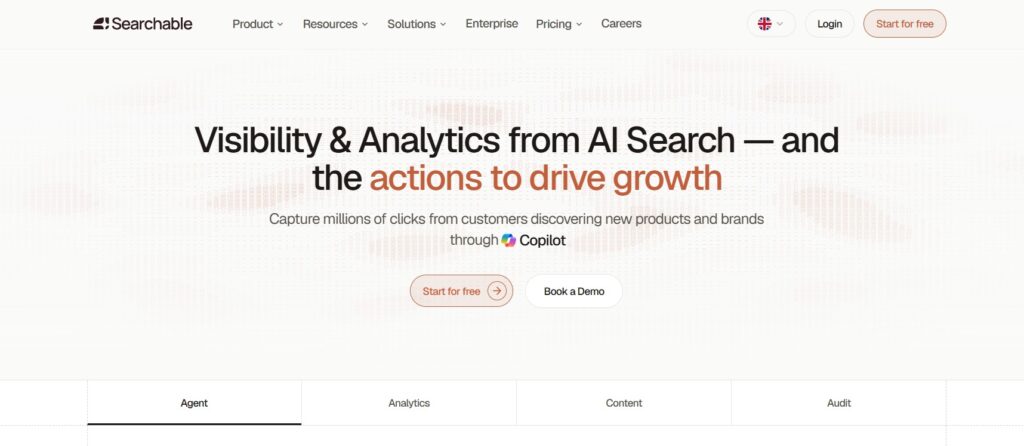
Searchable is an AI-powered SEO and Answer Engine Optimization platform. It tracks brand visibility across AI search experiences, then connects that data with prompt research, content work, on-page checks, and reporting.
The platform covers ChatGPT, Google AI Overviews, and Perplexity in its standard plans. Higher-tier and custom setups can include platforms such as Claude, Copilot, Gemini, Google AI Mode, Grok, and DeepSeek.
The main appeal of Searchable is that it does not stop at a visibility score. You can examine competitor share of voice, citations, source pages, brand sentiment, location-level performance, and the prompts that influence AI answers.
Quick Verdict: Who Should Use Searchable in 2026?
This Searchable AI review finds the platform most suitable for established brands, in-house SEO teams, ecommerce businesses, B2B software companies, and agencies that need a complete AEO workflow. It is especially useful when AI search tracking needs to become a regular part of content, technical SEO, and reporting work.
Searchable makes sense if your team already has content production capacity and someone responsible for acting on the insights. The platform can identify where visibility is weak, but the real value comes from publishing better pages, improving entity clarity, fixing technical issues, and tracking the outcome over time.
Smaller sites that only need a lean prompt tracker may find the entry price harder to justify. In that case, a more focused platform can be a better place to start.
Searchable Review: Core Feature Pillars
The strongest part of this Searchable AI review is the breadth of the platform. Searchable brings tracking, analysis, planning, technical checks, content creation, and client reporting into one workspace.
AEO Insights: Your AI Search Command Center
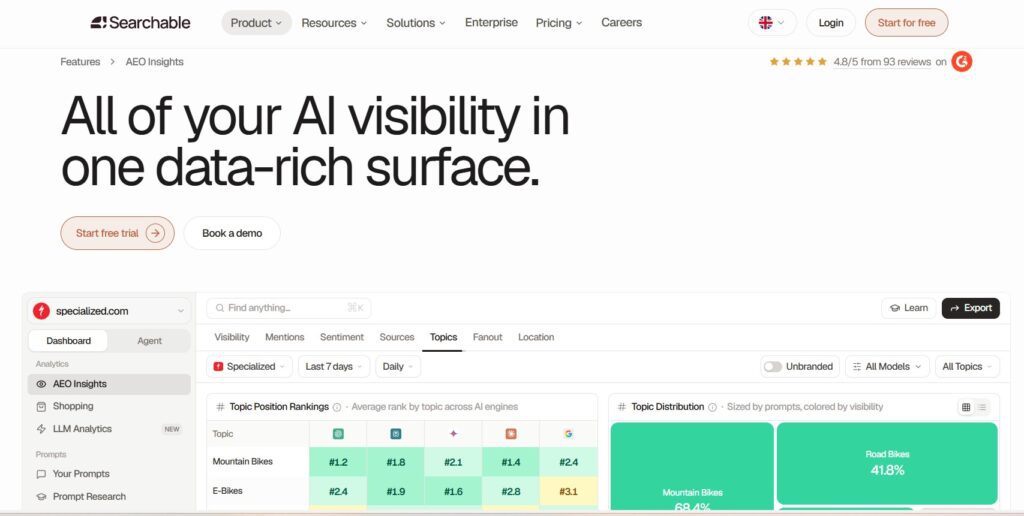
AEO Insights is the central analytics area inside Searchable. It tracks visibility trends, average position, competitor performance, share of voice, citations, mentions, sentiment, source domains, topics, query fanout, and location data.
For an SEO manager, this is more useful than running random searches in AI tools and taking screenshots. You can see whether your brand is appearing consistently, which competitors own the conversation, and where specific topics are falling behind.
The citation and mention split is particularly valuable. A brand can be named in an answer without being used as a supporting source, and those are two different signals. Searchable separates them so teams can focus on earning both stronger brand recognition and stronger source visibility.
The Sources view helps identify domains and URLs that AI systems use while answering category questions. This can guide content planning, digital PR, partnership work, and competitive source analysis.
Agent & Plan Mode: From Data to Action
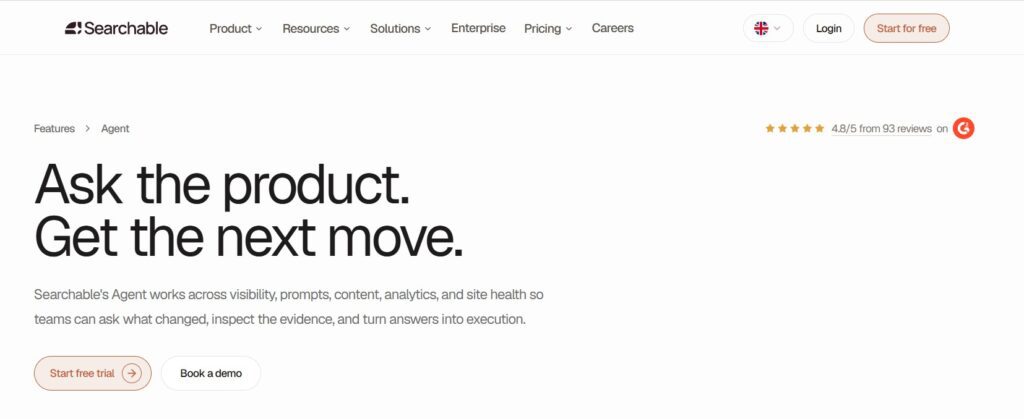
Searchable’s Agent lets users ask questions across visibility, prompts, content, citations, analytics, and site health data. It is built to explain the evidence behind an answer and convert findings into actions.
For example, instead of manually checking several dashboards, a marketer can ask why visibility declined for a topic or what content work should be prioritized for a competitor gap. That makes the platform easier to use for teams that want direction, not just another reporting layer.
Plan Mode adds a practical planning element. It can turn a data finding into an execution plan, which is helpful when a team needs to convert AI visibility research into a clear content or technical roadmap.
In this Searchable AI review, the Agent stands out because it connects analysis with next steps. That matters when AI search data is still unfamiliar to stakeholders who are used to keyword rankings and organic traffic reports.
Prompts: Buyer Questions and AI Intent Research
Searchable’s Prompts section tracks the questions that matter to a brand and helps discover more prompt ideas through brand, topic, and search context.
This feature changes the research process from keyword-first to question-first. A keyword such as “best CRM software” is useful, but users often ask AI tools fuller questions such as “Which CRM is best for a small B2B sales team with HubSpot integration?” The second query provides more context about intent, use case, and buyer needs.
Prompt research is useful for:
- Finding high-intent recommendation questions
- Tracking category, comparison, and alternative prompts
- Grouping prompts by brand, product, region, or topic
- Seeing which competitors appear repeatedly
- Planning pages that answer specific buyer questions
A good prompt set becomes a living measurement framework. Instead of monitoring vague brand mentions, your team can track the questions that could lead to product discovery, demos, signups, or sales.
Content Studio: Creating AI-Ready Pages and Articles
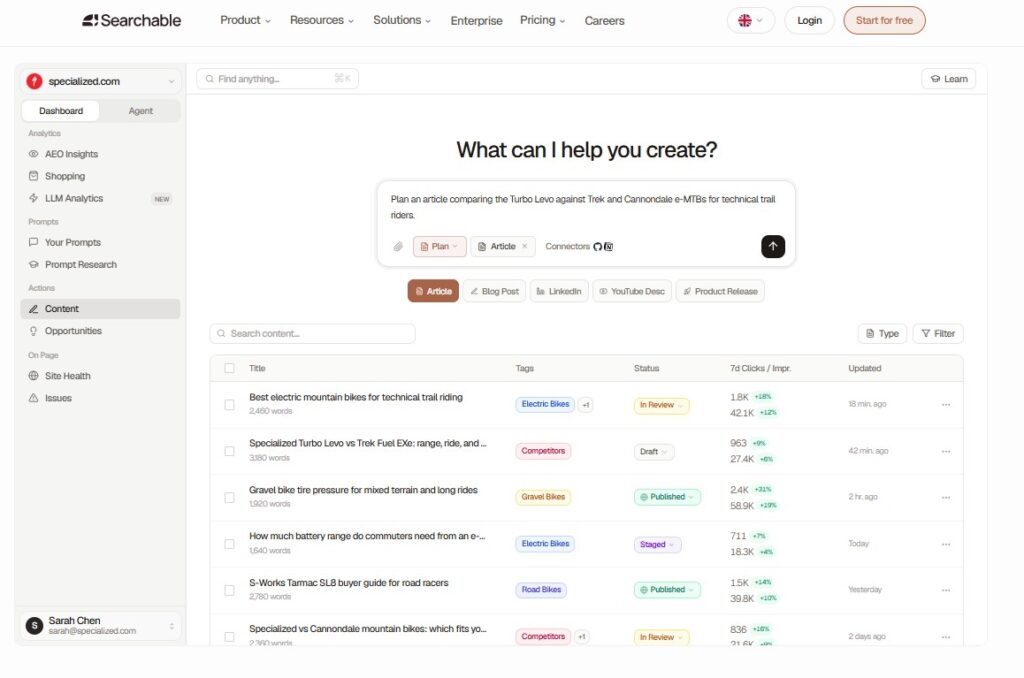
Searchable includes a Content feature with an agent and canvas for planning, writing, scoring, revising, and exporting content for AI search.
The workflow is useful because it keeps content work close to the AI visibility data. If a topic has weak citation coverage or a competitor owns a valuable prompt cluster, the team can move from the insight to a content brief without switching between several disconnected tools.
Searchable supports articles, landing pages, and product descriptions. Its pricing page also lists monthly article allowances for each main plan, from 20 on Pro to 200 on Enterprise.
Content output still needs a real editor. A good workflow is to use the platform for research, page structure, missing topic coverage, and initial drafting, then add product knowledge, firsthand examples, expert review, and brand personality before publishing.
On-Page & Site Health: Technical AEO Audits
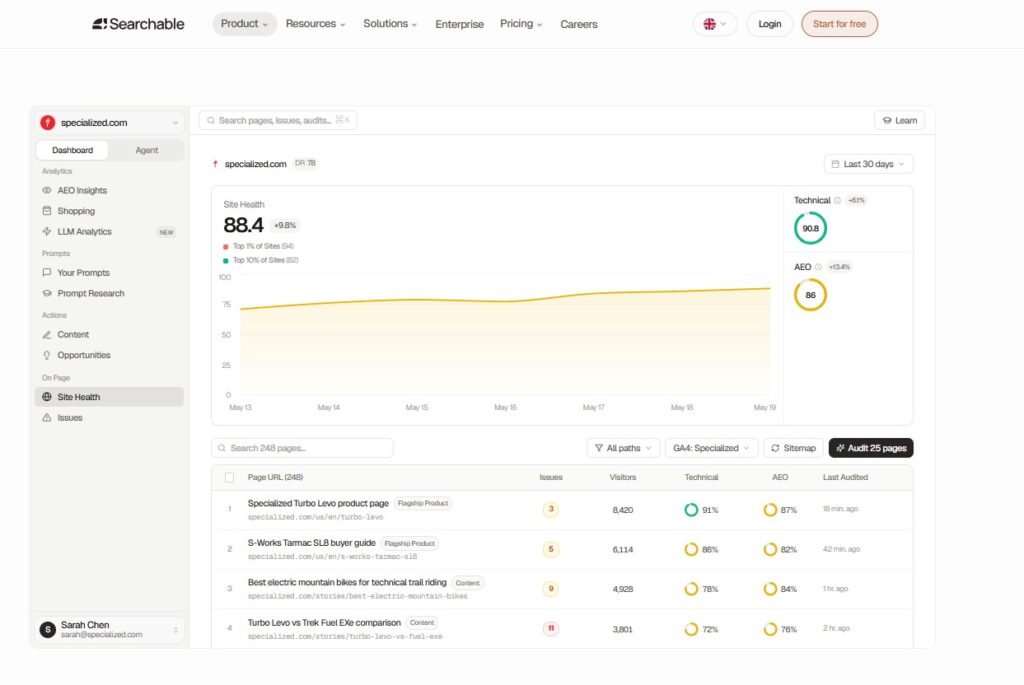
The On-Page section checks technical health, page-level issues, schema, crawler access, and AEO readiness.
That is important because strong writing alone is not enough. AI systems need to access, understand, and extract useful information from a page. Poor internal structure, unclear headings, thin product information, missing schema, or crawler restrictions can limit how well a page performs in AI search.
Searchable’s audit workflow can help teams check:
- Site health issues that affect crawlability
- Schema opportunities and structured-data gaps
- Content structure and page clarity
- AEO readiness across important pages
- Technical fixes to prioritize alongside content work
This is one of the reasons Searchable feels broader than a basic AI mention tracker. It covers the technical work that supports long-term AI visibility.
AI Shopping, LLM Analytics & Traffic: Advanced Analytics Surfaces
AI Shopping is designed for ecommerce teams. It tracks product visibility, brand share, merchant coverage, and the prompts that produce shopping-related AI answers.
This can be helpful for brands that sell products through their own store, marketplaces, and retail partners. If an AI engine names your product but directs shoppers to another merchant, that is different from being visible with your preferred store or retailer.
LLM Analytics measures AI crawlers, citations, referral activity, source pages, and conversion movement in analytics data. The Traffic area focuses on AI-influenced sessions, source mix, landing pages, and changes in performance.
These modules make the Searchable AI review more relevant for teams that need to connect visibility with business results. Being mentioned in AI answers is useful, but traffic, qualified leads, product discovery, and conversions are what make the work worthwhile.
MCP & Integrations: Connecting AI Visibility to Your Stack
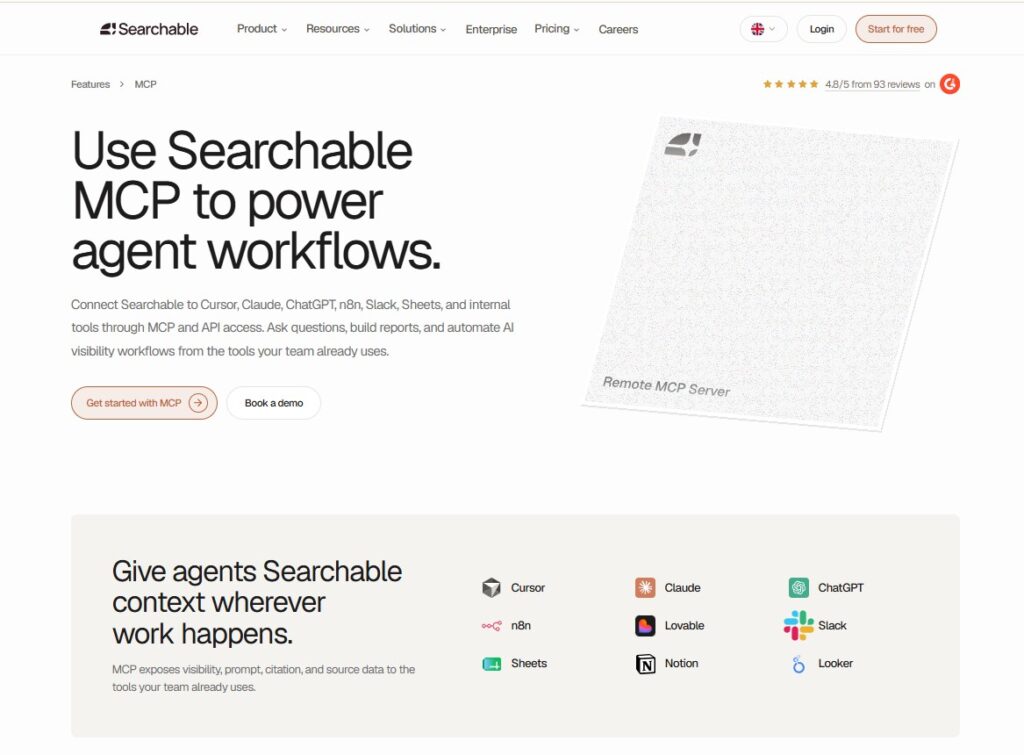
Searchable includes MCP support, which allows its visibility data to connect with agents, automations, internal tools, and reporting workflows.
Pro includes MCP, while Scale and Enterprise add tools such as Looker Studio, white-label reports, and API access.
For a marketing team, this means AI visibility data does not need to sit in a separate dashboard forever. It can become part of regular client reporting, leadership updates, internal performance dashboards, and automated workflows.
The integration depth is more meaningful for agencies and larger teams than for a solo marketer. Still, it gives Searchable room to grow with a business as AI search reporting becomes more established.
Agency Features: White-Label Reporting and Client Pitch Workspaces
Searchable has a dedicated Agency feature set for agencies managing multiple client accounts. It includes client AI visibility workspaces, prospect audits, white-label reporting, and API access.
This is useful for agencies that want to add AEO or GEO services without building a reporting process from scratch. A sales team can use prospect visibility data in an audit or pitch, then the delivery team can use the same platform for ongoing prompt tracking, reporting, and optimization work.
The Scale plan includes white-label reports, which makes it the most practical starting option for agencies that need client-facing deliverables.
Searchable AI Review Plan and Pricing
Plans for Brands
| Plan | Price | Key details |
|---|---|---|
| Pro | $125/month | Entry plan for one project. Around 100 prompts per model, roughly 9k AI answers per month, 20 articles, 200 audits, core tracking, MCP, exports, 14-day trial. |
| Scale | $400/month | Mid-tier for multiple projects. Around 500 prompts per model, about 45k AI answers, higher content and audit limits, up to 10 projects, plus Looker Studio and white-label reports. |
| Enterprise | From $999/month | High-volume plan. Around 1,250 prompts per model, roughly 112k AI answers, larger content and audit capacity, unlimited projects, unlimited data retention, dedicated specialist. |
| Custom | Custom pricing | Tailored setup on top of Enterprise, with custom prompt tracking, access to all supported AI models, custom tracking frequency, unlimited projects, API and SSO. |
Plans for Agencies
| Plan | Price | Key details |
|---|---|---|
| Launch | $250/month | For solo operators and small agency offerings. Around 200 tracked prompts per model, 18k AI answers analyzed monthly, 20 articles, 200 site audits, 5 projects, reports, MCP, Looker Studio, white-label reports, API access. |
| Growth | $400/month | Popular plan for growing agencies with several clients. Around 500 tracked prompts per model, 45k AI answers monthly, 80 articles, 1,000 site audits, 10 projects, specialized agency cohort training, reports, MCP, Looker Studio, white-label reports, API access. |
| Enterprise Agencies | $999+/month | For independent agencies with deeper white-label needs. Around 1,250 tracked prompts per model, 112,500 AI answers monthly, 200 articles, 3,000 site audits, unlimited projects, specialized agency training, reports, MCP, Looker Studio, white-label reports, API access, platform white-label coming soon. |
| Custom | Custom pricing | For global agencies needing custom coverage and support. Includes everything in Enterprise plus fully customizable prompt tracking, choice of all models, daily or weekly tracking, unlimited projects, custom prompt setup, API access, and Single Sign-On. |
Searchable AI Pros and Cons
This Searchable AI review rates the platform highly for breadth and execution depth. It is built for teams that want to make AI visibility an active part of their SEO and content process.
Pros
- Tracks visibility, citations, mentions, sentiment, share of voice, topics, query fanout, and location data in one platform
- Covers core AI search environments including ChatGPT, Google AI Overviews, and Perplexity, with broader model options for higher-tier accounts
- Combines analytics, prompt research, content work, technical auditing, and reporting rather than treating them as separate activities
- Agent and Plan Mode help turn data into practical next steps
- AI Shopping gives ecommerce teams product, brand, merchant, and shopping-prompt visibility data
- Agency workflows include prospect audits, client workspaces, API access, and white-label reporting
- Unlimited seats are available across the listed core plans, which is helpful for larger internal teams
- A 14-day trial gives teams time to test the platform before committing
Cons
- The $125 monthly starting price may not fit small sites that only need basic AI prompt monitoring.
- The wider reporting and client-facing features become available from the Scale plan, which costs $400 per month.
- The platform has many modules, so teams need a defined reporting and action process to get the most out of it.
- Content tools can speed up production, but every important page still needs expert review before publishing.
- Custom coverage for some AI models and enterprise requirements requires a sales conversation.
Searchable AI Alternative to Consider
| Tool | Starting price | AI coverage | Location coverage | Best for |
|---|---|---|---|---|
| Searchable | $125/month | ChatGPT, Google AI Overviews, Perplexity only | Broad market-level AI analytics, not deep per-city GEO checks. | Mid-sized brands and agencies needing a full AEO and reporting stack. |
| RadarKit | $29/month | ChatGPT, Perplexity, Gemini, Copilot, Google AI Mode, Google AI Overviews. | 50+ locations on core plans, more on higher tiers. | Smaller teams and growing agencies wanting affordable AI visibility and GEO tracking. |
RadarKit is the best Searchable AI alternative for teams that want to track AI visibility without moving straight into a higher-priced, enterprise-style platform. It monitors brand performance across ChatGPT, Perplexity, Gemini, Microsoft Copilot, Google AI Mode, and Google AI Overviews, while also tracking average position, sentiment, competitor presence, and share of voice.
A major strength is its location-based monitoring. RadarKit can run AI search checks across 50+ locations on Lite, Growth, and Pro plans, with 70+ available for Enterprise, which helps brands see how answers can differ by country or market.
It also includes AI agents that turn data into work. The Content Agent helps create and improve content, while Outreach, Reddit, and Chat Agents support promotion research, community analysis, and day-to-day questions.
RadarKit connects with Google Search Console, Google Analytics, and WordPress on all paid plans. This makes it easier to link AI visibility work with organic search data, site content, and AI-referred traffic.
Key Features
- AI share of voice: Compare how often your brand appears in AI answers against key competitors for the prompts you track.
- Location-based tracking: Check AI responses across 50+ locations to see where visibility is strong or weak.
- NLP and citation-led content: Use cited sources, entities, and important terms from AI answers to guide content updates.
- GEO Writer: Create or refresh AI-search-focused pages using citation data, query patterns, and competitor coverage.
- Query fanout tracking: Find related questions and subtopics that branch out from a target prompt and turn them into content ideas.
- AI traffic monitoring: Track visits coming from AI platforms and zero-click answers, not just traditional search engines.
- Plan Agent: Identify visibility gaps from Search Console and citation data, then turn them into a practical action plan.
- Content Agent: Optimize articles using tracked prompts, entities, and related queries so they are easier to understand and cite.
- Outreach Agent: Discover trusted, cited websites, pull contact details, and build outreach lists based on real citation behavior.
- Reddit Agent: Surface Reddit conversations that AI tools cite in your niche for research, engagement, and topic ideas.
- Chat Agent: Ask routine questions, run quick checks, and handle smaller tasks directly inside the platform.
- Integrations: Connect Google Search Console, Google Analytics, and WordPress so visibility, traffic, and content workflows stay aligned.
Plan and Pricing
Pricing begins at $29 per month for Lite, which includes two projects, 15 tracked prompts, 72-hour refreshes, AI traffic analytics, 50+ locations, and agent access. Growth costs $79 per month, while Pro costs $139 per month and adds 10 projects, 100 prompts, daily refreshes, more agent credits, and priority support.
For smaller brands, freelancers, and growing agencies, RadarKit offers a more accessible starting point than Searchable.
FAQs: Searchable AI Review
Is Searchable AI an SEO tool?
Searchable AI is an SEO and AEO platform. It focuses on how brands appear in AI-generated answers while also offering prompt tracking, content planning, technical audits, traffic insights, and competitor analysis.
Which AI platforms does Searchable track?
Standard plans track ChatGPT, Google AI Overviews, and Perplexity. Enterprise and Custom options can cover additional platforms, including Claude, Copilot, Gemini, Google AI Mode, Grok, and DeepSeek.
Can agencies use Searchable AI?
Yes. Searchable has agency-oriented features for client workspaces, prospect audits, white-label reports, API access, and multi-client AI visibility reporting.
Does Searchable create content?
Yes. The Content feature lets teams plan, write, score, revise, and export content designed for AI search workflows. The plan limits range from 20 articles per month on Pro to 200 on Enterprise.
Is Searchable useful for ecommerce brands?
Yes. AI Shopping tracks products, brands, merchants, and shopping prompts, making it useful for ecommerce teams that want to understand product visibility in AI-driven buying journeys.
Can Searchable track competitors in AI search?
Yes. Searchable includes competitor visibility, average position, share of voice, citation, source, and sentiment analysis. This helps teams compare their presence with competing brands across target prompts.
Does Searchable offer a free trial?
Searchable offers a 14-day free trial for Pro and Scale plans. The trial does not require a long-term commitment.
Conclusion
This Searchable AI review shows that the platform is more than a basic AI mention tracker. It brings together visibility reporting, citations, competitor intelligence, prompt research, content creation, technical AEO checks, shopping data, traffic analysis, and agency reporting in one place.
Searchable is a strong choice for brands and agencies that already take SEO seriously and want a structured way to build AI search visibility over time. Its feature depth makes the most sense when there is a clear team process for turning insights into content, technical improvements, and reporting.
For startups, freelancers, and smaller teams that want a simpler, action-focused option, RadarKit is the best Searchable AI alternative to consider. It provides the core tracking, citation, prompt, content, traffic, and agent features needed to start improving visibility across major AI search platforms.