In this article, AthenaHQ vs RadarKit for Local AEO is settled on features, location support, security and price. AthenaHQ is an enterprise platform for large brands and many locations, while RadarKit is a lower-priced tracker for what AI tells customers in one city.
Local AEO means getting ChatGPT, Gemini, Google AI Mode and similar assistants to name your business when someone nearby asks. Both tools are judged on how well they help with that.
RadarKit is named the best overall pick for local businesses. So, without any further ado, let’s get started.
Quick Pick: AthenaHQ vs RadarKit for Local AEO
- RadarKit: Best for owners of one shop or a handful of branches, plus local agencies, who want to see AI answers for their own city, with the nearby competitors named and agents to follow up.
- AthenaHQ: Best for franchise networks, restaurant groups and multi-brand enterprises that need approvals, security reviews, accuracy checks and workflows shared by several teams.
AthenaHQ vs RadarKit for Local AEO: Comparison Table
| Tool | Starting price | Free trial | Location support | AI platforms tracked | Local competitor data | Features Provided |
|---|---|---|---|---|---|---|
| RadarKit | From $29 monthly | One week free, then 48 hours to ask for a refund | Prompts leave from residential IPs in more than 50 countries; Enterprise adds state and city | ChatGPT, AI Mode, AI Overviews, Copilot, Perplexity, Gemini | Every recommended business with category, stars, reviews and position | Local Radar, Shopping Radar, Ads Radar, Query Fanout, Plan Agent, Outreach Agent, Reddit Agent, Content Agent, Chat Agent, Client Portal, MCP, REST API |
| AthenaHQ | Starter is $295 monthly, spent as credits | No trial; a free Essential tier includes $25 of credit | Country on Starter; multi-region and multi-language on Enterprise | 5 on Essential, 11 on Starter | Location-level tracking and benchmarking in the multi-location material | Olympus dashboard, Prompt Volume Estimation, Source Intelligence, Action Center, Content Optimization Agent, Athena Citation Engine |
What Local AEO Involves
When a person types “best dentist near me” or “family pizza in Leeds” into an assistant, the answer names a small set of businesses and cites a few sources. Local AEO is the work of getting your business into that set and keeping the details right.
Three things matter. The first is measuring how often you are named and at what position in each city. The second is learning which directories, review domains and outlets the assistant trusts. The third is acting on the gaps with content, citations and outreach. Metrics matter here, and 6 AI Search Visibility Metrics You Can’t Ignore in 2026 covers which figures belong in a client report.
RadarKit Overview
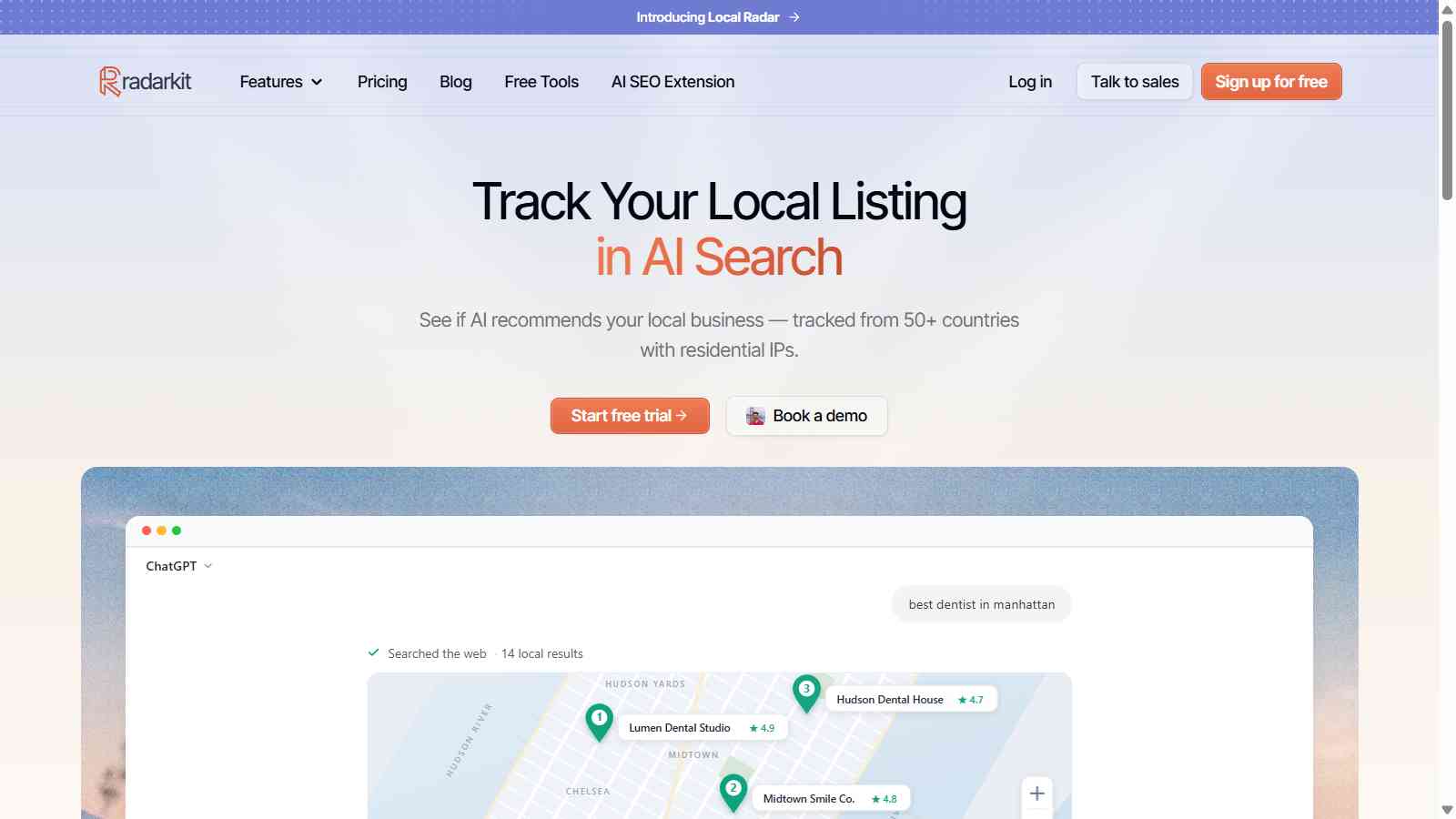
RadarKit is an AI visibility tool made for brands, local shops, online sellers and agencies. Customers put questions to six assistants (ChatGPT, Google AI Mode, Google AI Overviews, Microsoft Copilot, Perplexity and Gemini), and RadarKit stores each answer along with every brand and competitor it names.
It collects data by prompting the real chat and search interfaces, not model APIs, and each prompt can run from a residential IP in more than 50 countries. Five AI agents, a client portal and branded reports are part of the product.
For AthenaHQ vs RadarKit for Local AEO, it is the option built around the local question.
RadarKit’s Key Features
- AI Visibility Tool: Each project gets a Visibility Score and a Brand Reputation score, and both are set against the previous seven days.
- Average Position: One number gives where your domain lands inside AI answers, and an Average Position Rank sets it beside every other source that appears.
- Sentiment Breakdown: Brand appearances are split into positive, mixed and negative, and Top Sentiment Insights count phrases such as “known for affordability”.
- Share of Voice: Competitors answer the same prompts as your business, so their share can be read next to yours.
- Query Fanout: When a model quietly searches the web before it answers, those searches are recorded from real browser sessions and can be exported or passed to content work.
- Local Radar: Pick a prompt like “best dentist in Manhattan” and see each recommended business with its category, stars and review total, along with how often you are named (3 of 9 answers, for example), your position and a 30-day line.
- Shopping Radar: Product carousels in AI answers become a table of products, stores, prices and positions, and a gap view names prompts where your items never appear.
- Ads Radar: Sponsored results inside AI answers are recorded in a real browser, with the advertiser, copy, landing URL, first date seen, top bidder and share of answers carrying ads.
- Residential IP Locations: Each prompt can leave from a home-style IP in 50-plus countries, and Enterprise extends that to state and city tracking across 70-plus locations.
- Plan Agent: It reads live Search Console and AI citation data, finds where the brand is invisible and writes a strategy sheet that assigns each task to another agent.
- Outreach Agent: For every domain that cites competitors it locates a contact, drafts an on-brand email, sends through your Gmail, follows up and bargains within a ceiling you set.
- Reddit Agent: It opens the threads AI cites for your space, pulls in the discussion, notes which competitors come up and suggests how to enter naturally.
- Content Agent: Give it an article link and it anchors the piece to a tracked prompt, extracts entities, inserts query fanouts and returns it ready in the WordPress editor.
- Chat Agent: Ask about any project in plain language, or upload a .txt file of up to 1,000 words so the answer has context.
- Content Generation: New articles are built from Google results combined with AI citation data.
- Monitor Traffic: AI Traffic Analytics counts the visits that assistants send to your domain.
- GSC Integration: Search Console connects on every plan, with Google Analytics and WordPress alongside.
- Client Portal: Agencies give each client a login, with multi-project tracking and full history behind it.
- Branded PDF Reports: Reports go to clients under your own branding.
- REST API: Developers can read visibility, responses, top source domains, share of voice, rankings, sentiment and query fanout, add prompts, rerun a prompt on demand, export data and create an article.
- MCP: The Radarkit MCP server gives ChatGPT, Claude, Cursor or Codex 17 read tools, 4 write tools and 3 agent tools through a single sign-in, and every call reports credits charged and remaining.
- Free Tools: An LLMs.txt checker, an LLMs.txt generator and the AI SEO Extension are free.
RadarKit Pricing
- Lite: $29 per month covers two projects, fifteen prompts refreshed every 72 hours and 900 analyzed responses.
- Growth: $79 per month covers five projects, fifty prompts refreshed daily, 9,000 responses and two more seats.
- Pro: $139 per month covers ten projects, a hundred prompts refreshed daily, 18,000 responses, five more seats and priority support.
- Enterprise: Contract pricing, billed yearly, with unlimited projects, custom prompt tracking, 70-plus locations, single sign-on, unlimited seats and a dedicated manager.
- Monthly Agent Allowances: Content Agent: 6, 19 or 32 articles. Outreach and Reddit Agents: 10, 20 or 40 shared credits. Chat Agent: 15, 25 or 50 messages. Branded PDFs: 2, 10 or 20.
- Free Start: Seven days without payment, and a full refund for 48 hours after the first charge.
Best For (RadarKit)
In AthenaHQ vs RadarKit for Local AEO, RadarKit fits single-location businesses, small multi-branch brands, local agencies and small SEO teams that want city-level AI tracking and agents without an enterprise contract.
Pros of RadarKit
- Entry Price: $29 a month is about a tenth of AthenaHQ Starter.
- Local Radar: A named table of nearby competitors with ratings and reviews.
- No Credit Meter: Plans are sized by projects and prompts, not per-response credits.
- Agents Included: All five agents come with every plan.
Cons of RadarKit
- No Governance Suite: There are no approval workflows or accuracy-review tools at enterprise depth.
- No Map Grids: Neighborhood rank maps need a separate map tool.
How RadarKit Can Help Local AEO
For AthenaHQ vs RadarKit for Local AEO, a local business can add prompts such as “best dentist in Manhattan”, run them from a city IP and read the Local Radar table to see who AI recommends and where it ranks. The Plan Agent turns the gaps into tasks, and Growth at $79 holds 50 prompts, enough for ten branches with five prompts each. See our 10 Best Local AI Rank Trackers for Local Businesses for other tools in the category.
AthenaHQ Overview
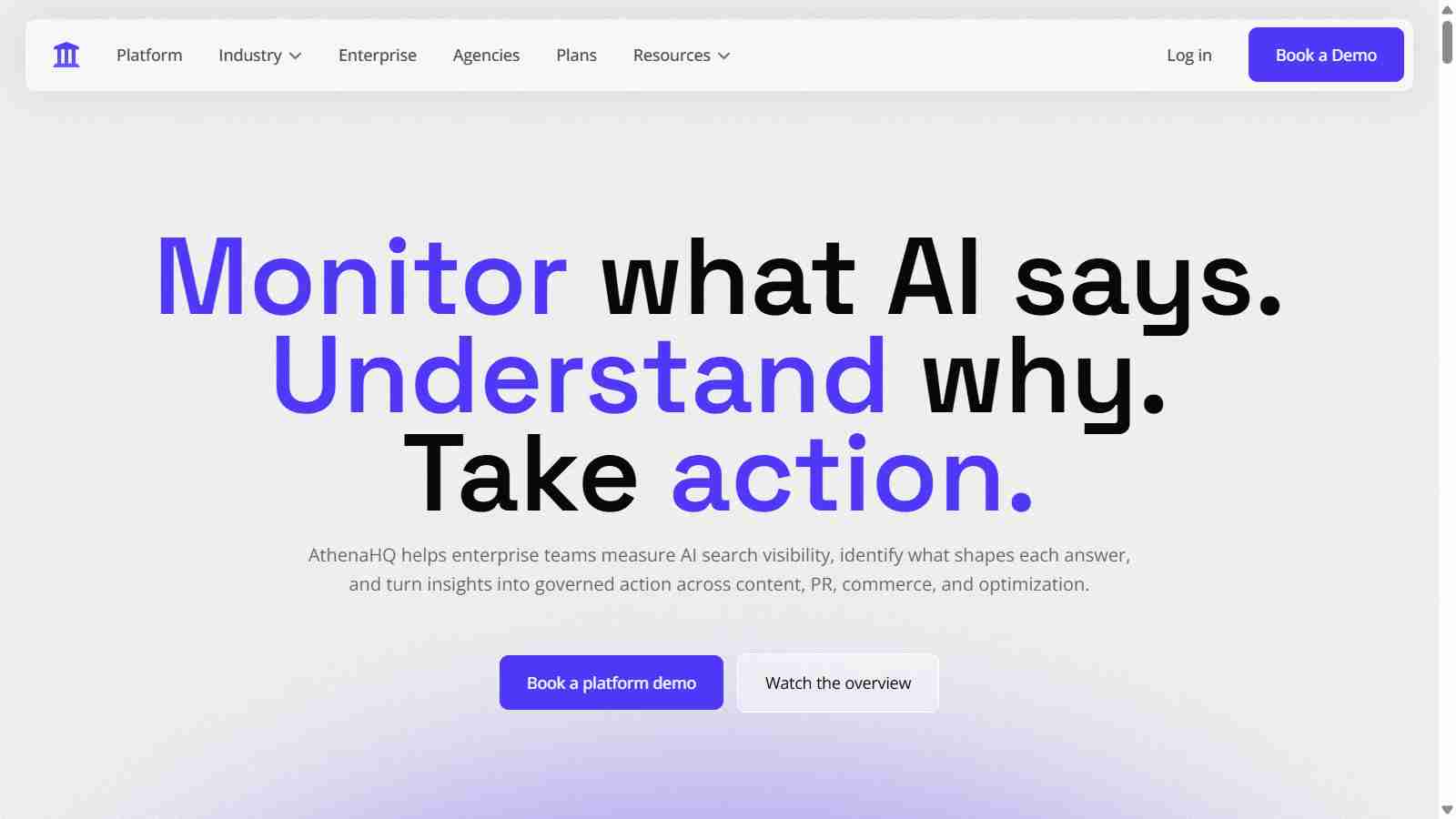
AthenaHQ is an AI search and answer engine optimization platform built for enterprise teams. Its pitch has three steps: monitor how AI answers, understand why, and take action. More than 300 global brands use it, and it carries a G2 High Performer badge for answer engine optimization.
It tracks up to 11 AI models, estimates prompt volume, traces the sources that shape answers and runs workflows for content, citation outreach and commerce. Dedicated Multi-Location sections cover restaurants, franchises, fitness, auto services and location-based services.
In AthenaHQ vs RadarKit for Local AEO, it is the enterprise-scale option. Our AthenaHQ AI Review 2026: Powerful GEO Platform or Overpriced Hype? covers it in full.
AthenaHQ’s Key Features
- AI Visibility & Citations: Presence, brand appearances, citations, share of voice, position and sentiment across AI platforms and markets.
- Olympus Dashboard: The main dashboard for visibility, with a Group Dashboard across several brands.
- Prompt & Demand Intelligence: Prompt Volume Estimation, prompt variations, personas and a Discover tab for new prompts.
- Competitive Intelligence: Unlimited competitor tracking and benchmarking.
- Source Intelligence: Which domains, URLs and social platforms AI cites, with tagging and export.
- Brand Integrity & Crawlability: Detects inaccurate statements and inaccessible URLs.
- Opportunity Prioritization: Ranks the actions with the highest expected impact.
- Action Center: Content Creation, Citation Outreach and Commerce Optimization workflows with ownership and measurement.
- Content Optimization Agent: Self-learning content improvement and actions on owned content and outside sources.
- Location-Level Recommendation Tracking: Monitors AI recommendations for each location individually.
- Local Accuracy Monitoring: Checks that AI gives correct hours, services and contact details for each address.
- Cross-Location Benchmarking: Compares locations, markets and regions to decide where to optimize.
- Restaurant and Franchise Tools: Cuisine, neighborhood and occasion tracking, menu accuracy, reservation attribution, network-wide tracking and franchisee benchmarking.
- Knowledge Base and Oracle: On Enterprise, answers are checked against verified brand facts to find discrepancies.
- Athena Citation Engine and Athena Recommendation Engine: Enterprise engines for citations and recommendations.
- Governance and Security: Rules for brand voice and approved sources, a two-step review flow, SAML and OIDC single sign-on, an audit log, SOC 2 and GDPR compliance.
- Executive Dashboard: BI tool support for Tableau, Power BI and Looker on Enterprise.
AthenaHQ Pricing
- Essential: Free. $25 of credit, 300 credits, five AI platforms (ChatGPT, Perplexity, AI Overviews, Gemini, Copilot), unlimited users.
- Starter: $295 a month. 3,600 credits, 11 models, unlimited topics, prompts and competitors, country-level support, CSV export, content optimization agent. Annual billing saves 17 percent.
- Credits: One credit equals one AI response. Claude, Grok, DeepSeek, Meta AI and Mistral cost five credits each.
- Add-Ons: API access and extra credits are paid add-ons.
- Enterprise: Custom. Multi-region and multi-language support, persona targeting, Knowledge Base, audit log, SSO and white-glove setup.
Best For (AthenaHQ)
Within AthenaHQ vs RadarKit for Local AEO, AthenaHQ fits large franchises, restaurant groups, multi-brand businesses and agencies that need governed workflows and security reviews.
Pros of AthenaHQ
- Deep Local Material: Restaurant, franchise, fitness and auto sections cover location-level tracking and accuracy checks.
- Governance: Approval flows, brand rules and access control suit big teams.
- Compliance: SOC 2 Type II and GDPR support security reviews.
- Eleven Models: Wide AI platform coverage.
Cons of AthenaHQ
- Starter Price: $295 a month is high for one or two locations.
- Credit Meter: Five of the 11 models cost five credits per response, so usage is hard to predict.
- Country-Level Support: Starter does not separate cities.
- Add-On Costs: API and extra credits cost more.
How AthenaHQ Can Help Local AEO
In AthenaHQ vs RadarKit for Local AEO, a franchise network can watch AI recommendations at every franchisee location from one dashboard, flag off-brand descriptions and benchmark top and bottom performers. A restaurant group can track recommendations by cuisine, neighborhood and occasion and see whether AI sends diners to OpenTable or Resy instead of the restaurant’s own booking link. Our 10 Best AthenaHQ Alternatives to Explore in 2026 compares it with other tools.
AthenaHQ vs RadarKit for Local AEO: Head-to-Head
Local Tracking
In AthenaHQ vs RadarKit for Local AEO, RadarKit reads a place the way a customer does: a residential IP in the chosen city asks the prompt, and Local Radar stores every recommended business with its rating and reviews. AthenaHQ tracks recommendations location by location and benchmarks them, but its local tools are written for multi-location brands.
Location Support
For AthenaHQ vs RadarKit for Local AEO, RadarKit supports city-level runs on every plan and adds state and city tracking across 70-plus locations on Enterprise. AthenaHQ Starter supports location at country level, and multi-region support belongs to Enterprise.
Accuracy Monitoring
Among the points in AthenaHQ vs RadarKit for Local AEO, AthenaHQ offers Local Accuracy Monitoring and, on Enterprise, a Knowledge Base with Oracle discrepancy detection to check hours, services and contact details. RadarKit does not have an equivalent accuracy suite, so a business that must audit every statement AI makes should weigh this.
Taking Action
For taking action in AthenaHQ vs RadarKit for Local AEO, AthenaHQ routes opportunities into governed Content Creation, Citation Outreach and Commerce Optimization workflows. RadarKit uses five agents: the Plan Agent builds the task sheet, the Outreach Agent emails domains that cite competitors, the Reddit Agent reads cited threads, the Content Agent rewrites articles and the Chat Agent answers questions.
Pricing Model
On price in AthenaHQ vs RadarKit for Local AEO, AthenaHQ Starter is $295 a month in credits, with a free Essential plan for testing. RadarKit is sized by projects and prompts: $29, $79 and $139 a month, with the portal, API and MCP included in every plan.
Reporting and Teams
For agencies in AthenaHQ vs RadarKit for Local AEO, RadarKit includes a Client Portal and Branded PDF Reports for agencies. AthenaHQ offers a Group Dashboard, an executive dashboard with BI tool support and agency pitch workspaces.
Security and Compliance
AthenaHQ names SOC 2 Type II, GDPR and a NIST CSF 2.0 implementation. RadarKit’s Enterprise plan adds single sign-on, and a business with strict security requirements should ask both for current details.
Developer Access
For developers in AthenaHQ vs RadarKit for Local AEO, RadarKit includes a REST API and an MCP server on every plan. AthenaHQ treats API access as a paid add-on on Starter.
What to Check Before Choosing
- Location Detail: Decide whether you need a country, a city or a branch-by-branch view.
- Number of Locations: Governance tools pay off at dozens of locations, not at one or two.
- Pricing Model: Compare credits against prompts and projects for your expected volume.
- Reporting Needs: Check whether you need a portal, branded PDFs or executive dashboards.
- Follow-Up Work: Decide whether you need governed workflows or agents that finish tasks.
Pricing for Two Local Businesses
To price AthenaHQ vs RadarKit for Local AEO, take a three-branch business with five prompts per branch, 15 prompts in total, and a 25-location franchise with ten prompts per location.
- RadarKit, Three Branches: Lite at $29 holds exactly 15 prompts, and Growth at $79 adds daily scans for 50.
- AthenaHQ, Three Branches: Starter at $295 supplies 3,600 credits, where each response costs one credit and some models cost five.
- RadarKit, 25 Locations: Prompt needs of 250 point to Enterprise for custom prompts and 70-plus locations.
- AthenaHQ, 25 Locations: Multi-location tracking, benchmarking and governance sit in Enterprise, which is quoted.
Final Thoughts: AthenaHQ vs RadarKit for Local AEO
AthenaHQ is the stronger platform for a large franchise or multi-brand enterprise that needs governance, accuracy checks and security reviews. Its price, credit model and country-level Starter plan make it a mismatch for most small local businesses.
RadarKit is the best overall pick. It starts at $29 a month, reads what AI tells customers in each city, names the nearby competitors AI recommends and gives you five agents to act on the gaps. For local businesses deciding in AthenaHQ vs RadarKit for Local AEO, it is the clearer and cheaper choice.
FAQs: AthenaHQ vs RadarKit for Local AEO
How many prompts does RadarKit Lite give a three-branch business?
Five per branch comes to fifteen, which is exactly what RadarKit Lite holds, so AthenaHQ vs RadarKit for Local AEO starts at $29 a month for that setup.
What does one AthenaHQ credit buy?
One credit pays for one AI response. Claude, Grok, DeepSeek, Meta AI and Mistral cost five credits each, so the 3,600 credits on Starter go further on the other models.
Does RadarKit or AthenaHQ suit a restaurant?
In AthenaHQ vs RadarKit for Local AEO, AthenaHQ has restaurant tracking by cuisine, neighborhood and occasion, plus OpenTable and Resy attribution, while RadarKit’s Local Radar reveals which nearby restaurants AI recommends and where yours ranks.
Can RadarKit be used from a developer assistant?
Yes. The RadarKit MCP server works with ChatGPT, Claude, Cursor and Codex, and the REST API returns visibility, sources and share of voice.
How quickly can I start with RadarKit?
Signing up begins a seven-day trial with no payment, and a full refund is available for 48 hours after the first charge.