In this article, Writesonic vs RadarKit for Local AI Visibility is decided on the three things a neighborhood business can measure: where a prompt runs from and which engines answer it, what evidence sits behind each answer, and what the plan lets you do about it every month.
Writesonic is an AI search visibility platform with an Action Center, an article writer and agent-led outreach. RadarKit is an AI visibility tool with a Local Radar report, five agents and prices that start at $29 a month.
RadarKit is named the best overall pick for local businesses. So, without any further ado, let’s get started.
Quick Verdict: A Content Engine with Tracking or a Local Tracker with Agents
- Choose RadarKit: When customers search by town, you want to see which nearby businesses assistants recommend, and you need six engines, daily reruns and five agents without paying for articles you will not use.
- Choose Writesonic: When AI tracking should sit inside a content subscription that includes an article writer, technical audits and sentiment, and you can live with ChatGPT, Gemini and Google AI Overviews on a self-serve plan.
Side-by-Side Snapshot: Engines, Location, Limits and Reporting
| Tool | Entry price | Engines tracked | Location control | Prompt limit at entry | Reporting | Features Provided |
|---|---|---|---|---|---|---|
| RadarKit | $29 monthly (Lite) | ChatGPT, AI Mode, AI Overviews, Copilot, Perplexity, Gemini on every plan | Residential IPs in 50+ countries; state and city on Enterprise | 15 prompts, rerun every 72 hours | Client Portal, Branded PDF Reports, REST API, MCP | AI Visibility Tracking, Local Radar, Query Fanout, Shopping Radar, Ads Radar, Plan, Outreach, Reddit, Content and Chat Agents |
| Writesonic | $79 monthly on annual billing (Starter) | ChatGPT, Gemini, Google AI Overviews; all 8 platforms on Enterprise | Any location and language in prompt-level data; custom regions on Enterprise | 50 prompts, 150 answers tracked daily | PDF, CSV and shareable reports; Looker Studio on Enterprise | AI Visibility Monitoring, Citation Analysis, Competitive Benchmarking, Action Center, AI Article Writer, AI Content Agent |
Same Prompt, Two Places: How Each Tool Handles Location and Engine Coverage
For Writesonic vs RadarKit for Local AI Visibility, take the prompt “best family dentist near Hudson Yards”. The answer depends on the engine that replies and on the place the question comes from. These two tools handle both variables in different ways.
Where the Prompt Comes From
RadarKit sends each prompt through the live chat or search product, from a residential IP in one of 50+ countries, and Enterprise narrows that to state and city across 70+ locations. In Writesonic vs RadarKit for Local AI Visibility, that makes location a setting of the run itself.
Writesonic also crawls the web interface of AI platforms rather than relying on APIs, and its prompt-level data can be viewed for any location and language. Custom prompts, regions and languages sit in the Enterprise column of its plan table.
Which Engines Answer
On engines in Writesonic vs RadarKit for Local AI Visibility, RadarKit reads six on every plan, so Lite and Pro see the same set. Writesonic Starter, Basic and Growth read ChatGPT, Gemini and Google AI Overviews, and the full eight platforms arrive with Enterprise.
What Comes Back for the Dentist Prompt
RadarKit returns the recommended businesses as rows with category, stars and review count, and reports how often your practice is named, at what average position, over a 30-day trend. Writesonic returns the full answer text with brand appearances highlighted, plus visibility, citations and sentiment per prompt. One reads like a local shortlist; the other reads like a content brief.
Writesonic at a Glance
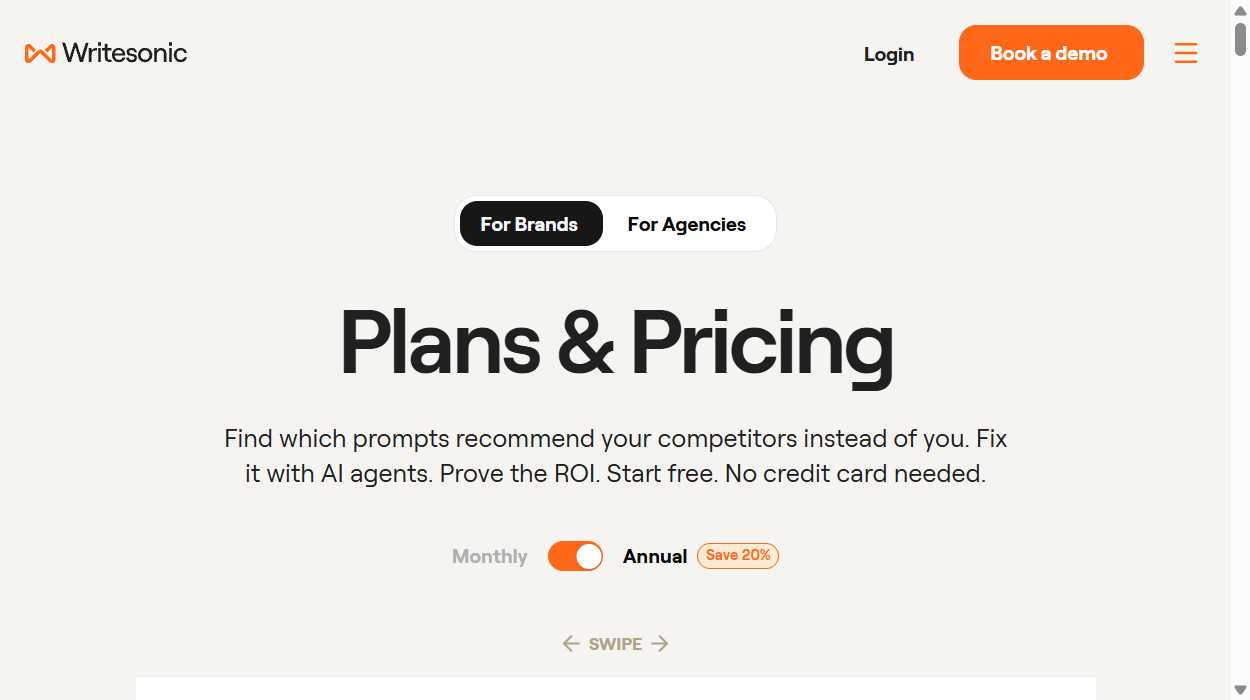
Writesonic frames its product as an AI Search Loop of tracking, prioritizing, acting and measuring. It covers eight AI platforms across 50+ markets and 50+ languages and draws on a dataset of 2 billion+ AI conversations.
For this Writesonic vs RadarKit for Local AI Visibility review, the details that matter are its engines per plan, its local controls and the way actions are packaged.
Writesonic Key Features
- AI Visibility Monitoring: Daily visibility scores, filtered by competitor, market, language and intent.
- Citation Analysis: Top cited URLs, competitor citations and breakdowns by source type.
- Competitive Benchmarking: Share of voice across prompts, platforms and markets.
- Sentiment Analysis: Themes and tone, included from Growth.
- Action Center: Recommendations ranked by ICE score (Impact, Confidence, Effort) across content, citations and technical fixes.
- AI Article Writer and AI Content Agent: Draft new content and refresh existing articles.
- AI Ads Tracker and AI Shopping Analytics: Sponsored and product placements in AI answers.
- MCP and API: Connect AI assistants and developer tools to the data.
Writesonic Pricing
- Starter: $79 a month on annual billing: 50 prompts, 150 answers a day, 15 AI articles, 10 technical audits, 1 user, 1 project.
- Basic: $199: 100 prompts, 300 answers a day, 25 articles, 2 users.
- Growth: $399: 200 prompts, 600 answers a day, Sentiment Analysis, an Action Center trial, 3 users, 2 projects.
- Enterprise: Custom: all 8 platforms, custom prompts, regions and languages, full Action Center, Outreach Agent, SSO.
- Trial: Seven days free, no card needed; annual billing saves 20%.
Best For (Writesonic)
Within Writesonic vs RadarKit for Local AI Visibility, Writesonic suits marketing teams that want tracking and content production under one bill.
Pros of Writesonic
- Content Bundled In: Articles and audits come with every plan.
- Web-Interface Tracking: Answers match what a user sees.
- Action Ranking: ICE scores order the work.
Cons of Writesonic for Local Visibility
- Three Engines Until Enterprise: Self-serve plans leave out Perplexity, Copilot and AI Mode.
- Local Controls at the Top Tier: Custom regions sit with Enterprise.
- Action Center Trial Only on Growth: Five in-content and five outside-source actions a month.
How Writesonic Can Help with Local AI Visibility
For Writesonic vs RadarKit for Local AI Visibility, a marketing team at a regional home-services brand can track 50 prompts, read which URLs AI cites in its category and ask the Article Writer for the missing topics. For wider options, see 10 Best Writesonic Alternatives for GEO Content Optimization 2026.
RadarKit at a Glance
RadarKit is an AI visibility tool made for brands, agencies and local businesses. It sends buyer-style questions to six assistants (ChatGPT, Gemini, Perplexity, Microsoft Copilot, Google AI Mode and Google AI Overviews) and keeps each reply with its brands, order and sources.
In Writesonic vs RadarKit for Local AI Visibility, it is the side built around a nearby customer asking a question.
RadarKit Key Features
- Local Radar: For a place-based prompt it gathers the recommended businesses with rating and reviews, then charts how often, and how high, yours appears over 30 days.
- Residential IP Locations: Every plan reaches 50+ countries; Enterprise narrows to state and city.
- AI Visibility Tool: Two scores per project, set against the prior week.
- Average Position: Where your domain typically ranks among the sources AI names.
- Sentiment Breakdown: Tone of each appearance, plus phrases that keep coming back.
- Share of Voice: Rivals measured on the same prompts.
- Query Fanout: The searches a model runs quietly before it answers.
- Shopping Radar and Ads Radar: Shopping carousels and sponsored placements.
- Plan Agent, Outreach Agent, Reddit Agent, Content Agent and Chat Agent: Five agents: one plans, one pitches, one studies Reddit, one rewrites articles and one answers questions.
- Monitor Traffic and GSC Integration: Counts AI-driven visits and connects Search Console.
- Client Portal and Branded PDF Reports: One login per client and reports under your own name.
- MCP and REST API: Assistants and developers can read the data.
RadarKit Pricing
- Lite: $29 monthly buys 2 projects and 15 prompts, rechecked every 72 hours, with 900 responses.
- Growth: $79 monthly buys 5 projects and 50 prompts rechecked daily, 9,000 responses and 2 more seats.
- Pro: $139 monthly buys 10 projects and 100 daily prompts, 18,000 responses, 5 more seats and priority support.
- Enterprise: Yearly contract: unlimited projects, custom prompts, 70+ locations, SSO.
- Trial: Seven days free; 48-hour refund window.
Best For (RadarKit)
In Writesonic vs RadarKit for Local AI Visibility, RadarKit suits owners of one shop or a few branches, local agencies and small SEO teams.
Pros of RadarKit
- Six Engines on Every Plan: No engine upsell.
- Named Local Rivals: Local Radar rows.
- Agents on Every Plan: Five, with monthly allowances.
- Lower Entry Price: $29 against $79.
Cons of RadarKit
- Fewer Engines Than Enterprise Writesonic: Claude, DeepSeek and Grok are not tracked.
- No Built-In Article Library: The Content Agent rewrites articles but there is no separate writer product.
How RadarKit Can Help with Local AI Visibility
In Writesonic vs RadarKit for Local AI Visibility, a dental practice with three branches can run five prompts per branch, find the two rivals ranked above it in Local Radar and hand the gap to the Plan Agent for content, outreach and Reddit tasks. Our 5 Best Tools to Track Query Fanout Keywords in 2026 explains why the hidden searches matter.
Source Evidence: What You Can Check Behind Each Answer
For source evidence in Writesonic vs RadarKit for Local AI Visibility, both tools keep the reply text. Writesonic highlights brand appearances in the full answer and adds Citation Analysis with top cited URLs, competitor citations and source-type breakdowns such as media, blogs, forums and user-generated content.
RadarKit stores sources with every answer, calculates Average Position among those sources and records Query Fanout, the extra searches a model ran first. For a local business, that fanout often reveals the exact “near me” wording that decides who is named. The numbers worth reporting are covered in 6 AI Search Visibility Metrics You Can’t Ignore in 2026.
Reporting and Client Delivery Compared
- Writesonic: Exports as PDF and CSV, shareable reports, tags by campaign or product line, Looker Studio on Enterprise.
- RadarKit: Client Portal logins with multi-project history, Branded PDF Reports with monthly allowances of 2, 10 or 20, Google Search Console and a REST API.
In Writesonic vs RadarKit for Local AI Visibility, an agency running ten local clients gets a ready-made client login from RadarKit on every plan, while Writesonic leans on exports and shared links.
Workflow Limits: What Each Plan Lets You Run in a Month
- Writesonic Starter: 15 AI articles, 10 audits of 100 URLs each and 10 agentic workflow trial runs.
- Writesonic Growth: 50 articles, 50 audits of 2,500 URLs each, 100 trial runs and 5 in-content plus 5 outside-source Action Center actions.
- RadarKit Lite: 6 Content Agent articles, 10 outreach and Reddit credits, 15 chat messages and 2 branded PDFs.
- RadarKit Growth: 19 articles, 20 outreach and Reddit credits, 25 chat messages and 10 PDFs.
- RadarKit Pro: 32 articles, 40 credits, 50 chat messages and 20 PDFs.
On limits in Writesonic vs RadarKit for Local AI Visibility, both tools meter the work. Writesonic meters articles, audits and trial runs, while RadarKit meters agent credits and keeps tracking separate.
Live Pricing and Prompt Limits for One Shop and One Agency
A shop with 15 prompts and an agency with 100 prompts across ten clients make the gap clear in Writesonic vs RadarKit for Local AI Visibility.
- Shop on RadarKit: Lite at $29 holds 15 prompts across 6 engines.
- Shop on Writesonic: Starter at $79 on annual billing holds 50 prompts across 3 engines.
- Agency on RadarKit: Pro at $139 holds 100 prompts across 10 projects with a client portal.
- Agency on Writesonic: Basic at $199 holds 100 prompts for 1 project; agency pricing is quoted separately.
RadarKit Lite answers count in responses: 15 prompts rerun every 72 hours across six models make 900 responses a month. Writesonic counts answers a day: 50 prompts across three engines make 150.
Best Fit: Which Business Should Pick Which
- A salon, clinic or restaurant: RadarKit, for the price, the local table and the six engines, the clearest pick in Writesonic vs RadarKit for Local AI Visibility.
- A local agency: RadarKit, for the client portal, branded reports and agents.
- A regional brand with a content team: Writesonic, if articles and audits matter as much as tracking.
- A national brand with many markets: Writesonic Enterprise, for all 8 platforms and custom regions.
Final Verdict: RadarKit Takes Local, Writesonic Takes Content
In Writesonic vs RadarKit for Local AI Visibility, Writesonic is a solid choice for teams that want one subscription for tracking and content. Local owners usually need something narrower: the nearby businesses assistants recommend, the engines customers actually use and a plan that costs a fraction as much.
RadarKit is the best overall pick in Writesonic vs RadarKit for Local AI Visibility. It reads six engines on every plan, runs from residential IPs in 50+ countries, names local rivals in Local Radar and includes five agents, a client portal, MCP and a REST API from $29 a month.
FAQs: Writesonic vs RadarKit for Local AI Visibility
How much cheaper is RadarKit Lite than Writesonic Starter?
RadarKit Lite is $29 a month and Writesonic Starter is $79 a month on annual billing, a $50 gap that matters in Writesonic vs RadarKit for Local AI Visibility for a single shop.
Which engines does RadarKit read that Writesonic Starter does not?
For Writesonic vs RadarKit for Local AI Visibility, the extra engines are Perplexity, Microsoft Copilot and Google AI Mode, alongside ChatGPT, Gemini and Google AI Overviews.
Can RadarKit track a prompt from a specific city?
Enterprise adds state and city tracking across 70+ locations; every other plan runs from residential IPs in 50+ countries.
Does Writesonic offer an API or MCP?
Yes, both appear in its resources, which helps in Writesonic vs RadarKit for Local AI Visibility for teams that automate reports, so assistants and developer tools can reach the data.
Which tool includes a client portal?
In Writesonic vs RadarKit for Local AI Visibility, RadarKit does, with a login per client and Branded PDF Reports.