The real choice in Profound vs BrightLocal for Multi-Location Brands is where you draw the line for measurement. Do you want one view of the whole brand, or a separate view for every store? Profound builds around the brand and adds an AI marketing workspace. BrightLocal builds around the individual location and scores each one on its own.
Below you will find what each tool does in practice, what it costs and who it suits. We also added RadarKit as it is the best overall option for Multi-Location Brands.
So, without any further ado, let’s get started.
Quick Decision: Profound vs BrightLocal for Multi-Location Brands
- Profound: Best for enterprise teams that want AI agents, prompt demand data and strict security around brand-level visibility.
- BrightLocal: Best for brands and agencies that want a separate AI score for each location, tied to citations and reviews.
- RadarKit: Best overall when you want real answers by city, rival ratings, shopping and ad capture, and agents that carry out the next steps.
Comparison Table: Profound vs BrightLocal for Multi-Location Brands
| Feature | Profound | BrightLocal | RadarKit |
|---|---|---|---|
| Core Idea | AI marketing platform with agents | Local SEO platform with AI tracking | AI search tracking with local, shopping, ads and agents |
| Unit of Tracking | Brand, with custom regions and languages | Single location | Project, with city-level residential IPs |
| AI Platforms | Up to 9 on Enterprise | ChatGPT, AI Mode, AI Overviews | ChatGPT, Gemini, Perplexity, Copilot, AI Mode, AI Overviews |
| Prompts | 50 on trial, custom on Enterprise | Up to 20 per location | 15, 50, 100 or custom |
| How Answers Are Collected | Structured prompts across AI platforms | Queries anchored to a location | Real chat interfaces, no APIs |
| Starting Price | Custom after a free trial | $31 a month for one location, yearly | $29 a month |
| Free Trial | 7 days | 14 days, no card | 7 days |
| Agents | AI Marketer and custom agents on credits | AI action items and Citation Builder | Plan, Outreach, Reddit, Content and Chat |
| Data Access | CSV, JSON and API on Enterprise | In-platform reports | REST API, MCP server and exports on every plan |
Why Multi-Location Brands Need AI Visibility Tracking
A shopper standing in one city and a shopper in another city can ask an assistant the same question and hear different business names. A national average does not tell a regional manager which stores AI recommends and which it ignores. That is the gap multi-location teams need to close.
Who reads the report changes the answer. A CMO wants one brand-level picture, a franchise owner wants a single store, and an agency needs both for every client. Keep those readers in mind as you work through this Profound vs BrightLocal for Multi-Location Brands guide, and start with What is AI Visibility and Why It Matters for Brands in 2026 if AI visibility is new to you.
Profound Overview
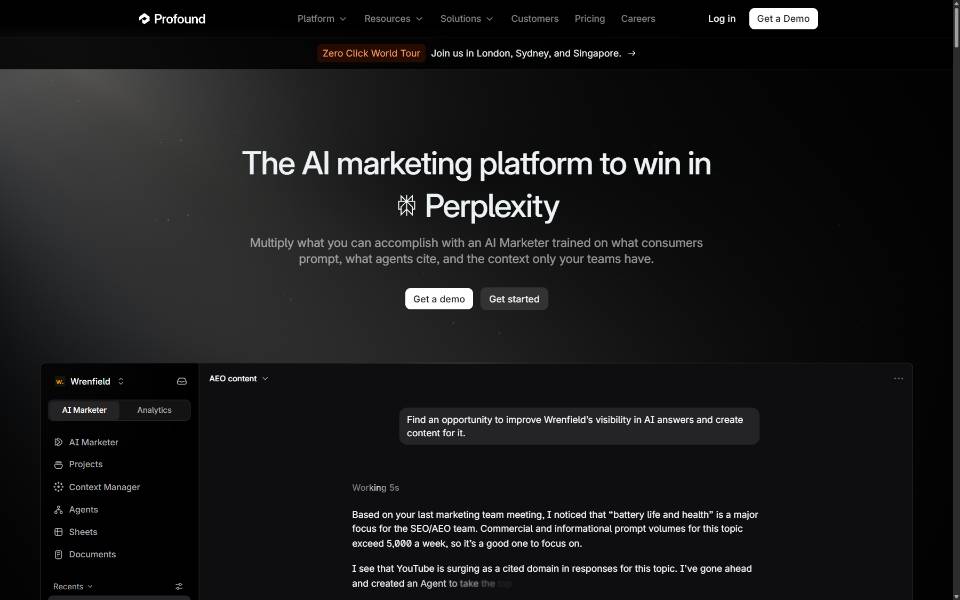
In Profound vs BrightLocal for Multi-Location Brands, Profound is built for big marketing departments and calls its AI Marketer a superintelligent teammate. The idea is that it already knows what consumers prompt, what AI agents cite and what your teams know about the brand, so it can spot work, draft it and ask for sign-off. Tracking is one module inside a wider space for content, PR, social and product launches.
Profound measures visibility by running structured prompts across AI platforms and analyzing where and how your brand appears, including citations, sentiment, ranking and competitive presence.
Profound’s Main Features
- Answer Engine Insights: Visibility, citations and sentiment are tracked for your brand and competitors, with a category-wide baseline and a visibility score by platform.
- Prompt Volumes: Real user conversations are analyzed so you can see how often people ask AI about a topic, such as coffee shop searches, and where demand is growing.
- AI Marketer: It identifies opportunities, drafts content and stages it for your approval instead of going live on its own.
- Content Rewrites: It rewrites content that is losing citations and stages the changes in your CMS, and it builds content for questions you have no answer for.
- FactCheck Agent: It finds outlets quoting old facts, such as outdated prices or specs, and drafts a personalized correction for each reporter.
- Context Manager: A living store of positioning, product knowledge and brand guidelines gives every agent the same starting point.
- Profound Sheets: Agents can run across many rows of work at once.
- Agent Analytics: Traffic that comes from AI sources is attributed across unlimited domains, and connectors exist for Cloudflare, AWS, Akamai, Fastly, Google Analytics, Vercel and WordPress.
- ChatGPT Shopping: Product visibility inside ChatGPT Shopping is tracked on Enterprise.
Profound Pricing
- Trial: The free trial analyzes 50 industry-recommended prompts every day for a week on ChatGPT, Gemini and Google AI Overviews. It includes limited agent credits, 5 prompt volume searches, 1 region and 1 language.
- Enterprise: Pricing is set per customer. The plan unlocks up to 9 engines, prompt editing, custom regions and languages, full history, CSV and JSON exports, the API, single sign-on and support tiers that reach a dedicated specialist with a 24-hour SLA.
- Agent Credits: Agents run on credits that are used each time an agent runs, and complex multi-step agents use more.
- Agency Growth: The self-serve agency plan includes 400 credits a month for each client workspace.
How Profound Helps Multi-Location Brands
In Profound vs BrightLocal for Multi-Location Brands, choose Profound when the main task is brand strategy across many markets. Unlimited seats let corporate, regional and agency colleagues share one workspace, and agents can rewrite stale material, such as old positioning, before a human approves it. Reporting centers on the brand and its category, which leaves store-by-store scoring to other tools.
Must Know
- Prompts: Trial users get a recommended prompt set for their industry, while Enterprise users can edit, disable or add prompts.
- Pricing: Enterprise cost is set after a demo, so budget needs a sales conversation.
Best For
Large organizations that want AI visibility, content creation and PR workflows in one governed workspace.
BrightLocal Overview
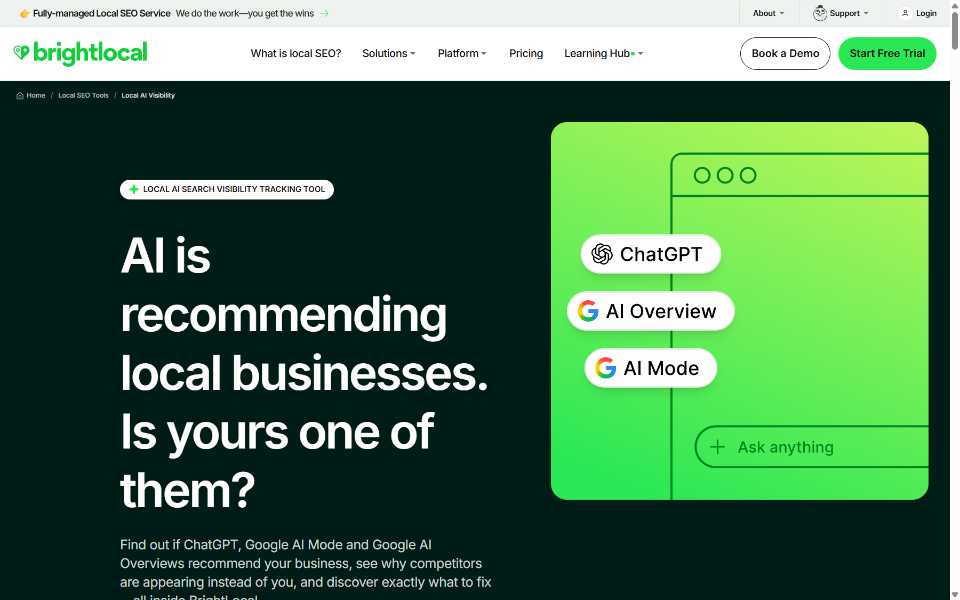
In Profound vs BrightLocal for Multi-Location Brands, BrightLocal grew out of local SEO and now adds a Local AI Visibility Tracker with a location-first design. Each query is tied to a specific place, so the result is close to what someone in that area would read.
The tracker separates two ideas. An appearance is when your location is named in an answer. A citation is when the model uses you as a source, which does not always lead to an appearance.
BrightLocal’s Main Features
- Location Visibility Score: Every location gets 0 to 100, split by platform and prompt and compared against its category rivals.
- Prompt Setup: Add a location and BrightLocal suggests prompts for the business category. Edit them and track up to 20 per location, branded and unbranded.
- Prompt-Level Results: Every prompt reports sentiment and recommendation strength.
- Competitor Comparison: Local rivals are found for you, and their appearance rate, share of voice and average position sit beside yours.
- AI Sources Leaderboard: It ranks the directories, local publications and regional domains AI cites for your category and reveals where you appear and where you do not.
- See How AI Describes You: Strengths and opportunities are summarized in plain English.
- Citation Builder: Citation gaps route straight into fixes without exports.
- Local Search Grid: On Track, up to five keywords are drawn as a map grid.
- Reviews and Listings: Manage keeps business details synced, and Grow adds review requests through email, SMS and in-store campaigns.
BrightLocal Pricing
- One Location: Yearly billing puts Track at $31 a month ($369 a year), Manage at $40 ($485) and Grow at $49 ($584). Month-to-month rates are $41, $54 and $65.
- 2 to 5 Locations: Track costs $47 a month on yearly billing, Manage $57 and Grow $65.
- 6 to 10 Locations: Track costs $62 a month on yearly billing, Manage $82 and Grow $98.
- 11 to 20 Locations: Track costs $78 a month on yearly billing, Manage $115 and Grow $148.
- 21 to 50 Locations: Yearly Track pricing climbs from $117 to $196 a month, and 100 or more locations move to a custom plan.
- Trial: The 14-day free trial needs no credit card.
How BrightLocal Helps Multi-Location Brands
The score belongs to one location, so a regional manager can see which stores earn AI recommendations and which rivals win the rest. Agencies get a score, a competitor comparison and a fix in one workflow, with results by platform and prompt for each client location. Because rankings, reviews and citations share the login in Profound vs BrightLocal for Multi-Location Brands, a gap found in AI search can be fixed without leaving the platform.
Must Know
- Platforms: ChatGPT, Google AI Mode and Google AI Overviews are covered today, with more promised.
- Prompt Limit: Each location tracks up to 20 prompts.
- Cost Growth: Plans are priced by location count, so spend rises as stores are added.
Best For
Brands and agencies that want a score per location beside citations, reviews and map rankings.
RadarKit Overview
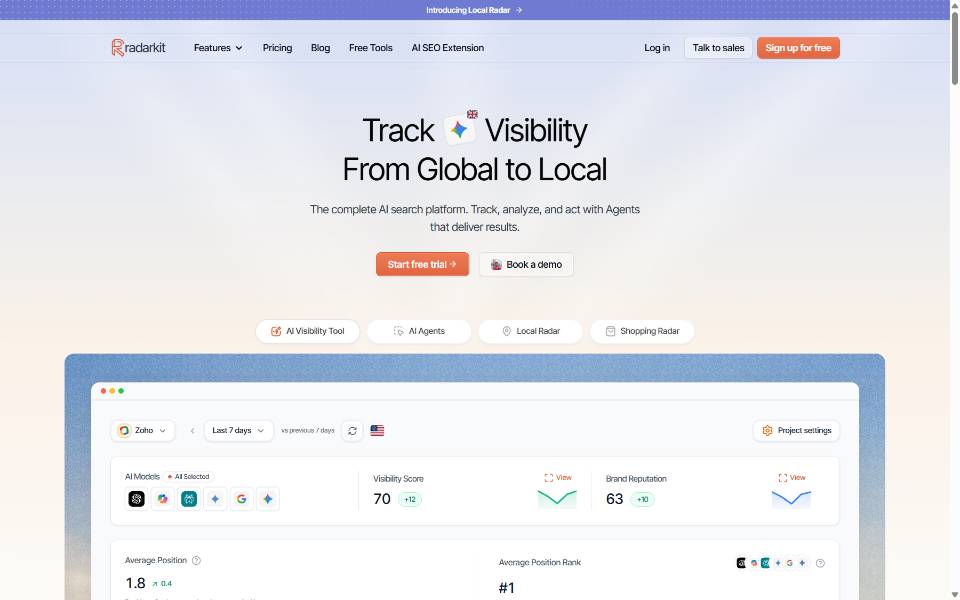
In Profound vs BrightLocal for Multi-Location Brands, RadarKit is an AI search tracking platform that does something simple and important: it prompts the real chat interfaces, not APIs, the way a customer would, and records every answer about your brand and your competitors. Prompts run on ChatGPT, Google AI Overviews, Google AI Mode, Copilot, Gemini and Perplexity, from residential IPs in more than 50 countries, so the answers match what people in each place actually see.
Tracking is just the base. Three radars read local rankings, product carousels and sponsored placements, and five agents then draft, pitch and reply. That stack is why RadarKit leads the Profound vs BrightLocal for Multi-Location Brands comparison for brands with many locations.
RadarKit’s Main Features
- Visibility Score: One score tracks how often your brand appears in AI answers, with the change against the previous seven days.
- Brand Reputation: A second score summarizes how AI answers describe your brand, and sentiment insights group the repeated phrases, such as “known for affordability”.
- Average Position: You see where your domain lands when it appears, plus a ranked table of the domains AI cites most often.
- Competitor Tracking: Competitor appearances and share of voice are compared across the same prompts.
- Six Platforms on Every Plan: Perplexity, Gemini, Copilot, AI Overviews, AI Mode and ChatGPT all run on Lite and above, with model selection available.
- Citation Analysis and Query Fanout: Every answer names the sources it relied on, and the follow-up searches AI runs are recorded.
- Local Radar: It captures every business AI recommends for a local prompt, such as “best dentist in Manhattan”, and reports your appearance rate, your rank in each answer and the rating and review count of every rival.
- Shopping Radar: It captures the product carousel as shoppers see it, with name, store, price, rating and position, and ranks which stores win each prompt.
- Ads Radar: It records every sponsored placement in answers, with advertiser, headline, landing URL, first-seen date and how often it ran.
- Plan Agent: It reads live Search Console and citation data, finds where you are invisible and builds a strategy sheet that hands each task to the right agent.
- Outreach Agent: It finds high-authority domains that cite your competitors, locates the contact, drafts on-brand emails, sends them through your Gmail and follows up within the limits you set.
- Reddit Agent: It reads the threads AI cites for your space, reveals where your brand is missing, surfaces the discussion and flags communities that ban brand posts.
- Content Agent: It rewrites an existing article around a tracked prompt, extracts the key entities, inserts the query fanouts and returns it in your WordPress editor.
- Chat Agent: You ask questions about your data in plain language.
- AI Traffic Analytics: Visits that arrive from AI platforms are counted, and Google Analytics and Search Console connect directly.
- REST API and MCP Server: The API covers projects, topics, prompts, running a prompt now, visibility, responses, sources, share of voice, rankings, query fanout, sentiment, exports and article creation. The MCP server adds 17 read tools, 4 write tools and 3 agent tools for clients such as Claude.
- Client Portal and Reports: Branded PDF reports and a client portal serve every location owner or agency client, with full history on every plan.
- Free Tools: An LLMs.txt checker, an LLMs.txt generator and an AI SEO browser extension are free with no signup.
RadarKit Pricing
- Lite: The $29 monthly plan holds 2 projects and 15 unique prompts, yields 900 responses a month and re-scans every 72 hours.
- Growth: The $79 monthly plan holds 5 projects and 50 prompts, yields 9,000 responses a month, scans daily and adds 2 seats.
- Pro: The $139 monthly plan holds 10 projects and 100 prompts, yields 18,000 responses a month, scans daily, adds 5 seats and brings priority support.
- Enterprise: A custom annual contract with unlimited projects, custom prompts, 70 or more locations, state and city level tracking, single sign-on, unlimited seats and a dedicated manager.
- Agent Allowances: Content Agent covers 6, 19 or 32 articles a month, Outreach and Reddit agents share 10, 20 or 40 action credits, and Chat Agent allows 15, 25 or 50 messages.
- Trial and Refund: Every plan starts with a 7-day free trial, and a full refund is available if you ask within 48 hours of the first charge.
How RadarKit Helps Multi-Location Brands
- See Each City Separately: Local Radar runs from a residential IP in the city you choose, so a store in one city sees its own list of recommended businesses and its own rank.
- Know the Exact Rivals: Every recommended business appears with its category, rating and review count, so a store manager knows who to beat.
- Get Honest Percentages: Appearance rate counts only answers that relate to your local prompt, so unrelated answers do not drag the score down.
- Track Three Answer Surfaces: Local results are read from ChatGPT, AI Overviews and AI Mode in the same view.
- Cover Retail Locations: Shopping Radar reveals which products make the carousel and which store wins, which helps brands that sell through several retailers.
- Watch Paid Competition: Ads Radar reveals who is bidding on your prompts and what share of answers carry ads.
- Act Without Extra Staff: The Plan Agent sets the tasks, and the Outreach, Reddit and Content agents execute them, so a small team can run many markets.
- Plug Into Your Stack: The API and MCP server let dashboards, assistants and reporting tools read the same data.
- Scale by Project: Plans hold 2, 5 or 10 projects, and Enterprise removes the limit and adds state and city tracking for large footprints.
Must Know
- Listings: RadarKit focuses on AI answers, so a listings platform such as BrightLocal is a natural partner.
- Prompt Tiers: Prompt counts rise with the plan, so large location counts usually start on Pro or Enterprise.
Best For
Brands and agencies with many locations that need genuine local AI answers, rival ratings, product and ad capture, and agents that follow through, all from $29 a month.
Profound vs BrightLocal for Multi-Location Brands: Feature-by-Feature Comparison
AI Platform Coverage
Enterprise customers of Profound can track as many as nine engines, including ChatGPT, Perplexity, Google AI Mode, Gemini, Copilot, DeepSeek, Claude, Google AI Overviews and Exa. BrightLocal follows three: Google AI Overviews, Google AI Mode and ChatGPT. RadarKit follows six on every plan through real interfaces.
Location Handling
BrightLocal ties each query to a location and scores that location. RadarKit runs prompts from city-level residential IPs and reads local answers as a ranked table of businesses. Profound relies on regions and languages. For store-level reporting, BrightLocal and RadarKit lead the Profound vs BrightLocal for Multi-Location Brands comparison, and Profound leads on market-level strategy.
Competitor and Source Analysis
BrightLocal finds local rivals automatically and ranks the domains AI cites. Profound adds a category-wide baseline and citation analytics. RadarKit names every recommended business with its category, rating and review count, then adds cited domains and share of voice. More tools are compared in 10 Best Local AI Rank Trackers for Local Businesses.
Beyond Search Answers
RadarKit is the only one of the three that captures shopping carousels and ads inside AI answers as separate products. Profound tracks ChatGPT Shopping on Enterprise and brand-level traffic through Agent Analytics. BrightLocal keeps its focus on local answers, citations and reviews.
Agents and Automation
Profound’s agents are the broadest, covering content, PR, social and launch work on a credit model. BrightLocal turns findings into prioritized action items and routes citation gaps into its Citation Builder. RadarKit’s five agents read live tracking data first, then draft content, send outreach and join community threads.
Data Access and Reporting
Profound gives Enterprise customers CSV and JSON exports, full history and the API. BrightLocal keeps results in its platform and sells API solutions separately. RadarKit puts a REST API, an MCP server, exports, history and branded PDFs on every plan. How Much Should You Pay for AI Search Visibility Tracking Tools? adds pricing context.
Profound vs BrightLocal for Multi-Location Brands: Pricing for a Real Footprint
In Profound vs BrightLocal for Multi-Location Brands, pricing behaves differently in each tool, so it helps to price one footprint. Take a brand with 10 locations.
- BrightLocal: 6 to 10 locations cost $62 a month for Track, $82 for Manage and $98 for Grow on yearly billing. The price rises with every added band of locations.
- Profound: Enterprise is custom, set after a demo, with agent credits chosen by usage.
- RadarKit: Pro costs $139 a month for 10 projects and 100 prompts, and Enterprise adds unlimited projects for larger footprints.
Use 6 AI Search Visibility Metrics You Can’t Ignore in 2026 to decide which numbers to track before you compare plans.
Profound vs BrightLocal for Multi-Location Brands: Strengths of Each Tool
Profound Strengths
- Workspace Breadth: One platform covers visibility, content, PR, social and launch work.
- Demand Data: Prompt Volumes uncover how often people ask AI about a topic.
- Governance: SSO, SOC 2 compliance, approvals and unlimited seats suit large teams.
BrightLocal Strengths
- Per-Location Scores: Every store gets its own 0 to 100 number and competitor view.
- Connected Fixes: Citation gaps flow into Citation Builder.
- Easy Trial: 14 days, no card.
RadarKit Strengths
- Real Answers: Prompts run in real chat interfaces from city-level residential IPs.
- Local, Shopping and Ads: Three radars capture local rankings, product carousels and sponsored placements.
- Working Agents: Plan, Outreach, Reddit, Content and Chat agents act on live data.
- Open Data: API, MCP and exports come with every plan, from $29 a month.
Who Should Choose Profound?
Profound suits a large marketing organization that needs agents for content and PR and wants enterprise security. It is the brand-strategy pick in Profound vs BrightLocal for Multi-Location Brands.
Who Should Choose BrightLocal?
BrightLocal suits teams that care most about store-level scores, citations and reviews and already manage listings. It is the pick for agencies with many local clients in Profound vs BrightLocal for Multi-Location Brands.
Who Should Choose RadarKit?
RadarKit suits teams that want everything in one place: city-level answers, rival ratings, shopping and ad capture, working agents and open data. It is the best overall choice in Profound vs BrightLocal for Multi-Location Brands. Another head-to-head is in RadarKit vs Peec AI vs Profound: Which AI Search Visibility Tool Is Better?.
Final Verdict: Profound vs BrightLocal for Multi-Location Brands
Each tool answers a different half of Profound vs BrightLocal for Multi-Location Brands: Profound brings enterprise breadth, and BrightLocal brings a score for every store.
RadarKit is the best overall choice. It reads genuine answers from six platforms in the cities that matter, ranks every competing business with its rating, captures shopping carousels and ads, and backs the data with five agents and an open API, from $29 a month. Teams can add BrightLocal for listings or Profound for enterprise content work and keep RadarKit as the record of what AI truly returns. More on Profound is in Profound AI Review for 2026: Is It Worth the Investment? and 9 Best Profound AI Alternatives for 2026.
FAQs: Profound vs BrightLocal for Multi-Location Brands
Can BrightLocal follow dozens of locations at once?
Yes. Prices follow location count through standard bands up to 50 locations, and a custom plan covers 100 or more.
Does Profound let me edit the prompts it tracks?
Enterprise users can edit, disable or add prompts. Trial users receive a recommended set based on their industry.
Which tool is quickest to start?
BrightLocal needs no card for a 14-day trial, and RadarKit and Profound both start with 7 free days.
How does RadarKit know what a local shopper sees?
It prompts real chat interfaces from a residential IP in the city you pick, then records the businesses, ratings and sources in each answer.
What gives RadarKit the edge for multi-location brands?
Local Radar by city, shopping and ad capture, five agents and an open API and MCP server make it the top pick in Profound vs BrightLocal for Multi-Location Brands.