AI visibility is about whether your brand actually appears inside those answers and how it is described when it does. It is different from classic SEO, which focuses on ranking links on a results page here, the “real estate” is the AI’s response itself, where only a handful of brands might be named.
If you are missing from those summaries, you are effectively invisible at the moment of decision, even if your site still ranks somewhere in organic search.
For brands, this makes AI visibility a core metric, not a nice extra. Tracking how often you are mentioned, which pages are cited, and how you compare to competitors helps you treat AI answers as a new channel you can measure and improve, just like search or social.
What Is AI Visibility?

AI visibility is about how often and how well your brand shows up inside AI-generated answers on platforms like ChatGPT, Gemini, Perplexity, Copilot, and Google’s AI Overviews.
Instead of asking “What’s my Google ranking?”, you’re really asking, “When people ask these AIs questions in my category, do I show up—and do I look good?”
In simple terms, AI visibility measures your brand’s share of voice inside AI systems: how frequently you are mentioned, whether you are cited as a source, and the sentiment or positioning attached to your brand in those answers.
It shifts the focus from being “on the results page” to being “inside the answer,” which is where many users now stop their journey.
For example, if someone asks an AI assistant for the best running shoes and it only lists your competitors, your AI visibility for that topic is basically zero.
If the answer consistently includes your brand with the right features and benefits, your visibility is strong.
This is different from traditional SEO, which focuses on blue links in search results. In AI search, the model gives a single, direct answer, so being missing from that answer often means losing the customer moment completely.
To manage this, brands are starting to use AI visibility tracking tools that act like an “AI rank tracker” for answer engines.
Platforms such as RadarKit, for example, directly prompt major LLM interfaces (like ChatGPT, Gemini, Perplexity, and others) with real-world queries and record how often your brand is mentioned, cited, or recommended across regions and competitors.
Why AI Visibility Matters for Brands 2026
AI visibility matters because it now decides whether your brand even enters the conversation when someone asks an AI for advice, ideas, or recommendations.
Buyers are already going to ChatGPT, Perplexity, Gemini, and AI Overviews before they open a single tab, and they trust these tools to shortlist options for them.
If your brand does not show up in those shortlists, you are not just losing traffic; you are losing consideration at the exact moment when a customer is choosing who to explore, compare, or contact.
This shift is happening amid the zero-click trend, where more and more journeys end with an AI or AI-style result rather than on your website, which means traditional SEO reports on rankings and clicks no longer tell you the full story.
You might still rank well on Google, but if AI answers mostly highlight your competitors when people search your category, they will quietly collect more attention, more branded searches, and more demand over time.
That is why brands are starting to treat AI visibility as a separate layer on top of classic SEO, focused on being mentioned, cited, and recommended inside AI responses, not just listed on a results page.
AI visibility also shapes reputation. When an AI repeatedly describes your product in a certain way, surfaces the same reviews and chooses the same talking points, it creates a story about your brand that people remember, even if they never read your full website.
If that story leans on outdated information or a few negative sources, it can quietly hurt trust and push users toward safer-looking alternatives.
Tracking how you appear in AI answers, which pages are cited, and what tone the AI uses gives you a chance to correct the record, strengthen the content AI learns from, and move the narrative closer to how you actually want to be seen.
Tools like RadarKit make this more concrete by running live browser sessions that ask natural questions across different AI systems, then logging how often your brand appears, where it is positioned in the answer, and which URLs are driving those mentions.
Instead of guessing how AI talks about you, you get a clear view of your presence inside AI conversations and a practical starting point for improving it through better content, stronger authority, and smarter AI SEO work in 2026.
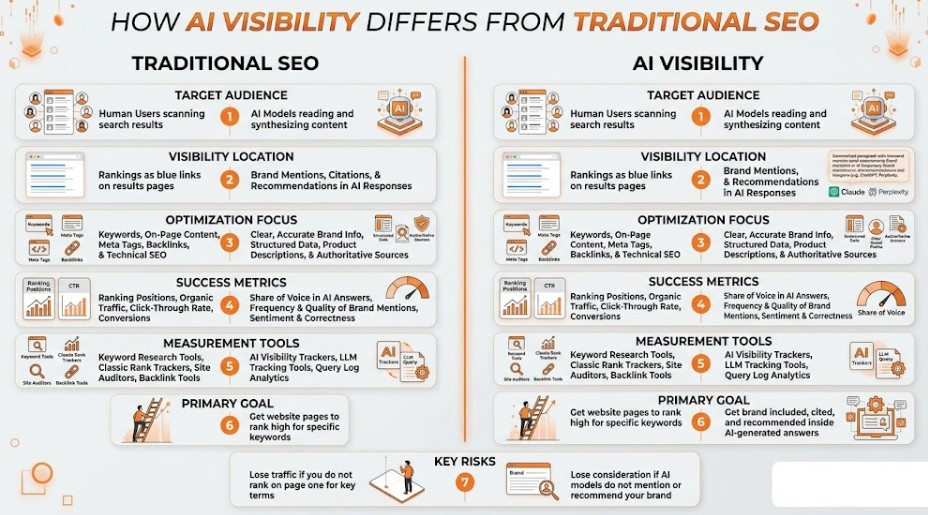
How AI Visibility Differs from Traditional SEO
| Traditional SEO | AI Visibility |
|---|---|
| Get your website pages to rank high in Google Search and other search engines for specific keywords. | Get your brand included, cited, and recommended inside AI-generated answers and AI overviews across LLM platforms. |
| Targets human users who scan a list of search results and choose which link to click. | Targets AI models that read, interpret, and synthesize content before showing a single, summarized answer to users. |
| Shows visibility as blue links on a search engine results page for a given query. | Shows visibility as brand mentions, citations, and recommendations inside AI responses, chat answers and AI overviews. |
| Optimizes keywords, on-page content, meta tags, backlinks, and technical SEO to improve page rankings. | Optimizes clear, accurate brand information, structured data, product descriptions, and authoritative sources that AI systems can reuse in answers. |
| Measures success with ranking positions, organic traffic, click-through rate, and conversions from search visits. | Measures success with share of voice in AI answers, frequency and quality of brand mentions, sentiment and correctness of information. |
| Uses keyword research tools, classic rank trackers, site auditors, and backlink tools. | Uses AI visibility trackers and LLM tracking tools that query multiple AIs and log where and how your brand appears. |
| Risk: You lose traffic if you do not rank on page one for important keywords. | Risk: You lose consideration if AI models do not mention or recommend your brand, even if your site still ranks in traditional search. |
The Importance of AI Visibility in 2026
AI is quietly becoming the place where many buying journeys begin, even if people still use Google alongside it. That shift makes AI visibility less of a buzzword and more of a basic question: when someone asks an AI about your category, are you even in the picture?
AI is where research starts
In 2026, many users will start with ChatGPT, Perplexity, or Gemini when they want a quick shortlist, a comparison, or a simple explanation.
They read the summary, maybe click one or two links, and move on. If your brand is not mentioned in that first answer, you miss the chance to be shortlisted before the user goes any deeper.
Visibility now means being named
Old school visibility was mostly about “Are we on page one?” Today, a more useful question is “Does the AI actually name us when someone asks about this problem?”
If the answer only highlights competitors, they get the attention, the clicks, and the trust, even if your site technically ranks somewhere in organic search.
AI answers shape the story about your brand
Whatever an AI repeatedly says about you slowly becomes the story people expect. If it leans on outdated specs, old screenshots, or a handful of bad reviews, it can make you look weaker than you are.
Checking how you show up in AI answers, which pages are cited, and what tone is used gives you a chance to correct that story and point AI back to better, more accurate sources.
Understanding AI visibility is a growth skill
Brands that take the time to understand how AI tools choose sources and form answers can design content and signals that are easier for these systems to trust and reuse.
With proper tracking in place, AI visibility turns into a real metric you can monitor and improve, instead of just hoping your brand appears when customers ask.
Metrics for Assessing AI Search Visibility
Here are the metrics that matter while assessing AI search visibility.
Prompt-Based Tracking
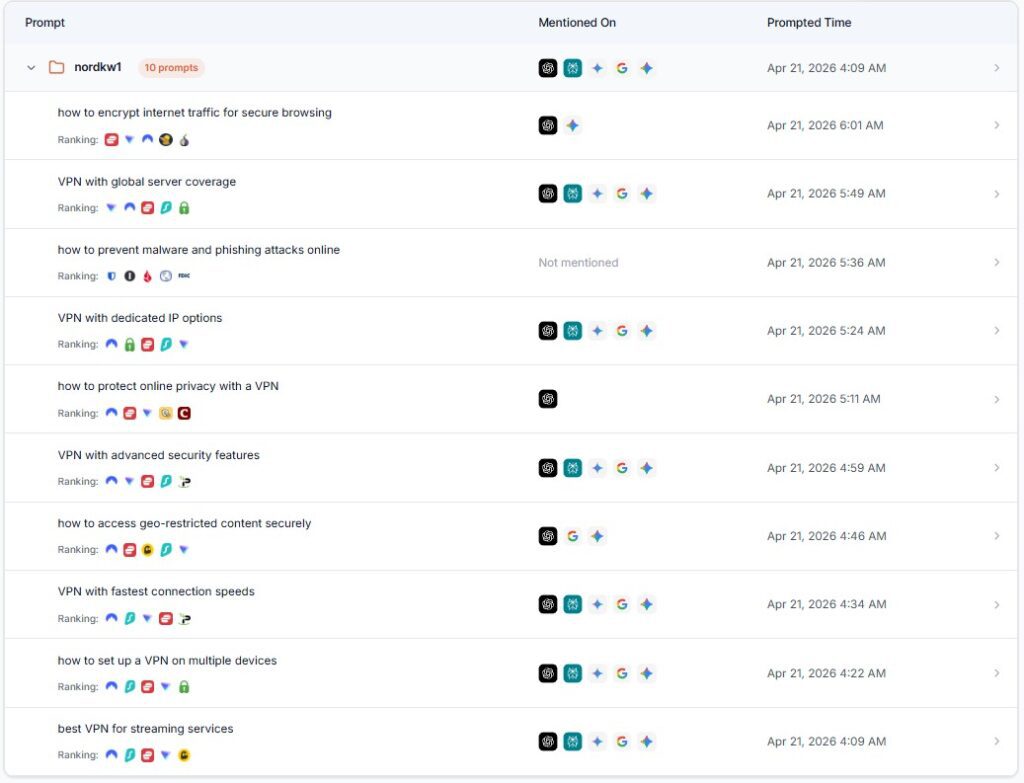
To effectively measure AI visibility, brands need to monitor how their brand appears in AI-generated responses across different AI platforms.
Prompt-based tracking involves entering various AI prompts into AI systems like ChatGPT, Perplexity, and Gemini to see how the AI responds regarding your brand.
This method allows you to understand the AI’s knowledge and sentiment about your brand and identify areas where you need to provide more accurate or compelling information.
Regular tracking using different prompts ensures you stay on top of how AI perceives your brand as AI models continuously evolve.
Cross-Platform Monitoring
Rather than focusing solely on one AI system, brands should monitor their visibility across various platforms, including ChatGPT, Perplexity, Gemini, and others. This approach provides a holistic view of your brand’s position in AI and ensures that you’re not missing out on crucial visibility opportunities.
Understanding AI and how it can impact your SEO is key. Tracking tools, like RadarKit, which tracks brand keywords 24/7 across multiple AI interfaces, play a critical role in automating this process and providing real-time insights into your brand’s presence in the AI ecosystem.
Share-of-Voice Analysis
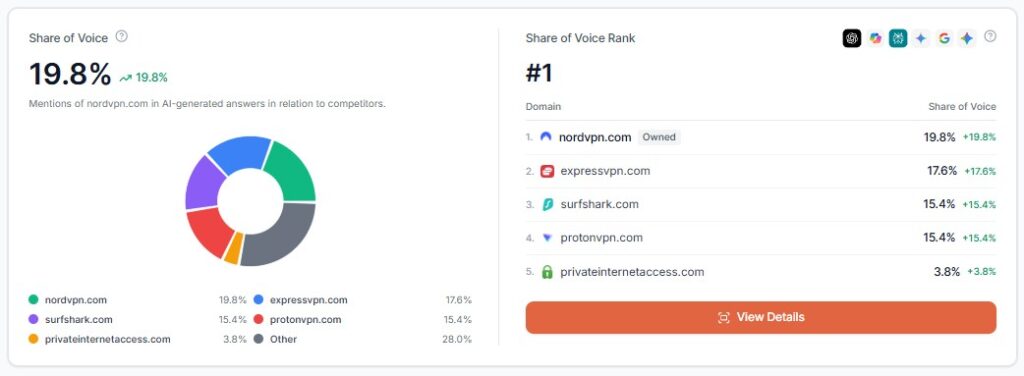
Share of voice analysis in the context of AI visibility involves measuring how often your brand is mentioned compared to your competitors in AI-generated responses.
This metric helps you understand your relative visibility and identify opportunities to increase your brand’s appearance.
By tracking your share of voice on AI assistants, you can assess the effectiveness of your AI SEO efforts and fine-tune your strategy to gain a competitive edge.
Tracking tools can automate this process, providing you with valuable data on your brand’s visibility relative to your competitors.
Visibility Scoring
A Visibility Score provides a snapshot of your overall performance across various AI platforms. This metric considers factors such as the frequency of brand mentions, the sentiment of those mentions, and the citation of your brand as a source.
By monitoring your Visibility Score, you can quickly assess the effectiveness of your AI SEO efforts and identify areas for improvement.
Citation Tracking
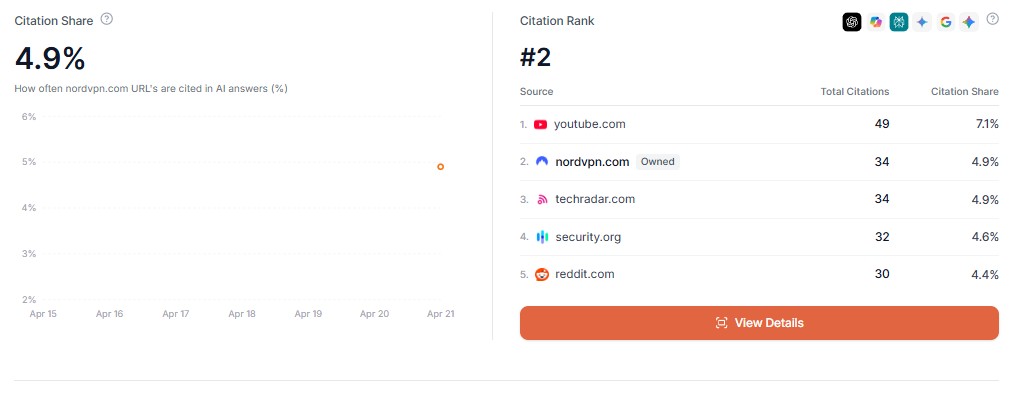
In the AI era, citations are the new backlinks. AI models often cite sources to support their responses, so tracking where your brand is being cited is crucial for AI visibility.
A citation in an AI-generated answer can drive traffic to your website and enhance your brand’s authority. By identifying the most cited sources by AI assistants, you can prioritize SEO and focus on building relationships with these key influencers.
The higher the ranking the brand has, the more visible it is in AI.
Brand Sentiment Tracking
Monitoring the sentiment surrounding your brand mentions in AI-generated responses is essential for managing your online reputation.
Are AI models portraying your brand positively or negatively? Sentiment analysis helps you understand how AI perceives your brand and identify potential issues that need to be addressed.
By monitoring brand sentiment, you can proactively manage your brand’s image and ensure that AI presents it in the best possible light.
Also, brand sentiment can help you find the best keywords to optimize your content so that your brand appears in AI more frequently, optimizing AI visibility.
Best Tool for AI Search Visibility Tracking
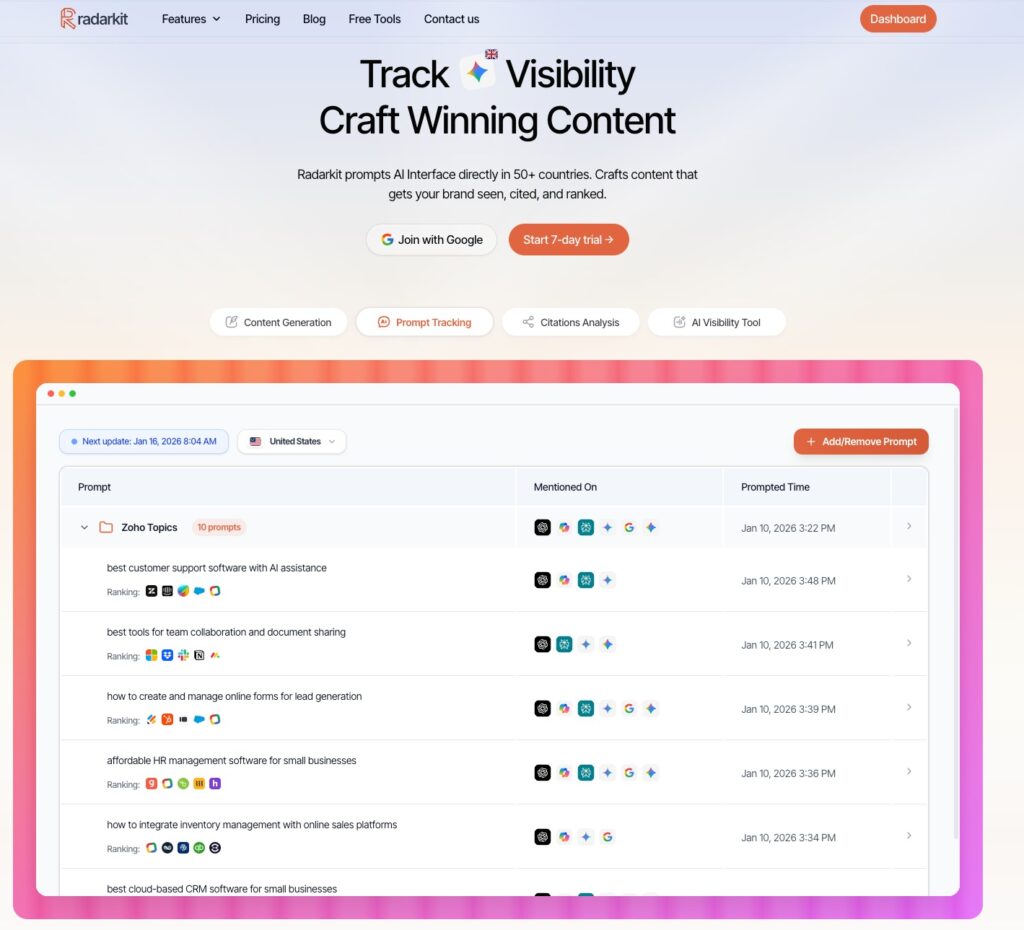
If you want a single tool to understand how visible your brand really is inside AI answers, RadarKit is one of the strongest options in 2026.
It is built specifically for AI search visibility, so instead of guessing how ChatGPT, Gemini, Perplexity, or AI Overviews talk about your brand, you get real screenshots, real answers, and clear numbers.
RadarKit works by using real browser sessions to prompt major AI platforms with your keywords and brand terms, just like an actual user would.
It then records whether your brand is mentioned, how it is described, which URLs are cited, and where competitors appear in the same answers.
Over time, this gives you a live picture of your AI share of voice across multiple countries and models, instead of a one-off manual check.
On top of tracking, RadarKit also connects with GA4 so you can see how changes in AI visibility line up with traffic and conversions from search and branded queries.
Its reporting features make it easy to share simple, client-ready summaries that show which prompts you are winning, where you have dropped out of answers and which pages you should improve next.
For teams that already invest in SEO but now want to see what AI is doing with their brand, RadarKit acts like an “AI rank tracker” and a content optimization assistant in one place.
Notable Radarkit AI features
Radarkit.ai (part of the Alpha startup at Web Summit Qatar) is currently one of the most focused AI search trackers on the market.
What really sets it apart is the accuracy of its results and the way it uses real browser tracking instead of APIs to collect live AI answers from 40+ countries.
- AI Share of Voice: Identify exactly which sites AI Chatbots trust most for your query vs. competitors
- Location-Based Tracking: Simulate real-time queries from 40+ countries using residential proxies to catch local citations and geo-specific data
- NLP & Fact-Based Content: Create content using the specific NLP terms and entities found in most cited sources to rank in AI search engines
- 1-Click GEO Content Writer: Generates optimized content that ranks in LLMs in 5 minutes without needing Google Search Console
- Query Fanouts Tracking: Tracks how AI models break one question into multiple angles and turn them into content sections
- AI Traffic Monitoring: See which AI platforms (ChatGPT, Perplexity, Gemini, Copilot) send actual visitors to your site
How to Improve Your AI Search Visibility
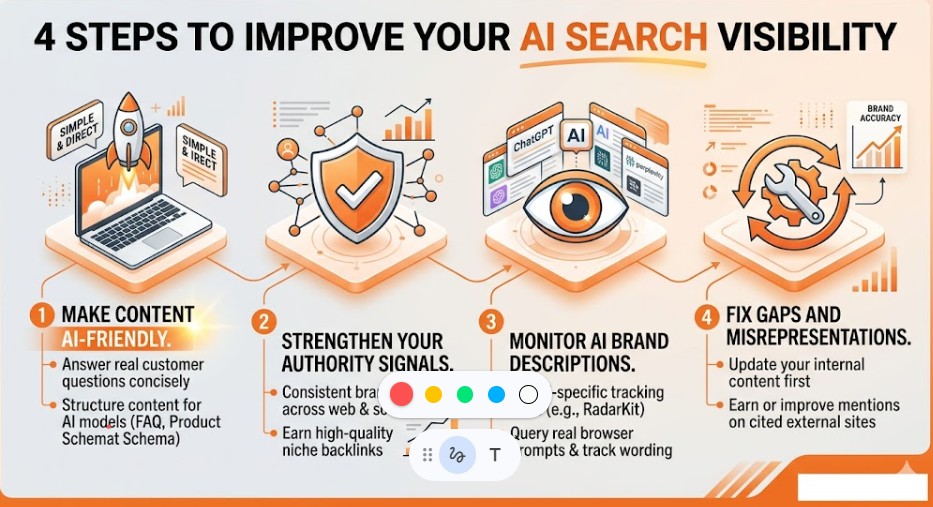
Make your content AI-friendly
Focus on pages that answer real customer questions in simple, direct language near the top, then add detail below. Use structured data (like Product, FAQ, and Organization schema) so AI systems can clearly understand who you are, what you offer, and key facts about your products.
Strengthen your authority signals
Make sure your brand information is consistent across your site, listings, and socials, and aim to earn mentions and links from relevant, trustworthy websites in your niche. This helps both search engines and AI models see you as a reliable source when they choose which brands to highlight.
Monitor how AIs actually describe your brand
Use a tool instead of manual checks so you can see how often you are mentioned and what wording AIs use around your brand. RadarKit runs real browser prompts across platforms like ChatGPT, Gemini, and Perplexity, then shows you your brand mentions, citations, and competitor presence in those answers.
Fix gaps and misrepresentations you find
If you see missing, outdated, or negative information in AI answers, update your own content first, then improve or earn mentions on the external sites that AIs already cite. Over time, this loop of updating, monitoring, and adjusting helps your brand show up more often and more accurately in AI-driven search.
FAQs
How is AI visibility different from Answer Engine Optimization (AEO)?
AI visibility is the outcome you are measuring, while Answer Engine Optimization is the set of tactics you use to influence that outcome. AEO focuses on structuring content, schema and entities so answer engines can understand and reuse your information, whereas AI visibility focuses on whether those engines actually mention and recommend your brand in real answers.
What metrics should I track to measure AI visibility for my brand?
Useful AI visibility metrics include brand mention rate across prompts, position within the answer, share of voice versus competitors, number of citations to your domain and sentiment of the surrounding text. Many teams also track AI referred sessions and conversions in analytics to see how often AI exposure turns into real traffic or leads.
How often should we audit our brand’s presence in AI answers?
Most experts recommend running a structured AI visibility audit at least monthly, with weekly spot checks on your most important queries or campaigns. This matters because models, training data and answer patterns change over time, so a one-time check can become outdated quickly.
Can small brands realistically compete with big brands on AI visibility?
Yes, smaller brands can still win visibility for focused, niche queries where they have deeper, more helpful content and stronger topical authority than larger competitors. By answering specific customer questions in detail and earning mentions on trusted niche sites, smaller brands can become “go-to” sources that AI systems like to cite.
Do I need a dedicated AI visibility tool if I already use SEO platforms?
General SEO platforms are starting to add basic AI visibility features, but dedicated tools provide deeper prompt-level tracking across multiple AI engines. If AI is becoming a key channel for your category, a specialist tool can show you exactly where you appear, what AIs say about you, and where competitors are ahead.
Conclusion
AI visibility is now a core part of search, not a side project. It is no longer enough to only rank in traditional results; you also need your brand to show up, be cited and be described correctly inside AI-generated answers.
By 2026, the brands that win are the ones that treat AI answers like a new surface for visibility, using tracking tools, share of voice metrics and ongoing content tweaks to stay present in the conversations AI has with their customers.
If you make AI visibility part of your SEO, you give your brand a real chance to be seen and trusted wherever people now start their research.