In this article, we are going to explore 8 Best Bluefish AI Alternatives. We will compare their feature, pricing, and which team they fit the most.
So, without any further ado, let’s get started.
Quick Pick Criteria
- RadarKit: Best Overall UI based AI visibility tracker combined with content, outreach, Reddit, and planning agents.
- Peec AI: Best for marketing teams that need clear reporting for prompts, visibility, position, sentiment, share of voice, and citations.
- OtterlyAI: Best for content teams that want AI search monitoring with crawlability checks, content audits, content scoring, and content briefs.
- Scrunch AI: Best for organizations that need AI visibility monitoring along with an AI-friendly version of their website for AI agents.
- Promptwatch: Best for teams that want prompt intelligence, crawler logs, visitor analytics, citation tracking, and AI content actions in one platform.
- SE Ranking: Best for SEO teams that want AI visibility tracking inside a wider SEO toolkit.
- Searchable: Best for brands that want AI visibility measurement with share of voice, citation data, sentiment analysis, and analytics connections.
- Profound: Best for growth and enterprise teams that need answer-engine insights, AI agents, traffic attribution, content workflows, and integrations.
Top 8 Bluefish AI Alternatives in 2026
RadarKit
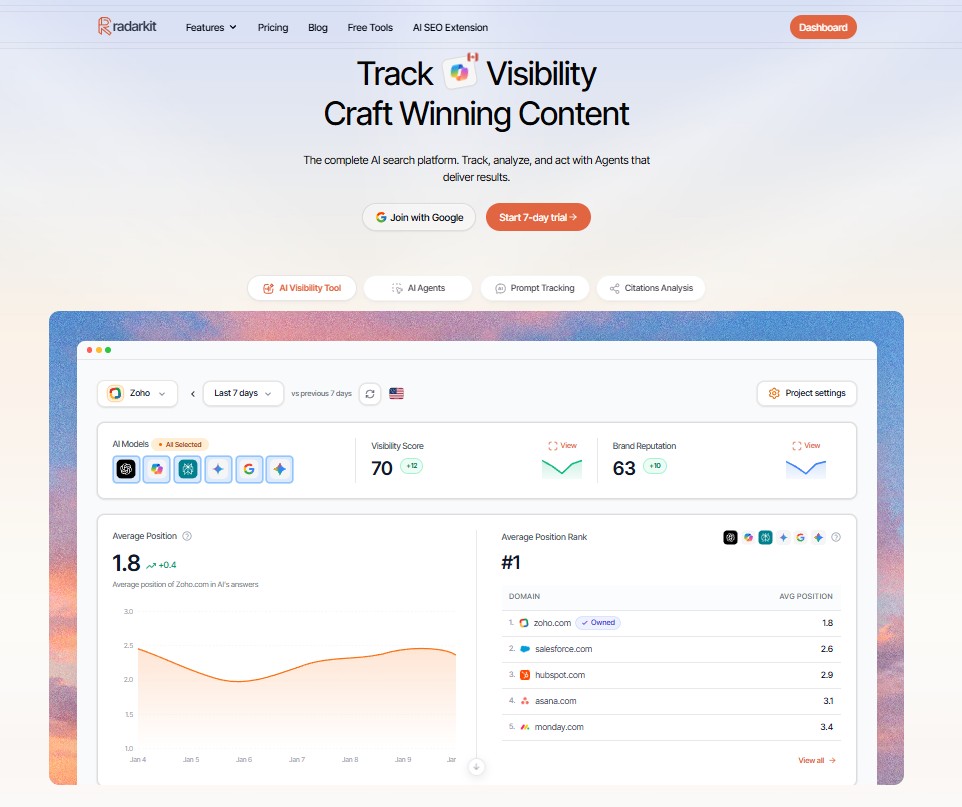
RadarKit is an UI based AI visibility tracker and optimization platform for brands, agencies, local businesses, and growth teams. It monitors how brands appear across ChatGPT, Perplexity, Gemini, Copilot, Google AI Overviews, and Google AI Mode across 50+ countries.
RadarKit is one of the most action-focused Bluefish alternatives because it connects visibility data with AI agents. Teams can use the platform to identify content opportunities, research outreach targets, explore Reddit discussions, and organize marketing tasks.
Key Features
-
-
AI Share of Voice: Measure how frequently your brand shows up in AI-generated answers relative to your main competitors for the exact prompts that matter to your business.
-
Location-based Tracking: Run the same prompt from 50+ countries using residential IPs to see how AI responses vary by market, then pinpoint locations where your visibility is strong or needs work.
-
NLP and Citation-led Content: Pull the sources, entities, and key terms that AI systems actually cite in their answers, then use those signals to guide content updates and new page ideas built for AI discovery.
-
Local Radar: See whether your local business appears and gets recommended in AI search for city, neighborhood, and “near me” queries, with results tracked from 50+ countries using residential IPs.
-
GEO Writer: Create or refresh AI-search-focused pages using citation data, query patterns, and competitor coverage as input, producing structured, entity-rich content optimized for both SERPs and AI answer engines.
-
Query Fanout Tracking: Discover the related questions and subtopics that AI systems generate from a single main prompt, then turn those fanout queries into content ideas and briefs that cover more user intents.
-
AI Traffic Monitoring: Track visits and referral traffic tied to AI platforms and zero-click answers, so you can measure visibility beyond traditional search metrics and understand how AI citations drive real traffic.
-
Plan Agent: Turn visibility gaps from Search Console data and citation insights into a practical, ordered action plan that tells you what to fix, where, and in what sequence.
-
Content Agent: Refine existing articles using tracked prompts, entities, and related queries so they’re easier for AI systems to understand, cite, and recommend in answers.
-
Outreach Agent: Find trusted, cited websites in your niche, pull author/contact details, and build outreach lists based on real citation patterns so you can pitch where AI actually draws its sources.
-
Reddit Agent: Highlight Reddit discussions that AI tools reference in your niche, giving you a ready-made list of threads for research, engagement, and topic discovery.
-
Chat Agent: Handle routine questions, quick checks, and smaller research tasks directly inside the platform without switching tabs or tools.
-
Integrations: Connect Google Search Console, Google Analytics, and WordPress so visibility, traffic, and content work stay in sync and feed into the same AI SEO workflow.
-
Plan and Pricing
Radarkit starts at $29 per month for Lite. Growth starts at $79 per month, Pro starts at $139 per month, and Enterprise starts at $449 per month with annual billing. Its paid plans include 50-plus locations, while Enterprise includes 70-plus locations and API access.
Best For
RadarKit is best for agencies, local businesses, and growth teams that want AI visibility reporting connected with content planning, outreach research, Reddit insights, and AI-assisted marketing actions.
Peec AI
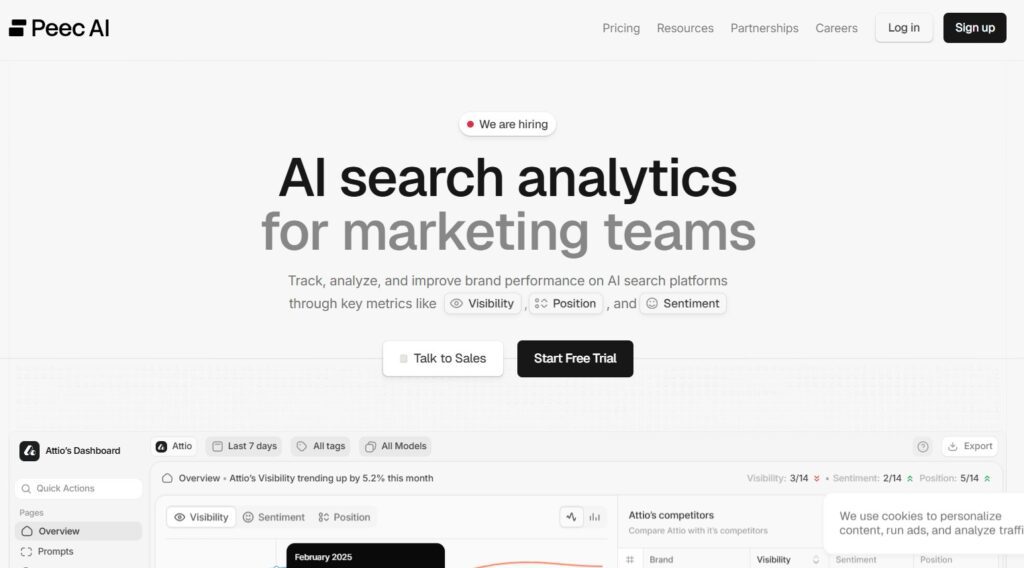
Peec AI is built for marketing teams that want a clear view of how AI search platforms frame their brand. Its core dashboard centers on visibility, position, and sentiment. That simple structure makes it easier to explain AI-search performance to content, brand, and executive teams.
The platform also focuses on prompt research and source intelligence. You can organize prompts, compare brands, identify the pages cited in answers, and turn those findings into recommendations for content and digital PR work.
Key Features
-
Visibility, position, and sentiment metrics: Measure whether your brand appears, where it appears in answers, and how positively AI platforms describe it.
-
Prompt discovery and organization: Add prompts, group them with tags, and use AI-suggested prompts and search-volume signals to prioritize opportunities.
-
Competitor benchmarking: Compare your brand with the companies that matter in your category and identify prompts where they appear more often.
-
Citation and source analysis: Find the websites and pages shaping AI responses, then use that information to improve your own content plan.
-
Reporting and workflow connections: Export CSV files, create Looker Studio dashboards, use the API, or connect AI visibility data through MCP to tools such as Claude, Cursor, and n8n.
Plan and Pricing
Best For
Peec AI is a strong choice for marketing teams that want uncomplicated AI-search reporting, source analysis, and a direct way to connect prompt performance with content priorities.
OtterlyAI
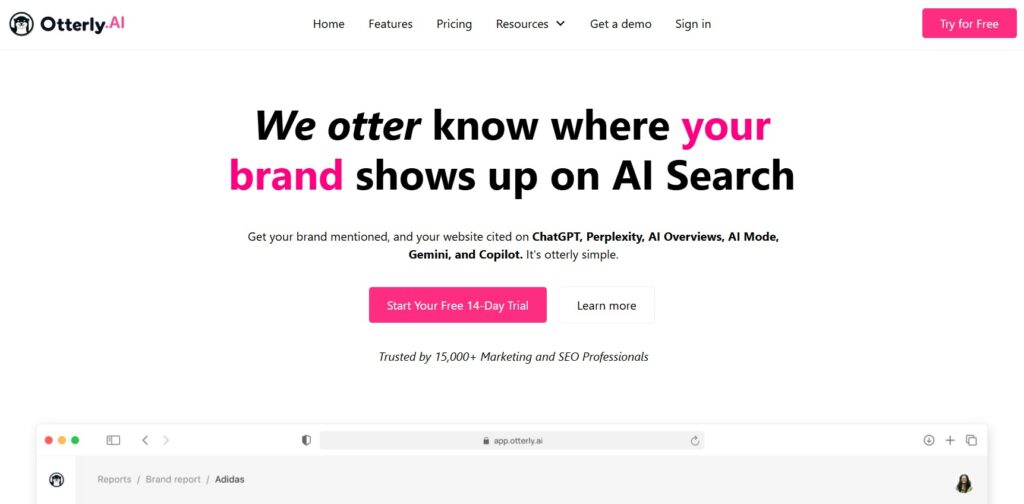
OtterlyAI approaches AI visibility as a content intelligence problem. It helps teams research prompts, monitor brand and website citations, and improve pages that are not being crawled or cited. It tracks ChatGPT, Perplexity, Google AI Overviews, Google AI Mode, Gemini, Copilot, and Claude.
The key difference is its on-page optimization focus. OtterlyAI does not only show where a brand is visible. It can audit a page for AI-readiness and citation potential, then provide a content brief and recommended fixes.
Key Features
-
Multi-engine brand and citation monitoring: Track brand mentions, website citations, competitors, and visibility changes across major AI search platforms.
-
Prompt research: Discover questions, topics, and intent patterns that can shape a prompt library and content calendar.
-
Crawlability and AI-readiness checks: Audit pages for crawlability, content issues, and factors that may prevent AI engines from using them.
-
Content Audit and Prediction: Review existing pages, see a predictive score before publishing, and use briefs to improve citation potential.
-
Public API and reporting: Access brand reports, prompts, citations, and workspace data programmatically for custom reporting or agency workflows.
Plan and Pricing
Best For
OtterlyAI suits content marketers and agencies that want one of the more content-focused Bluefish alternatives, particularly when page audits and AI-ready content briefs are important.
Scrunch AI
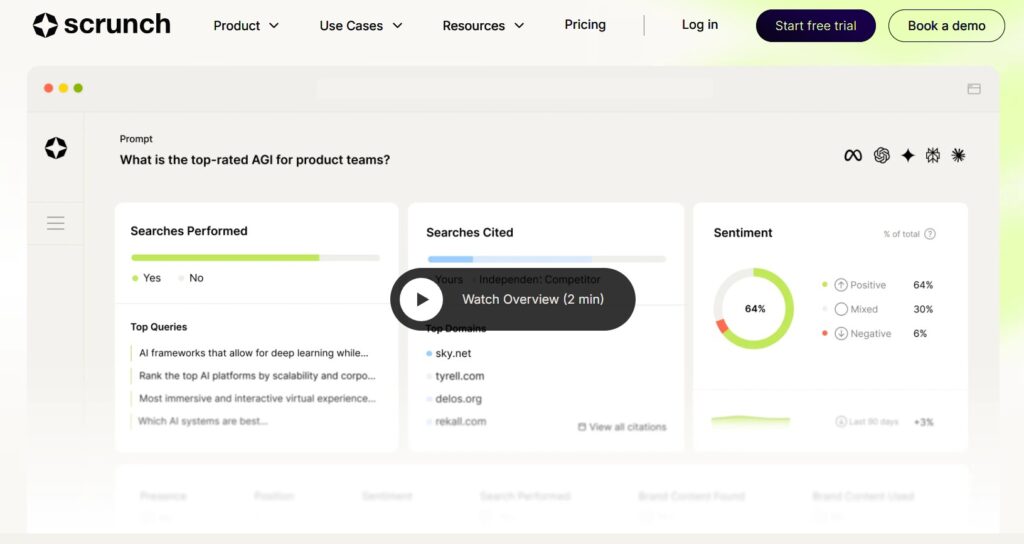
Scrunch AI combines monitoring, diagnostic insights, and a delivery layer called the Agent Experience Platform, or AXP. It tracks performance across prompts, topics, entities, competitors, personas, and locations. It also records AI-bot activity and identifies crawl errors that can affect visibility.
AXP is what sets Scrunch apart. It creates a parallel, lightweight version of selected website content for AI agents while keeping the regular visitor experience unchanged. That can be useful for larger sites that want structured, machine-readable content without redesigning their public pages.
Key Features
-
Prompt and entity monitoring: Track performance, trends, rankings, citations, and competitors at the prompt, topic, and entity level.
-
AI traffic and bot observability: View a real-time feed of AI bots crawling your site and follow agent-traffic trends.
-
Citation analysis and diagnostics: Identify the sources AI relies on, detect crawl errors, and receive guidance for priority improvements.
-
Agent Experience Platform: Deliver compressed, structured, AI-friendly page versions while preserving the human-facing website design.
-
Enterprise controls: Support multi-site and multi-region programs with role-based access control, a data API, and SOC 2 Type II compliance.
Plan and Pricing
Best For
Scrunch AI is best for organizations that want monitoring and technical AI-search delivery in the same platform, especially multi-site companies that need stronger control over how AI agents access their content.
Promptwatch
Promptwatch is an AI visibility and GEO platform designed to connect monitoring with action. It tracks brand mentions, citations, and sentiment across a broad group of answer engines. It also collects crawler logs and visitor analytics, so teams can investigate what AI systems accessed and what traffic followed.
The platform is notable for prompt intelligence. Its feature set includes prompt volumes, difficulty scoring, query fanouts, ChatGPT Shopping tracking, and Reddit insights. That makes it a helpful choice for teams building a wider AI-search program rather than tracking a small set of prompts.
Key Features
-
Unified multi-model tracking: Monitor brand visibility across ChatGPT, Perplexity, Google AI Overviews, AI Mode, Claude, Gemini, Meta Llama, DeepSeek, Grok, and related platforms.
-
Prompt intelligence: Use prompt volumes, difficulty scoring, query fanouts, and country, state, or city tracking to prioritize questions with commercial value.
-
Citation monitoring and content creation: Analyze cited sources, then use the platform’s AI actions to create content designed around those patterns.
-
Crawler logs and agent analytics: See AI crawler activity and visitor data to connect AI-search work with website traffic.
-
Shopping and community signals: Review ChatGPT Shopping data, ads visibility, and Reddit insights when those channels affect your category.
Plan and Pricing
Best For
Promptwatch is a good fit for teams that want to connect prompt research, source data, crawler evidence, AI-generated content, and visitor analytics in one AI-search workflow.
SE Ranking
SE Ranking is different from many Bluefish AI alternatives because it combines AI visibility work with a much broader SEO platform. Its AI Search Toolkit covers Google AI Overviews, Google AI Mode, ChatGPT, Gemini, and Perplexity. The surrounding suite adds keyword research, rank tracking, audits, competitive research, and reporting.
This makes SE Ranking appealing to SEO professionals who prefer one platform for traditional search and answer-engine optimization. The toolkit tracks linked and unlinked mentions, sources, answer positions, and changes over time.
Key Features
-
AI Results Tracker: Track brand mentions, links, positions, competitor visibility, and cached copies of AI answers for selected prompts.
-
AI Competitor Research: Analyze any domain’s AI presence, find relevant prompts and citations, and compare up to five competitors over time.
-
Source and coverage analysis: Map cited domains and URLs, group them by content type, and review performance by market and language.
-
AI visibility integrations: Send data to APIs, Data Studio, AgencyAnalytics, Whatagraph, Make, n8n, Zapier, and MCP-enabled assistants.
-
Wider SEO toolkit: Pair AI-search data with keyword research, technical audits, rank tracking, and agency reporting in the same account.
Plan and Pricing
Best For
SE Ranking is one of the best Bluefish AI alternatives for SEO agencies and in-house SEO teams that want AI visibility measurement alongside established keyword, audit, and reporting workflows.
Searchable
Searchable is an AI-powered SEO and AEO platform that helps brands track, understand, and improve visibility across AI search engines. Its focus is on converting AI responses into useful performance measures, including visibility, share of voice, citation frequency, sentiment, average position, and platform-level movement.
The platform also connects AI visibility work with web analytics. That matters for teams that want to move past mention counts and examine whether visibility improvements are linked with site performance.
Key Features
-
AI visibility scoring: Turn AI responses into metrics for rankings, share of voice, sentiment, average position, and movement by platform.
-
Citation frequency analysis: Measure how often a brand or website appears as a cited source in answer-engine responses.
-
Competitor benchmarking: Compare visibility patterns against competitors to identify prompts and topics with room for improvement.
-
Content recommendations: Use platform insights to guide content updates and topic priorities.
-
Analytics connections: Combine AI visibility work with GA4 and Google Search Console data to review the wider effect of content changes.
Plan and Pricing
Best For
Searchable.com is a practical option for brands that want AI visibility, citation metrics, competitor benchmarking, and analytics connections in a focused platform.
Profound
Profound is an answer-engine optimization platform for companies that want visibility tracking plus operational tools for content and measurement. It supports tracking across ChatGPT, Perplexity, Google AI Overviews, Google AI Mode, Gemini, Copilot, Grok, DeepSeek, and Claude, depending on plan level.
The platform’s distinctive feature set includes Profound Agents and Profound Sheets. These tools let teams run content generation, optimization, and other AEO tasks at scale. It also provides Agent Analytics for AI-sourced traffic attribution across domains.
Key Features
-
Answer Engine Insights: Track brand and competitor presence, mentions, citations, and prompt-level visibility across AI answer engines.
-
Profound Agents: Use autonomous workers for content generation, optimization, and additional AEO activities.
-
Profound Sheets: Run agent-based tasks at scale through a spreadsheet-style workflow.
-
Agent Analytics: Attribute AI-sourced traffic across tracked domains to understand which answer-engine efforts connect with visits.
-
Enterprise integrations and controls: Connect with Akamai, AWS, Cloudflare, Fastly, Google Analytics, Google Cloud Platform, Netlify, Vercel, and WordPress, with API, SSO/SAML, and SOC 2 support at the enterprise level.
Plan and Pricing
Profound is one of the most suitable Bluefish AI alternatives for growth and enterprise teams that need AI visibility data, content operations, traffic attribution, and technical integrations in one program.
How to Choose the Right Bluefish AI Alternatives
Identify your main goal
Start by deciding what you want to achieve with a Bluefish alternative. You may want to track brand mentions, monitor citations, compare competitors, improve product visibility, measure sentiment, or understand whether AI platforms are sending visitors to your website.
Some tools focus on measurement, while others help with content planning and execution. A monitoring platform may be enough for an experienced SEO team. A platform with content and AI agent workflows may be more useful for smaller teams or agencies.
Check AI platform coverage
AI visibility tools do not all monitor the same platforms. Most include ChatGPT, Perplexity, Google AI Overviews, Google AI Mode, and Gemini. Some also cover Claude, Copilot, Grok, DeepSeek, Meta AI, and AI shopping experiences.
Before choosing between Bluefish alternatives, check whether the platform supports your preferred AI engines, regions, languages, locations, and refresh frequency.
Decide whether you need content workflows
If your team only wants to measure visibility, a tracking platform may be enough. If you want to improve pages and create new content, look for tools that include content briefs, page audits, content scoring, article drafting, citation analysis, technical recommendations, outreach research, and publishing workflows.
The most suitable platform should help your team move from data to action.
Consider traditional SEO features
Bluefish focuses on AI marketing and brand visibility. Many businesses also need keyword research, rank tracking, backlink analysis, competitor research, and website audits for Google Search.
SE Ranking is a useful option for teams that want traditional SEO and AI visibility in the same platform. Other tools in this list are more focused on AI search.
Review reporting and integrations
Reporting becomes important when you work with multiple clients, locations, brands, or products. Look for client dashboards, data exports, APIs, Google Analytics connections, Google Search Console connections, Looker Studio support, and user permissions.
Enterprise organizations should also review account security, single sign-on, access control, data retention, and customer support.
Test real customer prompts
Use real customer questions when testing Bluefish alternatives. Include product searches, comparison queries, pricing questions, local searches, competitor searches, category questions, and buying-stage prompts.
FAQs: Bluefish AI Alternatives
What is the best Bluefish AI alternatives for AI visibility tracking?
The best choice depends on your goal. RadarKit works well for teams that want data plus action agents. Peec AI is useful for straightforward marketing reporting. OtterlyAI is a strong fit for content audits, while SE Ranking suits SEO teams that also need traditional SEO tools.
Which Bluefish AI alternatives is best for agencies?
Agencies should look closely at RadarKit, OtterlyAI, SE Ranking, Scrunch AI, and Profound. Useful agency features include multiple projects, workspaces, client reporting, exports, APIs, white-label or branded reports, and permission controls.
Can these tools track Google AI Overviews and ChatGPT?
Yes. Every platform in this list supports monitoring on at least some of the major AI search experiences. The exact models, locations, and check frequency vary by vendor and plan, so review the plan details before choosing.
What is the difference between AI visibility and traditional rank tracking?
Traditional rank tracking measures where a page appears in search results for a keyword. AI visibility tracking measures whether an answer engine mentions or links to your brand, how the answer describes it, which sources it cites, and how often competitors appear for comparable prompts.
Do AI visibility tools guarantee more citations or traffic?
No platform can guarantee citations, rankings, or traffic. These tools provide monitoring, source analysis, content guidance, and reporting that can help a team make better decisions. Results still depend on the quality, relevance, technical accessibility, and reputation of the content and brand.