In this article, we are going to explore what Zero Click SEO is and will share 5 tips to do Zero Click SEO.
So, without any further ado, let’s get started.
Quick Checklist for Zero Click SEO for GEO
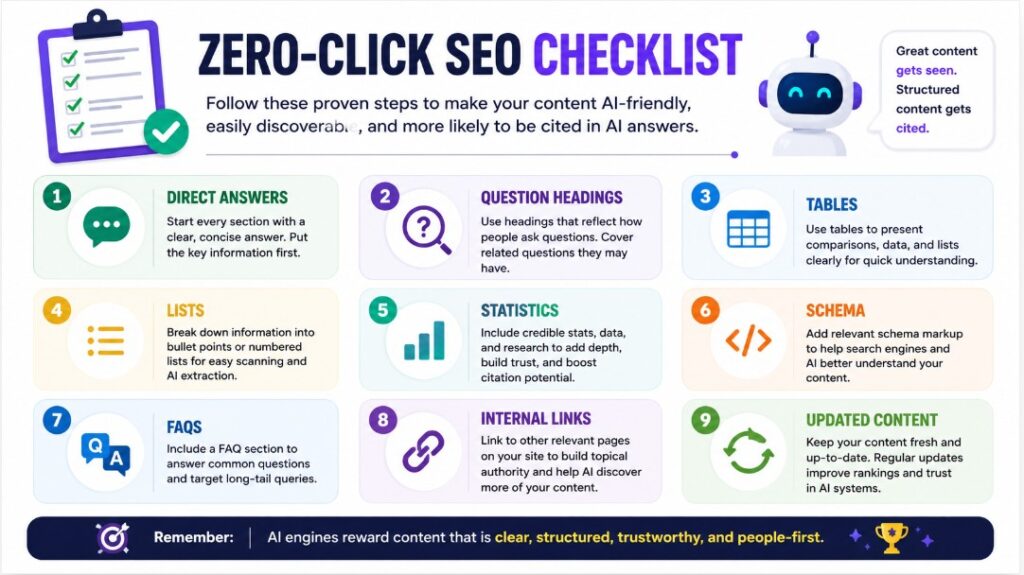
A simple checklist readers can follow:
- Start with direct answers
- Use Question headings
- Use Tables for comparison data and lists
- Make lists for information in the form of bullet points or a numbered list
- Use Statistics to add depth to your content
- Add relevant Schema markups
- Include an FAQ section and answer common related questions
- Internal links
- Keep your content updated
What is Zero Click SEO?
Zero click SEO is the practice of creating content that answers a user’s question directly on the search page or inside an AI-generated response, so your brand gets visibility even when no website visit happens.
It matters because search is no longer just a list of blue links, it now includes featured snippets, AI Overviews, local packs, knowledge panels, and conversational answers inside tools like ChatGPT and Gemini.
This shift is not small. In 2025, more than 64% of U.S. search queries ended without a click, and in a recent study, it was found that about 360 out of every 1,000 Google searches reached the open web.
AI Overviews have pushed this even further, with one analysis on the fetched page noting that AI Overviews were appearing on roughly 20% of Google searches by mid-2025, while another large search behavior study found traditional result clicks falling from 15% to 8% when an AI summary was present.
For content marketers, this changes the goal. You still want traffic, but you also want your brand, facts, and expertise to be the part of the answer people read first
How Zero Click SEO Works
Zero click SEO works by making your page easy to read, easy to extract, and easy to trust. Search engines and AI systems look for clean headings, direct answers, structured lists, tables, schema markup, and strong trust signals that help them understand what your content says and when it should appear.
The strongest pages usually answer the question in the first two or three sentences, then expand with detail below. They also cover the full question cluster around a topic instead of repeating one keyword over and over, because modern AI systems reward pages that resolve the broader intent behind the query.
That is why thin blog posts and padded introductions often lose ground in AI-heavy results. Generic content is easy to compress into a summary, while original expertise, first-hand detail, real examples, and structured explanations are harder to replace.
Top 5 Tips to do Zero Click Seo for GEO
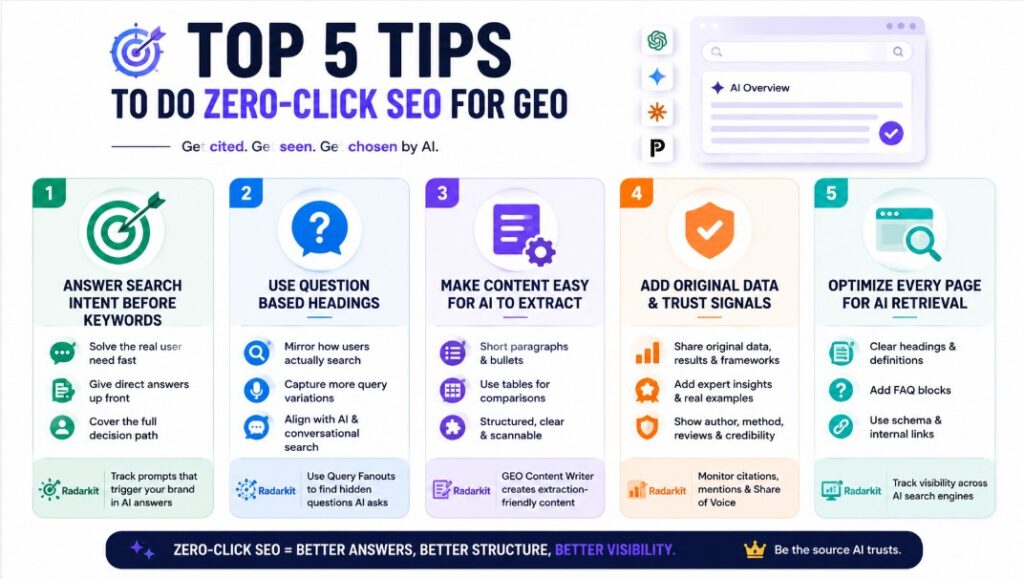
1. Answer Search Intent Before Keywords
Start by asking what the user wants solved, not what phrase has the highest search volume. Zero click SEO wins when your page answers the real need fast, because AI systems prefer pages that resolve the question clearly instead of circling around it.
A simple way to do this is to place a direct answer in the first few lines of the page and under every major heading. Then expand with examples, objections, comparisons, and next-step detail so the page covers the entire decision path, not just the headline term
Radarkit fits here because it helps you see which prompts actually trigger your brand inside AI answers across major assistants. That means you can compare the questions you target with the questions that are already producing mentions, then tighten your pages around the intent patterns that matter most
2. Use Question Based Headings
Question-based headings are easier for both people and AI systems to process because they mirror the way users actually search. Headings like “What is zero click SEO?” or “How does zero click SEO help GEO?” make the topic of the section obvious and create a clean setup for a short answer right below it.
This structure also helps you win more query variations. One well-framed question can align with typed search, voice search, AI prompts, and follow-up questions in conversational search journeys.
If you’re struggling to find related questions, Radarkit’s Query Fanouts feature uncovers the hidden questions AI systems generate, making it much easier to build heading structures that align with how AI retrieves information.
3. Make Your Content Easy for AI to Extract
Extraction-friendly content is one of the clearest wins in zero click SEO. Keep paragraphs short, place the answer immediately after the heading, use bullets when possible, and add tables for comparisons or grouped facts.
This does not make content robotic. It makes it usable. A page can still sound human while being neatly structured, and that balance is exactly what helps both the reader and the retrieval system.
Radarkit’s GEO Content Writer helps make content easier for AI to extract by building articles around NLP terms, citation data, facts, and question-led sections that align with how AI search systems read pages.
Instead of writing long generic copy, you can create structured content with direct answers, semantic depth, and FAQ-style blocks that are more likely to appear in AI Overviews, ChatGPT, Gemini, and other zero-click surfaces.
4. Add Original Data and Trust Signals
Original data changes the game because AI systems can summarize common knowledge easily, but they cannot replace first-party evidence as easily.
Benchmarks, customer results, proprietary frameworks, expert commentary, real screenshots, named methods, and updated statistics make your page more useful and more defensible.
Trust signals make that even stronger. Author names, business details, reviews, clear methodology, and topic depth all help your page feel real and reliable.
Radarkit allows you to monitor citations, mentions, and Share of Voice across multiple AI search engines after publishing.
5. Optimize Every Page for AI Retrieval
Do not treat GEO as something only blog posts need. Product pages, service pages, comparison pages, about pages, and category pages all need a retrieval-friendly structure.
Add clear headings, direct definitions, FAQ blocks, schema markup, internal links, and complete page-level context so each URL can stand on its own.
Best Tool for Zero Click SEO for GEO
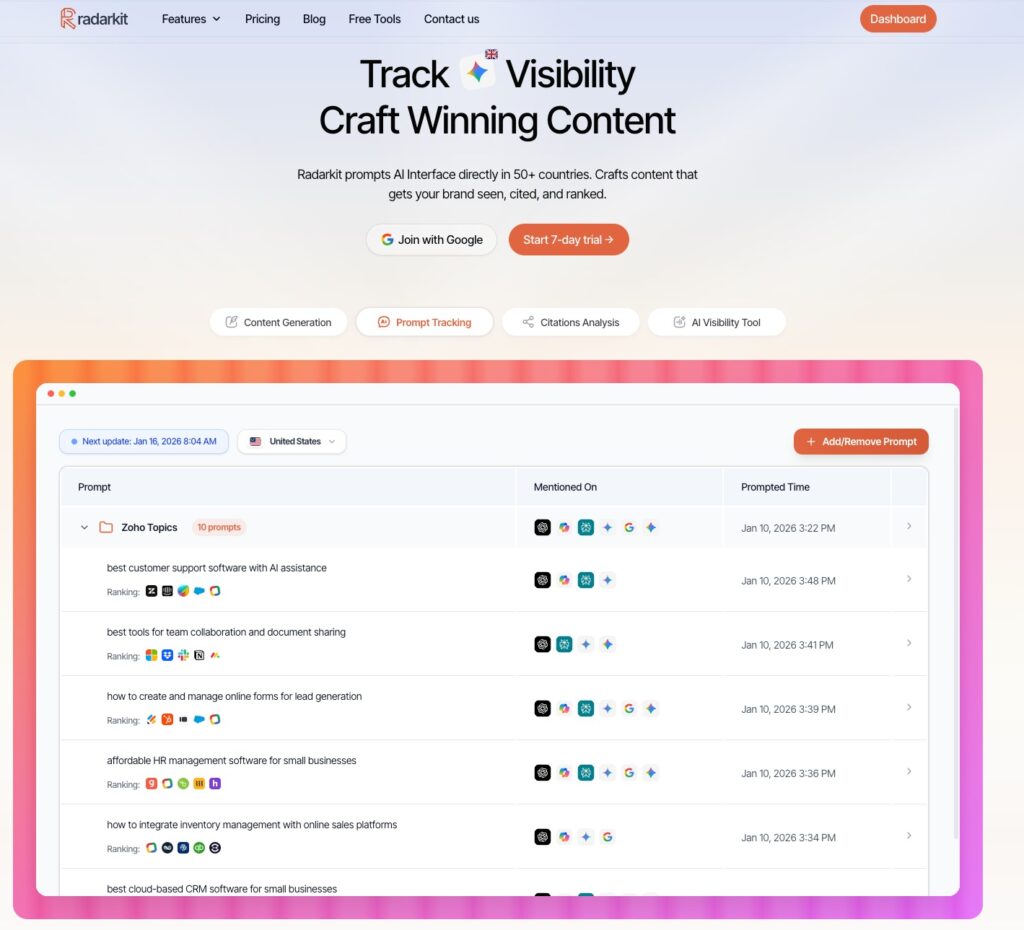
For zero click SEO for GEO, Radarkit stands out as one of the strongest tools because it is built around AI search tracking, citations, and content optimization rather than only classic keyword rankings.
Instead of guessing how AI systems talk about your brand, Radarkit shows how you appear across ChatGPT, Gemini, Perplexity, Google AI Overviews, and other assistants using real browser checks from over 50+ countries.
Notable Radarkit Features
- AI Share of Voice: See which domains AI assistants trust most for your queries versus competitors.
- Location-Based Tracking: Simulate queries from 50+ countries with residential proxies to capture local citations and AI behavior.
- NLP & Fact-Based Content: Pull entities and terms from top-cited sources to guide content that ranks in AI engines.
- 1‑Click GEO Content Writer: Spin up GEO-optimized content tailored to LLMs without needing Google Search Console data.
- Query Fanouts Tracking: Understand how AI models expand a single query into multiple subtopics and sections.
- AI Traffic Monitoring: See which AI platforms actually send visitors to your site, not just mention you in answers.
How Does Zero Click SEO Help GEO?
Zero click SEO helps GEO because GEO is about becoming part of the answer layer inside AI-driven search, not just ranking and hoping for a click.
The better your content works in zero-click surfaces, the better chance it has of being retrieved, understood, and named in AI responses.
AI citations
When your page is structured well, AI tools can pull facts, definitions, steps, comparisons, and brand references from it more easily.
GEO benefits from that because the goal is not only to rank, but to have your content used when AI builds an answer for the user.
This is one reason answer-first formatting matters so much. Short, clean answer blocks, supported by deeper context underneath, give AI systems something precise to reuse.
AI Overviews
AI Overviews summarize a query before many users ever reach the regular results, so earning visibility there can put your brand in front of the searcher at the exact moment the answer is formed.
That matters because click behavior changes sharply once the summary is present, and even a stable ranking can produce less traffic when the overview satisfies the search right away.
For GEO, this means your page has to be written for inclusion inside the summary, not only for position on the page. Definitions near the top, a clear hierarchy, concise answers, and a schema all improve the fit.
ChatGPT & Gemini visibility
People now do product research, comparisons, and early decision-making inside ChatGPT, Gemini, Perplexity, and similar tools. If your content is well organized and your brand appears consistently across the web, these systems are more likely to surface you during those research moments.
That makes GEO bigger than Google alone. You are optimizing for retrieval across a wider search environment where prompts, follow-up questions, and entity recognition all matter.
Brand mentions
Even when no click happens, repeated brand mentions can shape preference and recall. A user who sees your name in an AI answer, then again in an overview, then again in a comparison query is far more likely to remember you when it is time to act.
This is why modern reporting is shifting beyond rankings and clicks. AI visibility, brand mentions, and prompt-level presence now matter because they show whether your brand exists inside the answers people are actually consuming.
Authority building
Zero click SEO also builds authority because AI systems favor depth, experience, real numbers, and consistent brand signals across multiple places. When your site publishes detailed pages, covers a topic deeply, and reinforces the same expertise across related content, your brand becomes easier to trust and easier to retrieve.
Traditional SEO vs Zero Click SEO
| Traditional SEO | Zero Click SEO |
|---|---|
| Focuses on bringing users to the website through search clicks. | Focuses on appearing in AI answers, snippets, and search results without needing a click. |
| Success is usually measured by rankings, traffic, and CTR. | Success is usually measured by visibility, brand mentions, citations, and impressions. |
| Content is often written to rank for keywords. | Content is written to answer questions clearly and quickly. |
| Headings are usually topic-based and keyword-based. | Headings are usually question-based and answer-based. |
| Long-form content is common, but not always structured for extraction. | Content is structured so AI can easily read, summarize, and reuse it. |
| Schema is useful, but often treated as a support element. | Schema is a core part of making content understandable to AI systems. |
| The main goal is to get the user onto the site. | The main goal is to get the brand into the answer itself. |
| Works best for traffic-driven SEO campaigns. | Works best for GEO, AI Overviews, and zero-click visibility. |
Common Zero Click SEO Mistakes
Writing for keywords instead of questions
This is still one of the biggest mistakes in modern SEO. A page can be keyword-rich and still fail if it does not answer the actual question in a clear, useful way.
Long introductions
Long intros hurt extraction because they delay the answer. In zero click SEO, the best move is usually to answer first, then add depth after the core point is clear.
Thin content
Thin content is easy for AI systems to compress and easy for users to skip. If the page has no first-hand knowledge, no detail, and no reason to trust it, it gives the engine very little reason to treat it as valuable.
No structured headings
Without structured headings, your content becomes harder to scan and harder to retrieve. Headings are not decoration, they are the framework that tells both humans and machines where each answer begins and what it covers.
No supporting evidence
Pages without evidence feel shallow in an AI-first search environment. Real examples, updated data, visible expertise, and consistent business signals all help a page carry more weight.
FAQs
How do AI search engines choose which content to cite?
AI search engines usually cite content that is relevant, clear, trustworthy, and well-structured. They look for pages that match the user’s intent, give a direct answer near the top, and then expand with helpful context instead of hiding the point in long paragraphs. Clear headings, short answer blocks, FAQ sections, and updated information all make it easier for AI systems to lift your content confidently into summaries and AI Overviews
Can zero click SEO still bring leads if clicks are lower?
Yes, because visibility inside AI answers and search summaries can influence buyers before they visit your site. In many cases, the people who do click after that early research phase are more qualified because they already understand the basics and are closer to action.
Should I update old content or publish new pages first?
Start with existing pages that already have impressions, rankings, or topical relevance. Refreshing those pages with answer-first sections, question-based headings, schema, and better structure is often faster than starting from zero.
How long should a direct answer block be?
A strong answer block is usually short and focused, often around 40 to 60 words. That length is long enough to be useful and short enough to be extracted cleanly under a question-based heading.
Is schema enough to rank in AI search?
No, schema helps machines understand the page, but it does not replace quality, relevance, and trust. The best results come when schema supports content that is already clear, complete, and useful.
What should I track besides rankings?
Track AI mentions, citations, visibility by prompt, share against competitors, and whether your brand appears in AI Overviews and assistant responses. This is exactly where platforms like Radarkit are useful, because they monitor brand presence across major AI assistants and show how that visibility changes over time.
Final Thoughts
Zero click SEO is not about giving away everything for free. It is about becoming the brand people see first when search engines and AI tools assemble the answer. When you write for intent, use clean headings, add real expertise, and make every page easy to retrieve, GEO becomes much more practical and measurable.
Radarkit fits neatly into that workflow because it helps you move from guesswork to actual prompt-level visibility tracking across AI search environments. That matters now because rankings alone do not tell the full story anymore, and the brands that keep showing up inside AI answers are the ones most likely to stay visible as search keeps changing.