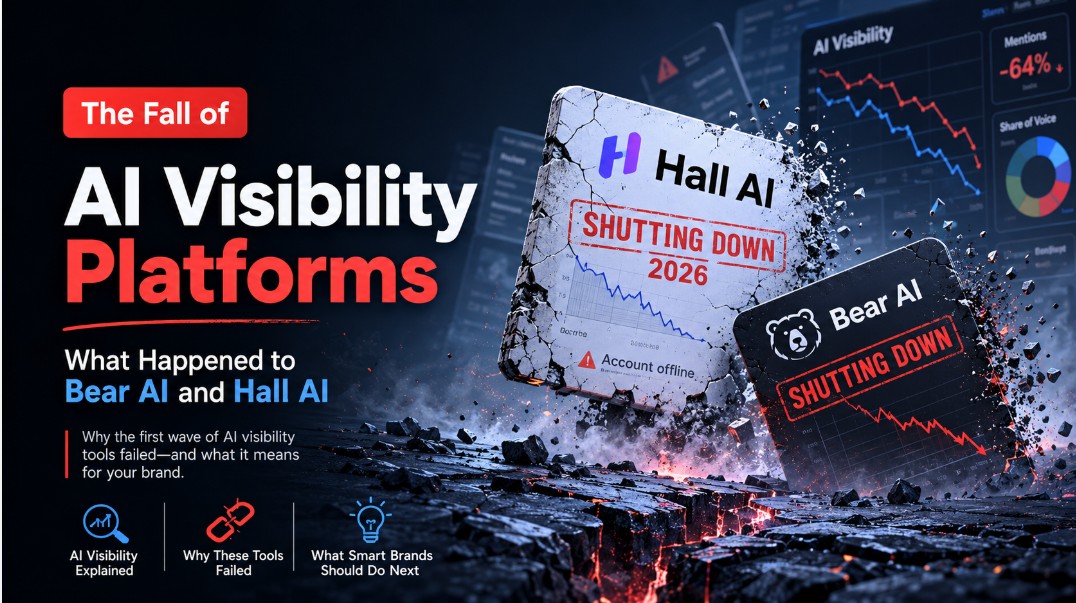
Hall AI shutting down in 2026 was a turning point for the AI visibility market. A tool that promised to show brands how often they appeared in ChatGPT, Perplexity and Google’s AI features suddenly went offline, leaving customers without dashboards, history or a clear migration path.
Hall was not the only one.Bear AI, a Y Combinator-backed AI visibility startup, also moved away from its original product, joining a growing list of GEO and AI visibility tools that either quietly shut down, froze development, or were forced into “maintenance mode” after failing to reach sustainable scale.
This is more than just “one startup failed”. Across the AI search visibility space, a pattern has emerged: tools built around monitoring-only dashboards, thin infrastructure and short-term cloud credits are collapsing, while a smaller number of infra-heavy, action-oriented platforms are becoming the real backbone of AI search strategy.
If you rely on AI answers for brand discovery, you need to understand why these tools are closing and what separates fragile products from durable platforms.
So, without any further ado, let’s get started
What AI Search Visibility Tools Actually Do (And Why They Matter)
Traditional SEO tools were built for a world of blue links and static SERPs. AI search visibility tools exist for a different reality. They help you see how AI systems mention, cite and describe your brand inside AI-generated answers, not just where you rank in Google.
Instead of focusing on “position 1 vs position 5”, these platforms usually track things like:
- How often is your brand mentioned across a defined set of prompts
- Which URLs, pages or domains get cited as sources
- Whether your brand is omitted in favor of competitors
- How visibility changes over time across different AI models
This matters because AI-generated answers are steadily absorbing more user attention. A growing percentage of queries now show AI Overviews or assistant-style answers, and users often never click through to a website at all. The first question is no longer “what rank do I have” but “am I in the answer at all”.
In that context, Hall AI and similar tools attempted to become the “Search Console” for AI answers. Their failure is not about the concept being wrong. It is about how fragile many first-generation tools were under the hood.
The Hall AI Shutdown: What Actually Went Wrong
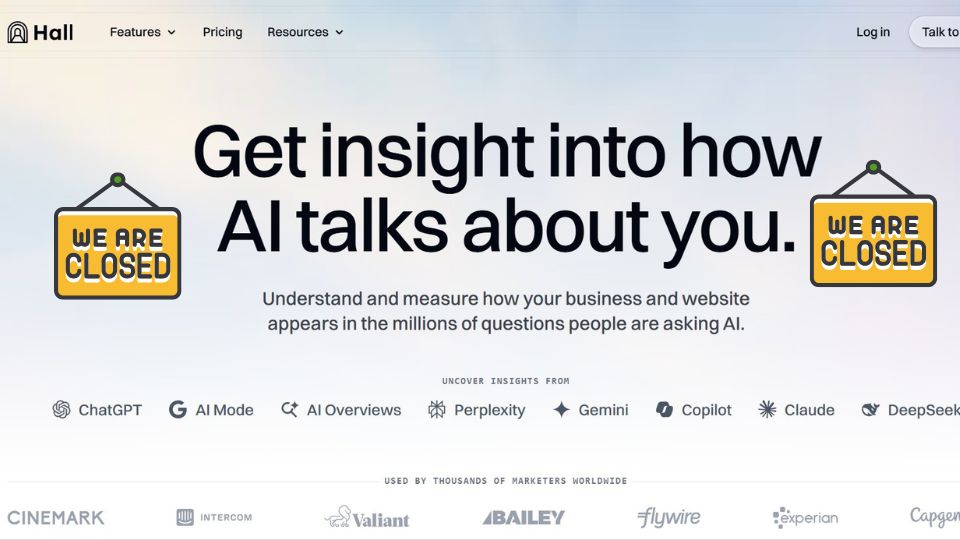
Hall AI entered the market promising to answer a very specific question for brands: “When people ask AI about us, do we show up?” It positioned itself as a GEO and AI visibility platform, letting teams track how often they were named in AI answers and how their content appeared across tools like ChatGPT, Perplexity and Google’s AI features.
In practical terms, that meant you could plug in a set of prompts, see which models mentioned you, and watch a line chart of your visibility over time.
At first glance, this was exactly what marketers needed. Traditional SEO tools were not built to watch AI answers, and Hall made that gap feel manageable through simple dashboards: prompts in, visibility graphs out.
But under the surface, Hall looked a lot like many other first‑wave GEO tools. It was primarily a monitoring dashboard rather than a full workflow product.
It could show you whether you were present or absent, but it didn’t walk you through which pages to change, what content to produce next, or how to turn those insights into outreach, PR or CRO decisions.
That “monitoring‑only” design became a core weakness. When customers asked “so what do we do now?” the answer often involved other tools: separate writers, separate SEO suites, separate outreach platforms.
Hall remained the place where you looked at numbers, not the place where you did the work. Reviews comparing Hall to alternatives call this out explicitly: it gave “insights” but forced users to bolt on separate software to actually act on them.
On top of this, Hall leaned heavily on third‑party LLM APIs and generic cloud infrastructure.
That helped the team move quickly at the start, but it meant the product’s costs and reliability depended on pricing and limits they didn’t fully control. As usage grew and API spend increased, the economics became much harder.
By mid‑2026, Hall had joined the list of AI visibility startups that couldn’t reach sustainable revenue, couldn’t keep infra costs in check, or couldn’t justify continued development given the constraints.
The shutdown left users rebuilding their AI visibility stack from scratch, and for many, migrating to platforms designed very differently under the hood.
What Happened to Bear AI?
Bear AI was a Y Combinator-backed AI visibility platform built to track brand mentions, citations, and competitors across AI search tools. The founders later moved on from Bear AI to focus on Specific Labs, meaning the original product is no longer their main priority.
While this shift can be viewed as a pivot, it also reflects how difficult it can be to build and scale a monitoring-heavy AI visibility platform. Keeping up with rapidly evolving AI search systems, tracking reliable data, and delivering actionable insights at scale is a demanding challenge
The Bigger Pattern: Why are AI Search Visibility Tools Closing?
Hall’s shutdown feels dramatic, but if you zoom out over 2023–2026, it looks less like a surprise and more like part of a wave.
There was an explosion of “track your brand in ChatGPT” tools, followed a few years later by consolidation and attrition.
Every few weeks, a new tool appeared with a slick homepage and a beta list; by 2026, many of those names had gone quiet, been acquired, or been repositioned into other products.
These early GEO tools share a familiar set of weaknesses. They were often launched very quickly on shallow infrastructure, reliant on one or two API providers, and structured as thin dashboards rather than deeply integrated systems.
The pitch was simple and similar across sites: enter your brand, watch your AI visibility score. That simplicity helped them win early adopters, but it also meant they treated GEO as a side experiment rather than as a core discipline that needed its own workflows, models and cost‑sensitive design.
As AI search matured and more serious budgets moved into this space, buyers started asking deeper questions.
They wanted to know how prompts were sampled, how representative the data was, whether the platform could handle thousands of queries and multiple models, and how all of this analysis translated into actual content and revenue wins.
Once the conversation shifted from “can you show me something?” to “can I trust this and use it to run strategy?”, a lot of shallow tools simply couldn’t keep up.
In that sense, Hall is less a standalone failure and more a visible data point on a larger curve. It represents what happens when an entire generation of tools focuses on visibility charts without building the infrastructure, domain depth and workflows that long‑term users expect.
The Infrastructure Problem: Borrowed APIs, Real Bills
A big part of this story is infrastructure. Many AI search visibility tools were essentially wrappers around LLM APIs.
They ran prompts through commercial models, logged outputs, and turned those outputs into dashboards. Architecturally, they depended on other people’s compute, other people’s rate limits and other people’s pricing.
In the early stages, this seems efficient. You can prototype quickly, avoid building your own crawling or execution stack, and lean on free or subsidized credits from providers like OpenAI partners, Google Cloud, or AWS.
But continuous AI visibility tracking is inherently expensive if you do it naïvely. To monitor trends, you have to run the same prompts day after day across different models, regions and settings.
Multiply that by hundreds of queries per client and dozens or hundreds of clients, and you are calling APIs at very high volumes.
There are three recurring issues.
- First, API bills escalate rapidly once you move beyond a handful of test prompts, especially when you expand model coverage to include ChatGPT, Gemini, Claude, Perplexity and Google AI Overviews.
- Second, many teams built their early operations around generous, time‑bound credits that masked the true cost of their workloads; when those credits expired, their unit economics flipped from “fine” to “broken” almost overnight.
- Third, because they didn’t own their infra, they had limited ability to batch, cache or precompute work in more cost‑efficient ways. Any change in external pricing or policies could suddenly make the product unviable.
Hall’s shutdown sits right in this context. It followed the pattern of a monitoring‑heavy, API‑dependent tool that worked in a small, subsidized environment but struggled to remain sustainable once real usage and real costs collided. And it is far from alone. Several market analyses mention that a significant share of “AI monitoring” tools across categories are now closing or consolidating for exactly this reason.
Founder Background and Product Direction: When SEO Is Not in the Room
A lot of first‑generation AI visibility platforms came from engineering or generic AI product backgrounds, rather than from SEO, analytics or content strategy. That shaped what they built and how.
You can see this in the metrics and UX choices. Dashboards often highlight clever or novel numbers that do not align with how CMOs, heads of SEO, or performance teams report success.
Visibility scores might look nice, but they’re not clearly tied to pipeline, revenue or specific pages. Tools feel like experimental toys rather than critical infrastructure.
Layered on top of this is investor pressure. Many AI startups were pushed to expand model coverage, regions and features to look competitive on paper, even if their infra and product foundations were not ready.
That produced a pattern where teams tried to support “all the models” and “all the markets”, added more dashboards but never fully solved core questions like cost per tracked prompt, integration into workflows, or clear ROI stories for buyers.
When growth slowed or funding tightened, those unresolved fundamentals caught up with them.
Without founders and product leaders who deeply understand SEO, AI search behavior and the realities of content operations, it is very easy for a GEO tool to stall at the “interesting but not essential” stage.
The Free Token Trap: Why Cloud Credits Aren’t a Business Model
The “free token trap” is a quieter but very important part of this ecosystem. Cloud providers have strong incentives to encourage experimentation, so they offer generous promotional credits for compute, storage and AI usage.
Many AI tools, including visibility platforms, used these credits to get off the ground. For a while, it worked: you could run thousands of AI calls, store plenty of data, and keep the product feeling cheap to run.
But those credits are designed to end. When they do, the same workloads that looked harmless begin to generate real monthly bills.
For any tool where pricing, packaging and user behavior were never stress‑tested against true costs, this is a shock.
Margins turn negative, cash burn spikes, and teams have to choose between sharply raising prices, cutting features, limiting use, or shutting down altogether.
Analysts who map AI tool lifecycles in 2026 explicitly note this pattern: products that only make sense while operating in “free credit mode” are disappearing as the market matures.
For customers, this translates directly into risk. You might adopt a tool that feels fast and cheap, only to see it throttle usage, increase prices abruptly or vanish once the free‑credit era ends.
Why Monitoring-Only Platforms Are the First to Fall
Among all the AI visibility tools that analysts track, the ones that appear most vulnerable are the monitoring‑only platforms. They provide answers to “are we visible?” but stop short of “what should we do next?”
Typically, they can tell you where your brand appears, where it doesn’t, and how often you’re cited. That by itself is not meaningless; it’s the first layer of any GEO program.
The problem is that without strong guidance on content, PR, partnerships or technical changes, the data becomes a monthly report rather than a driver of change. In downturns or budget reviews, tools that only show charts with no clear tie to outcomes are usually the first to be cut.
What Hall’s closure means for its former customers
When Hall went dark, most customers felt two things at once: panic about losing their data and confusion about what to replace it with.
For many teams, Hall wasn’t just a side project – it sat in their reporting stack, feeding screenshots into decks and shaping how they explained “AI visibility” to stakeholders.
Overnight, those dashboards stopped loading, trend lines froze, and the question shifted from “how visible are we?” to “who can we trust next?”
Radarkit addresses Hall’s gap by closing the loop from monitoring to action. Former Hall customers were used to seeing when they were missing from answers, but they still had to guess what to publish next.
Radarkit pulls citation data, top sources, and query fanouts together, then feeds that into content and outreach workflows: it helps you see which sites AI trusts, what structures those pages use, and how to shape your own content and campaigns to become part of that same citation network.
Instead of “monitor only”, Radarkit “monitor, fix, publish, measure” – exactly the loop Hall never fully built.
Radarkit’s Approach: Built for Stability, Scale and AI Discoverability
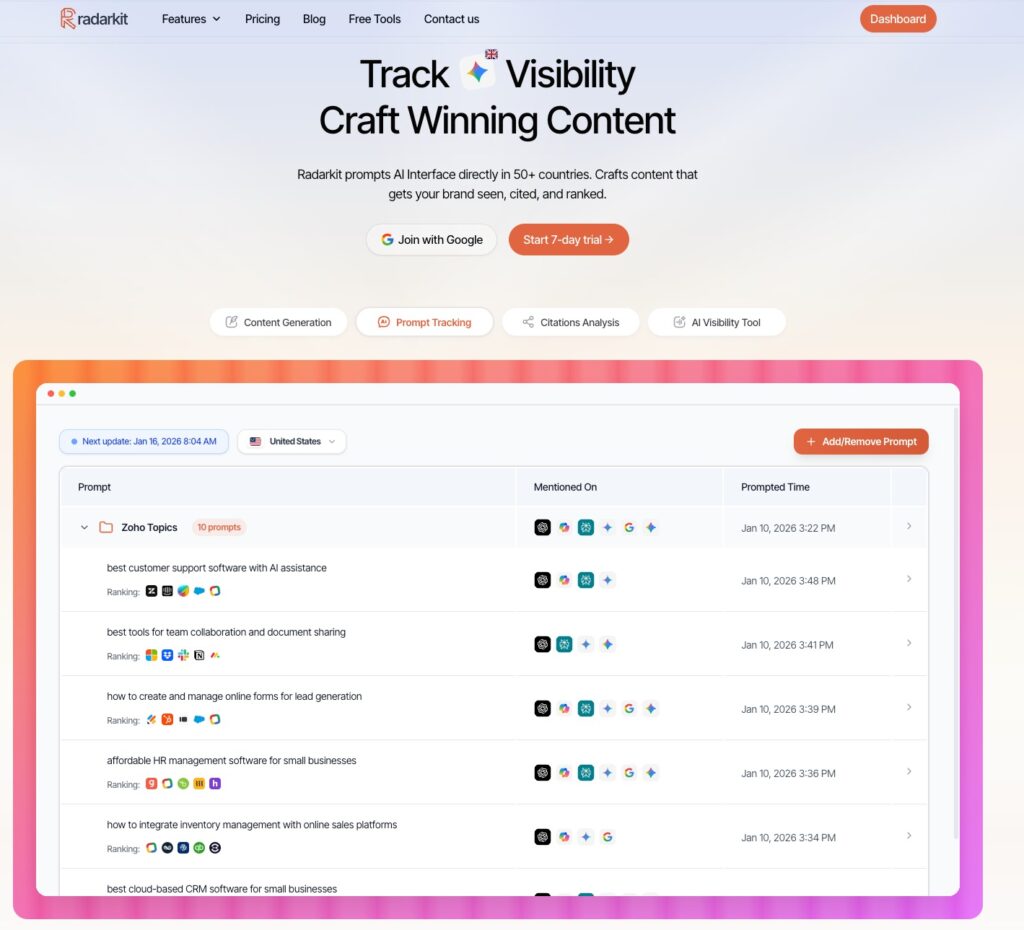
Now let’s look at what a more durable approach looks like in practice, using Radarkit as a concrete example of a platform designed for long-term AI visibility work.
Radarkit is an AI search, tracking, and content optimization tool focused on connecting AI visibility data to content, outreach, and reporting workflows. It is built with infra and action in mind from the start.
Tracks Large Prompt Sets and Millions of Data Points
Radarkit is designed to track large sets of prompts across multiple AI platforms and countries(over 50+).
- It has tracked over 100k prompts
- It shows Brand and competitor visibility side by side
- It has analysed over 20M+ citations and sources without falling over
Instead of collapsing when scale arrives, it is built around that level of data from day one.
Understands Query Fanouts (How AI “Thinks” Behind the Scenes)
One of Radarkit’s strongest angles is query fanout analysis. AI systems rarely answer a question with just one internal query. They break the question into multiple related angles and look up different facets before generating an answer.
Radarkit tracks:
- Which fanout queries the AI models use behind the scenes
- How those queries map to subtopics or entities
- How you can turn those fanouts into content sections
That gives brands a window into how AI systems structure the topic itself, which is far more useful than just seeing the final answer.
Deep Citation Analysis at Scale
Radarkit does not just note “you were cited” or “you were not cited”. It analyses:
- Which third-party sites and pages get cited most often
- What those pages look like in terms of structure, entities, examples and depth
- What kinds of content (guides, listicles, docs, studies) AI tends to trust in your niche
This lets you reverse-engineer what “citation-worthy” content looks like in your vertical and shape your content strategy around that.
NLP-Driven Content Optimised for AI and Google
Radarkit combines AI citation data with Google SERP insights to help you create content that is designed for both ranking and AI citations. It:
- Analyses top Google results and the most-cited AI sources for a keyword
- Extracts key entities, topics and facts that appear in trusted content
- Highlights gaps between your content and what AI expects to see
- Helps you generate or optimize content with those elements baked in
The result is content that feels complete, fact-rich and structured for extraction, increasing your chances of being referenced by AI assistants.
Turning Data into Outreach and Mentions
Radarkit also acts on citation data by identifying the third-party sources AI models trust the most and helping you reach out to them. It can:
- Surface high-value publishers and pages that are frequently cited
- Connect to your email stack
- Support outreach for mentions, quotes, or collaborations based on real citation patterns
This closes the loop between seeing who gets cited and actually building relationships with those sites, which in turn can reinforce your presence in AI answers.
Other Tools still standing (and what they offer)
| Tool | Monitoring | Content generation | Crawler logs / data capture | Models covered (examples) | Best for |
|---|---|---|---|---|---|
| Profound | Deep dashboards for AI mentions, share of voice and trends | No | Large prompt datasets and historical visibility logs | ChatGPT, Perplexity, Gemini, Claude and more | Enterprise teams needing robust reporting and compliance |
| Peec AI | High-volume brand and competitor monitoring across prompts | No | Stores prompt results and answer histories | Major LLMs (ChatGPT, Gemini, etc.) depending on plan | Agencies managing multiple clients on a budget |
| Otterly AI | Core mention tracking and visibility trends | No | Limited logs; oriented to reporting rather than raw logs | Main consumer-facing AI engines (varies by tier) | Small teams needing simple AI visibility monitoring |
| Semrush AI Toolkit | AI visibility metrics added to SEO reports (AI mentions, AI score) | Yes | Uses Semrush data plus AI visibility metrics (not raw AI crawler logs) | Google AI features plus selected LLMs via Semrush tools | Existing Semrush users wanting GEO inside their SEO stack |
| Ahrefs Brand Radar (or similar) | Brand-level AI visibility and competitor benchmarking | No | Large prompt and answer datasets from real queries | AI Overviews, AI Mode, ChatGPT, Perplexity (coverage varies) | Brands that want “share of voice in AI” dashboards |
What Strong AI Visibility Platforms Do Differently
When you look at tools that keep showing up in “best of 2026” lists, they share a different philosophy. They do still monitor, but they anchor everything around behavior, action, and integration.
Focus on real behavior
First, they focus on real behavior instead of abstract scores. They run real prompts across multiple AI engines, store prompt‑level results, and show how often you appear, where you rank inside AI answers, which sources were cited, and how that compares to competitors over time.
That aligns closely with how serious teams build GEO programs: they define a prompt universe, segment by intent, and track share of voice and citations across that universe as a core performance metric.
Feed content and outreach
Second, they are built to feed content and outreach. Execution‑oriented platforms use citation analysis to highlight which third‑party sites AI relies on, which formats consistently earn references, and what structural patterns (questions, summaries, schemas) appear in highly cited content.
They then plug that information into content editors, AI writers or playbooks so teams can produce genuinely “referenceable” content instead of just hoping existing pages will be picked up.
Invest in infrastructure and stability.
Third, they invest in infrastructure and stability. Instead of calling APIs on every single run, they use a mix of browser automation, caching, batching, and precomputation.
Some tools like Radarkit run real browser sessions from residential IPs to capture exactly what users see in different locations, which helps avoid the mismatch between API responses and real‑world interfaces.
Others integrate AI visibility into larger SEO suites, spreading infrastructure costs across multiple product lines. Either way, infra is treated as a core product decision, not a temporary hack.
Final Thoughts
Hall’s shutdown shows what happens when AI visibility is treated like a quick experiment instead of core infra. Tools built on borrowed APIs, free cloud credits, thin dashboards, and teams without real GEO/SEO chops are hitting a wall as soon as costs rise or funding pressure hits.
You shouldn’t avoid AI visibility, you just need to be picky.
Choose platforms that track real prompts, show you exactly how often and where you appear, help you turn gaps into content and outreach, and clearly invest in stable infrastructure instead of surviving on free tokens. That’s why many ex‑Hall users are switching to Radarkit as their Hall alternative: it behaves like infrastructure, not a toy dashboard, and is built for long‑term AI search visibility work