To monitor competitor mentions in AI search, we first need to accept that buyer discovery has changed.
People are no longer relying only on traditional search results to compare tools, services, and brands, because platforms like ChatGPT, Perplexity, and Google’s AI experiences now shape which names get recommended early in the decision-making process.
That means if your competitors are showing up in AI answers and you are not, you can lose visibility before a potential customer even visits a website.
That is exactly why we believe competitor monitoring in AI search deserves the same attention SEO teams once gave only to rankings and backlinks.
When we track who gets mentioned, which sources are being cited, and how brands are framed inside AI-generated answers, we get a much clearer view of what is influencing trust and preference in our category.
In this guide, we will break down how to monitor competitor mentions in AI search properly, what signals actually matter, and how to turn those insights into better content, stronger positioning, and a smarter visibility strategy.
So, without any further ado, let’s get started.
What does brand mention mean in AI search?
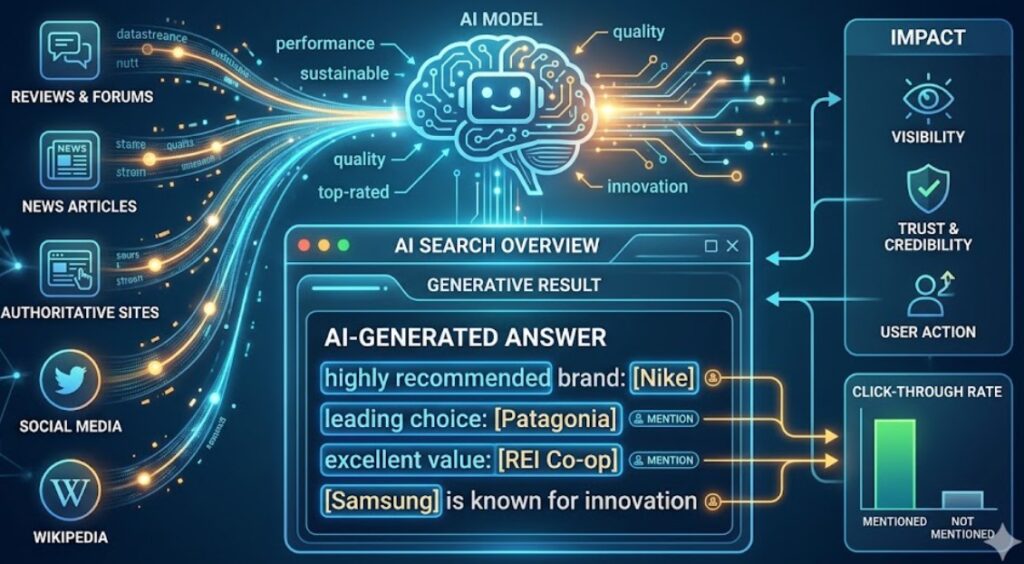
In AI search, a brand mention is any time an AI assistant brings a company into the answer, whether it recommends that brand directly, compares it with competitors, or cites a page connected to it.
That mention may appear as a clear recommendation, a supporting example, a cited source, or a ranked brand inside a generated response. This is what makes AI search different from traditional search tracking.
In a normal search result, you mostly care about where a page ranks, but in AI search, you also need to see whether the brand is present at all, how prominently it appears, what sentiment surrounds it, and which sources the model uses to justify that mention.
A competitor can win the answer even without owning the top organic result if the model keeps mentioning that brand in response to high-intent prompts.
That is why a “brand mention” should never be treated as a simple yes or no signal. What matters is the full context around the mention, including position, frequency, citation pattern, and framing.
Comparison of Monitor Competitor Mentions in AI Search and Traditional SEO Tracking
| Competitor Monitoring in AI Search | Traditional SEO Tracking |
|---|---|
| Tracks how often competitors are mentioned, cited, recommended, and framed inside AI-generated answers. | Tracks how competitors rank in search results for target keywords and how much organic visibility they own in SERPs. |
| Uses prompts, AI answers, brand mentions, citations, and share of voice as the main units of analysis. | Uses keywords, pages, backlinks, rankings, traffic, and SERP features as the main units of analysis. |
| Visibility means being included in the answer itself, often as a recommendation or cited source. | Visibility means appearing in search engine results as a clickable listing. |
| Focuses on mention frequency, citation share, sentiment, answer position, and brand framing. | Focuses on keyword overlap, ranking positions, backlink profiles, domain authority, and estimated traffic. |
| Influences who get recommended before the user even clicks on a website. | Influences that websites get discovered and clicked on from search results. |
| Citations help explain why competitors are being surfaced and which sources AI trusts. | Backlinks and traditional ranking signals matter more than citation-style answer sourcing. |
| A competitor wins when it is mentioned more often, cited more frequently, or positioned more favorably in AI answers. | A competitor wins when it outranks you, owns more keywords, or captures more organic traffic. |
| Best for understanding recommendation behavior, AI brand presence, and competitive share of voice in generative search. | Best for understanding ranking performance, search demand capture, and long-term organic traffic growth. |
| Works best with continuous prompt tracking because AI answers can shift by platform, source mix, and context. | Works best with ongoing rank and traffic tracking, with more mature and stable measurement methods. |
| Helps us understand how competitors are being chosen in AI-driven discovery. | Helps us understand how competitors are being found through traditional search. |
Why Monitoring Competitor Mentions in AI Search Matters for Brands
Monitoring competitor mentions in AI search helps you understand who the model is recommending instead of you when real buyers ask questions related to your category.
If your competitor keeps appearing in answers for commercial prompts, they are shaping the shortlist before the user even clicks through to a website. It also helps you see market perception more clearly.
AI assistants do not just mention brands, they describe them, compare them, and attach certain qualities to them, so monitoring competitor mentions shows you which positioning angles are becoming dominant in AI-generated discovery.
Another reason this matters is that citations often reveal why a competitor is being surfaced.
If the same third-party sites, category pages, or comparison articles keep getting cited alongside a competitor, that gives you a much clearer picture of the authority signals and content gaps influencing AI answers.
Where Competitors Show Up in AI Search Results
Competitors can show up across multiple AI environments, and each one deserves a separate monitor competitor mentions in AI search because the answer style, citation behavior, and discovery flow can vary by platform.
Looking at all AI search results as one blended channel usually hides useful differences in how and where a competitor is being recommended.
Competitor mentions in ChatGPT
In ChatGPT, competitor mentions often appear when users ask for the best tools, best services, alternatives, comparisons, or problem-solving recommendations.
What matters here is not only whether a competitor is named, but whether it appears near the top of the answer and whether the surrounding explanation makes it sound trusted, affordable, advanced, or better suited to a certain type of user.
This is why ChatGPT monitoring should focus on prompt-level visibility, average position, and sentiment together rather than mention count alone.
A brand that appears second or third in a recommendation list across many prompts may still be losing meaningful demand to the brand that consistently shows up first.
Competitor mentions in Perplexity
Perplexity is especially important because source attribution is more visible, which makes citation analysis far more actionable.
When a competitor is mentioned in Perplexity, you can often learn not just that it was recommended, but which pages or domains helped support that recommendation.
That makes Perplexity useful for identifying repeated authority sources, review sites, comparison pages, and publisher mentions that help competitors win visibility.
If you want to understand why a competitor keeps getting surfaced, Perplexity often gives some of the clearest clues.
Competitor mentions in Google AI Overviews and AI Mode
Google AI Overviews and AI Mode matter because they sit close to traditional search behavior while still shaping the answer through AI-generated summaries.
A competitor mentioned in this environment can influence users who are already in active research mode and looking for category-level guidance, alternatives, or buying advice.
These surfaces are worth tracking carefully because they blend classic search intent with AI-generated recommendation behavior.
If a competitor starts appearing repeatedly in AI Overviews or AI Mode for important non-branded queries, that can signal a serious visibility gap in one of the highest intent discovery environments.
Competitor mentions in Gemini, Copilot, and Claude
Gemini, Copilot, and Claude also matter because users increasingly rely on them for product research, workflow recommendations, and category comparisons.
Even when they are not your top traffic source today, they still influence how buyers learn which brands are credible, easy to use, or worth shortlisting.
These platforms should be monitored as part of a broader AI visibility strategy, especially if your audience is spread across different work environments and devices.
A competitor that looks average in one AI assistant can still dominate another, which is exactly why cross-platform monitoring gives a more realistic view of AI search competition.
How to Monitor Competitor Mentions in AI Search Step by Step
Here is how to Monitor Competitor Mentions in AI Search Step by step. We have explained this using Radarkit.
Step 1: Set Up Your Project and Add Your Brand + Competitor Domains
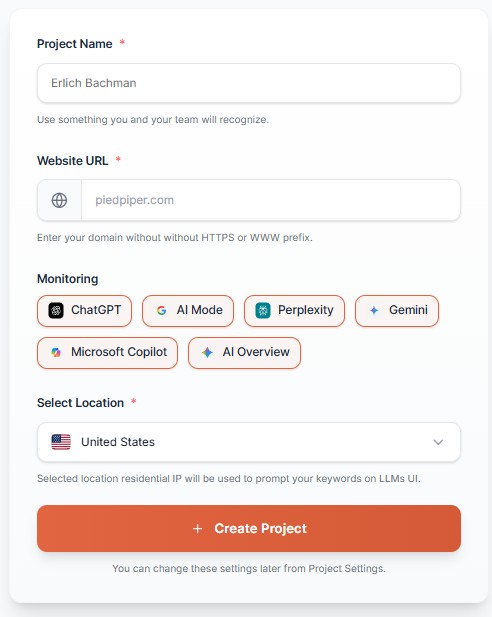
The first step to Monitor Competitor Mentions in AI Search is getting your workspace ready inside Radarkit. Once you sign up and land on your dashboard, you will create a new project centered around your brand.
Head to your Radarkit dashboard and click on “Project Settings.” Here you will enter your primary brand domain.
This is the brand you want to track and grow. But the real power comes from also adding your top competitor domains within the same project.
Radarkit allows you to track multiple domains simultaneously, so you can see exactly how competitors like Salesforce, HubSpot, Asana, or any rival in your niche are performing in AI-generated answers side by side with your own brand.
Once your domains are entered, select your target countries. Radarkit supports tracking across 50+ countries, which is critical if your market is not limited to one geography.
AI search engines often serve different responses based on user location, so tracking across regions gives you a complete competitive picture rather than a narrow, single-market view.
This foundational setup takes less than five minutes and becomes the command center for all your competitor monitoring going forward.
Step 2: Build and Configure Your Tracking Prompts
In Step 2, you will build your Prompt Library. Navigate to the Prompt Tracking section of your dashboard. Think about the exact buyer-intent questions your target customers are asking AI engines. These are prompts like:
“What is the best [your product category] for [use case]?”
“Which [your industry] tools do experts recommend?”
“Compare [your brand] vs [competitor brand]”
“What are the top-rated [product type] in [year]?”
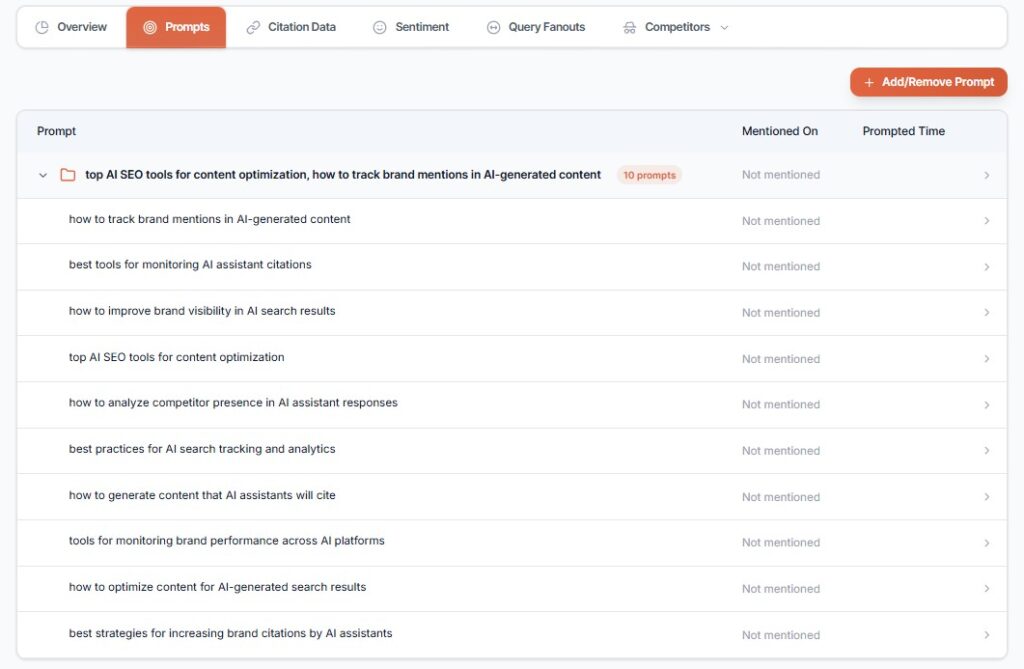
Enter these prompts into Radarkit and assign them to your project. Radarkit will then fire these prompts directly at AI engines, including ChatGPT, Gemini, Perplexity, Microsoft Copilot, AI Mode, and Google AI Overviews.
For each prompt, the platform records which brands were mentioned, in what position they appeared, and the context of the mention.
This step is the engine that powers all your competitor intelligence. The more thoughtful and varied your prompt library, the more comprehensive your competitive data will be.
Aim to cover informational queries, comparison queries, and recommendation queries that are relevant to your niche.
Step 3: Analyze Competitor Visibility Scores and Average Rankings
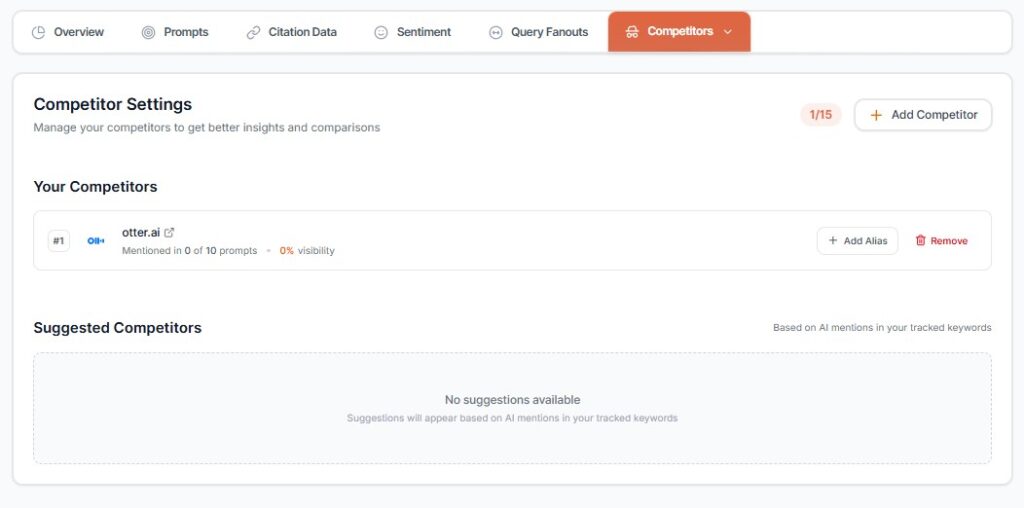
Once Radarkit has run your prompts across AI engines, you will have access to one of the most powerful competitive intelligence dashboards available for AI search. Step 3 is where you dig into the data and understand exactly how your competitors are performing.
Inside your Radarkit dashboard, navigate to the Average Rankings section.
Here you will see a clean table showing each tracked domain alongside its Average Position across AI answers.
For example, if you are in the CRM space, you might see your brand at position 3.2 while a competitor sits at position 1.8 — meaning AI engines are consistently recommending them before you in response to buyer queries.
Pay close attention to the Visibility Score for each brand. Radarkit assigns a numerical Visibility Score (out of 100) representing how often a brand appears in AI-generated answers relative to the total prompts tracked.
A competitor with a score of 70 is appearing in the majority of AI answers for your target queries. A score below 30 means they are rarely getting mentioned.
This instantly tells you who your real AI-search competitors are, which may surprise you — they are not always the same brands dominating traditional Google rankings.
Also, study the AI model breakdown. Radarkit segments results by individual AI engine: ChatGPT, Copilot, Perplexity, Gemini, AI Mode, and AI Overview.
A competitor may dominate on Perplexity but have a weak presence on Gemini. This gives you a surgical view of where to compete and where gaps exist for your brand to claim ground.
Step 4: Review Citation Sources and Sentiment Behind Competitor Mentions
Step 4 involves using Radarkit’s Citations Analysis and Sentiment Breakdown features to go deeper on “Monitor Competitor Mentions in AI Search.”
Navigate to the Citations Analysis tab in your Radarkit dashboard. For each competitor tracked, you can see which web sources AI engines are pulling from when they cite that brand.
These citations reveal exactly what content types and domains are feeding AI engines’ understanding of your competitors. Are they being cited from G2 review pages? Industry comparison articles? Their own blog content? LinkedIn posts? This intelligence is gold for your content strategy.
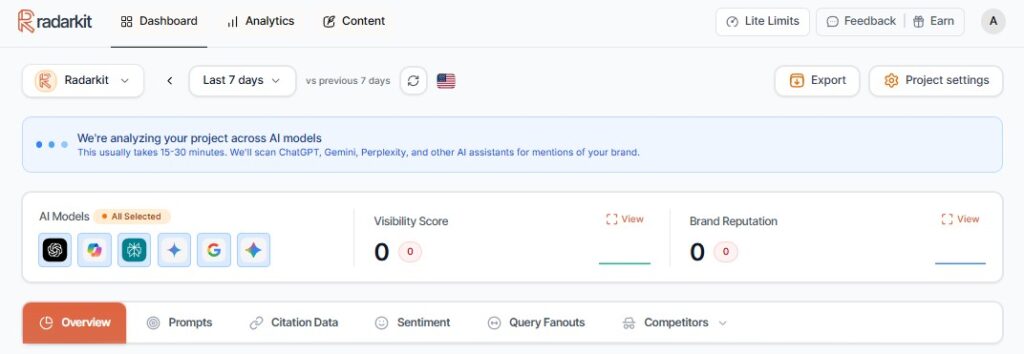
Next, review the Sentiment Breakdown. Radarkit categorizes every AI mention as Positive, Mixed, or Negative, and surfaces the specific sentiment themes associated with each brand.
You might discover that a competitor is being praised in AI answers for “affordability” and “ease of use” while your brand is being described in more neutral or technical terms.
These are not random; they reflect how AI engines have absorbed the web’s perception of each brand.
The Top Sentiment Insights feature highlights the most frequently occurring themes in AI mentions.
If a competitor keeps getting associated with “budget-conscious teams” or “enterprise-ready integrations,” that tells you exactly what narrative is driving their AI visibility.
Use this to identify gaps in your own brand messaging and create content that competes directly with the themes, giving competitors an edge.
Step 5: Use Radarkit’s Content Generation to Close the Gap and Outrank Competitors
Monitor Competitor Mentions in AI Search is only valuable if it drives action. Step 5 is where Radarkit goes beyond tracking and actively helps you create the content that will get your brand mentioned more often than your competitors in AI search answers.
Navigate to the Content Generation feature inside Radarkit. Based on the prompt data, citation sources, and sentiment insights you have gathered in the previous steps, Radarkit helps you generate optimized content that is structured and positioned to be picked up by AI engines. This is Generative Engine Optimization (GEO) in practice.
Here is how to execute it effectively. For every prompt where a competitor outranks you, create a dedicated piece of content that directly addresses that query.
Write comparison articles, how-to guides, and use-case pages that naturally incorporate the keywords and themes AI engines associate with your category.
Use Radarkit’s sentiment insights to ensure your content uses the same language and value propositions that AI models are rewarding in competitor mentions.
Beyond content creation, use your citation data to build a backlink and mentions strategy targeting the same source types that AI engines are pulling competitor citations from.
If AI engines are citing your competitor from three specific review sites and one industry blog, those are your highest-priority outreach targets.
Set Radarkit to run your prompt suite on a recurring schedule, “weekly or bi-weekly,” so you can track the direct impact of every content piece you publish.
As your Visibility Score climbs and your Average Position improves, you will see your brand moving up in AI-generated answers for the exact queries that drive business.
Best Tools to Monitor Competitor Mentions in AI Search
If you want to monitor competitor mentions in AI search properly, you need a tool that does more than count brand appearances.
The best options help you track prompts, compare competitors, review citations, study sentiment, and watch how visibility changes across platforms over time.
Radarkit.ai
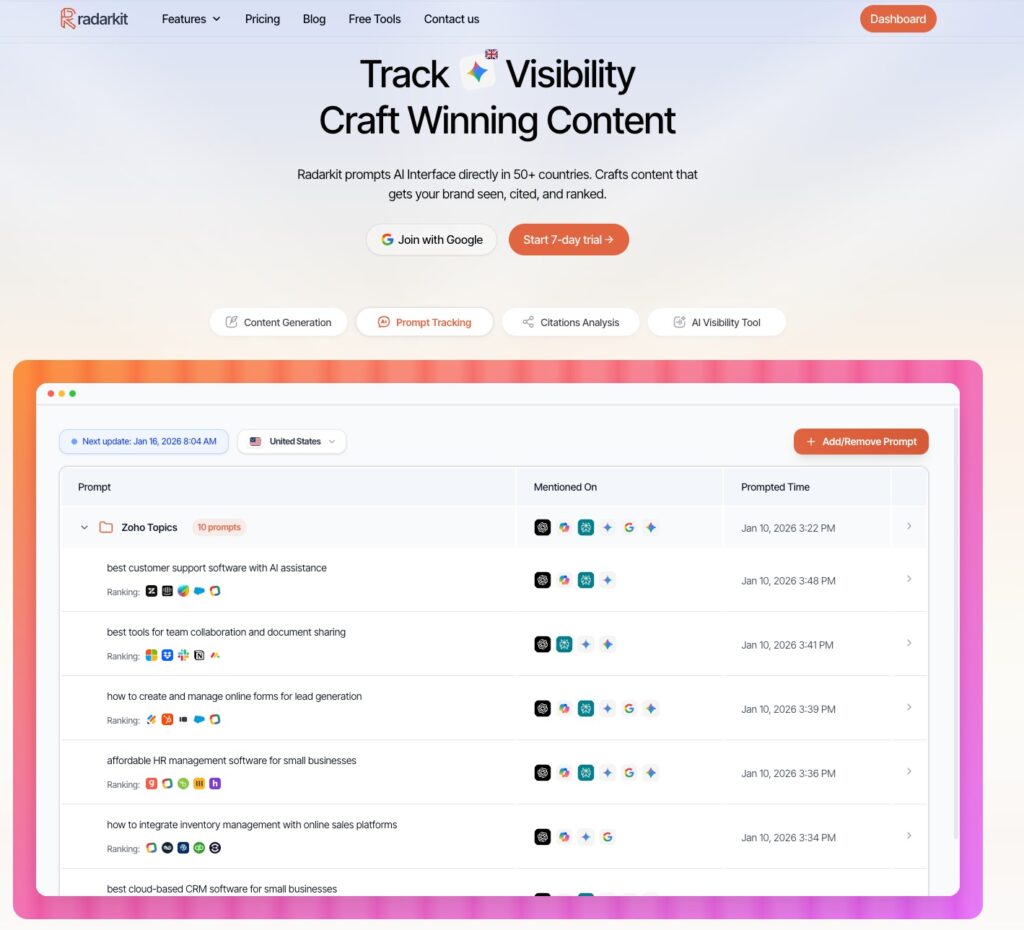
Radarkit is the strongest fit to monitor competitor mentions in AI search if your goal is to monitor competitor mentions across the full AI search workflow instead of treating AI visibility as a side feature.
Its public positioning is built around AI search tracking, prompt tracking, citation analysis, sentiment monitoring, content optimization, and competitor analysis across ChatGPT, Perplexity, Gemini, Copilot, Google AI Overview, and AI Mode.
This makes it especially useful for brands and agencies that want both monitoring and action in one place.
Another reason it stands out is that it combines visibility metrics like Share of Voice, Average Position, Brand Reputation, and Sentiment Breakdown with citation-level insights and AI traffic analytics, so you can see not just who is being mentioned, but why competitors are winning and what to fix next.
Its entry pricing also starts lower than many enterprise-focused tools, with Lite at $29 per month, Growth at $79 per month, and Pro at $139 per month, which makes it easier for smaller teams to start tracking competitor visibility without a big upfront commitment.
Scrunch AI
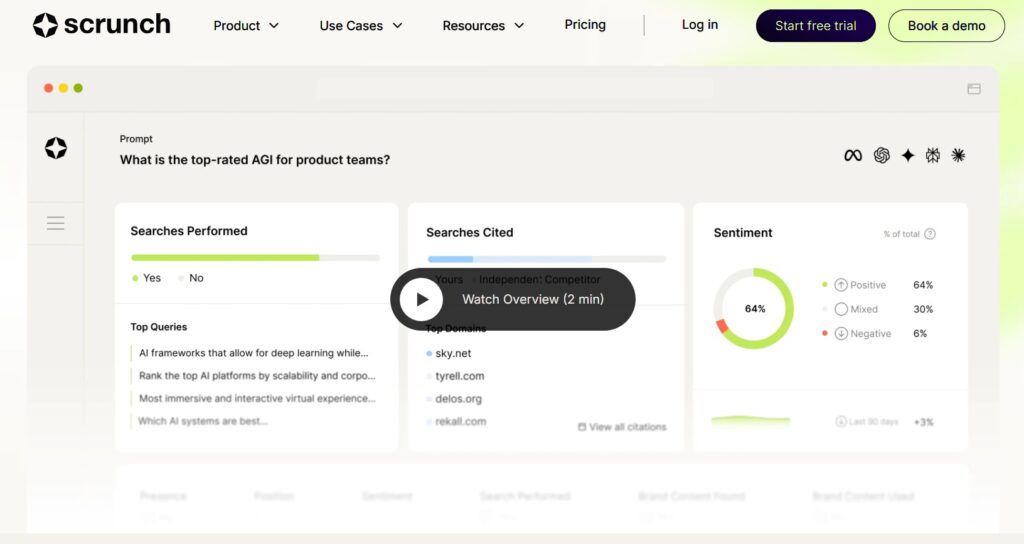
Scrunch is a strong option for you to Monitor Competitor Mentions in AI Search, it shows deep prompt-level analysis with more strategic segmentation around buyer journey and audience context.
It tracks prompt-level analytics across multiple AI platforms, including ChatGPT, Claude, Meta AI, Perplexity, Gemini, Google AI Mode, and AI Overviews, and it breaks share of voice down by persona and funnel stage.
This can be very useful if you want competitor mention data tied closely to marketing strategy.
Scrunch also stands out for its diagnostic layer, including AI bot crawl monitoring, page audits, and citation intelligence that helps teams understand whether low visibility is coming from weak content, technical crawl issues, or missing authority signals.
SE Ranking AI Visibility Tracker
SE Ranking is a practical choice for teams that already live inside SEO workflows and want AI visibility tracking added in a familiar environment.
Its AI Search Toolkit tracks brand mentions and links across AI Overviews, AI Mode, ChatGPT, Gemini, and Perplexity, while also supporting “Monitor Competitor Mentions in AI Search”, source analysis, cached AI answers, and historical visibility trends.
That makes it a solid fit if you want to compare how competitors are framed in AI answers and see which sources and URLs keep appearing behind those recommendations.
Ahrefs Brand Radar
Ahrefs Brand Radar is a good fit for marketers who already use Ahrefs and want brand-centric AI visibility insights inside a broader search platform.
It may not feel as purpose-built around AI visibility execution as Radarkit, but it can still be useful for teams that prefer working inside an established SEO stack and want AI brand monitoring tied to existing search data.
Profound
Profound is best suited to larger teams that want enterprise-grade visibility monitoring and competitive benchmarking at a higher price point.
Profound positions it as an enterprise-focused platform with broad AI platform coverage and competitive insights. If your organization needs a more enterprise-style setup and budget is less of a concern, Profound is still one of the better-known names in this space.
Metrics You Should Track When Monitoring Competitor Mentions
The biggest mistake you make when you monitor competitor mentions in AI search is watching only raw mentions and ignoring the rest of the context.
A useful measurement framework should combine frequency, prominence, citations, sentiment, and movement over time.
Mention Frequency Across Prompts
Mention frequency tells you how often a competitor appears across the prompts you track. This matters because a brand that shows up again and again across categories, comparisons, and use case prompts is building broader AI visibility than a brand that appears only once in a while.
While you Monitor Competitor Mentions in AI Search, you should also look at which prompts generate those mentions. If a competitor appears mainly in high-intent prompts, that is usually more valuable than showing up across a large number of vague informational prompts.
Share of Voice in AI Answers
Share of voice shows how much of the AI conversation belongs to your brand versus your competitors. On Radarkit’s homepage, Share of Voice appears as a key visibility signal, which reflects how central this metric is for understanding competitive presence across prompts.
This metric matters because AI search is often winner-heavy. A small group of brands can dominate the answer layer, so share of voice helps you see whether you are consistently included in that core set or being pushed out of the conversation.
Citation Share and Cited Domain Overlap
Citation share tells you how often a competitor’s own pages or supporting sources are used to justify an AI answer. Radarkit includes detailed citation data, which makes it possible to move beyond surface mentions and study the evidence layer behind them.
Cited domain overlap is just as important because it shows whether the same publishers, directories, review sites, and comparison pages are appearing across multiple competitors.
If you Monitor Competitor Mentions in AI search, where it keeps winning mentions, and the same supporting domains keep appearing around them, that is usually a sign that those third-party sources are influencing model trust.
Average Ranking or Position Inside AI Responses
When you monitor competitor mentions in AI search, Average position helps you understand where a competitor appears within the answer, not just whether it is present.
Radarkit displays Average Position and Average Rankings, which is useful because the first brand named in an AI answer often gets more attention than brands listed later.
This metric becomes even more useful when paired with prompt categories. A competitor that ranks first for “best” and “alternative” prompts is usually more dangerous than one that appears fifth in a long informational list.
Sentiment, Framing, and Recommendation Context
A mention is not automatically a good mention. Radarkit surfaces Sentiment Breakdown and Top Sentiment Insights, which show that the wording around a brand matters just as much as the appearance itself.
You should pay close attention to how competitors are framed in answers. If one competitor is consistently described as affordable, trusted, fast, or enterprise-ready, that framing can shape buyer perception even before the user clicks anywhere.
Prompt-level Wins and Losses Over Time
Prompt level wins and losses show where you are improving, where you are falling behind, and which queries deserve immediate attention.
This is one of the most practical ways to monitor competitor mentions because AI visibility does not move evenly across all prompts at once.
Time matters here. Radarkit’s tracked time ranges and refresh cadence make it possible to compare one period against another, which helps you separate real movement from random fluctuations.
Common Mistakes When Tracking Competitor Mentions in AI Search
Most weak AI visibility workflows fail because they oversimplify the channel. Competitor monitoring works best when you treat AI answers as a mix of recommendation logic, citation logic, and search intent rather than as a basic mention counter.
Tracking only your brand and not the full competitor set
If you track only your own brand and do not Monitor Competitor Mentions in AI Search, you miss the real competitive picture.
AI assistants answer comparative and recommendation-style prompts by surfacing several brands at once, so you need to know which competitors appear beside you, above you, and instead of you.
A brand can look stable in isolation while quietly losing visibility to faster-moving competitors. When you monitor competitor mentions in AI search, it helps you turn AI search data into a useful strategy rather than vanity reporting.
Ignoring citation sources behind AI answers
This is one of the biggest mistakes in AI search analysis. If you only record that a competitor was mentioned but ignore the sources behind the answer, you miss the clearest signal explaining why that competitor earned visibility in the first place.
Citation sources often point directly to the pages, publishers, and authority signals shaping AI recommendations. That is why tools that include detailed citation data give much more actionable insight than tools that only show surface-level mentions.
Using too few prompts or only branded prompts
A narrow prompt set creates a distorted picture. If you only track branded prompts, you may think your visibility is strong even though competitors dominate the broader non-branded prompts where new buyers actually discover options.
Good monitoring requires a mix of category prompts, use case prompts, comparison prompts, alternative prompts, and buying intent prompts. The broader and more realistic the prompt set is, the more accurately you can see where competitors are winning.
Focusing on snapshots instead of historical trends
Single snapshots can be misleading. AI answers shift over time, so looking at only one report or one day of data can cause you to overreact to noise and miss larger patterns.
Historical monitoring helps you see whether a competitor is consistently gaining momentum, dominating certain prompts, or losing strength after content changes.
That is why refresh cadence and time-based comparisons matter so much in AI visibility tracking.
Looking at mentions without business intent
Not every mention when you Monitor Competitor Mentions in AI Search is equally valuable. A competitor appearing in a low-intent educational query matters less than in a high-intent prompt where users are actively comparing solutions or asking for the best option.
This is why competitor monitoring should always be tied back to commercial relevance.
The real goal is not to collect more mentions on paper, but to understand where AI assistants are influencing serious buying decisions in favor of your competitors.
FAQs: Monitor Competitor Mentions in AI Search
How often should I monitor competitor mentions in AI search
We recommend monitoring competitor mentions at least weekly, and even more frequently if you are in a fast-moving market or actively publishing new content. AI search results can shift as prompts, sources, and platform behavior change, so regular tracking helps you spot rising competitors before they take over important buyer-facing queries.
Which AI platforms should I track first?
We would start with ChatGPT, Perplexity, and Google AI Overviews or AI Mode because these are some of the most important AI discovery environments right now. Each platform behaves differently, especially when it comes to answer style and citations, so tracking only one of them gives you an incomplete picture of where competitors are actually winning attention.
Are citations more important than mentions?
Citations are often more useful than plain mentions because they show the sources helping shape the answer. A mention tells you a competitor appeared, but a citation helps explain why they appeared, which is what makes citation tracking so important when you are trying to improve visibility instead of just reporting it.
Can competitor mentions in AI search affect conversions and pipeline
Yes, absolutely. When AI assistants repeatedly recommend a competitor in high-intent prompts like best tools, alternatives, or product comparisons, they can influence buyer preference before the user ever visits a website, which means competitor mentions can affect both conversions and pipeline.
What is the best way to improve visibility when competitors dominate AI answers?
The best way is to study the prompts, citations, and content patterns behind the answers your competitors are winning, then improve your own pages and supporting authority around those gaps.
We see the biggest gains when brands track prompt-level visibility, analyze the sources being cited, strengthen comparison and category content, and keep measuring progress over time instead of reacting to one isolated result.
Conclusion
It is now important to monitor competitor mentions in AI search for brands that want to understand how they are being discovered, compared, and recommended across platforms like ChatGPT, Perplexity, Google AI experiences, Gemini, Copilot, and Claude.
The real value is not just seeing whether a competitor appears, but understanding the prompts, citations, sentiment, and visibility patterns that help them win attention in buyer-facing answers.
Once we start monitoring those signals consistently, it becomes much easier to spot content gaps, strengthen the right pages, and improve how our brand shows up when potential customers ask AI tools for recommendations.
In our view, the brands that treat AI search monitoring as an ongoing competitive strategy, rather than a one-time check, will be in a much stronger position to earn trust, visibility, and pipeline as AI-driven discovery keeps growing