
In this article, we will be looking at Evertune Review, a GEO and AI visibility platform that helps brands understand how they appear across AI search tools such as ChatGPT, Google AI Overviews, Gemini, Perplexity, and Claude.
We will cover its main features, pricing, AI visibility tracking tools, content capabilities, advertising options, pros and cons, and how it compares with Radarkit.ai.
By the end, you will have a clear idea of whether Evertune is the right platform for your SEO, content marketing, ecommerce, or AI search visibility strategy.
So, without any further ado, let’s get started
Quick Capability Ratings
-
AI visibility tracking – 3.5/5
-
Prompt research – 3.5/5
-
Competitor analysis – 3.5/5
-
Citation and source analysis – 3.5/5
-
Content optimization – 3/5
-
Technical AI SEO – 3/5
-
Ecommerce and shopping insights – 3/5
-
ChatGPT advertising – 3.5/5
-
AI retargeting – 3/5
-
Ease of use for beginners – 2.5/5
-
Value for small businesses – 2.5/5
-
Overall capability rating – 3.5/5
What Is Evertune?
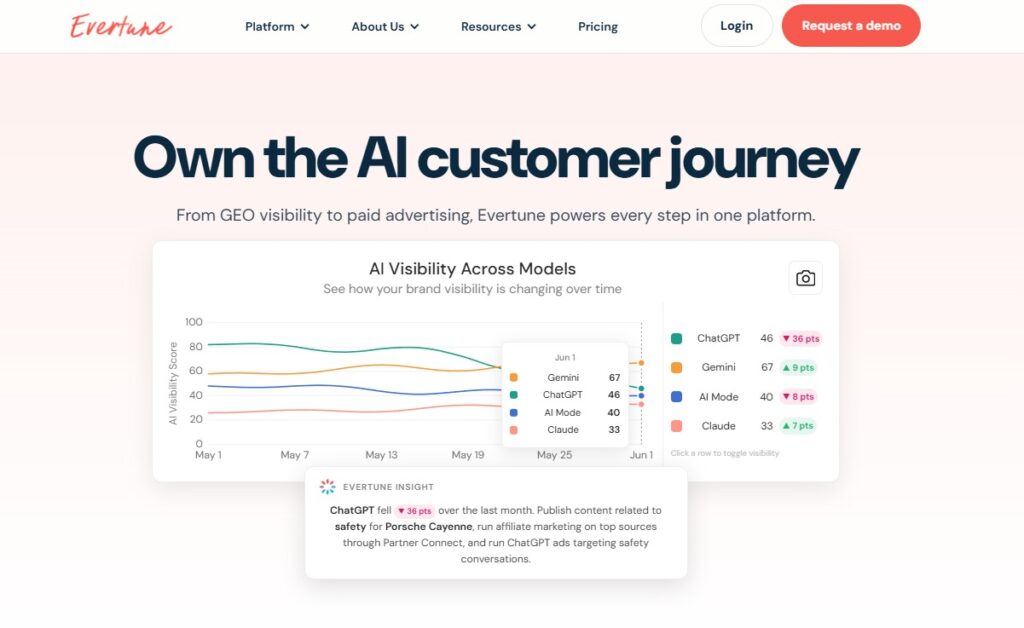
Evertune is an AI visibility and GEO platform designed for brands that want to improve how they appear in AI-generated answers. It tracks whether a brand is mentioned, where it ranks, how it is described, and which competitors receive recommendations across major AI platforms.
GEO stands for Generative Engine Optimization. It focuses on increasing a brand’s chances of appearing accurately and positively in responses from AI systems such as ChatGPT, Gemini, Claude, Perplexity, Google AI Overviews, and Google AI Mode.
Traditional SEO usually focuses on improving rankings in search engine result pages. GEO focuses on becoming part of the AI-generated answer itself. For example, instead of only trying to rank for “best CRM software,” a GEO strategy aims to make a CRM brand more likely to appear when someone asks ChatGPT, “What is the best CRM for a growing sales team?”
Evertune brings several activities into one platform:
- AI prompt research based on real consumer behavior
- AI visibility tracking across multiple models
- Competitor monitoring and brand sentiment analysis
- Citation and source analysis
- Product-level shopping intelligence
- AI content recommendations and content generation
- Website auditing for AI crawlers
- ChatGPT advertising and AI retargeting capabilities
The platform is aimed mainly at mid-market companies, enterprise brands, agencies, ecommerce businesses, and marketing teams that need a detailed AI visibility strategy.
Evertune’s Explore→Measure→Act→Advertise Framework
Evertune follows a four-step framework: Explore, Measure, Act, and Advertise. Each stage is connected, helping marketers move from AI search research to practical organic and paid campaigns.
Explore
The Explore stage is about understanding what potential customers ask AI tools.
Evertune uses its proprietary EverPanel to identify consumer prompts, topics, and intent patterns. The platform says EverPanel contains more than 150 million real user conversations and is demographically weighted to reflect broader internet behavior.
Rather than relying only on a manually created keyword list, Evertune groups similar prompts into meaningful topics. This matters because people ask AI questions in many different ways.
For example, a user researching project management software may ask:
- What is the best project management software for small teams?
- Which task management tool is easiest to use?
- What are good alternatives to Asana?
- Which project management platform has the best reporting?
These prompts may have different wording, but they all point to a related buying journey. Evertune is designed to group this type of intent together so teams can track the bigger opportunity instead of focusing on one exact phrase.
Measure
The Measure stage shows how often AI models mention a brand and how the brand compares with competitors.
Evertune says it samples each prompt up to 100 times per AI model. The goal is to reduce the influence of random answer variation. AI tools can produce different responses to the same question, so one prompt response may not represent a reliable pattern on its own.
The platform then turns this data into visibility scores, brand scores, average positions, share of answer, sentiment insights, and competitor comparisons.
Evertune also separates base-model data from consumer-app data:
Base-model data reflects what the model appears to know from its training.
Consumer-app data reflects what a user sees when an AI product performs live web retrieval or search.
This distinction can help a marketing team understand whether a visibility issue is mainly related to brand recognition, website quality, source coverage, technical SEO, or live retrieval performance.
Act
The Act stage helps turn AI visibility insights into practical work.
For example, if Evertune shows that a competitor is recommended more often for a specific product attribute, the platform can help identify relevant content topics, cited sources, website improvements, and messaging gaps.
Its Insights and Action Agent is designed to prioritize actions based on visibility data. Evertune also offers content planning, AI-generated drafts, source analysis, technical audits, and affiliate partnership opportunities.
This makes the platform useful for teams that do not want an analytics dashboard alone. The goal is to move from “our visibility is low” to “here is what we should publish, improve, pitch, or promote next.”
Advertise
The final stage is Advertise. Evertune connects AI visibility data with paid media activity.
If a brand has low organic visibility for a high-value topic, Evertune can help create advertising campaigns around those conversations. Its product pages describe ChatGPT advertising, AI Search Intent targeting, affiliate advertising partnerships, and AI retargeting after users leave an AI conversation.
This approach can be especially useful for brands that want immediate exposure while their organic GEO strategy develops over time.
Evertune Review: Core Features
AI Visibility Tracking
AI visibility tracking is the core of Evertune. The platform monitors how a brand appears across ChatGPT, ChatGPT Search, Gemini, Gemini Search, Google AI Mode, Google AI Overviews, Claude, Copilot, Perplexity, Meta AI, and DeepSeek.
Evertune provides several useful visibility metrics:
The AI Brand Score gives more weight to higher positions. Evertune explains that a first-position mention receives full weight, while lower placements receive progressively less weight. This is useful because being mentioned is valuable, but appearing first in a shortlist often has greater commercial impact.
For example, if an AI tool regularly recommends five email marketing platforms and your brand appears fifth, you have visibility. However, your brand may still receive less attention than the first or second recommendation. Evertune helps make that difference visible.
Prompt Research and EverPanel
Evertune’s Prompt Research feature helps marketers find the topics and questions buyers ask AI.
This is where EverPanel plays an important role. The platform says its consumer panel helps it identify how people phrase prompts, what questions are becoming more common, and which prompt clusters matter for a specific category.
The prompt research section includes:
-
Prompt Volumes, which shows the estimated popularity of AI prompt topics
-
AI Usage, which looks at AI usage behavior among relevant audiences
-
Prompt Research, which explores questions and consumer intent
-
Suggested Prompts, which helps build a tracking strategy around related topic clusters
This is valuable for SEO and content teams because AI prompts are usually longer and more conversational than standard keywords.
A person may search Google for “best running shoes.” The same person may ask an AI tool, “What running shoes are comfortable for flat feet and suitable for daily walks?” The second query contains more intent, more context, and more purchase signals.
Evertune helps turn these types of questions into a content and visibility plan.
Competitor and Citation Analysis
Competitor analysis in Evertune goes beyond checking who ranks above your brand.
The platform compares brands across AI visibility, average position, sentiment, consumer preferences, word associations, and share of answer. This gives teams a clearer view of which competitors AI models prefer for certain topics or product attributes.
For instance, an ecommerce brand may learn that it appears often for affordability but rarely for premium quality. A SaaS company may discover that it is mentioned for ease of use but not for reporting or enterprise features.
Evertune also identifies the websites and URLs that AI systems cite when answering category questions. It groups those sources into three categories:
-
Owned URLs: Pages from your own website that appear as sources
-
Strength URLs: Influential third-party pages that mention your brand positively
-
Opportunity URLs: Important third-party pages where your brand is currently absent
This is helpful for digital PR, affiliate outreach, review-site outreach, and content partnerships. Instead of contacting random publishers, teams can focus on sites that already influence AI-generated answers in their category.
Partner Connect adds another layer by helping users identify affiliate platforms that may provide access to relevant opportunity domains.
Content and Technical SEO Tools
Evertune includes content and website optimization features designed for AI search.
Its Site Audit evaluates how well AI crawlers can access and understand a website. The audit checks elements such as bot permissions, sitemap quality, website performance, JSON-LD structured data, title tags, meta descriptions, and heading hierarchy. Evertune says it can crawl up to 1,000 pages and can focus on a specific folder or subdomain.
The Bot Analytics tool tracks AI bot activity, including:
-
Which AI bots visited your website
-
How often they returned
-
Which pages they crawled
-
Response codes they received
-
The percentage of the website that AI bots could access
This information can help marketers spot technical issues that affect AI discovery. For example, if key product pages are blocked, return repeated errors, or have weak metadata, AI systems may have a harder time retrieving and understanding them.
Evertune’s Content Studio and Content Agent focus on turning visibility gaps into content ideas. Users can select a low-performing topic or consumer preference, review suggested messaging, and generate an article draft from templates. The platform says it supports six templates, articles from 250 to 3,000 words, brand guidelines, and Markdown or HTML exports.
The most practical way to use this feature is as a content research and briefing tool. It can help writers identify the right angle, product attributes, questions, and source gaps before creating a polished human-led article.
ChatGPT Ads and AI Retargeting
Evertune stands out because it combines GEO with paid advertising.
Its Ads Manager is designed to help brands run paid advertising on ChatGPT based on AI visibility gaps. If a brand is not appearing organically for a valuable prompt topic, the platform can help create a campaign for those conversations.
Evertune also describes two additional paid capabilities:
-
AI Search Intent: Reaches users on external sources that AI models cite
-
AI Retargeting: Re-engages people after they leave an AI conversation and visit cited sources or related websites
The company says its AI Retargeting workflow starts with real AI behavior and prompt research, identifies cited sources, builds relevant audiences, and activates campaigns through programmatic advertising channels.
This creates a broader funnel. A buyer may start with an AI question, click an article or review site to learn more, leave without purchasing, and later see a relevant ad. Evertune is built to connect those stages instead of treating AI visibility and performance marketing as separate activities.
Evertune Review: Plan and Pricing
| Plan | Price | Best For | Key Inclusions |
|---|---|---|---|
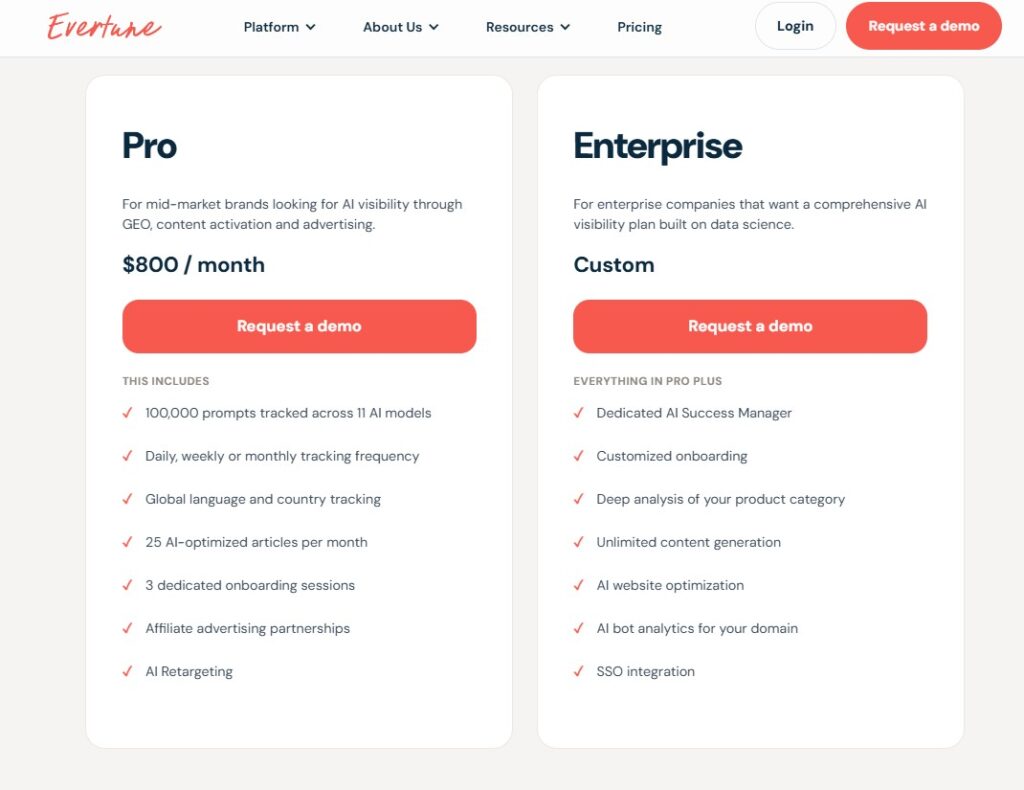
| Pro | $800/mo | Mid-market brands and growing marketing teams | 100,000 prompts across 11 AI models, flexible tracking frequency, global language and country tracking, 25 AI-optimized articles per month, onboarding sessions, affiliate advertising partnerships, and AI Retargeting |
| Enterprise | Custom | Enterprise brands and advanced GEO programs | Everything in Pro, plus an AI Success Manager, custom onboarding, deep category analysis, unlimited content generation, AI website optimization, bot analytics, and SSO |
Pro Plan ($800/mo)
The Evertune Pro plan costs $800 per month. It is designed for teams that need large-scale prompt tracking and want both organic GEO insights and advertising options.
The plan includes 100,000 tracked prompts across 11 AI models. Users can choose daily, weekly, or monthly tracking frequency depending on their reporting needs.
It also includes global language and country tracking, which is useful for brands operating in more than one market. A company selling in the United States, India, the United Kingdom, and Australia can use location and language tracking to better understand how AI answers differ by audience.
The Pro plan also includes up to 25 AI-optimized articles per month, three dedicated onboarding sessions, affiliate advertising partnerships, and AI Retargeting. This makes it better suited to active marketing teams than businesses that only need a few prompt checks each month.
Enterprise Plan (Custom)
The Enterprise plan uses custom pricing. It is designed for larger organizations that want a more complete AI visibility program.
Enterprise customers receive everything included with Pro, along with a dedicated AI Success Manager, custom onboarding, deeper product-category analysis, unlimited content generation, AI website optimization, bot analytics, and single sign-on support.
This plan is likely a better fit for companies with multiple product lines, large websites, international markets, complex approval workflows, or dedicated SEO and performance marketing teams.
For an enterprise business, the biggest value is not only the additional tracking. It is the ability to connect AI visibility data with technical SEO work, content production, brand monitoring, source outreach, and media buying in one coordinated program.
Evertune Review: Pros and Cons
Pros
- Tracks visibility across a wide range of major AI models and AI search products.
- Samples prompts up to 100 times per model, helping teams study answer variation instead of relying on one result.
- Uses EverPanel and prompt clustering to support consumer-focused AI search research.
- Separates base-model visibility from consumer-app visibility for more detailed diagnosis.
- Includes competitor analysis, sentiment, word association, and share-of-answer metrics.
- Identifies cited domains and URLs for PR, content partnership, and affiliate outreach opportunities.
- Offers product-level AI shopping visibility for ecommerce teams.
- Includes content planning, content generation, site audits, and AI bot analytics.
- Connects GEO data with ChatGPT advertising and AI retargeting workflows.
- Supports global country and language tracking in the Pro plan.
Cons
- The $800-per-month starting price may be more suitable for established teams with a dedicated AI search budget.
- The wide feature set can require time to set up properly, especially when building category trackers, competitor lists, content workflows, and reporting processes.
- Businesses with very simple needs may prefer a lighter tool focused mainly on tracking a limited number of prompts.
- The strongest results will come from teams that can act on the insights through content, technical improvements, PR, affiliate partnerships, or paid campaigns.
Who Should Use Evertune?
Evertune is best for brands that see AI search as an important customer acquisition and brand discovery channel.
It is particularly useful for businesses that want to understand how AI tools influence research, comparisons, product selection, and purchase decisions.
Evertune can be a strong fit for:
-
Enterprise SEO teams: Teams that need detailed AI visibility reporting alongside technical SEO, content, and source analysis.
-
Ecommerce brands: Companies that want to track product recommendations, AI shopping cards, retailers, pricing, reviews, and product-level visibility.
-
SaaS companies: Businesses competing for mentions in category comparisons, software recommendations, alternatives queries, and feature-based prompts.
-
Content marketing teams: Teams that want to build article ideas around real AI prompt topics and consumer questions.
-
Digital PR teams: Marketers looking for high-influence cited sources where their brand needs more coverage.
-
Affiliate teams: Businesses that want to identify potential affiliate publishers and source-based partnership opportunities.
-
Performance marketers: Teams interested in combining AI visibility insights with ChatGPT ads, cited-source targeting, and programmatic retargeting.
-
Agencies: Agencies managing AI visibility, content, technical SEO, and paid growth for multiple client brands.
Evertune may be more than a small local business needs if the goal is simply to monitor a few AI prompts. However, it can become highly valuable when AI search visibility is connected to a wider growth strategy.
Evertune vs a Better Alternatives
| Evertune | Radarkit.ai |
|---|---|
| Starts at $800 per month | Starts at $29 per month |
| Demo-based access | Includes a 7-day free trial |
| Tracks AI visibility across 11+ AI models and AI search experiences | Tracks ChatGPT, Gemini, Perplexity, Copilot, Google AI Mode, and Google AI Overviews |
| Supports global country and language tracking | Includes Local Radar for local AI visibility tracking across 50+ countries |
| Offers broad AI competitor analysis | Tracks local competitors, ratings, reviews, rankings, and AI recommendations |
| Includes Shopping Intelligence for products, retailers, pricing, and reviews | Includes Shopping Radar for products, sellers, rankings, prices, ratings, and AI shopping carousels |
| Supports ChatGPT advertising campaigns | Includes Ads Radar to monitor advertisers, ad copy, landing pages, and ad frequency |
| Includes AI Search Intent targeting and AI Retargeting | Includes AI visibility monitoring, ad analysis, and AI search optimization workflows |
| Focuses on AI visibility, source analysis, and paid activation | Tracks website traffic from LLM and AI assistant referrals |
| Identifies owned URLs, strength sources, and opportunity sources | Shows cited domains, URLs, citation share, content types, and competitor citation patterns |
| Includes Content Studio and Content Agent for content planning and drafting | Includes Content Agent for AI citation-based content optimization |
| Includes Partner Connect for affiliate partnership opportunities | Includes Outreach Agent for citation-based outreach and prospect research |
| No dedicated Reddit-focused tool listed | Includes a Reddit Agent for finding relevant discussions and citation opportunities |
| Includes action and content-oriented AI tools | Includes Plan, Outreach, Reddit, Content, and Chat agents |
| Suited to mid-market and enterprise GEO programs | Suited to agencies, ecommerce brands, local businesses, affiliate marketers, and content teams |
Radarkit.ai is an AI search visibility platform that helps businesses track how they appear in ChatGPT, Google AI Overviews, Google AI Mode, Gemini, Copilot, and Perplexity. It monitors brand visibility, average position, sentiment, cited sources, competitors, and AI referral traffic. The platform runs prompts through real AI chat interfaces rather than relying only on model APIs.
While Evertune focuses heavily on enterprise GEO research, repeated prompt sampling, content activation, and AI advertising, Radarkit.ai combines AI visibility tracking with local business monitoring, product tracking, ad monitoring, content tools, traffic analytics, and specialized AI agents.
Radarkit.ai is especially useful for agencies, SEO professionals, local businesses, ecommerce brands, affiliate marketers, and smaller marketing teams that need actionable AI search data without starting at an enterprise-level price.
AI Visibility Tracking
Both Evertune and Radarkit.ai track brand visibility across major AI search platforms.
Evertune tracks visibility across ChatGPT, ChatGPT Search, Gemini, Gemini Search, Google AI Mode, Google AI Overviews, Claude, Copilot, Perplexity, Meta AI, and DeepSeek. It focuses on prompt-level visibility, share of answer, average position, AI Brand Score, sentiment, and competitor analysis.
Radarkit.ai tracks visibility across ChatGPT, Google AI Overviews, Google AI Mode, Gemini, Copilot, and Perplexity. It shows when a brand appears, its average position, brand reputation, sentiment, citation data, and competitor visibility for the same prompts.
Evertune is more focused on high-volume enterprise prompt analysis. Radarkit.ai is more focused on helping businesses continuously monitor live AI search results and turn those insights into content, outreach, and local SEO actions.
AI Agents for Outreach and Reddit
One of Radarkit.ai’s major features is its AI Agents suite.
The platform includes Plan, Outreach, Reddit, Content, and Chat agents. These agents use a brand’s RadarKit data and brand kit to create practical visibility tasks based on citation gaps, competitor performance, Google Search Console data, tracked prompts, and existing content.
The Plan Agent can review AI citation data and Google Search Console information to create a visibility strategy. It can identify areas where competitors are receiving more citations or recommendations and turn those findings into specific tasks.
The Outreach Agent is designed for citation-based link building and digital PR. It finds websites that cite competitors, identifies possible contact details, drafts outreach emails, and supports Gmail-based outreach workflows.
The Reddit Agent focuses on Reddit discussions that appear in AI citations. It helps users find relevant threads, review conversations, identify competitor mentions, and understand how a brand can contribute naturally to relevant discussions.
Evertune includes content, source, partner, and advertising tools. Radarkit.ai adds a more direct agent-based workflow for teams that want help with outreach, Reddit research, content optimization, and visibility planning.
Local Radar
Radarkit.ai includes a feature called Local Radar, which is designed for local businesses.
Local Radar tracks whether AI systems recommend a local business for location-based prompts. It shows appearance rate, ranking position, ratings, reviews, and competing businesses that appear in the same AI answers.
Radarkit.ai Local Radar supports tracking from more than 50 countries using residential IPs. This helps businesses see how recommendations can change by location.
Evertune includes global country and language tracking, which is useful for larger international brands. Radarkit.ai is particularly useful when a business wants to monitor local recommendations, nearby competitors, local review signals, and city-level AI search visibility.
Shopping Radar
Radarkit.ai also offers Shopping Radar for ecommerce businesses and product-focused brands.
Shopping Radar tracks the products that AI tools show for commercial prompts. It captures product names, sellers, prices, ratings, product positions, appearance rate, and the prompts where a product is missing.
For example, an online furniture brand can monitor a prompt such as “best standing desk under $500.” Shopping Radar can show whether the company’s product appears in the AI product carousel, its ranking position, the sellers displayed, and the competing products shown.
This feature is useful for ecommerce teams that want to understand how AI systems recommend products, retailers, and price points.
Evertune also offers Shopping Intelligence, which focuses on product visibility, retailers, pricing, reviews, and product recommendation gaps. Both platforms can support ecommerce AI search monitoring, although Radarkit.ai provides a clearly defined Shopping Radar feature for tracking product carousels and sellers.
Ads Radar
Radarkit.ai includes Ads Radar, a feature that tracks advertisements shown in AI-generated answers.
Ads Radar records the advertisers appearing for selected prompts, how often ads appear, the creative used, ad copy, landing pages, and the share of AI answers that include advertising.
This helps marketers understand paid competition around high-value AI search prompts.
For example, if a company tracks “best CRM for a small sales team,” Ads Radar can show which brands are buying ads, how often their ads appear, and what copy they use. This gives paid media teams a clearer view of the advertising activity around AI search topics.
Evertune takes a different approach. Its Ads Manager is designed to help brands run ChatGPT advertising campaigns using AI visibility data. It also supports AI Search Intent targeting and AI Retargeting.
In simple terms, Radarkit.ai helps users monitor who is advertising in AI answers, while Evertune focuses more on helping brands plan and activate their own AI advertising campaigns.
Content Generation and Optimization
Both Evertune and Radarkit.ai include content capabilities.
Evertune uses Content Studio and Content Agent to help teams identify visibility gaps, choose AI-relevant messaging, build content strategies, and create article drafts based on targeted prompts and consumer preferences.
Radarkit.ai’s Content Agent focuses on improving existing content based on AI citations and Google search data. It can connect an article to a tracked prompt, identify relevant entities, add query fanouts, and prepare the content for editing or WordPress publishing.
Radarkit.ai also provides citation insights that show which content types AI assistants cite most often. This can help content teams decide whether a topic is better suited to a listicle, review, guide, community discussion, product page, or comparison article.
Evertune is well suited to teams that want content planning tied to broad category visibility. Radarkit.ai is useful for marketers who want to connect prompt data, citations, existing content, and publishing workflows more directly.
AI Citation and Competitor Analysis
Evertune and Radarkit.ai both analyze AI citations and competitors.
Evertune identifies the URLs and websites that influence AI-generated answers. It organizes them into owned URLs, strength URLs, and opportunity URLs so users can find content gaps and third-party outreach opportunities.
Radarkit.ai shows the domains, URLs, content types, cited AI models, citation volume, citation share, and competitor backlink information connected to a tracked prompt set. It also identifies whether cited content is a listicle, review, guide, forum discussion, social platform, product page, or another content type.
This feature is useful for content marketers and outreach teams. If AI tools repeatedly cite competitor review pages, Reddit discussions, or comparison articles, the business can create stronger coverage or build relationships with relevant publishers.
AI Traffic Monitoring
Radarkit.ai includes AI referral traffic monitoring.
The platform is designed to help users monitor traffic coming from AI assistants and connect AI visibility with real website visits. This is useful because appearing in an AI answer is valuable, but marketers also need to understand whether that visibility is driving visitors to their website.
A business can use this information to identify whether AI search visibility is contributing to awareness, referral traffic, content engagement, or conversions.
Evertune focuses more on AI visibility, prompt research, sources, content activation, and paid media. Radarkit.ai adds a more direct traffic-monitoring layer for teams that want to watch LLM referral activity alongside rankings and citations.
MCP and Workflow Access
Radarkit.ai also highlights MCP support, which brings AI visibility data into other tools and workflows.
This can be useful for teams that want to access AI search insights while working inside their usual tools, rather than opening a separate dashboard for every task. It supports a more connected workflow for content planning, reporting, strategy, and outreach.
For agencies and multi-client teams, Radarkit.ai also offers multi-project tracking, client reporting, client portal features, and branded PDF reports.
Which Tool Should You Choose?
Choose Evertune if you need a large-scale GEO platform with extensive prompt research, broad AI model coverage, repeated prompt sampling, AI Brand Score reporting, source analysis, content activation, AI website optimization, ChatGPT advertising, and AI Retargeting.
Choose Radarkit.ai if you want a more accessible AI visibility platform with local AI search tracking, shopping monitoring, ad intelligence, AI referral traffic data, citation tracking, competitor analysis, client reporting, and AI agents for content, outreach, Reddit, and strategy work.
Both tools support AI search visibility work. The better choice depends on whether your priority is enterprise-level GEO and paid AI activation with Evertune, or a broader daily workflow for tracking, local visibility, products, ads, traffic, content, and outreach with Radarkit.ai.
FAQs: Evertune Review
What does Evertune do?
Evertune is a GEO and AI visibility platform. It helps brands discover the AI prompts customers use, track brand mentions across AI models, compare competitors, analyze cited sources, improve content and technical SEO, and run advertising based on AI visibility gaps.
Which AI platforms does Evertune track?
Evertune tracks ChatGPT, ChatGPT Search, Gemini, Gemini Search, Google AI Mode, Google AI Overviews, Claude, Copilot, Perplexity, Meta AI, and DeepSeek.
Does Evertune offer ChatGPT advertising?
Yes. Evertune says its Ads Agent can build and manage paid ChatGPT advertising campaigns using AI visibility data. It is designed to target relevant conversations where a brand has lower organic visibility.
How much does Evertune cost?
Evertune’s Pro plan costs $800 per month. It includes 100,000 tracked prompts across 11 AI models, flexible tracking frequency, global language and country tracking, 25 AI-optimized articles per month, onboarding sessions, affiliate advertising partnerships, and AI Retargeting. Enterprise pricing is custom.
Is Evertune good for small businesses?
Evertune can be useful for small businesses that have a significant AI search, content, and growth budget. However, its $800-per-month Pro plan and broad feature set make it a more natural fit for mid-market brands, agencies, ecommerce companies, and enterprise marketing teams.
Small businesses that mainly want affordable AI visibility tracking, competitor monitoring, citation analysis, and local AI search checks may find Radarkit.ai more suitable, with plans beginning at $29 per month.
Final Thoughts: Is Evertune Worth It?
Evertune is worth considering for mid-market brands, agencies, ecommerce businesses, and enterprise teams that want to improve their presence in AI search. It brings AI visibility tracking, prompt research, competitor insights, citation analysis, content support, technical SEO tools, and AI advertising into one platform.
Its $800-per-month starting price makes it more suitable for businesses with an active SEO, content, digital PR, or paid media budget. Smaller teams that mainly need affordable AI visibility tracking, local monitoring, AI traffic data, content support, and outreach tools may find Radarkit.ai a more practical option.
Overall, Evertune is a capable platform for brands that want to measure, improve, and grow their visibility across AI-generated search results.