In this article, we compare 7 BrightLocal alternatives for local AI visibility in 2026.
BrightLocal is one of the best-known local SEO platforms, and in September 2026 it added a Local AI Visibility Tracker that scores each location from 0 to 100 across ChatGPT, Google AI Overviews and Google AI Mode. It is a sensible first step, but it is a narrow one: three engines, 20 prompts per location, and a platform that supports four countries. Many agencies and multi-location brands outgrow that quickly.
The reviews cover RadarKit, Local Falcon, Promptwatch, AthenaHQ, Semrush AI Visibility Toolkit, Otterly and Peec AI. For each one we explain how it actually works, its distinctive features, how deep its local capabilities go, where it falls short and what it costs. All pricing and feature details were checked on the vendors’ own pages in October 2026. So, without any further ado, let’s get started.
Quick pick criteria
Our first recommendation is RadarKit. It tracks six AI engines (ChatGPT, Google AI Mode, Google AI Overviews, Copilot, Perplexity and Gemini) by prompting real chat interfaces, and its Local Radar shows how often AI recommends your business, your position and which competing businesses win instead, from 50+ countries. Unlike most trackers, it also includes agents that turn the data into content, outreach and Reddit replies. Plans start at $29/month.
- RadarKit: Best for local businesses and agencies that want local AI tracking plus agents, reporting and MCP/API in one plan.
- Local Falcon: Best for teams that think in map grids and want AI platform scans next to Google and Apple Maps rankings.
- Promptwatch: Best for content-led teams that want crawler logs, content agents and city-level monitors on higher plans.
- AthenaHQ: Best for multi-location brands that need location-level tracking and can plan around a credit model.
- Semrush AI Visibility Toolkit: Best for teams already working inside Semrush.
- Otterly: Best for low-cost prompt monitoring across many countries.
- Peec AI: Best for marketing teams that want clean, simple AI search analytics with strong source and perception reporting.
Comparison table
| Tool | Best for | Starting price | Local AI features |
|---|---|---|---|
| RadarKit | Local businesses and agencies | $29/month | Local Radar (appearance rate, position, competing businesses with ratings); 50+ countries; city and state targeting on Enterprise |
| Local Falcon | Map grid plus AI platform scans | $24.99/month (credit package) | AI visibility grids from 9 to 441 points; ChatGPT, AI Overviews, AI Mode, Gemini, Grok |
| Promptwatch | Content teams and agencies | $95/month (brands), $199/month (agencies) | Country on all plans; US state and city on Business and agency plans |
| AthenaHQ | Multi-location brands | Free Essential plan; $295/month Starter ($245/month billed annually) | Named locations tied to a country; location-level tracking |
| Semrush AI Visibility Toolkit | Teams already on Semrush | $99/month | Brand Performance with 68,000+ location options; prompt tracking in 220+ countries |
| Otterly | Budget prompt monitoring | $29/month | Country-level monitoring in 70+ countries |
| Peec AI | Clean AI search analytics | $95/month | Country-level location per prompt |
What BrightLocal offers for local AI visibility
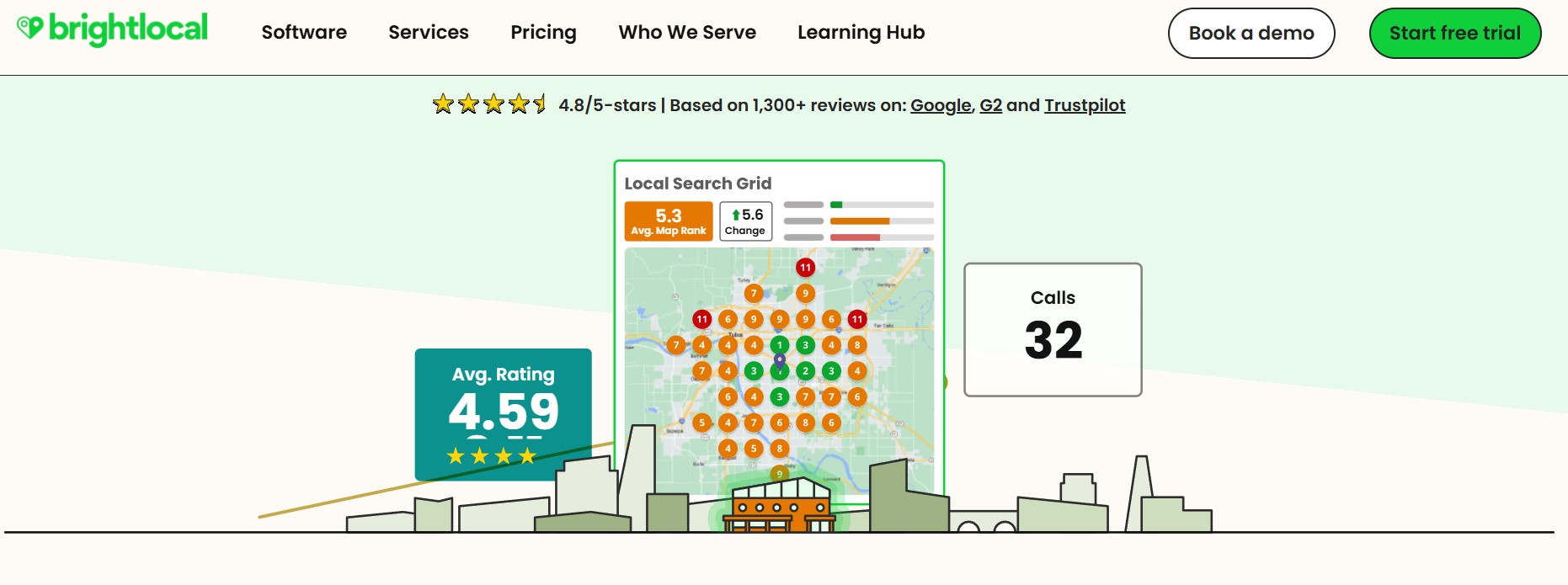
BrightLocal has spent more than 15 years building local SEO software, and its pitch is that AI visibility belongs next to rankings, reviews and citations in the same login. Its own consumer survey (1,164 respondents) reports that 58% of consumers have used AI to find or get a recommendation for a local business, and that 75% of people who use AI for this then check Google before choosing. That is the argument for tracking both.
The Local AI Visibility Tracker works per location. You add a location, accept or edit the prompts suggested for your business category (up to 20), and BrightLocal gives you a visibility score out of 100 with a breakdown by platform and by prompt. It auto-detects local competitors, compares mention rate, share of voice and average position, shows an AI sources leaderboard (Google Business Profile, Yelp and Facebook rank highest in its research), and explains in plain English why competitors are ahead. Gaps in directory coverage can be sent straight into Citation Builder.
- Scoring guide: above 75 means AI recommends you consistently and early, 50 to 74 means you are in the conversation but competitors win more of it, below 50 means most people will not hear your name.
- AI Insights: on Manage and Grow plans, BrightLocal Brain combines grid, rank, citation, reputation and website signals into prioritized actions per location.
- Platform stack: Local Search Grid, Local Rank Tracker (100 keywords and four competitors per location), Citation Tracker, Google Business Profile audits and review tools.
- Services: Managed SEO at $1,299/month, Citation Builder from $2 per citation, and custom API access.
Plans are Track ($31/month, or $369 billed annually), Manage ($40/month) and Grow ($49/month), all with the AI tracker included and a 14-day trial with no credit card. The gaps are what send teams elsewhere: only ChatGPT, AI Overviews and AI Mode are covered, there is a hard cap of 20 prompts per location, the platform supports the USA, UK, Canada and Australia, and there is no agent layer that writes content or runs outreach. For a wider overview of the category, see our 10 best local AI rank trackers for local businesses.
7 Best BrightLocal Alternatives for Local AI Visibility
1. RadarKit
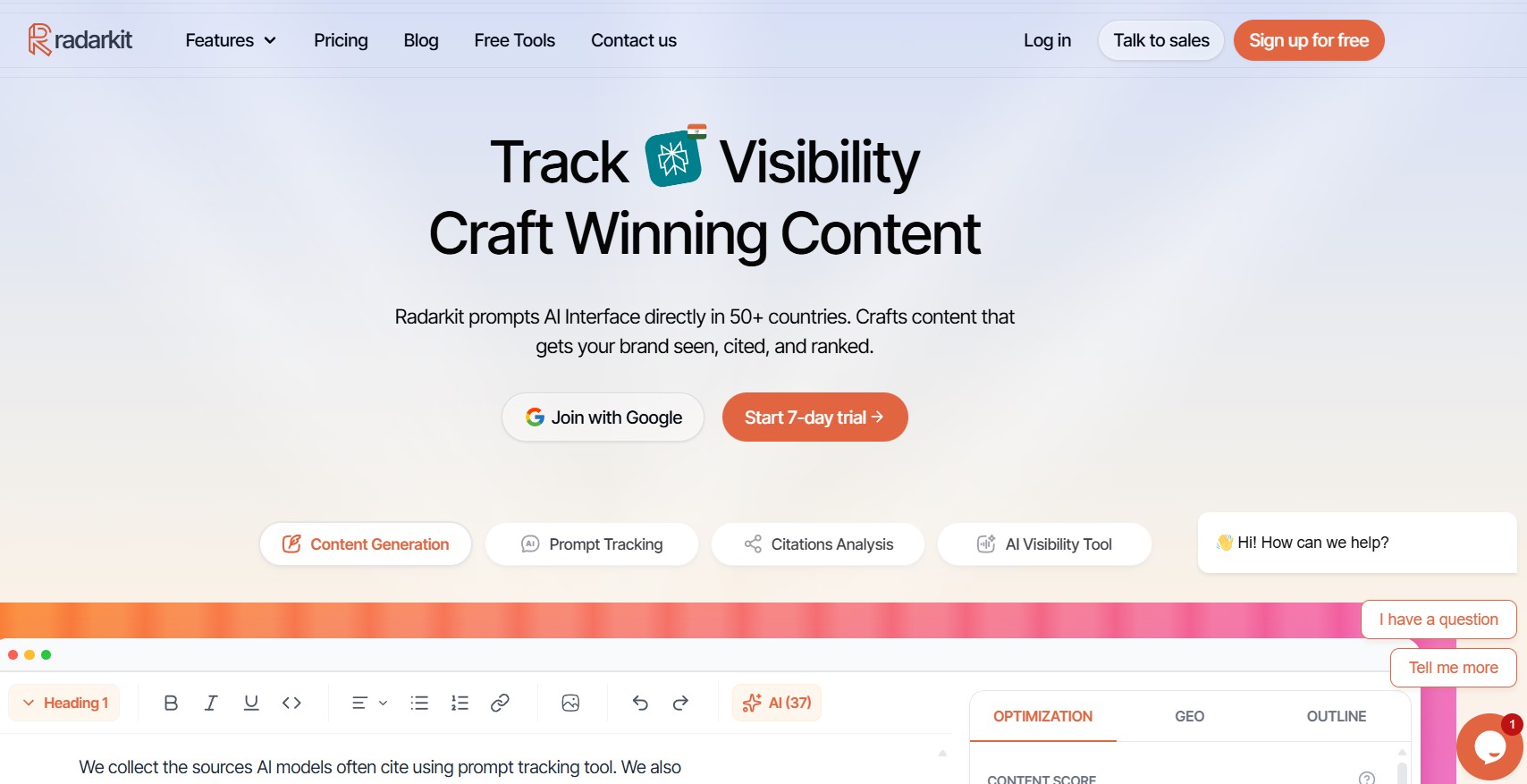
RadarKit is an AI search tracking platform built around a simple loop: track how AI answers mention you, analyze why, then act with agents. Its method is the thing to understand first. Instead of calling model APIs, it opens the real chat interfaces the way a customer would, from residential IPs in the country you choose, and records the full answer. That means the output reflects what people actually see, including carousels, local recommendations and ads.
Why it’s strong
For local work, this is where RadarKit differs from BrightLocal. BrightLocal scores a location against competitors on three engines. RadarKit’s Local Radar tracks six, records every business AI recommends for a local prompt with its rating and review count, and then hands the gaps to agents that can write the content, pitch the sites AI cites and join the Reddit threads AI pulls from.
Every plan, including the $29 Lite plan, includes all six engines, Local Radar, Shopping Radar, Ads Radar, the agents, MCP and API access, and the Client Portal. Plans differ by prompts, refresh speed and volume, not by locked features. That makes it unusually easy to start small and scale.
Key features
- Six-engine tracking: ChatGPT, Google AI Mode, Google AI Overviews, Microsoft Copilot, Perplexity and Gemini on every plan.
- Real chat interface prompting: prompts run through the consumer UIs, not model APIs, so answers match what users see.
- Prompt tracking and refresh: unique prompts tracked on a schedule (72 hours on Lite, daily on Growth and Pro), with full historical data on every plan.
- Local Radar: appearance rate (for example 3 of 4 answers), average position, rating and review count, plus every competing business AI recommends and the sources behind the answer.
- Residential IP geotargeting: prompts run from 50+ countries (70+ on Enterprise), so you see the answer a local customer would get.
- Visibility, sentiment and share of voice: brand and competitor mentions compared across the same prompts.
- Citation analysis: which domains and pages AI relies on, so you know where a listing or mention would matter.
- Query fanout capture: the sub-searches the model runs behind the scenes, captured live from real prompts and exportable.
- Shopping Radar: tracks the product carousel with product, store, price, rating and position, shows which stores win and how often your products appear.
- Ads Radar: captures ads inside AI answers, including advertiser, headline, description, landing page, creatives, how often they ran and the share of your answers that carry ads.
- Plan Agent: reads Search Console and AI citation data, finds where you are invisible and builds a strategy sheet, then assigns tasks to the other agents.
- Outreach Agent: finds high-authority domains that cite competitors, locates contacts, drafts on-brand emails, sends through your Gmail, follows up and negotiates within a ceiling you set.
- Reddit Agent: reads the Reddit threads AI cites for your space, shows where your brand is missing and how to join naturally.
- Content Agent and GEO Writer: optimizes existing articles around tracked prompts, entities and query fanouts and publishes through WordPress (6, 19 and 32 articles per month on Lite, Growth and Pro).
- Chat Agent: ask questions about your own data in plain language (15, 25 and 50 messages per month).
- AI Traffic Analytics: see AI-driven visits to your site alongside visibility.
- Integrations: Google Search Console, Google Analytics, WordPress and Gmail.
- MCP and API: a REST API at api.radarkit.ai covering visibility, responses, top source domains, share of voice, query fanout, exports, adding or re-asking prompts and creating articles, plus an MCP server for Claude and Cursor.
- Reporting: Client Portal, branded PDF reports (2, 10 and 20 per month by plan), extra seats and human support.
- Free tools: LLMs.txt checker and generator and an AI SEO Chrome extension, no signup needed.
Local features explained
Local Radar is built for the question a local owner asks: “when someone searches for my service in my city, does AI pick me, and who does it pick instead?” It reports your appearance rate as the share of local answers that name you, your position within those answers, and a table of every recommended business with rating, review count and appearances. Unrelated answers do not drag the score down, which keeps the number meaningful. One distinction matters for reporting: Local Radar measures positions inside AI answers, which is different from the map grid rankings that BrightLocal and Local Falcon produce.
- Country targeting: 50+ locations on Lite, Growth and Pro; 70+ on Enterprise.
- City and state level tracking: listed on the Enterprise plan only.
- Multi-client work: projects per plan (2, 5 and 10), plus Client Portal for agency delivery.
- Competitor view: every business AI recommends instead of you, with its rating and review count.
Where it falls short
- City and state targeting is limited to the Enterprise plan.
- Lite refreshes every 72 hours rather than daily.
- Prompt allowances (15, 50 and 100) are modest compared with large enterprise programs.
- It does not manage citations, listings or reviews the way BrightLocal does.
Pricing
- Lite: $29/month. 2 projects, 15 prompts, 900 responses a month, 72-hour refresh, 6 Content Agent articles, 15 Chat Agent messages.
- Growth: $79/month. 5 projects, 50 prompts, 9,000 responses, daily refresh, 19 articles, 2 extra seats.
- Pro: $139/month. 10 projects, 100 prompts, 18,000 responses, daily refresh, 32 articles, 5 extra seats, priority support.
- Enterprise: custom, annual. Unlimited projects, custom prompts, 70+ locations, state and city tracking, SSO, dedicated manager.
- Every plan starts with a 7-day free trial.
Best for
Local businesses and agencies that want local AI tracking across six engines with agents, reporting and API access included from the first plan. See how it stacks up in RadarKit vs Peec AI vs Profound and RadarKit vs Promptwatch vs Searchable.
2. Local Falcon
Local Falcon began as the geo-grid rank tracker that local SEOs used to see how a Google Business Profile ranks from many points across a city. It has since added AI platforms and now describes itself as an agentic AI search and local SEO platform. If you like BrightLocal’s Local Search Grid, this is the closest in spirit.
Why it’s strong
Its AI tracking uses the same grid idea. Because AI answers vary from one ask to the next, Local Falcon runs the same prompt from every point on a grid, from 9 up to 441 points, and treats each point as a separate sample. The result is a map of where AI recommends you, plus a consistency rate you can trust more than a single check from your office.
Key features
- AI visibility grids: ChatGPT, Google AI Overviews, Google AI Mode, Gemini and Grok scanned from every grid point.
- Geo-grid rank tracking: Google Business Profile and Apple Maps rankings, with ten grid sizes from 3×3 to 21×21.
- Share of AI Voice (SAIV) and Share of Local Voice (SoLV): compare AI presence and map presence side by side.
- Buyer Persuasion Score: measures whether AI recommends your business or steers people away.
- Brand Phrases: the phrases AI uses about you, how often and with what sentiment.
- Cited sources: the sites AI references in each scan, so you know where to earn mentions.
- Falcon AI analysis: written recommendations for each report (25 credits per report).
- Falcon Agent: conversational agent that can update Google Business Profile, respond to reviews and publish posts; included with credit packages.
- Campaign Reports and scheduling: run scans for groups of locations, keywords and platforms on a schedule.
- Competitor Report: compare rankings, visibility and opportunities against rivals.
- Falcon Guard: monitors changes to Google Business Profile fields.
- Reviews Analysis and Local Keyword Research tool: review sentiment and keyword ideas for local and AI search.
- Sales Enablement: 1 credit per lead lookup for GBP details and local rankings, useful for agency prospecting.
- Integrations: Claude Connector, ChatGPT plugin, MCP, data API, Looker Studio, Slack, Zapier and n8n.
Local features explained
Local Falcon is the most map-native option here. The same keyword can be scanned on Google Maps and on AI platforms, then compared. The trade-off is cost: every grid point is a credit, so a 21×21 AI grid costs 441 credits per scan. That makes planning important for agencies with many locations and keywords.
- Works anywhere in the world and in any language.
- Grid sizes from 3×3 (9 points) to 21×21 (441 points).
- Both Google and Apple map platforms plus AI platforms in one campaign.
- Credit Explorer in the account estimates monthly usage.
Where it falls short
- Credit-based pricing: costs rise with grid size, keywords, locations and frequency.
- Monthly credits expire at the end of each month; annual plans roll over within the year.
- The on-demand API is a separate $199/month plus usage fees.
- No Perplexity or Copilot tracking listed on the AI visibility page.
Pricing
- Monthly packages: $24.99 to $199.99 per month (7,500 to 63,000 monthly credits).
- Annual packages: $299.88 to $2,399.88 per year.
- Enterprise packages: $499 to $4,999 per month.
- Pay-as-you-go credits: $0.05 each, never expire.
- 100 free credits on signup, no credit card required.
- Data API and integrations free on packages above the Starter monthly plan.
Best for
Local SEO agencies and multi-location teams that want map grids and AI platform scans in one tool. Read our full list of Local Falcon alternatives if you are weighing options.
3. Promptwatch
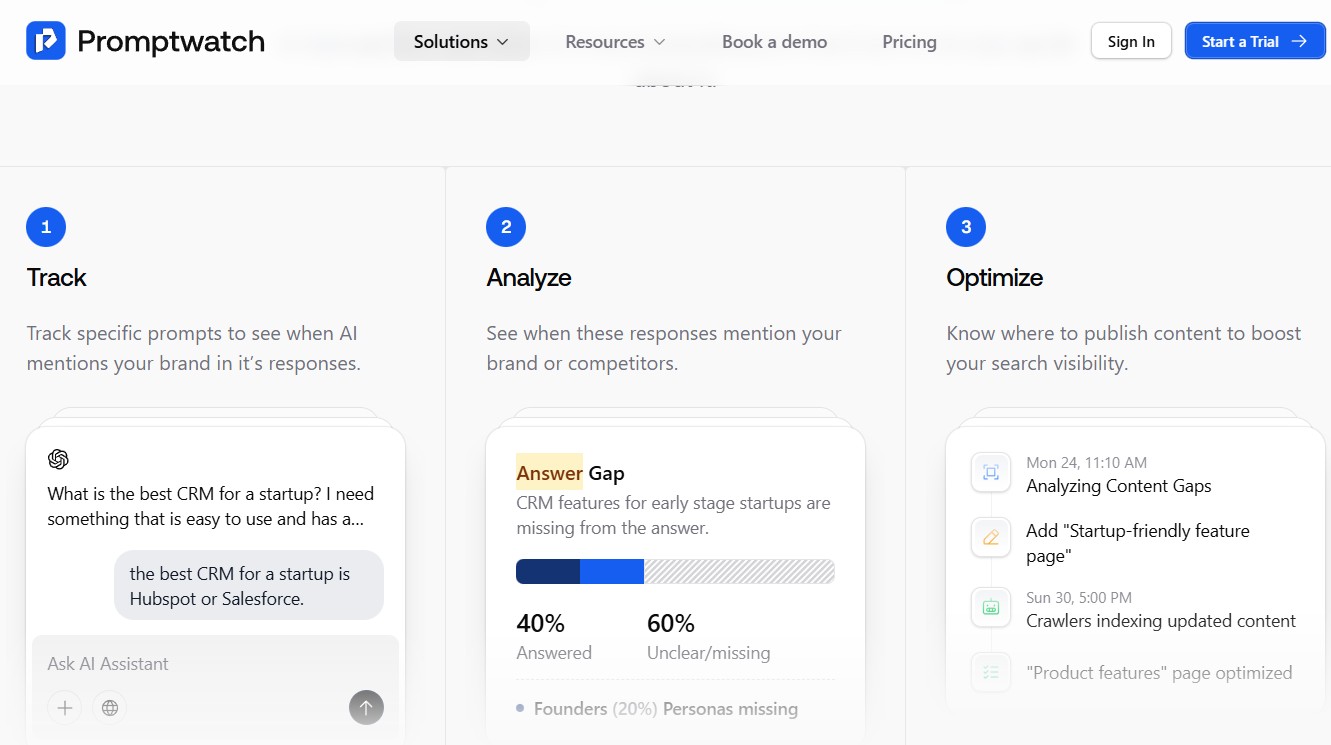
Promptwatch, built by an Amsterdam company, is a GEO platform that treats AI visibility as a loop: monitor prompts, find content gaps, generate pages that fill them and watch whether AI crawlers actually pick them up. Its data collection is notable because live-search platforms such as ChatGPT, Gemini, Perplexity and Copilot are collected from the real consumer products, and Google results from real search pages.
Why it’s strong
Where BrightLocal stops at tracking and recommendations, Promptwatch goes into content production and technical analytics. If your local program involves a website, location pages and a blog, that combination can be more useful than a score.
Key features
- Monitors: a monitor is a panel of prompts running on a schedule for one language, location, persona and model set.
- Visibility metrics: visibility score (0 to 100), share of voice, sentiment, position in answer, citation rank and self-citation rate.
- Broad model coverage: around 14 models including ChatGPT, AI Overviews, AI Mode, Copilot, Perplexity, Claude, Gemini, DeepSeek, Mistral, Alexa, Codex and Claude Code.
- Persona stacking: asks every prompt from an audience profile such as a first-time shopper or enterprise buyer.
- Citation and source analysis: domains, URLs, source types, plus dedicated Reddit, YouTube and LinkedIn citation views and off-site mentions.
- Query fanouts: the hidden searches an AI model runs for a prompt.
- Agent Analytics and crawler logs: see which AI bots visit your site, which pages they fetch and how crawling maps to citations; works with Cloudflare, AWS CloudFront, Fastly, Vercel, Netlify, Akamai and more.
- Visitor analytics: traffic arriving from AI platforms with top pages and locations.
- Content agents: content gap analysis, briefs, AEO articles and content refresh, publishing to WordPress, Webflow and Framer.
- Fact-checking: compares AI claims about your brand with a knowledge base.
- Agent Chat and Action Board: an AI analyst over your data and a kanban of prioritized actions.
- Shopping Insights and Ads Radar: shopping results, ads and product prices in AI answers (Business plan).
- MCP, REST API and reports: MCP and API on every plan, PDF reports, Looker Studio connector and white-label exports.
Local features explained
Each monitor can target a country, plus an optional US state and city that tell the model where the user is. Those state and city fields only work for the United States and are locked below the Business plan. Language and location are fixed after a monitor is created, so a new city means a new monitor. Agency plans include state and city targeting on every tier, which makes them better value for multi-location local work.
- Country-level tracking on every plan.
- State and city: Business ($579/month) and all agency plans.
- New projects are seeded with extra monitors aimed at another country or city to show variation.
- Visibility-by-country dashboards and heatmaps.
Where it falls short
- The cheapest plan with city targeting is $579/month for brands (or $199/month on the agency track).
- Business is demo-gated.
- State targeting is United States only.
- Prompt, response and credit quotas are hard caps.
Pricing
- Essential: $95/month. 1 project, 50 prompts, 6,000 responses, 500 agent credits.
- Professional: $245/month. 2 projects, 150 prompts, 18,000 responses, 5 AEO articles, Agent Analytics.
- Business: $579/month. 5 projects, 350 prompts, state and city tracking, Shopping Insights, Ads Radar.
- Yearly billing: $950, $2,450 and $5,790 for the brand plans.
- Agencies: Kick-off $199/month, Growth $399/month, Scale $799/month.
- Enterprise: custom. 7-day free trial on the lower tiers.
Best for
Content-led teams and agencies that want crawler analytics, content agents and city-level monitors. See our Promptwatch alternatives for local businesses.
4. AthenaHQ
AthenaHQ is a San Francisco GEO platform organized around three steps: monitor what AI says, understand which sources and claims shape it, then act through governed content, outreach and commerce workflows. It is aimed at larger marketing teams, with a free entry plan and enterprise features behind sales.
Why it’s strong
What makes it relevant here is its multi-location positioning. Its docs describe named locations attached to prompts, and its industry pages talk about benchmarking locations against each other and checking that AI shows correct hours, services and contact details.
Key features
- AI visibility dashboard: mentions, citations, share of voice, position, mention rate and an estimated AI search value.
- Prompt management: topics, personas, locations, prompt variations and a Discover tab for new prompts; Search Console queries can seed prompts.
- Prompt volume estimation: numeric estimates of how often a topic is searched on AI platforms.
- Source intelligence: which domains, pages and social platforms AI cites, with tagging and export.
- Oracle and Knowledge Base (Enterprise): checks AI answers against verified brand facts and flags inaccurate claims.
- Action Center: content briefs and articles, citation outreach and commerce optimization for Shopify.
- Site Health: crawl scopes, page scores and an AI access check of robots.txt against crawler responses.
- Athena Citation Engine: a model that predicts how likely content is to be cited (Enterprise).
- Agency tools: pitch workspaces and shareable prospect reports.
- Integrations and API: GA4, Search Console, Shopify, WordPress, Webflow, Looker Studio, Slack, CMS connectors, REST API and MCP.
Local features explained
In AthenaHQ, a location is a named place attached to a country that you can assign to prompts. The credit calculator states that each location runs the same prompt set independently, so costs scale with every location you add. The multi-location industry page describes tracking recommendations for each location, local accuracy monitoring and cross-location benchmarking, and claims support from 10 up to 10,000 locations.
- Locations tab on the Prompts page, with API and MCP tools to create and edit locations.
- Filters for locations and countries across dashboards and scheduled reports.
- Starter lists country-level support; multi-region and multi-language is an Enterprise item.
- Whether the Locations tab is included on Starter is not confirmed on official pages.
Where it falls short
- Credit costs multiply with locations, models and cadence.
- Claude, Grok, DeepSeek, Meta AI and Mistral cost 5 credits per response; prompt expansion multiplies by 4.
- API access and extra credits are paid add-ons on Starter with no published price.
- The strongest features (Oracle, Citation Engine, SSO) sit on Enterprise.
Pricing
- Essential: free, with $25 free credit and 300 credits, five engines.
- Starter: $295/month, or $245/month billed annually. 3,600 credits, 11 models, unlimited topics, prompts and competitors.
- Enterprise: custom credits, multi-region support, persona targeting, SSO, executive dashboards.
- 1 credit equals 1 AI response.
Best for
Multi-location brands and enterprises that can plan around a credit model. See our AthenaHQ review and 10 best AthenaHQ alternatives.
5. Semrush AI Visibility Toolkit
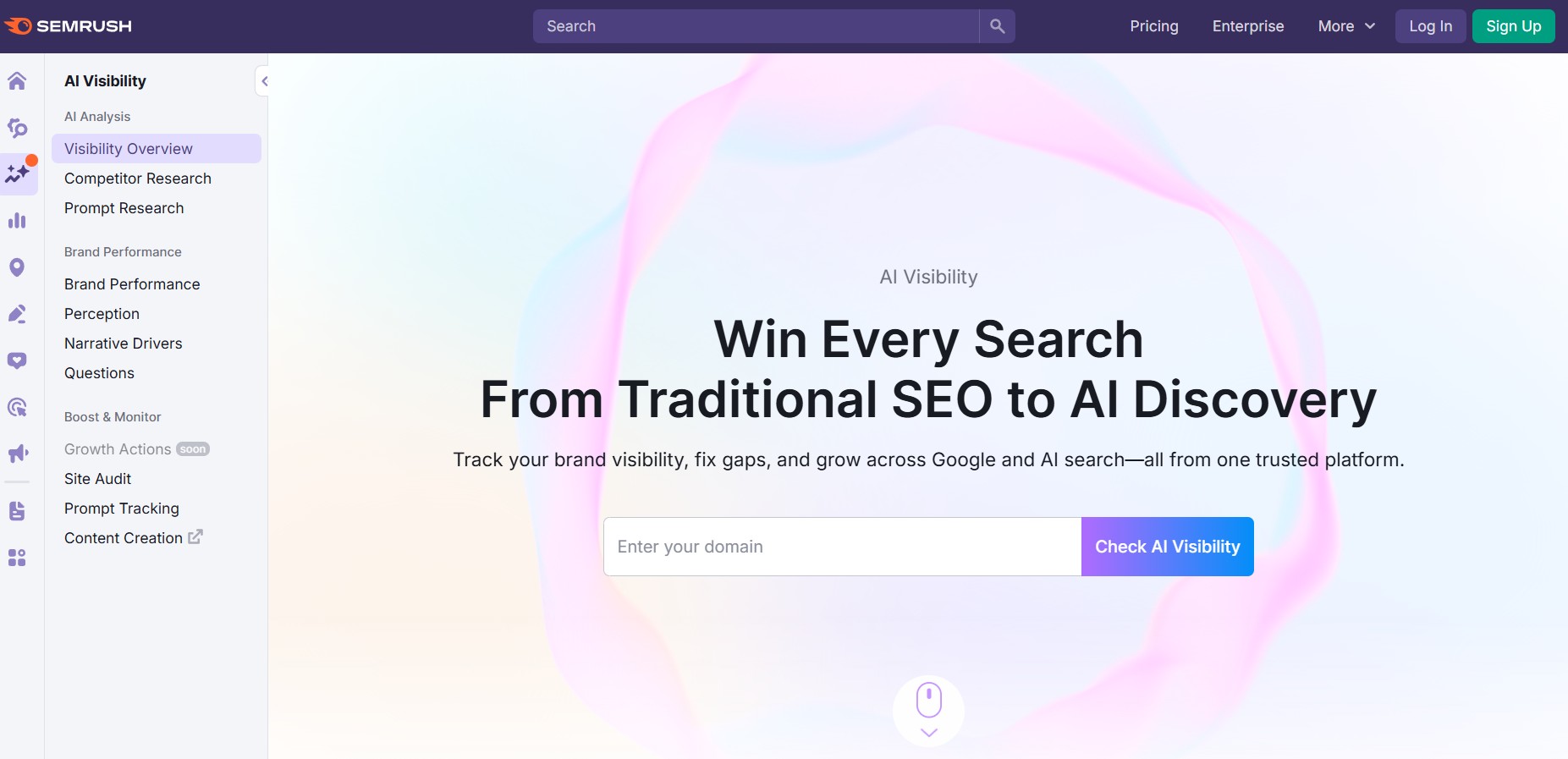
Semrush added AI visibility to a platform that millions of SEOs already use. The AI Visibility Toolkit can be bought on its own or as part of Semrush One, and it connects AI data to keyword, site audit and traffic tools you may already pay for.
Why it’s strong
It works with two data sources. A large prompt database covers ChatGPT, Gemini, Google AI Overviews and AI Mode. Brand Performance, separately, builds synthetic branded and non-branded prompts from your domain and location and reports weekly. Daily Prompt Tracking sits inside Position Tracking.
Key features
- Visibility Overview: a 0 to 100 AI Visibility Score for any brand, benchmarked against competitors.
- Competitor Research: compare against up to four competitors on mentions, citations and topic coverage.
- Prompt Research: topic volume, difficulty and intent, like keyword research for AI.
- Brand Performance: weekly share of voice, sentiment, perception and narrative drivers across AI platforms with recommendations.
- Prompt Tracking: daily tracking of your own prompts with sources reports, tags and SERP snapshots.
- AI Search Site Audit: flags blocks for AI crawlers such as OAI-SearchBot and Claude bots.
- AI Traffic and Content Toolkit: clickstream estimates of AI referral traffic and AI-optimized content scoring in separate toolkits.
- Reporting and integrations: CSV exports, scheduled emails, My Reports add-ons and an MCP server.
Local features explained
Location handling is a real strength. Brand Performance is tied to one location and language, with 68,000+ location options including cities. Prompt Tracking supports 220+ countries and territories. The catch is that extra domains or locations in Brand Performance cost $99 each, so costs rise per location, and Prompt Tracking is desktop only.
- Prompt Tracking: location and language per campaign, with comparison against Google and Bing results.
- Topic volume is available in only 15 countries.
- Pro+ includes multi-location and device tracking on the SEO side.
Where it falls short
- Standalone toolkit includes only 25 prompts and one Brand Performance domain.
- Perplexity is covered in Brand Performance only; Claude and Copilot are not listed.
- Brand Performance prompts are synthetic and refresh weekly.
- Semrush describes AI metrics as directional signals.
Pricing
- AI Visibility Toolkit: $99/month, no free trial. 25 prompts, 1 domain.
- Extras: +50 prompts $60/month; extra user licenses $99; extra location $99.
- Semrush One Starter: $165.17/month billed annually (50 prompts).
- Semrush One Pro+: $248.17/month billed annually (100 prompts).
- Advanced and Enterprise AIO: custom.
Best for
Teams already on Semrush that want AI visibility next to rankings and audits. See our Semrush AI Visibility Toolkit review, toolkit alternatives and alternatives for local businesses.
6. Otterly
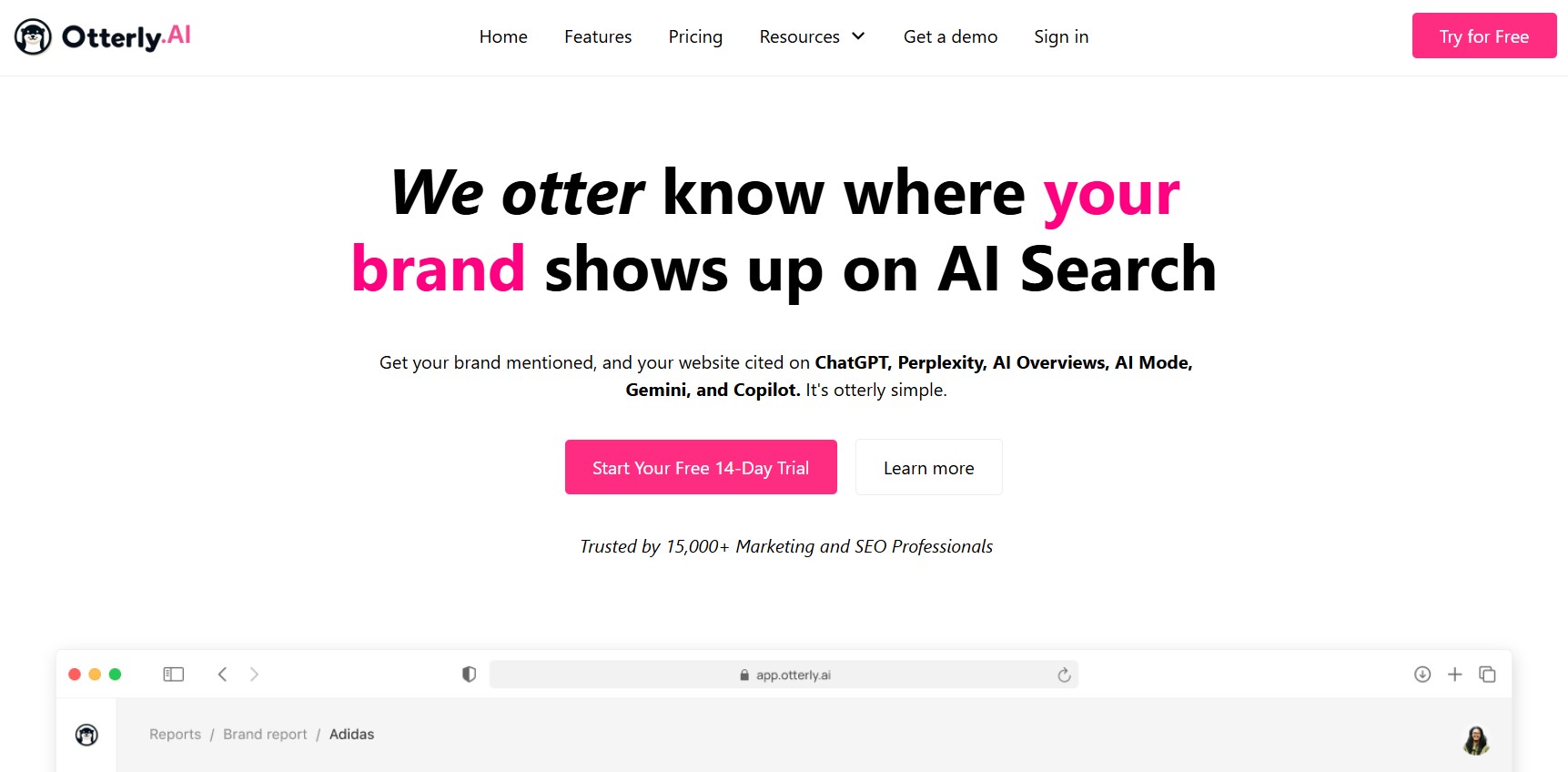
OtterlyAI, from OtterlyAI GmbH, positions itself as a Content Intelligence Platform for AI Search. It runs your prompt library daily on AI search engines, stores every answer and scores mentions, sentiment and cited links. It is one of the most affordable ways to start tracking.
Why it’s strong
It also leans on optimization: audits that test how AI crawlers see your site, content checks that grade a page’s AI readiness, and a recommendations queue that ranks fixes by impact.
Key features
- AI Prompt Research: turns a topic, brand or URL into prompts grouped by intent and funnel stage, with a query fan-out view.
- Brand reports: coverage, share of voice, average rank, net sentiment and a Brand Visibility Index; unlimited brands and competitors.
- Brand Profiling: the attributes and objections AI associates with you.
- Citation tracking: every cited URL and domain, checked daily, with Gap Analyzer for prompts competitors win.
- GEO Audit and Crawlability Check: tests 19 AI crawlers against robots.txt and your live server.
- Content Audit and Recommendations: 15 structural checks and 13 AI-readiness dimensions, plus ten recommendation types.
- Shopping and ChatGPT Ads tracking: product cards and ads inside ChatGPT.
- Agent Analytics: AI crawler traffic via file upload, webhook, Netlify, Cloudflare or WordPress.
- Integrations: public API, MCP server with OAuth, Looker Studio connector, PDF and CSV export.
Local features explained
Otterly’s geography is country-level. Its help center lists 70+ countries with per-engine support (for example ChatGPT is unavailable for Hong Kong), and you can write prompts in any language. Prompt text and country are fixed after creation. It does not document city, state or store-level targeting, so it fits national or country-by-country monitoring better than hyperlocal work.
- Monitoring in any language with the country context you set.
- Brand reports can be filtered by country, tag and engine.
- Agencies get pitch workspaces and branded Looker Studio reports through the partner program.
Where it falls short
- Four engines are included in base plans; Claude, Gemini and AI Mode are paid add-ons.
- No city-level targeting documented.
- SOC 2 Type II is on the roadmap with no date.
- Optimization is audits and recommendations, with no content-writing agent.
Pricing
- Lite: $29/month. 15 prompts.
- Standard: $189/month. 100 prompts, API, MCP, Agent Analytics.
- Premium: $489/month. 400 prompts.
- Annual billing: 15% off (about $25, $160 and $422 per month).
- Add-ons: extra 100 prompts $99/month; Claude from $29 to $439 per month depending on plan.
- Enterprise: custom, from 1,000 prompts. 7-day free trial, no credit card.
Best for
Marketers who want low-cost prompt monitoring across many countries. See our Otterly alternatives and Otterly alternatives for local businesses.
7. Peec AI
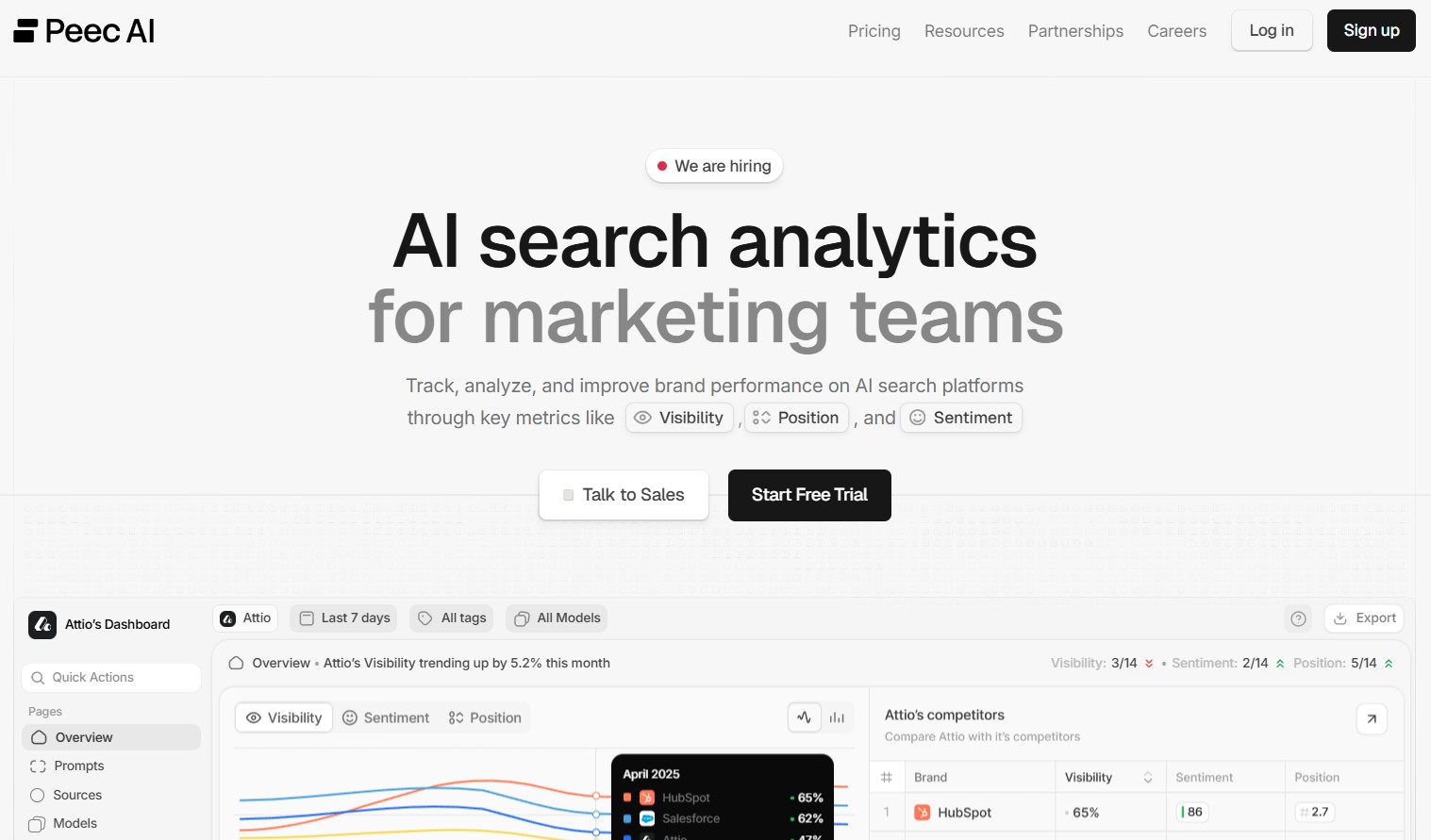
Peec AI is a Berlin-based AI search analytics platform that reports three headline metrics: Visibility (how often you are mentioned), Position and Sentiment. It scrapes the web interfaces of AI platforms as a logged-out user, arguing that this matches the average person’s experience better than APIs.
Why it’s strong
Peec has moved quickly in 2026, adding Brand Perception, an Ads page, AI Shopping, Query Fanouts, AI referrals through Google Analytics and an agent with an Actions workflow. It also has simple, predictable pricing and unlimited users on every plan.
Key features
- Prompt tracking: prompts with topics, tags, personas, bulk import, automatic branded vs non-branded and intent classification, and a prompt volume score.
- Visibility, Position, Sentiment and Share of Voice: compared against competitors over time.
- Source analytics: domain and URL detail, retrievals, citation share and source classification (competitor, editorial, reference, UGC).
- Brand Perception: attribute scoring, objections and fact-checking against facts you define.
- Ads library: ChatGPT ads on your prompts, advertisers and landing pages.
- AI Shopping: catalog upload, SKU-level visibility and win rate, top merchants.
- Query Fanouts: the searches AI runs behind a prompt.
- Actions and content optimizer: ranked opportunities with an in-app editor for suggested page changes.
- Agent Analytics: crawlability audit of 40+ bots, crawl insights from server logs and AI referrals via GA4.
- Peec Agent, MCP and API: agent with memory and 30 skills, MCP at api.peec.ai/mcp, Data Studio connector on higher plans.
Local features explained
Prompts take a country-level location setting, and the plan limits countries per project: 1 on Starter, 3 on Pro and Advanced. The pricing table lists a Local GEO row without a description, but the documentation we reviewed explains only country-level location, so city-level targeting is not confirmed. For local businesses it is best treated as a national or country-level monitor.
- Unlimited languages on every plan.
- Sub-brand tracking and unlimited projects for agencies.
- Prompts can be shared across projects.
Where it falls short
- Only three models can be active on self-serve plans; extra models cost $30 to $140 per month each.
- Claude, Grok and other API models are Enterprise-only per the pricing page.
- Country caps of 1, 3 and 3 apply per project.
- The API is Pro and above per pricing, but docs describe it as beta and Enterprise-only.
Pricing
- Starter: $95/month. 50 prompts, 3 models, 1 country, 4,500 monthly AI answers.
- Pro: $245/month. 150 prompts, 3 countries, API.
- Advanced: $495/month. 350 prompts, Data Studio integration.
- Annual billing: 15% discount.
- Agencies: $245, $495 and $795/month on a credit model with pitch projects.
- Enterprise: custom.
Best for
Marketing teams that want clean AI analytics and are comfortable with three models at a time. See our Peec AI review and best Peec AI alternatives.
What you should look for in a BrightLocal alternative
AI engine coverage
BrightLocal covers ChatGPT, Google AI Overviews and AI Mode. If your customers also use Gemini, Perplexity or Copilot, check how many engines each plan includes and whether extra engines cost more. Some tools include everything; others charge per engine.
Location precision
Local intent depends on where the question is asked. Check whether a tool targets a country, a state, a city, a named location or a grid of points, and which plan unlocks it. Also check whether prompts run from real local IPs.
Measurement type
Map grid rankings and AI answer positions measure different things. A grid ranks a profile on a map, while AI answers are narrative recommendations with no fixed ranking. Keep them separate in reports and use both.
Prompt limits and pricing model
BrightLocal allows 20 prompts per location. Other tools price by prompts, credits, grid points or responses, so estimate your locations, prompts and refresh rate before comparing prices.
Reporting and actions
Look for client-ready reports, exports, MCP or API access, and agents or recommendations that turn data into content, outreach and fixes. Dashboards alone rarely move rankings. See also our SplashDash alternatives.
FAQs: BrightLocal alternatives for local AI visibility
What is local AI visibility?
Local AI visibility is how often AI platforms such as ChatGPT and Google AI Mode recommend your business when someone asks a local question. It is usually measured as an appearance rate, a position and a share of voice against nearby competitors, and it can change from one neighborhood to the next.
Which AI engines does BrightLocal track?
BrightLocal’s Local AI Visibility Tracker currently covers ChatGPT, Google AI Overviews and Google AI Mode. BrightLocal says it aims to add more platforms in the future.
How many prompts can I track in BrightLocal?
You can track up to 20 prompts per location as standard, and BrightLocal states you cannot track more than 20 per location. The tracker is included in the Track, Manage and Grow plans.
Is BrightLocal still worth using?
Yes, if you need citations, Google Business Profile tools, reviews and rank tracking in one platform. Its platform works in the USA, UK, Canada and Australia. Teams that need more engines, more prompts, other countries or agents often pair it with or replace it with an AI-first tool.
What makes RadarKit different from BrightLocal?
RadarKit tracks six AI engines through real chat interfaces and shows appearance rate, position and competing businesses with ratings in Local Radar. It adds Shopping Radar, Ads Radar, query fanout and citation analysis, Plan, Outreach, Reddit and Content agents, a Client Portal, and MCP and API access from the $29/month plan. BrightLocal is stronger on citations, listings and reviews.
Final thoughts
BrightLocal is a solid local SEO platform, and its new tracker brings AI visibility to location-level reporting. The gaps are engine coverage, a 20-prompt cap per location and four supported countries.
RadarKit is our top pick: six engines on every plan, Local Radar with competitor ratings, Shopping and Ads tracking, four agents, a Client Portal and MCP and API from $29/month. Local Falcon suits teams that want map grids, Promptwatch and AthenaHQ suit larger content and multi-location programs, and Semrush, Otterly and Peec AI fit teams with a specific stack or budget. Start with RadarKit’s 7-day trial and compare it against your current local reports.