
Why Tracking Local AI Visibility Matters
Local AI visibility tracking helps businesses understand whether they appear when customers ask AI platforms for nearby services. It shows more than a mention count, revealing how prominently a business appears, how it is described, and which competitors receive recommendations.
These insights help businesses identify gaps across services and locations. Citation analysis also highlights the directories, publications, and webpages referenced in answers, giving marketing teams a clearer direction for content updates and local listing improvements.
For businesses exploring Promptwatch Alternatives for Local Businesses, the value lies in making better decisions. Regular monitoring helps teams follow changes, compare location performance, and focus their efforts on the questions relevant to their customers.
Why Promptwatch May Not Be Enough?
Promptwatch provides AI visibility tracking, citation analysis, competitor insights, and geographic targeting. However, a local business may need these insights connected to a wider set of location-management and local SEO tasks.
City-level monitoring and neighborhood-level visibility maps answer different questions. Businesses managing several branches may also need individual-location reporting, while teams handling everyday local marketing may want Google Maps tracking, review management, and business listing tools alongside AI monitoring.
Choosing between Promptwatch Alternatives for Local Businesses is therefore about matching capabilities to your workflow. Promptwatch may meet your AI monitoring needs, while a dedicated local platform can provide the additional geographic detail and operational tools your business requires.
5 Best Promptwatch Alternatives for Local Businesses
RadarKit
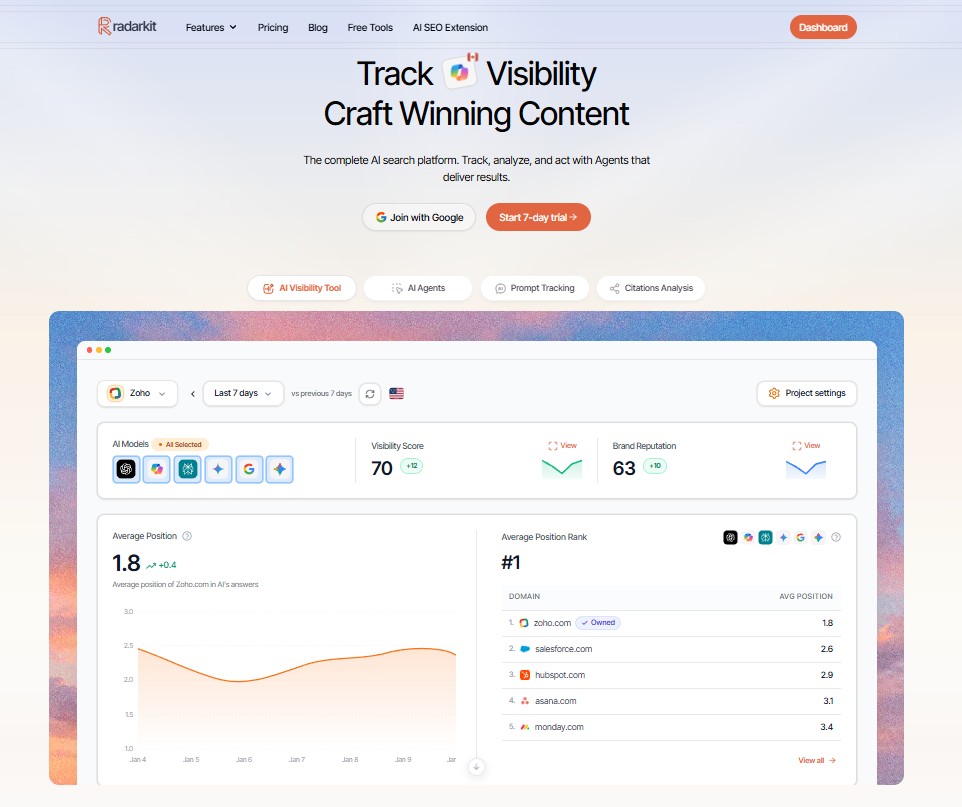
RadarKit combines AI search monitoring with Local Radar, citation analysis, and agents for content, outreach, planning, and community work. It tracks consumer-facing answers across ChatGPT, Google AI Mode, Google AI Overviews, Microsoft Copilot, Perplexity, and Gemini.
Among Promptwatch Alternatives for Local Businesses, RadarKit is particularly relevant when you want to move from identifying a visibility gap to preparing the work that addresses it.
Local Business Features Explained
RadarKit’s Local Radar tracks whether AI recommends your business, where it places you in the answer, and which other businesses appear alongside you. It runs prompts through consumer-facing AI interfaces rather than model APIs, using residential IPs across more than 50 countries to provide geographic context.
- Appearance rate: Measures the share of relevant local AI answers that recommend your business. Unrelated answers do not dilute the score, making it easier to understand your visibility within the local recommendations being tracked.
- Recommendation position: Records your placement in each answer and your average position over time. This separates simply being mentioned from appearing near the top of a recommendation list.
- Automatic monitoring: Runs your selected prompts automatically and captures the businesses AI recommends. You can follow patterns across repeated checks instead of relying on a single manually generated answer.
- Local competitor comparisons: Compares recommended businesses by position, appearance frequency, rating, and review count. This shows who consistently appears for the same questions your customers might ask.
For example, a dental practice could monitor “best dentist in Manhattan” and see whether it appears regularly, averages third position, or is missing from most recommendations. Those are different visibility patterns, and Local Radar makes the distinction easier to understand.
Its value is the combination of frequency, prominence, and competitor context. You can see not only whether AI recommends your business, but how consistently it does so and where you sit among the other choices.
Why It’s Strong
-
Citation analysis: Identifies the websites referenced in AI answers. These findings can help direct content research, directory work, and outreach.
-
Query fanout tracking: Captures the additional searches AI performs while preparing an answer. This gives your team more detail about the topics involved in a recommendation.
-
Content Agent: Helps create or optimize content using search results, AI citation data, relevant entities, and content gaps.
-
Outreach Agent: Helps prepare pitches to websites connected to tracked topics and citations.
-
Reddit Agent: Supports research into relevant discussions and preparation of contributions.
-
Shopping Radar: Tracks product placements, prices, ratings, and merchants in shopping results.
-
Ads Radar: Records sponsored placements and advertisers appearing in supported AI experiences.
-
Reporting and integrations: Includes client portals, branded PDF reports, Google Analytics, Google Search Console, WordPress, API, and MCP access.
The combination makes RadarKit one of the more action-oriented Promptwatch Alternatives for Local Businesses. Monitoring, planning, and content work can stay connected rather than becoming separate tasks in unrelated tools.
Pricing
-
Lite: $29 per month for two projects and 15 tracked prompts, refreshed every 72 hours.
-
Growth: $79 per month for five projects and 50 prompts, refreshed daily.
-
Pro: $139 per month for ten projects and 100 prompts, refreshed daily.
Enterprise provides custom allowances and state- and city-level tracking. Content and reporting allowances vary by plan.
Best For
RadarKit suits local businesses and agencies that want AI visibility insights alongside content, outreach, and client-reporting workflows.
2. BrightLocal
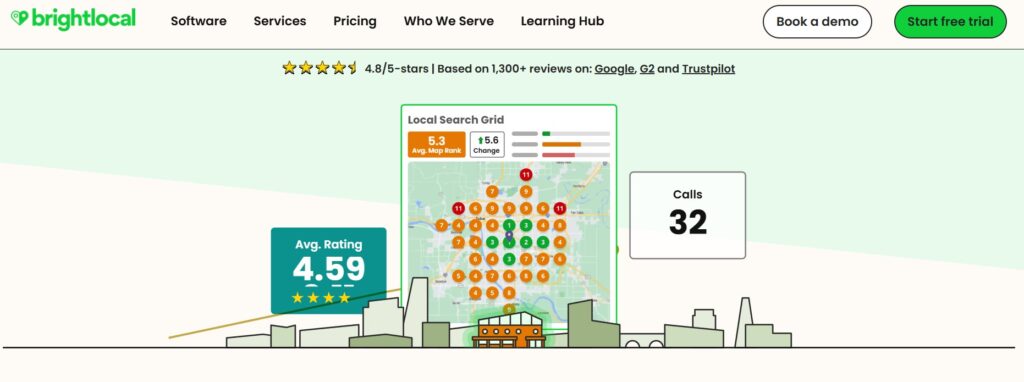
BrightLocal brings AI visibility into a broader local SEO platform. Its Local AI Visibility Tracker sits alongside tools for rankings, business listings, reviews, citations, and Google Business Profile analysis.
It is a practical choice among Promptwatch Alternatives for Local Businesses when the same team manages both AI discovery and everyday local SEO.
Local Business Features Explained
BrightLocal measures AI visibility for individual business locations. Each location receives its own score, allowing a business to compare branches without relying on a single brand-wide average.
Its prompts are anchored to a specific location. Businesses can use suggested questions based on their category or customize prompts around their services and customer needs.
The tracker covers ChatGPT, Google AI Mode, and Google AI Overviews. Results include visibility scores, sentiment, recommendation strength, and comparisons with local competitors.
BrightLocal also identifies cited domains and whether your business appears on them. If an important directory is missing your listing, Citation Builder provides a route to address that gap.
Its AI tracker and traditional Local Search Grid serve different purposes. The AI tracker measures location-level recommendation performance, while Local Search Grid maps traditional Google local rankings.
Why It’s Strong
-
Individual-location scores: Helps separate the performance of one branch from another.
-
Automatic competitor discovery: Identifies the businesses appearing in tracked recommendations.
-
Recommendation analysis: Goes beyond counting mentions to examine how the business is described.
-
Citation opportunities: Shows relevant domains where the business is present or missing.
-
Citation Builder connection: Links identified listing opportunities with a submission workflow.
-
Google Business Profile audits: Helps review profile information and compare it with competitors.
-
Listings and reputation tools: Higher plans add synchronization, posting, review monitoring, and review-generation features.
-
Agency reporting: Supports shareable dashboards and white-label reporting.
For teams comparing Promptwatch Alternatives for Local Businesses, BrightLocal’s strength is the connection between AI findings and familiar local SEO work.
Pricing
For one location, monthly plans cost $41 for Track, $54 for Manage, and $65 for Grow. Annual subscriptions are available.
Local AI Visibility is included across these plans. Each location supports up to 20 prompts, with twice-monthly tracking. Citation Builder submissions are purchased separately.
Best For
BrightLocal suits businesses that want AI visibility, rankings, listings, and reputation management within the same platform. Confirm geographic availability, as its main platform supports the USA, UK, Canada, and Australia.
3. Local Falcon
Local Falcon focuses on visibility across geographic areas. It combines traditional Google Maps and Apple Maps tracking with AI recommendation scans, making it useful for businesses whose visibility changes across a service region.
When comparing Promptwatch Alternatives for Local Businesses, Local Falcon is especially relevant if a single location score does not provide enough detail.
Local Business Features Explained
Local Falcon runs AI prompts from individual GPS points across a configurable grid. Each point captures an answer, the businesses mentioned, their order of appearance, and cited pages.
The results become a geographic heatmap. This makes it easier to see whether a business appears near its office but loses visibility farther away.
Businesses can adjust grid size, radius, and scan center. They can also disable points that fall outside relevant areas, such as locations over water.
Share of AI Voice measures how frequently the business appears across the sampled area. Buyer Persuasion Score adds context by assessing how strongly the answer encourages or discourages choosing the business.
These measurements should be read differently from traditional rankings. An AI recommendation position reflects order of mention, not a Google Maps ranking.
Why It’s Strong
-
AI visibility heatmaps: Shows where recommendations change across a geographic area.
-
Traditional map tracking: Measures Google Maps and Apple Maps separately from AI visibility.
-
Citation analysis: Identifies pages supporting the AI answers.
-
Falcon AI recommendations: Turns scan findings into suggested optimization work.
-
Falcon Agent: Supports connected tasks such as scans, profile audits, review responses, and scheduled posts.
-
Falcon Guard: Monitors Google Business Profile changes.
-
Local keyword research: Helps develop conventional keywords and conversational questions.
-
Multi-location reporting: Supports location groups, campaigns, historical reports, and white-label reporting.
For example, a dental practice could use grid results to investigate why it appears around its office but less often in nearby neighborhoods. That makes Local Falcon one of the more geographically detailed Promptwatch Alternatives for Local Businesses.
Pricing
Monthly packages start at $24.99 for 7,500 credits. Higher packages provide larger credit allowances.
Scans consume credits according to their grid size. A 5×5 grid uses 25 scan credits, and Falcon AI report analysis adds 25 credits per report. Plan usage should account for locations, prompts, platforms, and scan frequency.
Best For
Local Falcon suits service-area businesses, multi-location operators, and agencies that need neighborhood-level AI visibility alongside traditional map reporting.
4. OtterlyAI
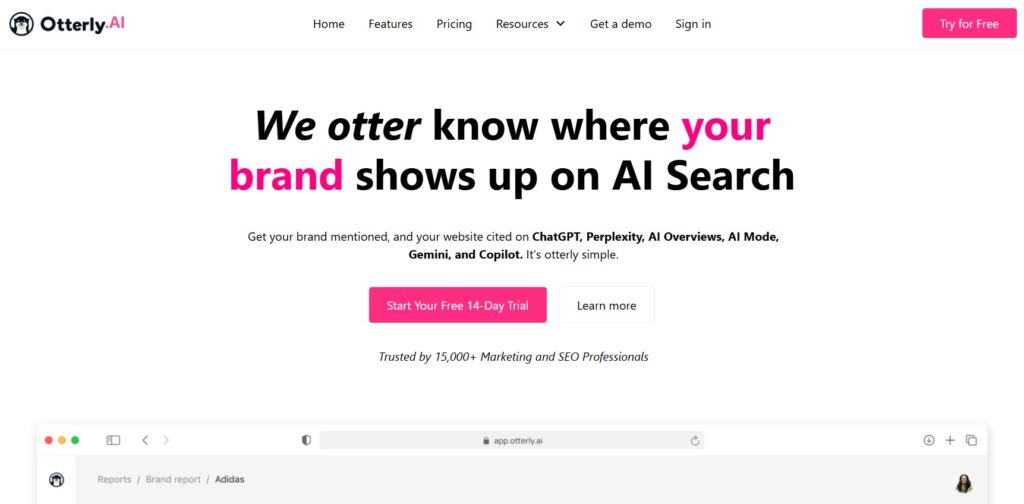
OtterlyAI combines daily AI-answer monitoring with citation analysis, prompt research, and GEO audits. It helps businesses track appearances over time and investigate the pages connected to those answers.
It belongs among Promptwatch Alternatives for Local Businesses that prioritize recurring monitoring and website insights rather than geographic heatmaps.
Local Business Features Explained
OtterlyAI supports country-based prompt execution. Businesses can monitor questions containing their city, services, and customer needs, while the country setting provides broader geographic context.
For example, a landscaping company could monitor questions about garden maintenance, patio installation, or local service recommendations. These prompts can help reveal where the business appears and which competitors are mentioned.
However, a local term inside a prompt does not establish city-specific IP execution. OtterlyAI’s documented country monitoring should not be treated as neighborhood geo-grid tracking.
Its citation reports can also help a business investigate relevant pages. A cited article may support an answer without actually mentioning the business, so checking brand presence on that page adds useful context.
Why It’s Strong
-
Daily monitoring: Builds a recurring record of tracked answers.
-
Brand reporting: Tracks visibility, rankings, and competitor appearances.
-
Citation analysis: Identifies linked URLs and domains.
-
Citation-page checks: Helps determine whether a cited page mentions the brand.
-
AI Prompt Research: Supports development of a monitoring set around customer questions.
-
GEO audits: Reviews website pages and provides recommendations.
-
Team access: Includes unlimited team members and brand reports.
-
Reporting integrations: Higher plans add Looker Studio, API, MCP, and Agent Analytics.
These capabilities make OtterlyAI useful when comparing Promptwatch Alternatives for Local Businesses focused on mentions, citations, and website readiness.
Pricing
Lite costs $29 per month for 15 prompts, Standard costs $189 for 100, and Premium costs $489 for 400.
ChatGPT, Google AI Overviews, Perplexity, and Microsoft Copilot are included. Google AI Mode, Gemini, and Claude are paid add-ons.
Best For
OtterlyAI suits smaller marketing teams that want daily monitoring, citation research, and website audits without needing neighborhood-level visibility maps.
5. Peec AI
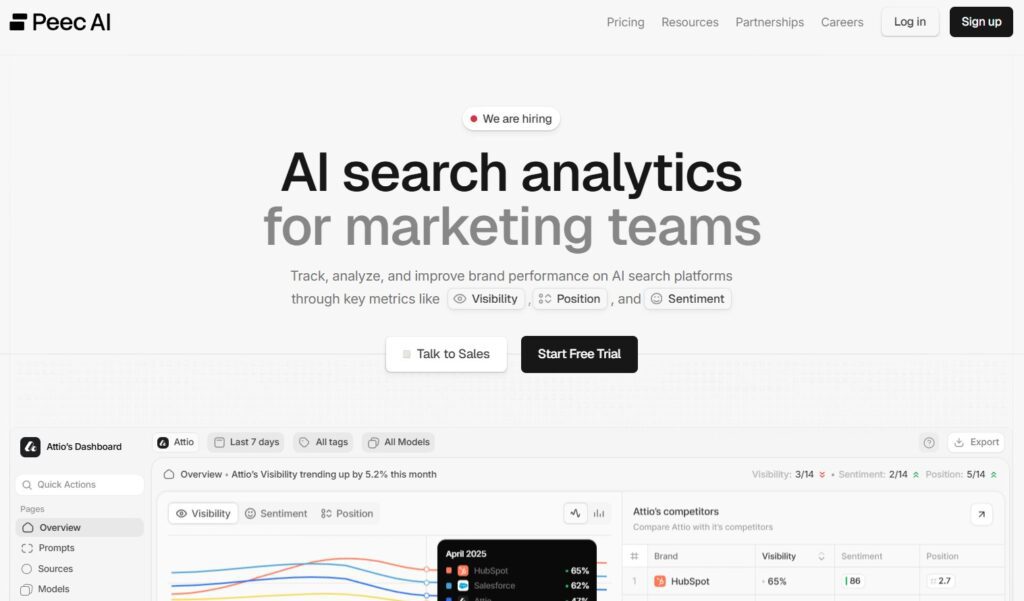
Peec AI combines structured prompt tracking with citation research, competitor analysis, and prioritized actions. Its organization tools help teams separate different topics, audiences, markets, and customer questions.
Among Promptwatch Alternatives for Local Businesses, Peec AI is a useful option when the priority is understanding the pages behind recommendations and turning those findings into assigned work.
Local Business Features Explained
Peec AI supports country-based execution, with prompts organized through topics and tags. A team can group questions around locations, services, branches, or customer needs.
This helps keep local research manageable. Questions about emergency repairs can be separated from maintenance enquiries, while branded prompts can be reviewed independently from broader recommendations.
The documented prompt location setting is country-based. Peec AI’s pricing matrix also lists Local GEO, but its exact geographic methodology and plan availability should be confirmed when city-level execution is required.
Citation gaps provide another local use case. If competing businesses appear on repeatedly referenced directories or articles, the team can review those pages and decide whether a listing, content contribution, or outreach effort makes sense.
Why It’s Strong
-
Daily brand metrics: Tracks visibility, position, sentiment, and share of voice.
-
Prompt organization: Supports topics, tags, bulk imports, and branded or unbranded classification.
-
Intent labels: Separates informational, commercial, and transactional questions.
-
Retrieved versus cited pages: Distinguishes content used during answer preparation from URLs explicitly linked in the answer.
-
Citation-gap analysis: Identifies pages where competitors appear but the business does not.
-
Page classification: Groups different kinds of websites and content, helping teams choose appropriate actions.
-
Prioritized Actions: Organizes work around site audits, owned content, and earned placements.
-
Progress tracking: Lets teams manage actions and compare their completion with visibility trends.
Peec AI also provides a relative prompt-demand score. This helps prioritize topics, but it should not be read as an exact count of searches entered into an AI platform.
For teams evaluating Promptwatch Alternatives for Local Businesses, its main value is making research more organized and actionable.
Pricing
Peec AI starts at $95 per month, Pro at $245, and Advanced at $495, with custom Enterprise pricing.
Best For
Peec AI suits marketing teams and agencies that want structured reporting, competitor citation research, and a clear process for managing follow-up work.
What to Compare Before Choosing
-
Local tracking depth: Check whether the tool monitors country-level results, individual locations, city-specific answers, or neighborhood grids. Choose the geographic detail that matches your service area.
-
AI engines covered: Confirm that it tracks the platforms relevant to your customers and whether additional engines require separate access.
-
Recommendation insights: Look beyond mention counts. Appearance frequency, recommendation position, and sentiment provide a clearer picture of how your business is presented.
-
Competitor analysis: Look for comparisons that reveal which businesses consistently appear for the same services and locations.
-
Citation analysis: Choose tools that identify referenced websites and pages, especially those featuring competitors but not your business.
-
Actionable features: Consider whether the platform helps with content, outreach, listings, reviews, or website improvements after identifying a gap.
-
Reporting and integrations: Check location-level reports, historical trends, client access, exports, and connections to your existing tools.
Frequently Asked Questions
Which Promptwatch Alternative Suits Local Businesses?
RadarKit is a strong choice for businesses that want local AI recommendation tracking alongside practical marketing tools. Local Radar shows whether your business appears, where it sits in recommendation lists, and which competitors appear alongside it. Its content and outreach agents help turn those findings into focused work.
What Makes RadarKit’s Local Radar Useful?
Local Radar measures both appearance frequency and recommendation position. This gives you a clearer picture than a mention count alone, helping you distinguish occasional appearances from consistent, prominent recommendations. Competitor comparisons add context through positions, ratings, and review counts.
Can RadarKit Track City-Level AI Visibility?
Yes, RadarKit supports city-specific tracking using residential IP addresses, with state- and city-level tracking available on Enterprise. Local business tracking is also listed across its standard plans. Choose the plan based on whether you need to monitor local recommendations or require more granular geographic execution.
How Does RadarKit Help Beyond Monitoring?
RadarKit connects visibility data with Content, Outreach, Reddit, Chat, and Plan agents. These tools help prepare content, identify relevant discussions, and develop outreach around tracked opportunities. That connection makes the platform useful for teams that want a clear next step after reviewing their results.
Is RadarKit Suitable for Local SEO Agencies?
RadarKit supports multiple projects, client portals, branded PDF reports, and integrations with Google Analytics and Google Search Console. API and MCP access also support custom workflows. Together, these capabilities help agencies keep client monitoring, reporting, and follow-up work connected.
Final Verdict
RadarKit deserves a place near the top of your shortlist when comparing Promptwatch Alternatives for Local Businesses. Its strongest appeal is the combination of Local Radar, competitor insights, citation analysis, and agents that help your team act on what the tracking reveals.
Rather than stopping at whether your business was mentioned, RadarKit helps you understand its recommendation frequency, position, and competitive context. For businesses and agencies that want monitoring connected to content, outreach, and reporting, it offers a well-rounded approach. Match the plan to your geographic requirements, particularly when city-specific tracking is essential.