Comparison Table: Similarweb Alternatives
| Tool | Best for | What you can research | Standout features | Starting price |
|---|---|---|---|---|
| Radarkit | Brands and agencies tracking AI search visibility | AI prompts, brand mentions, competitor visibility, citations, and local AI recommendations | Local Radar tracks local business recommendations across 50+ countries; also includes citation analysis, AI traffic analytics, content and outreach agents, and client reports. | $29/month. |
| Semrush | Teams managing SEO and AI search together | Keywords, competing domains, rankings, site issues, and AI visibility | Combines competitor research, rank tracking, site audits, content tools, and AI prompt tracking. | $139/month for its paid SEO plan. |
| Ahrefs | Content teams researching organic competitors | Ranking keywords, competing pages, backlinks, and content topics | Site Explorer, Keywords Explorer, Content Explorer, Site Audit, and AI brand research. | $129/month for Lite. |
| Ubersuggest | Bloggers and smaller websites | Keyword ideas, competitor pages, rankings, backlinks, and site issues | Straightforward keyword and content research, site audits, rank tracking, and limited AI Model Insights. | From $29/month. |
| SpyFu | PPC and SEO competitor research | Google Ads keywords, ad history, organic keywords, and ranking history | Connects paid and organic research through ad history, keyword comparisons, site audits, and reports. | $39/month. |
| Moz Pro | Teams running an organized SEO workflow | Keywords, backlinks, rankings, site issues, and AI visibility | Keyword Explorer, Link Explorer, Site Crawl, campaigns, and AI visibility dashboards. | $49/month for Starter. |
| SE Ranking | Agencies managing ongoing SEO projects | Keywords, competitors, backlinks, site issues, and AI prompts | Daily rank and prompt tracking, website audits, reporting, and optional agency features. | $129/month, or $103.20/month billed annually. |
What Is Similarweb?
Similarweb is a digital intelligence platform that helps you understand how websites and apps perform online. It estimates website visits, shows where traffic comes from, and provides insights into audience behavior, competitors, and market trends.
Marketers use Similarweb to compare websites, explore traffic channels, find popular pages, and see how a business performs against others in its industry. It is useful when you want a broader picture of a market before planning your SEO, advertising, or content strategy.
Why Look for a Similarweb Alternative?
Sometimes you already know which competitors matter. Your next job is to find the keywords they rank for, inspect their backlinks, study their ads, or improve your own pages. A focused SEO or PPC tool can take you further with those tasks.
Your budget and team size also shape the decision. A freelancer researching a handful of websites needs different limits from an agency managing several client campaigns. Rather than choosing the tool with the most features, choose one that makes your regular work easier.
7 Best Similarweb Alternatives for SEO, Competitor Research, and AI Search
1. Radarkit
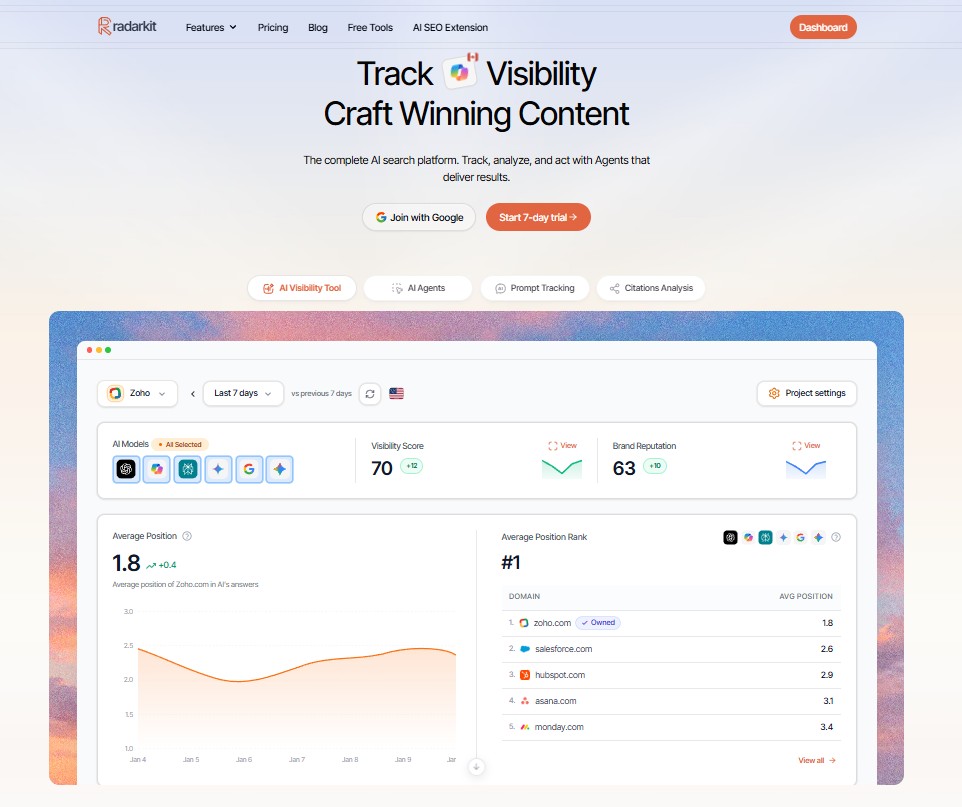
Radarkit focuses on a part of digital visibility that traditional traffic reports do not fully explain: what people see when they ask AI tools a question. It tracks selected prompts across ChatGPT, Google AI Mode, Google AI Overviews, Microsoft Copilot, Perplexity, and Gemini. You can monitor your brand, compare competitors, and inspect the sources cited in AI answers.
For example, a software company could track prompts such as “best tools for monitoring brand mentions in AI search.” Radarkit would help its team see whether its brand appears, which competitors appear alongside it, and what content the AI responses cite. That turns a vague question about AI visibility into something the team can review regularly.
Why it’s strong
Radarkit does more than record mentions. Its citation and competitor data can point you toward topics to cover, pages to improve, and places where outreach may help. It also includes AI agents for content, outreach, Reddit research, and conversations about your tracking data.
The platform includes Google Search Console and Google Analytics integrations, client reporting, and MCP and API access. These features make it useful for teams that want to connect AI-search findings to ongoing content and reporting work.
Key features
-
AI Share of Voice: Compare your brand’s presence with competing domains to see which websites AI assistants reference most often for your tracked prompts.
-
Location-Based Tracking: Run the same prompt from 50+ countries through residential IPs. This helps you identify market-specific citations, brand mentions, competitor visibility, and variations in AI-generated results.
-
NLP and Citation-Led Content: Identify the entities, terms, facts, and information patterns used in AI-cited sources, then use those insights to create more complete content for AI search.
-
GEO Writer: Create new or refresh existing AI-search content using citation patterns, NLP terms, query fanouts, and competitor context. It can also be used when Google Search Console data is unavailable.
-
Query Fanout Tracking: See the related questions, subtopics, and follow-up queries AI platforms connect to a main prompt. This gives writers a clearer idea of the sections, entities, and information a page may need.
-
AI Traffic Monitoring: Track which AI platforms send visitors to your website, helping you separate real referral traffic from simple brand mentions or citations.
-
Shopping Radar: Monitor how your brand, products, and competitors appear in AI shopping results. Track product recommendations, retailer citations, comparison prompts, and shopping-related visibility across AI platforms.
-
Inline Citations: View the exact domains, pages, and sources AI assistants cite in their responses. This helps you understand which websites influence AI answers and identify potential citation opportunities for your brand.
-
AI Agents: Radarkit includes agents for strategy, content work, outreach, Reddit research, shopping visibility, and in-platform assistance. Each agent uses your brand kit and Radarkit data to keep tasks relevant to your visibility goals.
-
Plan Agent: Reviews Search Console and AI citation data, identifies visibility gaps, creates a strategy sheet, and routes each recommended action to the appropriate agent.
-
Outreach Agent: Finds authority websites that AI answers cite for competing brands, searches for contact details, drafts brand-aligned emails, and can send outreach through Gmail.
-
Reddit Agent: Reviews AI-cited Reddit threads in your category, identifies where competitors are discussed instead of your brand, and surfaces relevant conversations so you can assess participation opportunities.
-
Content Agent: Connects an existing article to a tracked prompt, extracts important entities, adds relevant query fanouts, and prepares an optimized version in the editor.
-
Chat Agent: Provides chat-based help inside Radarkit for day-to-day questions, research, and tasks, with monthly message limits that vary by plan.
-
MCP: Use Model Context Protocol (MCP) to connect Radarkit data and workflows with compatible AI tools. This allows teams to bring tracked prompts, citation insights, visibility data, and content recommendations into their existing AI workflows.
Pricing
- Lite ($29/month): 2 projects, 15 tracked prompts, 72-hour refresh, 50+ locations, all core AI agents (Content, Outreach, Reddit, Chat), GSC + GA + WordPress integrations, client portal, 2 branded PDF reports, human support.
- Growth ($79/month): 5 projects, 50 tracked prompts, daily refresh, 50+ locations, higher agent limits (19 Content articles, 20 Outreach/Reddit credits, 25 Chat messages), 10 branded reports, 2 extra seats, human support.
- Pro ($139/month): 10 projects, 100 tracked prompts, daily refresh, 50+ locations, even higher agent limits (32 Content articles, 40 Outreach/Reddit credits, 50 Chat messages), 20 branded reports, 5 extra seats, priority support.
- Enterprise (custom, annual): Unlimited projects, custom prompt tracking, 70+ locations, API access, SSO, dedicated manager, unlimited seats, custom contract terms, priority feature access, custom agent limits and reporting.
Each listed plan includes MCP access. Radarkit advertises a seven-day trial.
Best for
Radarkit fits brands, content teams, and agencies that want to understand their presence in AI answers and use those findings to guide content and outreach.
2. Semrush
Semrush is a broad platform for improving visibility in search and AI answers. It brings keyword research, competitor analysis, rank tracking, site audits, and AI visibility features into the same workspace. If Similarweb helps you identify a market opportunity, Semrush can help you plan the pages and campaigns you need to pursue it.
Imagine that a competitor has built strong search visibility around a product category. In Semrush, you can investigate relevant keywords, compare competing domains, choose terms to track, and check your site before creating a new landing page. That gives a team a practical path from research to execution.
Why it’s strong
Semrush handles several connected SEO tasks without requiring you to move between separate platforms for each one. Its paid plans also include varying levels of AI visibility research, so teams can study traditional search and AI answers as part of the same strategy.
Its range is most useful when you regularly switch between research, tracking, optimization, and reporting. For occasional keyword lookups, you may not need all of that capacity.
Key features
-
Keyword research: Helps you find related search terms and assess which topics belong in your content plan. You can use it to build article clusters or identify terms for commercial pages.
-
Competitor research: Lets you study the search performance of other domains. This can reveal competing pages and topics you have not covered yet.
-
Position Tracking: Monitors selected keywords over time. It helps you see whether new pages and updates improve your visibility.
-
Site Audit: Checks your website for technical and on-page issues. The results give you a starting list of fixes for your SEO workflow.
-
AI visibility reports: Lets you research how domains appear in AI search and monitor brand sentiment.
-
Custom prompt tracking: Follows questions your customers are likely to ask AI tools, with allowances that vary by plan.
-
Content optimization: Helps teams refine pages around target topics; availability depends on the plan.
-
Reporting options: Lets you package and share performance data, with some advanced reporting features available as paid add-ons.
Pricing
Semrush offers a limited Free plan. Its listed paid plans are:
-
SEO: $139 per month, or $117.33 per month with annual billing.
-
Starter, SEO + AI Search: $199 per month, or $165.17 per month with annual billing.
-
Pro+, SEO + AI Search: $299 per month, or $248.17 per month with annual billing.
-
Advanced, SEO + AI Search: $549 per month, or $455.67 per month with annual billing.
-
Enterprise: Custom pricing.
The SEO plan includes five monitored websites and 500 daily tracked keywords. Higher plans increase tracking limits and add more AI prompt capacity.
Best for
Semrush works well for agencies and in-house teams that want one platform for keyword research, competitor analysis, technical SEO, and AI-search monitoring.
3. Ahrefs
Ahrefs is especially useful when you want to understand how competing websites earn visibility in organic search. It combines keyword research, backlink analysis, content research, rank tracking, and site auditing. It also includes AI-related tools for monitoring brand visibility and selected prompts.
A typical workflow starts with a competing page. You can inspect the keywords it ranks for, review websites linking to it, and find other pages covering the same topic. From there, you can plan a page that answers readers’ questions more thoroughly and identify relevant sites for outreach.
Why it’s strong
Ahrefs gives you several ways to investigate why a page performs well. Backlinks, ranking keywords, competing pages, and search results all provide a different part of the picture. That depth is helpful when content research needs to go further than collecting keyword ideas.
Its pricing also makes an important distinction between the AI prompts included in its main SEO plans and broader Brand Radar research. Check both if AI visibility is a major reason you are considering Ahrefs.
Key features
-
Site Explorer: Lets you inspect a competitor’s search visibility, leading pages, and backlinks. It is a useful first stop when researching an unfamiliar domain.
-
Keywords Explorer: Helps you evaluate search terms and look at the pages already ranking for them. This makes it easier to judge whether a topic suits your site.
-
Content Explorer: Finds published content around a topic. You can use it to discover formats, examples, and potential outreach prospects.
-
Rank Tracker: Monitors the keywords you choose so you can follow campaign progress rather than relying on one-time searches.
-
Site Audit: Crawls your website and organizes technical issues for review.
-
Brand Radar: Helps you research how brands appear in AI answers.
-
Tracked AI prompts: Monitors selected prompts daily, with the number included depending on your plan.
-
Report Builder and MCP access: Supports reporting and connected data workflows.
Pricing
-
Lite: $129 per month for five projects, 750 tracked keywords, and five tracked AI prompts.
-
Standard: $249 per month for 20 projects, 2,000 tracked keywords, and 10 tracked AI prompts.
-
Advanced: $449 per month for 50 projects, 5,000 tracked keywords, and 20 tracked AI prompts.
-
Enterprise: Starts at $1,499 per month with an annual commitment.
Ahrefs also offers limited free access for verified website owners. Broader Brand Radar AI research and some additional features have separate pricing.
Best for
Ahrefs is a strong fit for SEO professionals, link builders, and content teams that spend a lot of time studying organic competitors and individual pages.
4. Ubersuggest
Ubersuggest offers an accessible set of tools for keyword research, content planning, competitor analysis, rank tracking, and site checks. It is aimed at people who want to improve a website without building a large SEO software stack.
If you manage a blog, for instance, you can search for a topic, collect related keyword ideas, study competing pages, publish an article, and track the target terms. The workflow is simple enough for one person to manage alongside writing and updating content.
Why it’s strong
Ubersuggest presents its main research tasks in a straightforward way. Its pricing is also easier to approach for smaller websites than many larger platforms. You can start with the essentials and pay attention to practical limits, including how many projects, tracked terms, audit pages, and exports your plan includes.
It also offers AI Model Insights for ChatGPT, Gemini, and Google AI Overview. The number of prompts and update frequency depend on the tier, so that feature is worth checking closely if AI tracking matters to you.
Key features
-
Keyword ideas: Generates related terms to help you expand a topic beyond its most obvious phrase.
-
Content ideas: Shows pages and topics you can study before building an editorial plan.
-
Competitor analysis: Helps identify competing sites, their top pages, and the search terms bringing them visibility.
-
Rank tracking: Follows your target keywords after you publish or update content.
-
Site Audit: Checks pages for issues that could be added to your maintenance list.
-
Backlink data: Helps you look at sites linking to competing pages or domains.
-
AI Model Insights: Provides prompt-based insights across selected AI platforms within plan limits.
-
Exports and training: Lets you save research results and includes learning resources for users building their SEO skills.
Pricing
Ubersuggest lists Individual, Business, and Enterprise/Agency plans within a range of $29 to $99 per month. Lifetime purchase options are also available at checkout. Monthly subscriptions offer a seven-day trial.
Before choosing a plan, check its project, keyword, audit, export, and AI prompt limits. Those limits can matter more than the headline price once you begin using the tool regularly.
Best for
Ubersuggest suits bloggers, freelancers, and small business owners who want keyword and competitor research without a complex setup.
5. SpyFu
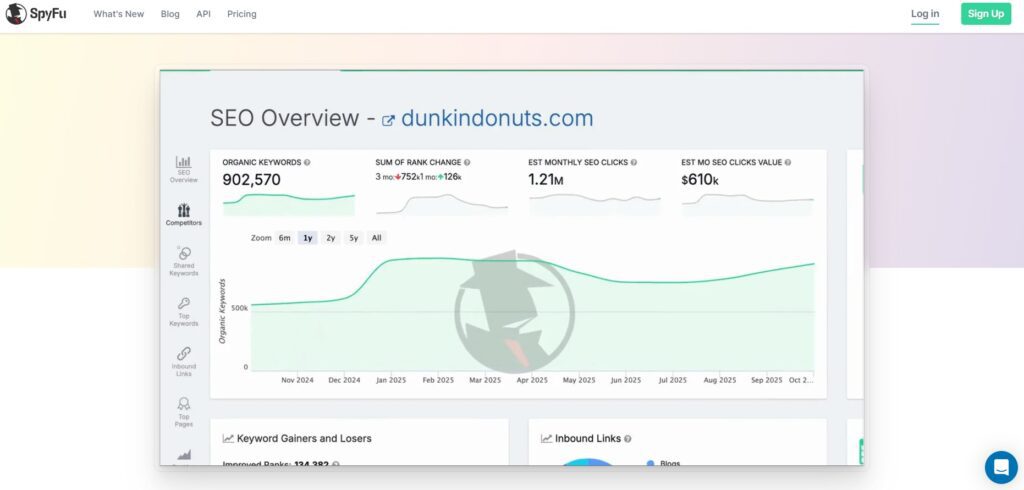
SpyFu is built around a question performance marketers ask often: what are competitors doing in Google search? It combines paid keyword research, ad history, organic rankings, competitor comparisons, and backlink research. That mix makes it particularly useful when SEO and Google Ads both play a part in your strategy.
Suppose you are planning a campaign for a software product. SpyFu can help you study search terms competing advertisers target, look at the messages they have used in ads, and find related organic keywords. You can then use that research to shape your landing page and campaign plan.
Why it’s strong
SpyFu’s historical data gives you more context than a snapshot of current rankings or ads. You can look at how a competitor’s search activity has developed and compare several domains for keyword opportunities. Its current plans also include site audits, tracked rankings, automated reports, and AI brand monitoring.
Key features
-
PPC keyword research: Helps identify the Google Ads keywords competing domains target.
-
Ad history: Lets you review past ad copy and campaigns, which can help with message and offer research.
-
Organic keyword research: Shows terms competing websites rank for in unpaid search results.
-
Kombat: Compares domains to find keywords that competitors share or that only one domain targets.
-
Ranking history: Shows how a domain or page has performed for a keyword over time.
-
Backlink research: Helps identify links connected to competing pages and topics.
-
Site Audit: Crawls a connected site for technical and on-page issues.
-
Reports and integrations: Includes automated reports, Google Search Console integration, and access to SpyFu data through its ChatGPT integration.
Pricing
-
Basic: $39 per month, or $29 per month with annual billing.
-
Pro + AI: $119 per month after a $59 first-month offer, or $89 per month with annual billing.
-
Team/Agency: $249 per month, or $187 per month with annual billing.
Best for
SpyFu is a useful choice for PPC specialists and SEO teams that want to study competitor keywords, ad messaging, and search history together.
6. Moz Pro
Moz Pro offers a structured approach to SEO research and site improvement. It brings together Keyword Explorer, Link Explorer, rank tracking, site crawling, on-page analysis, and competitor research. Its paid plans also include AI visibility dashboards and prompt tracking.
If you publish content each month, Moz can support the whole cycle. You can research a term before writing, check the pages already competing for it, monitor rankings after publication, and review technical issues that may affect your website.
Why it’s strong
Moz makes recurring SEO work easier to organize. Its Campaigns bring tracked websites and keywords together, while Site Crawl highlights issues that deserve attention. Domain Authority and Page Authority add familiar comparison points when you are researching links.
The AI features fit alongside that existing workflow. You can track prompts, review AI citations and sentiment, and use content briefs when planning new pages.
Key features
-
Keyword Explorer: Helps you find search terms and examine the results competing for them.
-
Link Explorer: Shows backlinks to domains and pages for link research.
-
Authority metrics: Provides Domain Authority and Page Authority for comparing link profiles.
-
Campaign tracking: Keeps a website, its competitors, and selected keywords together for ongoing review.
-
Site Crawl: Finds technical issues across the pages you monitor.
-
On-page analysis: Helps assess how well a page addresses a chosen keyword.
-
AI visibility dashboards: Tracks brand appearances across supported AI models.
-
AI content briefs: Helps turn keyword and prompt research into a content plan.
Pricing
-
Starter: $49 per month for individuals managing one website.
-
Standard: $99 per month, or $79 per month with annual billing.
-
Medium: $179 per month, or $143 per month with annual billing.
-
Large: $299 per month, or $239 per month with annual billing.
-
Enterprise: Custom pricing.
Standard includes three tracked sites, 300 tracked keywords, one AI visibility dashboard, and 50 tracked prompts. Higher tiers increase those allowances.
Best for
Moz Pro is a good match for small and mid-sized teams that want a clear SEO routine supported by keyword, link, technical, and AI visibility tools.
7. SE Ranking
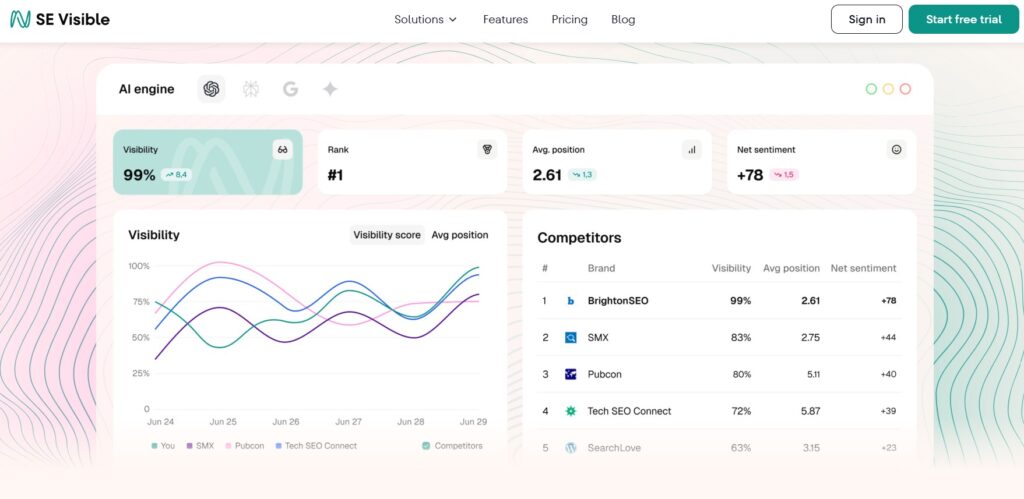
SE Ranking combines ongoing SEO work with AI-search tracking. It includes rank tracking, keyword and competitor research, backlink monitoring, website audits, on-page checks, integrations, and reporting. Its Core and Growth plans also include daily AI prompt tracking.
For an agency, that means you can set up client projects, monitor search terms, review site issues, and follow AI visibility without treating each task as an unrelated report. It also offers optional client-facing features through its Agency Pack.
Why it’s strong
SE Ranking gives teams clear project and tracking allowances. Core includes 10 projects, 2,000 daily tracked keywords, and 100 daily tracked AI prompts. Growth raises those to 30 projects, 5,000 keywords, and 250 prompts.
That makes it easier to compare plans against a real client roster or content calendar. Its research, audit, and integration features also support the daily work behind the numbers.
Key features
-
Rank tracking: Monitors selected terms so you can see how campaigns perform over time.
-
Keyword research: Helps find topics and search terms for new or updated pages.
-
Competitive research: Lets you examine competing domains and spot search opportunities.
-
Backlink monitoring: Tracks links to your website and helps you review changes.
-
Website Audit: Crawls site pages to identify technical issues.
-
On-page checker: Gives page-level information for improving a target URL.
-
AI prompt tracking: Follows selected questions across supported AI search experiences.
-
Reporting and integrations: Includes report building and connections to analytics tools; extra white-label features are available through the Agency Pack.
Pricing
-
Core: $129 per month, or $103.20 per month with annual billing.
-
Growth: $279 per month, or $223.20 per month with annual billing.
-
Enterprise: Custom pricing.
-
Agency Pack: From $69 per month with annual billing.
-
Additional AI Search capacity: From $89 per month, or $71.20 per month with annual billing.
The base Core and Growth plans already include AI prompt allowances. Additional AI Search capacity is an optional purchase. A 14-day trial is available for both plans.
Best for
SE Ranking suits agencies and growing marketing teams that need repeatable SEO research, daily tracking, audits, and reporting across multiple projects.
How to Choose the Right Tool
-
For AI-answer research: Pick Radarkit if prompts, competitor mentions, and citations are your main focus.
-
For broad SEO work: Pick Semrush if your team needs research, tracking, audits, content tools, and AI visibility together.
-
For links and organic competitors: Pick Ahrefs if you spend most of your time investigating pages and backlink profiles.
-
For an approachable starting point: Pick Ubersuggest if you manage a smaller number of sites and want clear keyword and content workflows.
-
For Google Ads research: Pick SpyFu if competitor keywords, ads, and historical activity guide your decisions.
-
For an organized SEO routine: Pick Moz Pro if campaigns, site checks, link research, and AI tracking suit your process.
-
For multiple ongoing projects: Pick SE Ranking if tracking capacity and client reporting are priorities.
Frequently Asked Questions
What is the best overall Similarweb alternative?
Semrush is a strong overall choice if you want a wide selection of SEO, competitor research, and AI-search tools. The answer changes with your main task. Ahrefs is particularly useful for organic and backlink research, SpyFu for Google Ads research, and Radarkit for visibility in AI answers.
Which Similarweb alternative is best for AI search?
Radarkit is the most focused AI-search tool in this list. It tracks selected prompts across multiple AI platforms and helps you study brand mentions and citations. Semrush, Ahrefs, Moz Pro, and SE Ranking also include AI features alongside their wider SEO tools.
Is there a free Similarweb alternative?
Semrush offers a limited Free plan, and Ahrefs provides limited free access for verified website owners. Trials are also available for some of the other tools. Check the included reports and usage limits if you expect to use a free option for regular work.
Which Similarweb alternative is best for agencies?
SE Ranking is a practical option for agencies that manage several projects and need daily tracking and reports. Semrush and Ahrefs may be better fits when clients need deeper research in the areas those platforms cover. Check user seats, exports, and client-facing report options before choosing.
Can a Similarweb alternative show exact competitor traffic?
Competitor traffic shown in third-party platforms is generally an estimate, not direct access to a company’s private analytics. These figures can help you compare patterns and identify opportunities. For precise visits and conversions on a website you own, use its first-party analytics.
Final Thoughts
The best Similarweb alternatives are not necessarily the ones with the longest feature lists. They are the ones that help you complete your most important research and marketing tasks.
Choose Radarkit for AI-answer visibility, Semrush for broad SEO work, Ahrefs for backlinks and organic research, Ubersuggest for a straightforward starting point, SpyFu for Google Ads intelligence, Moz Pro for an organized SEO routine, or SE Ranking for multi-project tracking and reporting.
Once you know which report or workflow you will use most often, the right choice becomes much clearer.