In this article, we will compare RadarKit vs Peec AI vs Profound to help you choose the right AI search visibility platform for your business.
So, without any further ado, let’s get started
Quick Decision
If you do not have time to read the entire RadarKit vs Peec AI vs Profound comparison, choose RadarKit.
RadarKit gives most SEO professionals, affiliate publishers, local businesses, content teams, and agencies the best value. It starts at $29 per month, tracks major AI platforms, includes local AI visibility monitoring across 50+ countries, and provides built-in agents to help with content, planning, outreach, and Reddit research.
Comparison Table: RadarKit vs Peec AI vs Profound
RadarKit stands out because it gives users more ways to act on their AI visibility data. Instead of only tracking where a brand appears, users can create content plans, optimize pages, find outreach opportunities, study Reddit discussions, and monitor local AI recommendations.
RadarKit Overview
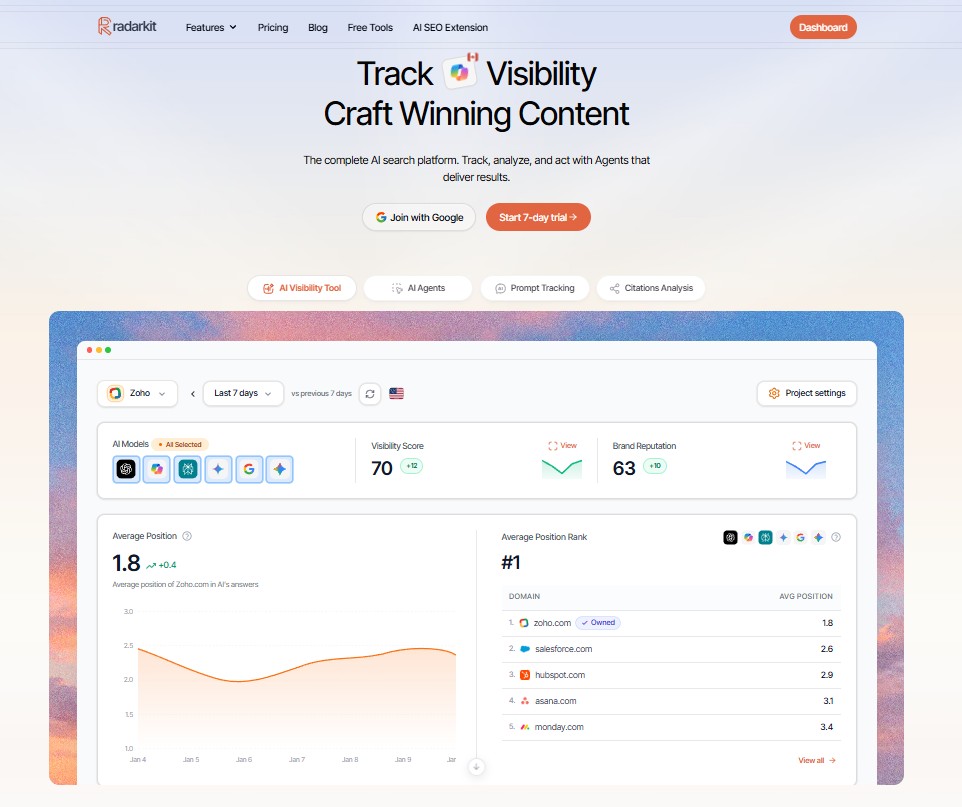
RadarKit is an AI search visibility platform that helps businesses monitor how they appear in AI-generated answers. It tracks brand mentions, recommendation positions, competitor performance, citations, content opportunities, and sentiment across major AI platforms.
The platform supports ChatGPT, Gemini, Perplexity, Microsoft Copilot, Google AI Mode, and Google AI Overviews. This gives users a broad view of how their brand appears in different AI search environments.
RadarKit is designed for marketers who want to move from data to action. It does not only show visibility numbers. It also helps users understand why competitors are being mentioned and what practical steps can improve their own visibility.
RadarKit’s Main Features
-
- Multi-platform tracking: RadarKit AI tracks visibility across ChatGPT, Gemini, Perplexity, Copilot, Google AI Mode, and Google AI Overviews.
- Citation analysis: Users can see which pages and websites AI systems cite for relevant prompts. This helps identify the content types, sources, and topics that influence AI answers.
- Competitor research: RadarKit AI compares your brand with competitors. It can show which competitors are mentioned most often, what prompts they appear for, and what sources help them earn visibility.
- Share of voice: This feature measures how frequently a brand appears compared with competitors across selected prompts.
- Local Radar: Local Radar checks whether AI platforms recommend a business for location-based searches. It supports tracking from more than 50+ countries using residential IPs.
- Query fanout tracking: AI platforms often break broad questions into related searches and subtopics. RadarKit AI helps users understand this wider question set and use it for content planning.
- AI traffic analytics: The platform tracks AI referral traffic so businesses can understand whether AI search visibility is sending visitors to their website.
- Google Search Console integration: Growth and higher plans can connect with Google Search Console. This helps users compare traditional Google search performance with AI visibility data.
- Content Agent: The Content Agent helps turn citation data, competitors, search intent, related questions, and NLP terms into content ideas and drafts.
- Outreach Agent: The Outreach Agent helps identify citation and authority opportunities. It can support outreach planning for media mentions, relevant websites, and content placements.
- Reddit Agent: The Reddit Agent helps users find relevant discussions where their brand, product category, or expertise can be helpful.
- Plan Agent: The Plan Agent turns research into a structured GEO action plan for the coming weeks or months.
These features make RadarKit useful for marketers who want a complete view of their AI search performance without using several separate tools.
RadarKit AI Agents
RadarKit includes four built-in agents: Plan Agent, Content Agent, Outreach Agent, and Reddit Agent.
The Plan Agent helps users turn AI visibility data into a clear list of next steps. It can identify prompt gaps, competitor opportunities, content improvements, and areas where a brand needs more visibility.
The Content Agent helps content teams create or update pages around tracked prompts. It can use citation insights, related questions, entities, and competitor data to guide content production.
For example, if a competitor is repeatedly mentioned for “best AI SEO tools,” the Content Agent can help you create a stronger comparison page, improve your product page, or expand related content on your website.
The Outreach Agent helps users find relevant backlink and digital PR opportunities. It can support outreach research, contact discovery, and email drafting through a connected Gmail workflow.
The Reddit Agent helps marketers find relevant Reddit discussions, customer questions, product comparisons, and competitor mentions. It is useful for understanding how people discuss your niche and finding ideas for better content.
RadarKit’s agent system is a major advantage for smaller teams. It helps users handle planning, content, outreach, and research from the same platform instead of moving between multiple tools.
RadarKit Local Radar
Local Radar is one of RadarKit’s strongest features.
It helps businesses track whether AI platforms recommend them for local searches. This is useful for businesses that depend on customers in specific cities, regions, or service areas.
For example, a business can track prompts such as:
-
Best dentist in Meerut
-
Top SEO agency in Delhi
-
Best divorce lawyer near me
-
Best dermatologist in Mumbai
-
Best restaurant in London
Local Radar helps users monitor local business appearance rate, recommendation positions, competing businesses, ratings, review counts, and location-based visibility across 50+ countries.
This makes RadarKit an excellent choice for:
-
Local SEO agencies
-
Dentists and healthcare providers
-
Lawyers and legal firms
-
Restaurants and hotels
-
Real estate businesses
-
Home service companies
-
Consultants
-
Multi-location brands
-
Service-area businesses
Peec AI and Profound can support broader country or regional tracking, but RadarKit is the better choice for businesses that need dedicated local AI recommendation monitoring.
Plans and Pricing
RadarKit offers four plans: Lite, Growth, Pro, and Enterprise. The Lite plan costs $29 per month and includes two projects, 15 tracked prompts, and updates every 72 hours. It is suitable for individual website owners, affiliate publishers, and users who want to test AI visibility tracking at a low cost.
The Growth plan costs $79 per month and includes five projects, 50 prompts, and daily tracking. This is the best starting plan for active SEO, GEO, and content campaigns because daily updates make it easier to track changes.
The Pro plan costs $139 per month and includes 10 projects, 100 prompts, daily tracking, more agent usage, additional seats, and a larger number of branded reports. It is a suitable choice for growing agencies and teams managing multiple brands.
The Enterprise plan has custom pricing. It is designed for larger agencies and enterprise companies that need unlimited projects, custom prompt limits, more locations, API access, SSO, custom reports, and dedicated support.
RadarKit also includes a 7-day free trial, making it easy to test the platform before committing to a paid plan.
Best For
RadarKit is best for solo SEO professionals, affiliate publishers, local businesses, local SEO agencies, SaaS startups, content teams, and small to mid-sized agencies. It is especially useful for users who want affordable AI search tracking and need practical tools to act on what they find. If you want to track visibility, create better content, study citations, research competitors, find outreach opportunities, and monitor local AI recommendations from one dashboard, RadarKit is the strongest choice.
Peec AI Overview
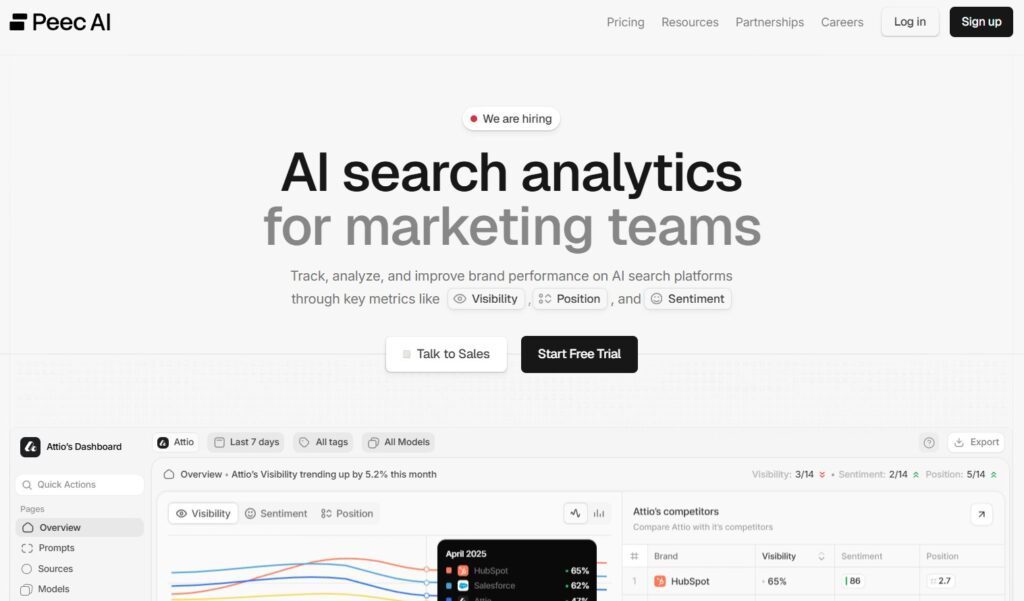
Peec AI is an AI search analytics platform for marketing teams and agencies. It helps businesses track how often their brand appears in AI answers, where it appears, how it is described, and which competitors receive more attention.
Its main focus is analytics. Peec AI tracks visibility, position, sentiment, competitors, prompts, citations, and sources. It is a good choice for teams that need to present AI search performance clearly to clients, executives, or internal stakeholders.
Peec AI is less focused on built-in outreach or local SEO workflows. Instead, it is built for teams that already have writers, PR specialists, SEO professionals, analysts, and reporting systems in place.
Peec AI’s Main Features
-
AI visibility tracking: Peec AI tracks whether a brand appears in AI answers for selected prompts.
-
Position tracking: It shows where your brand appears when AI platforms recommend multiple businesses or products.
-
Sentiment analysis: Users can study how AI systems describe their brand and the themes connected to those mentions.
-
Competitor comparisons: Peec AI allows users to compare visibility, position, sentiment, and citation performance with competitors.
-
Prompt tracking: Users can create prompt lists around product categories, use cases, alternatives, comparisons, services, and customer questions.
-
Prompt tags: Prompts can be grouped by category, audience, product, country, campaign, or stage of the customer journey.
-
Citation analysis: The platform helps users see which pages and domains influence AI answers.
-
Content opportunities: Citation and competitor data can help teams identify areas where they need better comparison content, stronger review profiles, editorial coverage, or more relevant community participation.
-
Country tracking: Peec AI supports country-level tracking for businesses that target more than one market.
-
Daily tracking: Paid plans refresh prompt data daily.
-
CSV exports: Users can export AI search data for custom reports and further analysis.
-
Looker Studio support: Higher plans support Looker Studio for reporting dashboards.
-
MCP integration: Peec AI can connect with tools such as Claude, Cursor, and n8n for reporting, analysis, and workflow automation.
-
Agency tools: It includes client projects, client seats, pitch projects, and agency workflow features.
Peec AI provides useful reporting data, but it does not offer the same ready-to-use content, outreach, Reddit research, or local tracking tools available in RadarKit.
Plans and Pricing
Peec AI offers four main plans: Starter, Pro, Advanced, and Enterprise. The Starter plan costs $95 per month and includes 50 prompts, one project, daily tracking, unlimited users, and a choice of three AI models. It is suitable for one brand that wants to monitor a focused set of important prompts.
The Pro plan costs $245 per month and includes 150 prompts, two projects, daily tracking, unlimited users, and tracking across up to three countries per project. It is better suited to growing marketing teams that manage several product categories or markets.
The Advanced plan costs $495 per month and includes 350 prompts, five projects, multi-country tracking, unlimited users, and Looker Studio support. It is designed for larger marketing teams and agencies that need stronger reporting options.
The Enterprise plan comes with custom pricing. It is built for businesses that need unlimited projects, custom prompt limits, broader AI model coverage, API access, SSO, advanced reports, and dedicated support.
A key point is that standard Peec AI plans include only three selected AI models. Businesses that need broader coverage may need to pay extra for more models or choose an Enterprise plan.
Best For
Peec AI is best for in-house marketing teams and agencies that need a clear reporting system for AI search performance. It is useful for businesses that already have established content, SEO, PR, and outreach teams but need better data to guide their work. Peec AI is also a good option for agencies that use Looker Studio, build custom client dashboards, manage client workspaces, and want MCP-based automation. However, users looking for a more affordable tool with local AI tracking and built-in content or outreach agents will likely get more value from RadarKit.
Profound Overview
Profound is an Answer Engine Optimization platform designed for larger brands and agencies. It helps businesses understand how they appear in AI search engines and how AI crawlers interact with their website.
The tool combines AI visibility tracking with prompt-volume research, citation analysis, technical AEO insights, AI traffic attribution, crawler analytics, ChatGPT Shopping tracking, and AI agent workflows.
Profound is more enterprise-focused than RadarKit and Peec AI. It is built for teams with larger AEO budgets, technical SEO resources, large content operations, and advanced reporting requirements.
Profound’s Main Features
-
Answer Engine Insights: Profound tracks AI visibility, citations, competitors, sentiment, and share of voice across answer engines.
-
FactCheck: This feature helps users identify potentially inaccurate AI claims about their brand and understand the sources behind them.
-
Prompt Volumes: Profound provides prompt-volume information that can help teams find important AI search questions and prioritize content topics.
-
Content gap analysis: Users can identify prompts where competitors receive more citations or better visibility.
-
Trend monitoring: Teams can study changes in AI search demand and emerging content opportunities.
-
Agent Analytics: Profound tracks AI crawlers that visit a website and helps users understand what pages are being accessed.
-
AI traffic attribution: It can help identify AI platforms that send visitors to a website and show whether that traffic leads to valuable actions.
-
Technical AEO insights: Profound can help teams identify issues related to rendering, structured data, website accessibility, and page performance.
-
ChatGPT Shopping tracking: Ecommerce brands can monitor how products appear in ChatGPT Shopping experiences.
-
AI agents: Profound includes agent templates, content workflows, a custom agent builder, and Profound Sheets for larger content projects.
-
Enterprise controls: The platform supports API access, SSO, user roles, permissions, and enterprise-level support.
Profound has advanced capabilities, but many smaller businesses may not need this level of technical detail. RadarKit is easier to adopt for teams that need clear AI visibility insights and practical marketing workflows without the higher cost.
Profound Plans and Pricing
Profound offers Starter, Growth, and Enterprise plans. The Starter plan costs $99 per month and includes 50 prompts, 1,500 monthly responses, ChatGPT tracking, daily updates, one user seat, one region, one language, email support, and 100 monthly agent credits. It is suitable for small companies that want to test basic AEO tracking.
The Growth plan costs $399 per month and includes 100 prompts, 9,000 monthly responses, ChatGPT, Perplexity, and Google AI Overviews tracking, daily updates, three user seats, prompt-volume access, Agent Analytics, CSV and JSON exports, and 400 monthly agent credits. This plan is aimed at growing brands and larger AEO teams.
The Enterprise plan has custom pricing and includes access to more answer engines, custom prompt limits, multiple companies, custom regions and languages, API access, SSO, SAML, dedicated support, and custom agent usage.
Profound provides powerful enterprise features, but its Growth plan costs considerably more than RadarKit Pro. Businesses should choose Profound only if they will actively use advanced features such as AI crawler analytics, prompt volumes, technical AEO insights, and large-scale content workflows.
Best For
Profound is best for enterprise brands, larger SaaS companies, ecommerce companies, well-funded agencies, and businesses with technical SEO teams. It is a strong choice for organizations that need AI crawler monitoring, AI traffic attribution, advanced AEO content research, ChatGPT Shopping tracking, technical analysis, and custom workflow controls. For most smaller marketing teams, RadarKit remains the better fit because it offers a more affordable and easier-to-use platform with broader standard model coverage, local AI visibility tracking, and action-focused agents.
RadarKit vs Peec AI vs Profound: Feature-by-Feature Comparison
AI Models and Search Engine Coverage
RadarKit includes ChatGPT, Gemini, Perplexity, Copilot, Google AI Mode, and Google AI Overviews across its plans. This gives users broad coverage without needing to select only a few models.
Peec AI supports the main AI search platforms, but standard plans include a choice of three models. Users who need wider coverage may need to pay extra.
Profound’s Starter plan focuses on ChatGPT. Its Growth plan expands coverage to ChatGPT, Perplexity, and Google AI Overviews. Broader answer engine coverage is available through Enterprise plans.
RadarKit is the best choice for users who want major AI platform coverage from the beginning. Peec AI is suitable for teams that only need a few selected models. Profound is more suitable for enterprise users with custom platform requirements.
AI Visibility, Brand Mentions, and Sentiment
RadarKit, Peec AI, and Profound all track the key metrics needed for AI search monitoring:
-
Brand mentions.
-
Visibility or share of voice.
-
Recommendation positions.
-
Competitor appearances.
-
Sentiment.
-
Citation patterns.
-
Historical changes.
Peec AI is particularly focused on visibility, position, and sentiment reporting. Profound adds enterprise-level tools such as FactCheck and advanced answer engine insights.
RadarKit offers the best balance because it combines these important measurement features with agents that help users take action. A marketer can identify a gap, create content, plan outreach, research communities, and monitor progress without depending on multiple separate platforms.
Citation Analysis and Content Opportunities
All three tools provide citation analysis, but the workflow is different.
RadarKit helps users study cited sources, content types, competitor patterns, and related prompt opportunities. Its Content Agent helps convert those findings into content work.
Peec AI helps teams find sources that influence AI answers and use that information for content planning, review management, PR, and reporting.
Profound adds prompt-volume intelligence, content gap analysis, FactCheck, agent templates, and large-scale AI content workflows. This makes it useful for enterprise content teams.
RadarKit is the best option for day-to-day SEO and content work. It is easier for a smaller team to identify an opportunity and immediately start working on it. Profound is stronger for large-scale enterprise AEO content programs, while Peec AI is better for reporting-focused teams.
Local SEO and Local AI Search Tracking
RadarKit is the clear winner for local SEO.
Its Local Radar feature helps businesses understand whether AI platforms recommend them for local searches. It can show appearance rate, recommendation position, competing businesses, ratings, reviews, and local prompt visibility.
Peec AI supports country-level tracking, which is useful for international brands. Profound supports more advanced regional options at Enterprise level. However, neither tool has a dedicated local recommendation product similar to RadarKit Local Radar.
If you work with local businesses such as dentists, lawyers, clinics, restaurants, real estate companies, or service providers, RadarKit is the best choice.
AI Agents, Content, Outreach, and Community Workflows
RadarKit provides native Plan, Content, Outreach, and Reddit Agents. These tools help users turn data into practical work inside the platform.
Peec AI focuses more on reporting and analytics. Its MCP integration is useful for teams that want to connect data with other tools and existing workflows.
Profound provides advanced agent capabilities, including templates, custom agent building, content workflows, and Profound Sheets. These tools are useful for large content teams but may require more setup and a larger budget.
RadarKit is the better choice for marketers who want ready-to-use action tools. Peec AI is useful for teams with existing automation systems. Profound is best for enterprises building custom AEO workflows at scale.
AI Crawler Analytics and Technical AEO
Profound has the strongest feature set for AI crawler analytics and technical AEO.
Its Agent Analytics feature helps users understand which AI crawlers visit their website, what pages they access, and how AI-related traffic may lead to visits or conversions. It also supports technical analysis around website accessibility and AI crawler readiness.
RadarKit and Peec AI focus more on AI answer visibility, competitors, citations, content opportunities, and reporting.
Choose Profound if AI crawler activity, AI traffic attribution, and technical AEO are major priorities. Choose RadarKit if you want a more practical marketing platform at a lower price.
Reporting, Dashboards, and Integrations
RadarKit supports Google Search Console, Google Analytics, WordPress, Gmail-based outreach workflows, branded PDF reports, Client Portal access, and Enterprise API access.
Peec AI supports CSV exports, Looker Studio, client workspaces, pitch projects, MCP, and Enterprise API or SSO access.
Profound supports CSV and JSON exports, enterprise API access, technical integrations, and advanced enterprise controls.
Peec AI is a good choice for agencies that rely heavily on Looker Studio and custom dashboards. Profound is suitable for enterprise reporting and technical integrations. RadarKit is the best option for marketers who need straightforward client reporting, useful SEO integrations, and action tools in one place.
RadarKit vs Peec AI vs Profound Pricing
RadarKit is the most budget-friendly option. Peec AI costs more because it focuses on analytics, reporting, and agency workflows. Profound becomes the most expensive choice once users move beyond the Starter plan.
RadarKit Pricing
RadarKit offers the best starting price and includes broad AI platform coverage, Local Radar, useful agents, reports, and important SEO integrations.
Peec AI Pricing
Profound Pricing
Which Tool Offers Better Value for Money?
-
Best low-cost option: RadarKit.
-
Best overall value for most SEO users: RadarKit.
-
Best for local AI visibility: RadarKit.
-
Best for content planning and outreach support: RadarKit.
-
Best for agency reporting and Looker Studio: Peec AI.
-
Best for MCP-based automation: Peec AI.
-
Best for AI crawler analytics: Profound.
-
Best for prompt-volume research: Profound.
-
Best for enterprise AEO campaigns: Profound.
RadarKit vs Peec AI vs Profound: Pros and Cons
RadarKit Pros and Cons
Pros
-
Starts at only $29 per month.
-
Covers six major AI search platforms.
-
Includes Local Radar for local AI search visibility.
-
Offers Plan, Content, Outreach, and Reddit Agents.
-
Supports Google Search Console, Google Analytics, WordPress, and Gmail.
-
Includes branded PDF reports and Client Portal access.
-
Suitable for local businesses, affiliate publishers, content teams, and agencies.
-
Gives users practical ways to improve AI visibility.
Cons
-
Lite plan updates every 72 hours instead of daily.
-
Lower plans have smaller prompt limits.
-
API and SSO are Enterprise features.
-
Agent allowances should be reviewed before choosing a plan.
Peec AI Pros and Cons
Pros
-
Strong visibility, position, sentiment, competitor, and citation analytics.
-
Daily tracking on paid plans.
-
Unlimited users on standard brand plans.
-
Supports client workspaces and agency pitch projects.
-
Includes Looker Studio support on higher plans.
-
MCP can support custom automation workflows.
-
Useful for reporting-focused marketing teams.
Cons
-
Higher starting price than RadarKit.
-
Standard plans include only three selected AI models.
-
Additional model coverage may increase costs.
-
No dedicated Local Radar feature.
-
No native outreach or Reddit research agent.
-
API and SSO require Enterprise.
Profound Pros and Cons
Pros
-
Advanced enterprise AEO platform.
-
Includes AI visibility, citations, sentiment, competitor tracking, and FactCheck.
-
Offers prompt-volume intelligence.
-
Includes AI crawler and AI traffic analytics.
-
Supports ChatGPT Shopping tracking.
-
Provides AI agents, templates, custom workflows, and Profound Sheets.
-
Includes advanced enterprise controls such as SSO and API access.
-
Suitable for large AEO content programs.
Cons
-
Growth pricing is much higher than RadarKit and Peec AI.
-
Starter plan only tracks ChatGPT.
-
Broader platform coverage requires higher-level plans.
-
Better suited to organizations with bigger budgets and dedicated teams.
-
Advanced technical features may be unnecessary for smaller businesses.
Who Should Choose RadarKit?
RadarKit is the best choice for solo SEO professionals, affiliate publishers, local businesses, SaaS startups, content marketers, and small to mid-sized agencies. It is ideal for users who want AI visibility tracking without paying enterprise-level prices. It is also the strongest option for local SEO because Local Radar helps businesses track city-based and “near me” AI recommendations. If you want one platform for AI tracking, content planning, citation research, outreach, Reddit research, reporting, and local visibility, RadarKit offers the most complete package.
Who Should Choose Peec AI?
Peec AI is best for in-house marketing teams and agencies that need a data-focused AI search reporting platform. It works well for teams that manage client dashboards, use Looker Studio, export data regularly, and already have separate content, PR, SEO, and outreach processes. Peec AI is also useful for teams that want to connect AI visibility data with Claude, Cursor, n8n, or another MCP-compatible workflow. It is a good analytics platform, but it is less suitable than RadarKit for users who want built-in local tracking and direct action tools.
Who Should Choose Profound?
Profound is best for enterprise brands, larger SaaS companies, ecommerce companies, large agencies, and businesses with technical SEO teams. It is suitable for organizations that need AI crawler analytics, AI traffic attribution, prompt-volume research, ChatGPT Shopping tracking, advanced AEO content workflows, and custom enterprise controls. Profound can be a valuable platform for large-scale AEO programs, but smaller teams may find RadarKit more affordable, easier to use, and better suited to practical day-to-day SEO and GEO work.
Final Verdict: Is RadarKit, Peec AI, or Profound Better?
RadarKit is the best overall choice for most users.
It is more affordable than Peec AI and Profound, includes broad AI model coverage, provides Local Radar, and offers built-in agents for content, planning, outreach, and Reddit research. This gives users a clear path from tracking AI visibility to improving it.
Peec AI is a useful choice for teams that need reporting, client workspaces, Looker Studio, and MCP-based automation. Profound is a powerful enterprise AEO platform for teams that need AI crawler analytics, technical insights, prompt-volume data, and advanced workflows.
However, when comparing price, AI platform coverage, local SEO support, ease of use, and practical marketing features, RadarKit offers the best overall value.
FAQs
Is RadarKit cheaper than Peec AI and Profound?
Yes. RadarKit starts at $29 per month. Peec AI starts at $95 per month, while Profound starts at $99 per month.
Which tool is best for local SEO?
RadarKit is the best option for local SEO because it includes Local Radar. This feature helps businesses track whether AI platforms recommend them for local and city-based searches.
Which tool is best for AI search reporting?
Peec AI is a strong choice for reporting because it supports CSV exports, agency workspaces, client projects, Looker Studio, and MCP-based workflows. Profound is also suitable for enterprise reporting.
Which tool tracks AI crawlers?
Profound tracks AI crawlers through its Agent Analytics feature. It helps users understand which AI systems visit their website and how AI traffic interacts with their pages.
Which tool is best for content optimization?
RadarKit is the best choice for smaller teams that want built-in content optimization support. Its Content Agent helps users turn AI visibility and citation insights into practical content work. Profound is better suited to large enterprise teams that need custom agent workflows and large-scale AEO content operations.