In this article, we compare RadarKit vs Promptwatch vs Searchable to see which AI visibility and AEO platform is the best choice for your 2026 strategy.
We’ll look at their AI search tracking, citation intelligence, competitor monitoring, local visibility, technical SEO capabilities, content workflows, integrations, pricing, and overall value.
So, without any further ado, let’s get started.
RadarKit vs Promptwatch vs Searchable: Quick Verdict
- Choose RadarKit if you want an affordable GEO tracker with strong citation intelligence, local AI recommendation monitoring, content and outreach workflows, and agency-friendly reporting.
- Choose Promptwatch if you need AI visibility monitoring plus technical AI crawler analytics from Cloudflare or server logs. It is a good fit for technical SEO teams that want to understand whether AI bots can reach, fetch, and access important pages.
- Choose Searchable if you need an all-in-one AEO platform for visibility tracking, site audits, content optimization, integrations, and multi-project management.
For most marketers, publishers, consultants, and growing agencies, RadarKit is the best overall choice in this RadarKit vs Promptwatch vs Searchable comparison.
It covers the core GEO workflow without forcing teams into a high starting price. You can track AI visibility, study citations, identify competitors, monitor local AI recommendations, plan content, and create client-ready reports from one platform.
RadarKit vs Promptwatch vs Searchable Comparison Table
AI model and answer-engine coverage
AI search is not one channel. ChatGPT, Google AI Overviews, Google AI Mode, Perplexity, Gemini, Copilot, Claude, Grok, DeepSeek, and other tools can produce different answers for the same query.
For this RadarKit vs Promptwatch vs Searchable comparison, model coverage matters because brands need to track the platforms their actual customers use. RadarKit tracks six major AI-search environments, including ChatGPT, Google AI Mode, Google AI Overviews, Microsoft Copilot, Gemini, and Perplexity.
Promptwatch lists a broader menu of supported platforms, including ChatGPT, Perplexity, Google AI Overviews, Google AI Mode, Claude, Gemini, Meta Llama, DeepSeek, Grok, OpenCode, and Claude Code. Searchable lists coverage across ChatGPT, Claude, Perplexity, Google AI Overviews, Copilot, Gemini, Grok, and DeepSeek.
Prompt tracking frequency and limits
Prompt capacity affects the depth of your GEO campaign. A small brand may only need 15 high-intent prompts, while an agency may need hundreds of prompts across clients, categories, locations, competitors, and funnel stages.
RadarKit starts with 15 prompts on its Lite plan and refreshes them every 72 hours. Its Growth and Pro plans offer daily tracking with 50 and 100 prompts. Promptwatch starts with 50 prompts and daily tracking, while Searchable starts with 100 prompts on its Professional plan.
Brand visibility, sentiment, and competitor tracking
AI visibility tracking should answer more than one question. It should show whether a brand appears, where it appears in the answer, how competitors are positioned, which sources are cited, and whether the model presents the brand positively and accurately.
RadarKit, Promptwatch, and Searchable all offer some combination of brand mentions, competitors, visibility scores, sentiment, and source analysis. RadarKit puts particular attention on comparing brands in AI responses, citation share, source patterns, recommendation positions, and local competitors.
Citation, source, and query-fanout intelligence
Citation research is one of the most useful parts of a GEO campaign. If AI tools regularly cite a specific review site, industry publication, Reddit discussion, product guide, video, comparison article, or documentation page, that information can shape a more useful content and outreach plan.
RadarKit supports citation intelligence, cited URL analysis, content-type analysis, and query fanout capture. Promptwatch also tracks cited sources, off-site mentions, Reddit influence, YouTube citations, content gaps, and competitor source patterns. Searchable combines citation data, sources, topics, fanout queries, sentiment, and accuracy signals in its AEO Insights area.
Content workflows and publishing capabilities
AI-search visibility data is valuable only when it leads to action. A useful platform should make it easier to create a comparison page, improve a product landing page, expand a guide, fix a missing FAQ, update documentation, or plan outreach.
RadarKit includes Content, Outreach, Reddit, Chat, and Plan agents. Promptwatch includes agents, a knowledge base, content workflows, and CMS publishing options. Searchable includes AI-focused content generation for blog posts, landing pages, and technical documentation.
Technical SEO and AI crawler visibility
Technical SEO affects whether AI crawlers can access a website. Problems with robots.txt, rendering, status codes, CDN settings, authentication walls, redirects, or slow pages can limit discovery and indexing.
Promptwatch is the strongest technical choice in the RadarKit vs Promptwatch vs Searchable comparison because it includes crawler-log monitoring. It can use Cloudflare data to show AI-bot requests, URLs, timestamps, status codes, and user-agent information. Searchable also supports AI-readability audits and technical recommendations, while RadarKit is more focused on answer-side visibility and market intelligence.
Local, ecommerce, and geographic tracking
Location can change AI-generated recommendations. A person asking for “best dentist near me” or “best accounting firm in London” may receive a different answer based on country, city, language, and search conditions.
RadarKit’s Local Radar is designed specifically for this type of monitoring. It can show whether a business appears in AI answers, its recommendation position, competitors, ratings, review counts, and appearance rates across location-specific environments. Promptwatch includes country, state, and city tracking at higher tiers, while Searchable provides geographic visibility and country-level trends.
Integrations, reporting, and API access
Integrations matter when AI-search data needs to move into existing marketing, analytics, reporting, content, or client-management workflows.
RadarKit includes Google Analytics, Google Search Console, WordPress, branded PDF reports, historical data, and client portal functionality. Promptwatch includes API, MCP, Data Studio, CMS integrations, and Cloudflare connectivity. Searchable supports integrations with GA4, Search Console, Linear, Slack, HubSpot, Salesforce, Webflow, WordPress, and Framer.
Pricing, scalability, and overall value
Pricing should be considered alongside prompt capacity, projects, refresh frequency, reporting needs, and the features your team will use regularly. A platform with more features is not always better if those features do not match your workflow.
RadarKit offers the lowest starting price at $29 per month. Promptwatch starts at $95 per month, while Searchable starts at $125 per month. Searchable offers more prompt capacity at entry level, but RadarKit provides a more accessible way to begin structured AI visibility tracking, citation research, and local GEO monitoring
RadarKit Overview
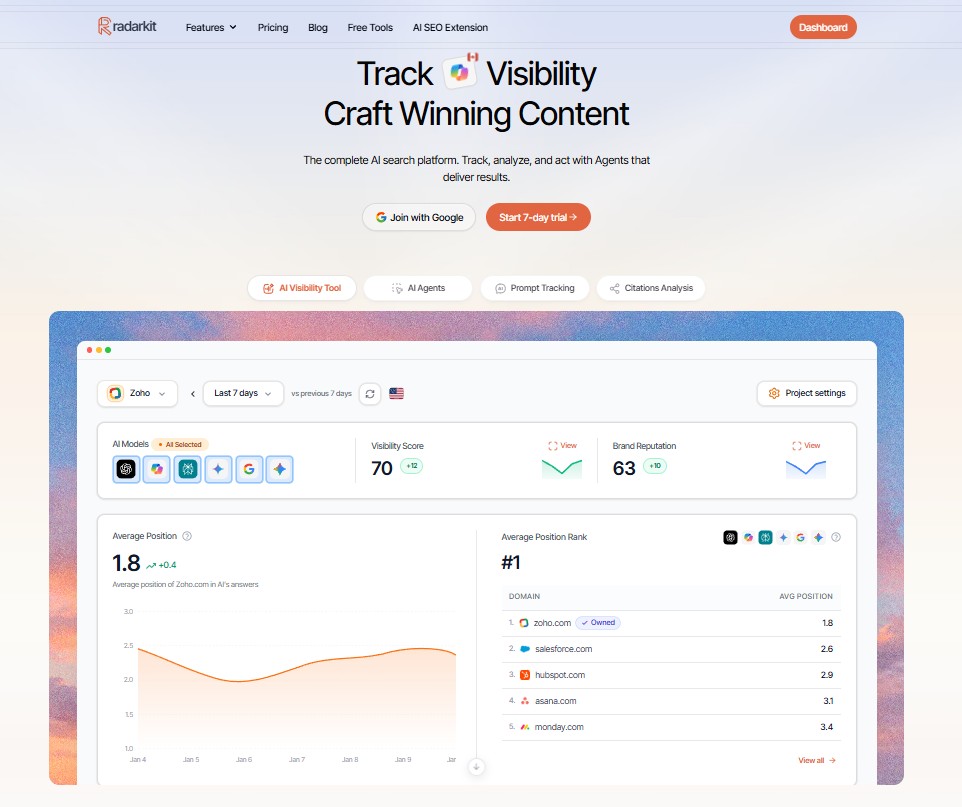
RadarKit is an AI-search visibility platform for brands, agencies, SaaS companies, local businesses, publishers, and content marketers. It helps users track how often a brand is mentioned, recommended, ranked, or cited in AI-generated answers.
The platform tracks selected prompts across major AI search environments. It can show brand mentions, competitors, citation sources, recommendation positions, sentiment, content types, local visibility, and related search opportunities.
RadarKit works well for teams that want to connect AI visibility data with content creation, citation research, outreach, local SEO, and agency reporting.
RadarKit Standout Features
-
Multi-model AI visibility tracking: RadarKit tracks selected prompts across ChatGPT, Google AI Mode, Google AI Overviews, Microsoft Copilot, Gemini, and Perplexity. It helps users see whether their brand is mentioned, how often it appears, where it appears in the answer, and which competitors receive stronger recommendations.
-
Live-interface answer monitoring: RadarKit runs prompts through live AI interfaces. This makes it useful for capturing visible answer content, cited sources, search-driven results, answer layouts, and location-specific variations.
-
Brand mention tracking: Users can monitor whether a brand appears in AI-generated answers for category, commercial, local, comparison, feature, reputation, and alternatives-related prompts.
-
Recommendation position tracking: RadarKit can show where a brand appears in an AI response. Being listed first in a recommendation list can create more visibility than being included at the bottom of a long answer.
-
Competitor tracking: The platform lets users compare their brand against selected competitors across the same prompt set. This helps reveal who AI engines recommend when your brand is not included.
-
Citation intelligence: RadarKit shows the websites and URLs cited in AI answers. Users can identify which pages influence recommendations and use that information to improve their content strategy.
-
Citation share analysis: This feature helps users understand which domains receive the most citations across tracked prompts. It can highlight influential publishers, review sites, forums, documentation pages, and competitor websites.
-
Content-type analysis: RadarKit can show the formats AI systems cite most often, including listicles, product pages, guides, reviews, forums, social discussions, videos, and documentation.
-
Query fanout capture: Query fanout helps users discover related questions and follow-up searches connected to a primary prompt. This can support better FAQ sections, topic clusters, comparison content, product pages, and content briefs.
-
Local Radar: Local Radar is RadarKit’s most distinctive capability. It is built for businesses that want to monitor AI-generated local recommendations across cities, regions, and countries.
-
Local appearance rate: Local Radar can show how often a business appears in AI answers for a local search. This is useful when a company wants to track visibility for terms such as “best dentist near me” or “best accounting firm in London.”
-
Local recommendation position: The feature can show a business’s position in local AI answers. It helps users understand whether they appear as a leading recommendation or a lower-priority option.
-
Local competitor analysis: RadarKit can identify which businesses appear alongside or instead of the tracked business. This gives local SEO teams a clearer view of their real AI-search competitors.
-
Location-specific tracking: The platform supports location-based monitoring across more than 50 countries. This is useful for multi-location businesses, international companies, and agencies serving clients in different markets.
-
Content Agent: RadarKit’s Content Agent helps users turn citation data, competitor gaps, search patterns, and AI visibility opportunities into content ideas and optimization work.
-
Outreach Agent: The Outreach Agent can help teams build an outreach workflow from citation data. If certain publishers, review websites, or industry resources appear frequently in AI answers, users can evaluate whether those sources are relevant for digital PR or earned visibility.
-
Reddit Agent: RadarKit includes a Reddit-focused agent to help users research community discussions and relevant conversation topics. This is useful because Reddit often appears in AI-generated recommendation answers.
-
Chat and Plan Agents: These features allow users to explore data, create plans, discuss opportunities, and build a practical GEO roadmap inside the platform.
-
Google Analytics and Search Console integration: RadarKit can connect visibility data with website performance. This helps teams compare AI visibility trends with referral traffic, search performance, conversions, and branded search activity.
-
WordPress integration: The WordPress connection helps content teams move from AI-search research to content creation and publishing more efficiently.
-
Branded PDF reports and client portal: RadarKit includes agency-ready reporting features. Consultants can share historical data, visibility updates, citation insights, and local performance with clients through branded reports and a client portal.
Who Should Use RadarKit?
RadarKit is a strong choice for:
-
SEO consultants offering GEO services
-
Digital marketing agencies managing several clients
-
SaaS teams tracking commercial and comparison prompts
-
Affiliate publishers creating reviews and alternative content
-
Local businesses monitoring AI recommendations
-
Content teams researching citations and source formats
-
Agencies that need branded PDF reports and client access
RadarKit Pros and Cons
Radarkit Plan and Pricing
| RadarKit Plan | Monthly Price | Projects | Prompts | Tracking Frequency |
|---|---|---|---|---|
| Lite | $29 | 2 | 15 | Every 72 hours |
| Growth | $79 | 5 | 50 | Daily |
| Pro | $139 | 10 | 100 | Daily |
| Enterprise | Custom | Unlimited | Custom | Daily or weekly |
Promptwatch Overview
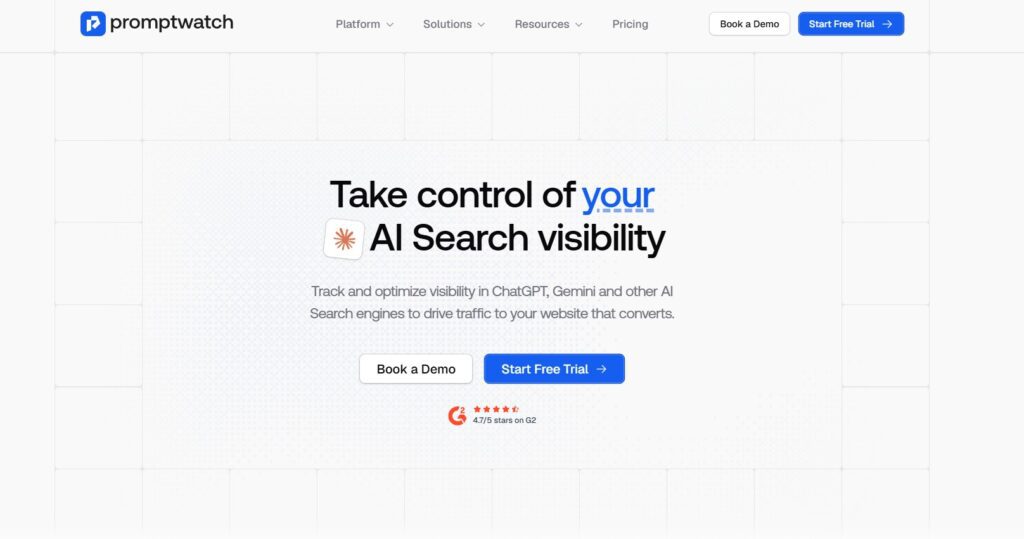
Promptwatch is an AI-search optimization platform that combines answer-side tracking with technical crawler monitoring. It helps users see whether brands appear in AI answers, which sources are cited, how competitors perform, and whether AI crawlers can access their websites.
Its main difference in the RadarKit vs Promptwatch vs Searchable comparison is Agent Analytics. This feature connects AI visibility work with Cloudflare or server-level data to show AI-bot visits and page access patterns.
Promptwatch also includes content gaps, sentiment, entity tracking, knowledge-base capabilities, content agents, CMS publishing workflows, reporting, API access, and MCP support. It is well suited to teams that want a technical and operational approach to AI search.
Promptwatch Standout Features
Promptwatch offers a broad collection of AI-search optimization capabilities:
-
Multi-model AI answer tracking across a wide menu of platforms
-
Brand visibility, sentiment, entity monitoring, and competitor comparison
-
Citation tracking for domains, URLs, content formats, Reddit, YouTube, and third-party mentions
-
Content-gap analysis based on existing content and AI-answer patterns
-
Knowledge base functionality for grounding content and agent output
-
Content agents and approval-based CMS publishing workflows
-
Agent Analytics for AI crawler-log monitoring
-
Cloudflare Logpush and Worker connection options
-
Country, state, city, shopping, and ad-focused insights on higher plans
-
API, MCP, Data Studio, and custom reporting support
Promptwatch’s crawler analytics can help technical teams identify whether AI bots reach key URLs and whether pages return successful status codes. This makes it useful for reviewing crawlability after migrations, CDN changes, robots.txt updates, rendering changes, or other technical work.
Who Should Use Promptwatch?
Promptwatch is a good fit for:
-
Technical SEO teams
-
Enterprise SEO teams with Cloudflare infrastructure
-
SaaS businesses with large documentation or content libraries
-
Agencies offering technical GEO and AI-search optimization services
-
Teams that need to connect prompt monitoring with crawler-access data
-
Ecommerce brands interested in shopping and local AI-search insights
-
Companies that want CMS publishing workflows and content agents
Promptwatch is particularly useful when a team needs more than a visibility dashboard. If a brand is absent from AI answers, the team can review citations, content gaps, technical accessibility, and crawler patterns before deciding what to improve.
Promptwatch Pros and Cons
Promptwatch is a capable choice for technical teams. However, marketers who mainly need citations, local AI recommendations, competitor analysis, content planning, and client reporting may find RadarKit easier to adopt and more cost-efficient at the start.
Promptwatch Plan and Pricing
Promptwatch Essential includes daily tracking, four selected models, Agent Chat, MCP, and API access. Professional adds the Knowledge Base and Agent Analytics features. Business adds country, state, city, Shopping Insights, Ads Radar, and more agentic optimization capacity.
Searchable Overview

Searchable is an AEO-focused performance marketing platform. It combines AI visibility tracking, citation analysis, competitor benchmarking, site auditing, content optimization, alerts, analytics, and workflow integrations.
In this RadarKit vs Promptwatch vs Searchable comparison, Searchable is best known for its AEO Insights area and AI-readability auditing. It helps teams assess how a site can become easier for AI systems to understand, quote, and potentially cite.
Searchable is designed for brands that want to connect AI-search visibility data with content creation, technical audits, marketing tools, and conversion-focused workflows. It is especially relevant for growing in-house teams and agencies managing many client projects.
Searchable Standout Features
Searchable provides a complete AEO and content workflow:
-
Competitor benchmarking and share-of-voice analysis
-
Brand mention, citation, sentiment, and accuracy monitoring
-
AEO Insights for topics, sources, fanout, location data, and citation trends
-
Site auditor for AI readability, schema, content structure, and crawlability opportunities
-
SEO and AEO content generation for blogs, landing pages, and technical documents
-
Real-time alerts for mentions, ranking changes, and competitor activity
-
Integrations with GA4, Search Console, Linear, Slack, HubSpot, Salesforce, Webflow, WordPress, and Framer
-
API and MCP options for advanced reporting and automation
-
Unlimited projects on paid plans
Searchable’s site auditor is one of its most useful capabilities. It can help identify pages that need clearer answers, stronger structure, better schema, improved crawlability, or more complete topical coverage.
Who Should Use Searchable?
Searchable is a good fit for:
-
In-house AEO and content marketing teams
-
Agencies managing multiple client brands and domains
-
SaaS companies with many landing pages, comparison pages, and documentation assets
-
Teams that need AI visibility data alongside content optimization recommendations
-
Marketers using CRM, analytics, project-management, and CMS tools
-
Businesses that want unlimited project access on paid plans
-
Teams with large prompt sets and audit requirements
Searchable is a practical option for organizations that want content and audit functionality within the same platform. A team can identify a visibility gap, audit the related page, create content recommendations, assign work through an existing workflow, and monitor progress over time.
Searchable Pros and Cons
Searchable is a strong AEO platform for larger content operations. For a marketer whose priority is cost-efficient GEO monitoring, citation intelligence, local recommendations, and client reporting, RadarKit remains the more focused choice.
Searchable Plan and Pricing
Searchable Professional is positioned for growing in-house teams and smaller agencies. It includes 100 prompts, 20 articles per month, 200 page audits, alerts, analytics, and workflow support.
Searchable Scale is intended for teams that need higher prompt capacity, greater content output, more audits, multi-country tracking, and more advanced support.
Feature Comparison: RadarKit vs Promptwatch vs Searchable
AI Search Engine Coverage
RadarKit tracks six major answer engines: ChatGPT, Google AI Mode, Google AI Overviews, Microsoft Copilot, Gemini, and Perplexity. This covers the platforms that matter most for many brands, publishers, and agencies.
Promptwatch lists the widest menu of AI platforms, while Searchable also tracks a broad set of AI answer engines. Before choosing either Promptwatch or Searchable, confirm which models are included in your selected plan and whether model selection limits apply.
AI Visibility and Competitor Analysis
All three tools help users track brand appearances, competitor mentions, and visibility trends. RadarKit provides an effective balance of mention tracking, position data, sentiment, citations, and competitor comparisons.
Promptwatch adds entity tracking and detailed content-gap workflows. Searchable focuses on share of voice, sentiment, accuracy, competitor activity, and consolidated AEO Insights reporting.
For a practical RadarKit vs Promptwatch vs Searchable decision, RadarKit is often enough for teams that want to know where they appear, who is replacing them, and which content opportunities deserve attention.
Citation Intelligence and Source Research
RadarKit is particularly strong for citation research. It helps users analyze cited domains, individual URLs, citation share, source formats, source rankings, and related queries.
This is valuable for affiliate publishers, comparison-content teams, and SaaS marketers. If AI tools repeatedly cite listicles, reviews, documentation, Reddit discussions, editorial guides, or videos in your category, RadarKit can help turn those findings into a realistic content roadmap.
Promptwatch and Searchable also provide citation analysis, but RadarKit offers a cleaner starting point for teams that want to make citation research a core part of their GEO workflow.
Local AI Search Visibility
RadarKit wins this category because Local Radar is designed specifically around AI-powered local recommendations. It can show whether a business appears in responses, how often it is recommended, where it ranks, and which competitors appear instead.
Promptwatch offers local tracking on its Business plan. Searchable includes location-based visibility trends and geographic tracking. Both are useful, but RadarKit gives local AI recommendation tracking a more central role in its platform.
A local agency could use RadarKit to monitor prompts such as “best dentist in Mumbai,” “best lawyer in Meerut,” or “best digital marketing agency in Delhi.” The data can then support local landing pages, review strategies, Google Business Profile improvements, local citations, and service-page updates.
AI Crawler Analytics and Technical Diagnostics
Promptwatch is the clear specialist for AI crawler analytics. It can connect with Cloudflare data and provide visibility into AI-bot requests, URL-level access, timestamps, status codes, and user-agent information.
Searchable also supports AI-readability audits, content structure checks, and crawlability recommendations. RadarKit does not focus on server-log-level crawler analysis.
If your primary question is, “Can AI crawlers reach our website and key pages?”, Promptwatch is the best option. If your primary question is, “Are we being cited and recommended in AI answers?”, RadarKit is the more direct and affordable choice.
Site Auditing and AI Readability Recommendations
Searchable is the strongest platform for AEO site auditing. Its auditor focuses on technical accessibility, content structure, schema opportunities, direct-answer formatting, and other factors that can improve AI readability.
Promptwatch also supports content gaps, technical workflows, crawler data, and content optimization. RadarKit is more focused on visibility monitoring, citations, local AI recommendations, and workflow agents.
For teams with a large content library, Searchable’s auditing capabilities may be valuable. For teams beginning their GEO program, RadarKit’s citation and prompt data may provide a clearer first step.
Content Generation and Optimization Workflows
All three platforms include content-related capabilities. RadarKit offers Content Agent functionality informed by AI citation and search insights. Promptwatch includes content agents, knowledge-base support, and CMS publishing workflows. Searchable produces SEO- and AEO-oriented content for blogs, landing pages, and technical documents.
The right choice depends on your process. If you need research, planning, citation data, content ideas, outreach, and reporting, RadarKit offers a balanced workflow. If you need agentic publishing and technical content operations, Promptwatch is more specialized. If you need a large content and audit system, Searchable is a strong option.
Outreach, Reddit, and Off-Site Visibility Workflows
RadarKit has a unique advantage here. Its Outreach Agent and Reddit Agent make it easier to connect citation findings with off-site visibility opportunities.
For example, a marketer can identify that AI answers frequently cite Reddit discussions, independent reviews, product roundups, or publisher comparisons. The team can then decide whether to create a better owned resource, pitch relevant publications, contribute genuinely to community discussions, or improve product documentation.
Promptwatch and Searchable also show off-site citations and source patterns. However, RadarKit provides a more direct bridge between citation intelligence and outreach-focused action.
Reporting, Client Management, and Team Collaboration
RadarKit is especially useful for agencies because it includes a client portal, historical data, branded PDF reports, multiple projects, and extra seats on higher plans. These features help consultants turn AI visibility data into a client-friendly story.
Promptwatch supports custom reports, Data Studio, API, and team workflows. Searchable provides analytics dashboards, alerts, workflow integrations, and unlimited projects.
For agencies selling GEO services, RadarKit offers the most accessible reporting setup. It allows teams to start with lower costs while still delivering branded and understandable reports to clients.
Integrations, API, and MCP Access
Searchable has the broadest business and marketing integration list. It connects with GA4, Search Console, Linear, Slack, HubSpot, Salesforce, Webflow, WordPress, and Framer.
Promptwatch is strong for technical and programmatic workflows through API, MCP, Data Studio, Cloudflare, and CMS connections. RadarKit includes Google Analytics, Google Search Console, WordPress, reporting tools, and Enterprise API access.
If advanced automation is the main goal, Promptwatch or Searchable may be better options. If you want the most useful core GEO workflow without a complex setup, RadarKit remains the better overall choice.
Pricing Comparison: Which Tool Offers Better Value?
RadarKit Pricing and Value
RadarKit starts at $29 per month for two projects and 15 prompts. This makes it one of the most accessible ways to begin AI visibility monitoring.
The Growth plan at $79 per month adds 50 prompts and daily tracking. For many in-house teams, this is a useful balance between affordability and campaign depth.
RadarKit Pro costs $139 per month for 100 prompts, 10 projects, daily refreshes, more agent credits, and greater reporting capacity. This is a strong option for small agencies and SaaS teams managing several categories or client accounts.
Promptwatch Pricing and Value
Promptwatch starts at $95 per month for one project and 50 prompts. The entry plan has higher prompt capacity than RadarKit Lite, but it is also more than three times the starting price.
Its Professional plan costs $245 per month and adds more prompts, a knowledge base, and Agent Analytics. Promptwatch becomes most valuable when a team actively uses technical crawler information, content workflows, and advanced reporting features.
Searchable Pricing and Value
Searchable starts at $125 per month for unlimited projects, 100 prompts, 20 articles per month, and 200 page audits. That can provide good value for an agency or in-house team running several brands.
However, smaller businesses may not need unlimited projects, 20 articles, or 200 audits. For those users, RadarKit can be a more focused and cost-effective starting point.
Cost Per Tracked Prompt Comparison
Searchable offers the lowest approximate cost per prompt at entry level. Still, cost per prompt is only one part of the decision.
RadarKit gives smaller teams a lower monthly commitment, useful local AI visibility capabilities, citations, agents, client reports, and core integrations. That makes it easier to test and adopt without paying for capacity that may not be needed yet.
Frequently Asked Questions
Which Tool Is Cheapest?
RadarKit is the cheapest option in this RadarKit vs Promptwatch vs Searchable comparison. Its Lite plan starts at $29 per month, compared with $95 per month for Promptwatch Essential and $125 per month for Searchable Professional.
Which Tool Offers the Best Value for Agencies?
RadarKit offers the best value for many small and growing agencies. It includes multi-project capacity, citation research, Local Radar, branded PDF reports, a client portal, historical data, content tools, outreach features, and a lower entry price.
Searchable can be a better fit for larger agencies that need unlimited projects, high prompt capacity, audits, content production, and extensive workflow integrations. Promptwatch is a better choice for agencies that sell technical AI crawler analysis as part of their GEO service.
Which Tool Is Best for an In-House SEO or GEO Team?
RadarKit is the best fit for most in-house SEO or GEO teams that want to begin with practical AI visibility tracking and citation research. Its Growth plan provides 50 daily tracked prompts, which is enough to cover core commercial, branded, comparison, use-case, and local queries.
Searchable is useful for teams with a larger content program and audit needs. Promptwatch is best when technical crawler visibility is a major priority.
Which Tool Is Best for Local SEO and AI Local Recommendations?
RadarKit is the best choice for local SEO and AI local recommendation monitoring because of Local Radar. It focuses on whether a business is recommended in local AI answers, how frequently it appears, what position it holds, and which nearby competitors are also included.
This makes RadarKit useful for local agencies, healthcare providers, legal firms, restaurants, home-service businesses, and multi-location brands.
Can These Platforms Prove That AI Visibility Drives Revenue?
These platforms can help measure AI visibility, citations, competitor mentions, referral activity, and related trends. However, visibility scores alone do not prove revenue impact.
The best approach is to compare AI visibility data with GA4, Search Console, CRM data, conversions, branded search growth, referral sessions, leads, and sales. RadarKit’s Google Analytics and Search Console connections can support this broader measurement process.
Final Verdict: RadarKit vs Promptwatch vs Searchable
RadarKit is the overall winner in this RadarKit vs Promptwatch vs Searchable comparison.
Promptwatch is an excellent choice for teams that need Cloudflare-based AI crawler analytics and technical visibility. Searchable is a strong AEO platform for organizations that want site audits, content workflows, many integrations, and unlimited projects.
However, RadarKit gives most marketers the best combination of affordability, AI visibility tracking, citation intelligence, local recommendation data, content planning, outreach support, reporting, and agency-ready features.
RadarKit is especially compelling for SEO consultants, affiliate publishers, SaaS teams, local businesses, content marketers, and agencies that want to build a practical GEO service without starting with expensive enterprise software. Its Local Radar feature, citation intelligence, model coverage, agent tools, branded reports, and accessible pricing make it the most balanced AI visibility platform for most use cases.