In this article, we compare 7 Semrush AI Visibility Alternatives for Local Businesses based on the needs of local businesses. The focus is on features that help you understand whether AI recommends your business, which nearby competitors appear, and what information shapes those recommendations.
So, without any further ado, let’s get started.
Quick Pick Criteria
For this Semrush AI Visibility Alternative for local-business comparison, our top recommendation is RadarKit. Its dedicated Local Radar, tracking across 50+ countries, competitor comparisons, and marketing agents make it a strong starting point with City- and state-level targeting.
Here is how the 7 Semrush AI Visibility alternatives fit different needs:
-
RadarKit: Best overall for local AI recommendations across 50+ countries and agent-assisted marketing work.
-
Peec AI: Best for researching the sources behind local brand mentions.
-
Profound: Best for larger businesses needing regional analysis and enterprise workflows.
-
Rankability: Best for agencies combining AI tracking with Local Pack scans and business-profile audits.
-
Ahrefs Brand Radar: Best for researching local topics, competitors, and cited websites.
-
Otterly AI: Best for smaller teams starting daily AI visibility monitoring.
-
Promptwatch: Best for connecting geographic tracking with content and crawler analysis
7 Best Semrush AI Visibility Alternatives for Local Businesses
| Tool Name | Best For | Starting Price | Key Features | Local Features |
|---|---|---|---|---|
| RadarKit | Local businesses wanting AI tracking and marketing agents together | $29/month | Brand monitoring, citation analysis, competitor insights, marketing agents, MCP and API access | Local Radar, residential-IP tracking across 50+ countries, appearance rates, recommendation positions, and competitor ratings. State- and city-level targeting on Enterprise |
| Peec AI | Teams researching citations and competitive visibility | $95/month | Daily monitoring, sentiment, share of voice, citation gaps, source analysis, and recommended actions | Geographic analysis and detection of map widgets and local-business cards. Confirm Local GEO access for your subscription |
| Profound | Multi-location businesses needing enterprise reporting | Custom pricing | Answer Engine Insights, Prompt Volumes, citation analysis, Agent Analytics, and marketing workflows | Country, state or province, and city targeting on Enterprise, with service- and region-based organization |
| Rankability | Agencies managing AI visibility and traditional local SEO | $97/month | Daily AI tracking, organic rank tracking, content projects, branded reports, MCP and API access | Local Pack grid scans, business-profile audits, and keyword-location tracking |
| Ahrefs Brand Radar | Local SEO specialists needing flexible research and monitoring | $50/month for custom prompts | Custom prompt tracking, searchable AI-answer indexes, citation analysis, competitor research, and brand aliases | Location-based custom checks, local-intent prompt generation, and regional research |
| Otterly AI | Smaller businesses starting daily AI monitoring | $29/month | Daily tracking, brand reports, citation analysis, prompt research, GEO audits, and recommendations | Coverage across 50+ countries and monitoring of location-specific questions. Country coverage is distinct from city-level tracking |
| Promptwatch | Local content teams connecting tracking with website improvements | $95/month | Brand monitoring, citation research, content gap analysis, content agents, and crawler insights | Country-level tracking on Professional; state- and city-level tracking on Business |
RadarKit
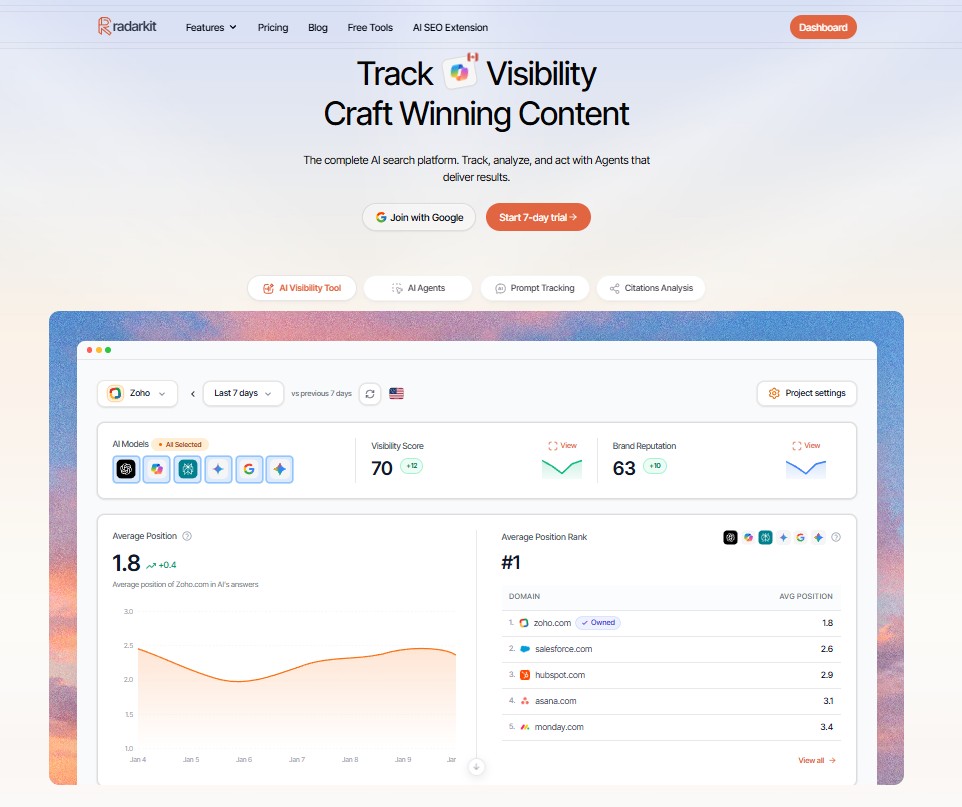
RadarKit takes the first position because local-business recommendations are a dedicated part of its platform. Local Radar measures whether AI selects your business, where it places you, and which other businesses it recommends.
Among these Semrush AI Visibility alternatives, RadarKit offers a useful combination of local monitoring, wider brand analysis, and agents that help teams act on the findings.
Why It’s Strong
The local reporting is built around questions an owner can use: how frequently are we recommended, how prominently do we appear, and who appears alongside us?
RadarKit also captures answers through consumer-facing AI interfaces. Its Local Radar uses residential IPs across 50+ countries, with city-level residential-IP tracking available through the appropriate package.
Key Features
-
Local appearance rate: Measures the share of relevant local AI answers recommending your business. This gives a clinic or restaurant a more focused view than a report mixing local and unrelated questions.
-
Position tracking: Records where the business appears within recommendations. You can examine whether it is regularly included near the beginning or further down an answer.
-
Local competitor discovery: Captures recommended businesses and compares their positions, ratings, review counts, and appearances. This helps reveal the competitors present in the answers you monitor.
-
Citation and query research: Shows cited sources and captures background searches AI performs while answering. A local marketing team can use these findings to research relevant directories, publications, and service-page topics.
-
Marketing agents: Content, Outreach, Reddit, and Chat agents support drafts, pitches, research, and other tasks using RadarKit data. Content allowances and agent credits depend on the plan.
-
Reporting and connections: Includes branded PDF reports, a Client Portal, Google Search Console, Google Analytics, WordPress, MCP, and API access. These help connect local visibility work with existing reporting.
Local Business Features Explained
Consider a dental practice tracking “emergency dentist in Manhattan” and “dentist for nervous patients in Manhattan.” Local Radar can show which businesses appear, their positions, and the ratings and review counts displayed in the captured recommendations.
The important buying detail is targeting depth. Local-business tracking and 50+ countries or locations are included across standard plans, but the pricing matrix reserves state- and city-level targeting for Enterprise. Do not interpret the $29 entry plan as unrestricted city-level tracking.
That distinction makes RadarKit one of the Semrush AI Visibility alternatives worth evaluating with a location-specific demonstration.
Pricing
-
Lite: $29/month for two projects, 15 prompts, a 72-hour refresh, and six Content Agent articles or optimizations monthly.
-
Growth: $79/month for five projects, 50 prompts, daily monitoring, and 19 Content Agent articles or optimizations monthly.
-
Pro: $139/month for ten projects, 100 prompts, daily monitoring, and 32 Content Agent articles or optimizations monthly.
MCP and API access are included in all three plans. Enterprise adds custom capacity, 70+ locations, and state- and city-level targeting. A seven-day trial is available.
Best For
Local businesses and agencies wanting recommendation tracking with practical marketing workflows.
Peec AI
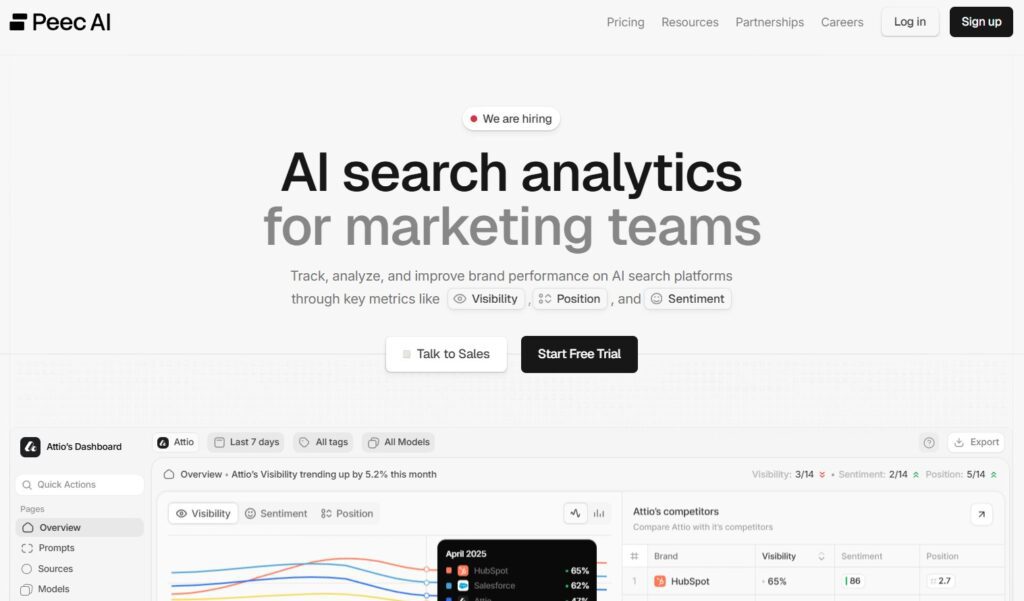
Peec AI helps businesses understand their appearances in AI answers and the sources influencing those answers. It combines visibility, position, sentiment, competitive reporting, and recommended actions.
Its value among Semrush AI Visibility alternatives comes from investigating local discovery beyond the business’s own website.
Why It’s Strong
A local marketing team often needs to know which external pages matter for its tracked questions. Peec separates retrieved sources from visible citations and provides gap analysis for sources that mention competitors but not your business.
That gives the team a more specific research task than simply publishing another general article.
Key Features
-
Daily brand measurement: Tracks visibility, position, sentiment, and share of voice against competitors. You can compare performance across services and tracked topics.
-
Source classification: Organizes influential sources into categories such as editorial, reference, user-generated content, and owned pages. Each category can point toward a different type of work.
-
Citation gap analysis: Finds frequently used sources that include competitors but omit your brand. This can help prioritize relevant directory research and editorial opportunities.
-
Prompt organization: Uses topics, tags, personas, and intent classifications to organize questions. A local agency could separate emergency services, routine services, and pricing questions within a project.
-
Local-result detection: Its documented response data can identify map widgets and extract local-business cards, including business names and available Google Maps links.
-
Recommended actions: Groups improvement opportunities into earned- and owned-media work, with agent-generated actions available within the product’s current feature set.
Local Business Features Explained
Peec’s local usefulness includes source analysis, geographic reporting, and recognition of map-based answer elements. Its documentation can report the share of captured answers containing a map or local-business result.
However, map-result detection is not the same as running a Google Maps ranking grid. When comparing Semrush AI Visibility alternatives, confirm Peec’s Local GEO workflow and subscription access for your specific city or branch setup.
Pricing
-
Starter: $95/month for 50 prompts, three selected models, and one project.
-
Pro: $245/month for 150 prompts, three selected models, and two projects.
-
Advanced: $495/month for 350 prompts, three selected models, five projects, and Looker Studio integration.
-
Enterprise: Custom annual pricing with customizable tracking, expanded access, and SSO.
Standard brand plans include daily monitoring and unlimited users. Additional models are sold separately.
Best For
Local marketing teams investigating cited sources and competitive coverage.
Profound
Profound combines AI visibility analysis, regional tracking, audience research, technical analytics, and marketing agents. It is particularly relevant to businesses with several locations, markets, or teams sharing the same reporting system.
For larger operators comparing Semrush AI Visibility alternatives, its regional controls deserve attention.
Why It’s Strong
Profound’s Enterprise analytics setup supports countries, states or provinces, and cities. Administrators can assign regions, languages, competitors, and prompt allocations to categories.
A regional healthcare group, for example, could organize its analysis around service categories and the markets where those services are offered.
Key Features
-
City and regional targeting: Supports country, state or province, and city regions within Enterprise analytics configuration. Coverage and allowances depend on the contract.
-
Answer Engine Insights: Measures brand presence, citations, sentiment, ranking, and competitor appearances across purchased engines.
-
Category-based organization: Groups owned assets, competitors, prompts, regions, and languages. This provides a structure for businesses reporting across different services or markets.
-
Prompt Volumes: Helps research audience demand using a dataset of real AI conversations. Teams can use the findings to inform their prompt and content planning.
-
Agent Analytics: Tracks crawler access and AI-sourced traffic, with connections to infrastructure and analytics platforms. This helps examine whether important service pages are being accessed.
-
Marketing agents: Supports reusable research, writing, and reporting workflows informed by company context. Agent use operates through credits.
Local Business Features Explained
Profound supports genuine geographic configuration rather than relying solely on city names typed into questions. Its Enterprise settings let businesses add a city as a monitored region and associate it with selected categories.
That makes it a meaningful option among Semrush AI Visibility alternatives for multi-market organizations. Confirm the purchased engines, regions, languages, and category limits during scoping.
Pricing
Profound currently lists a free seven-day trial and custom Enterprise pricing. The trial runs 50 prompts daily across ChatGPT, Gemini, and Google AI Overviews in one region and language.
The trial uses recommended prompts that cannot be customized. Enterprise provides ongoing daily tracking, customizable prompts, and contract-based regional coverage.
Best For
Multi-location organizations needing city-based analysis and shared enterprise workflows.
Rankability
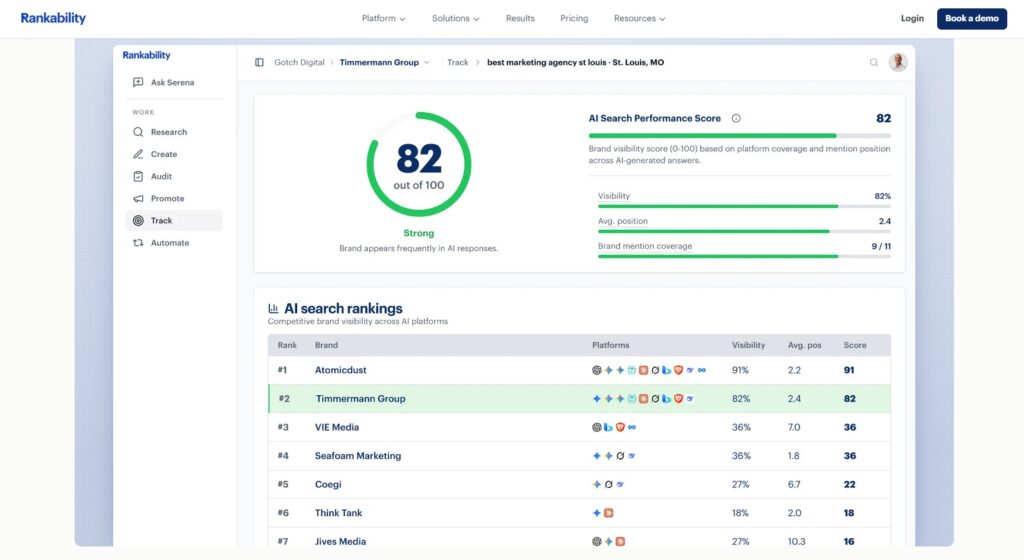
Rankability brings AI monitoring, organic tracking, Local Pack scans, business-profile audits, and content delivery into an agency-focused platform. All paid plans include unlimited client workspaces and team members, with shared usage allowances.
It stands apart from several Semrush AI Visibility alternatives by explicitly combining AI-answer measurement with traditional local-search tools.
Why It’s Strong
Local client work rarely involves AI answers alone. An agency may also need to report Google rankings, inspect a business profile, and improve a service page.
Rankability puts those tasks within the same delivery system while keeping their allowances separate.
Key Features
-
Daily AI tracking: Monitors selected queries across 11 included platforms, covering major assistants and Google’s AI search surfaces. The same platform coverage applies across paid tiers.
-
Local Pack grids: Scans one keyword for one business across a grid of locations. A standard scan covers up to 25 points, allowing teams to examine geographic ranking differences.
-
Google Business Profile audits: Provides local and brand audits that cover business profiles and consistency. These have separate allowances from recurring Local Pack scans.
-
Organic rank tracking: Monitors Google keywords weekly, with each keyword-location-language combination using a separate slot.
-
Content projects: Includes research, a brief, an outline, an AI-assisted draft or revision, optimization guidance, and export for a new page or refresh.
-
Client reporting: Supports branded reports, client keyword approvals, Search Console and Analytics data, plus API and MCP access.
Local Business Features Explained
Rankability is useful when a local campaign needs to measure two different outcomes: inclusion in AI answers and placement in Google’s Local Pack.
For example, an agency serving a roofing contractor could monitor buying questions in AI while running separate Local Pack scans for relevant service keywords. These remain separate reports, not interchangeable ranking scores.
Among Semrush AI Visibility alternatives, this is a practical option for agencies handling full local SEO delivery.
Pricing
-
Starter: $97/month for 100 AI queries, 20 content projects, 50 Google keywords, and ten Local Pack scans monthly.
-
Agency: $297/month for 300 AI queries, 80 content projects, 150 Google keywords, and 30 Local Pack scans monthly.
-
Agency Pro: $497/month for 500 AI queries, 160 content projects, 250 Google keywords, and 50 Local Pack scans monthly.
Annual prices are $970, $2,970, and $4,970. A limited seven-day trial requires a card.
Best For
Agencies managing AI visibility, Maps reporting, and local content together.
Ahrefs Brand Radar
Ahrefs Brand Radar supports both broad discovery and custom prompt monitoring. You can investigate existing AI-answer data, then track selected questions across chosen platforms and locations.
Its role among Semrush AI Visibility alternatives is especially useful for research-led local campaigns.
Why It’s Strong
A local business may need to investigate more than its own name. It may want to research a service category, a city, a competing practice, or a directory that frequently appears.
Brand Radar supports searches across brands, products, regions, and people, alongside cited-page and domain analysis.
Key Features
-
Custom local-intent prompts: Lets teams create their own questions, select tracking locations, and generate prompt ideas with local-intent instructions.
-
Flexible monitoring frequency: Supports daily, weekly, or monthly checks across selected engines. This allows teams to allocate checks according to priority.
-
Existing-answer research: Provides access to searchable AI indexes without first waiting for a custom tracking campaign to collect history.
-
Citation analysis: Identifies pages and domains referenced by AI, helping local teams research relevant publications, directories, and comparison pages.
-
Brand aliases and competitors: Supports multiple names and websites under an entity, useful when a business is known by different names.
-
Prompt tags and reporting: Organizes tracked questions by topic or customer journey and supports reporting connections and programmatic access.
Local Business Features Explained
Custom prompts can run across one or more selected locations. The prompt generator also accepts instructions such as “local intent only,” helping build questions around a particular service area.
For geographically focused Semrush AI Visibility alternatives, confirm the available locations before purchasing. Also distinguish custom monitoring from the broader AI-answer indexes, which follow their own refresh schedules.
Pricing
-
Custom Prompts Basic: $50/month for 2,500 checks.
-
Custom Prompts Growth: $100/month for 7,000 checks.
-
Custom Prompts Scale: $250/month for 25,000 checks.
-
AI indexes: $199/month for one platform or $699/month for all platforms, including 2,500 custom checks.
One standard check equals one prompt execution across one model and one location. More locations and more frequent monitoring increase consumption.
Best For
Local SEO specialists wanting flexible tracking and deeper source research.
Otterly AI
Otterly AI provides daily monitoring, citation analysis, prompt research, and GEO audits in plans starting at $29 per month. Unlimited team members are included, allowing an owner and marketing partner to share access.
For smaller businesses evaluating Semrush AI Visibility alternatives, it offers a focused entry point into regular measurement.
Why It’s Strong
A small team can begin with a limited set of important questions and review them daily. Otterly also includes audits and recommendations, so the workflow can extend beyond checking whether the brand appeared.
Key Features
-
Daily prompt checks: Base plans monitor ChatGPT, Google AI Overviews, Perplexity, and Microsoft Copilot.
-
Brand visibility reporting: Includes a Brand Visibility Index, domain ranking, and unlimited brand reports for examining appearances over time.
-
Link citation analysis: Shows the pages referenced in captured answers. A local business can investigate whether its website or relevant third-party pages are included.
-
Prompt research: Helps identify questions for monitoring, supporting a more deliberate prompt set than brand-name searches alone.
-
GEO auditing: Provides page-level audit allowances and recommendations. These can support reviews of important service and location pages.
-
Agency reporting: Standard and Premium include Looker Studio, API, MCP, and Agent Analytics access, with agency-partner benefits available to eligible accounts.
Local Business Features Explained
Otterly supports more than 50 countries. A local business can monitor geographically worded questions within supported markets and research the citations those questions produce.
Country coverage should not be presented as proof of city-level residential-IP collection or Google Maps grid tracking. When assessing Semrush AI Visibility alternatives, demonstrate your required local setup rather than assuming those capabilities are equivalent.
Pricing
-
Lite: $29/month for 15 prompts and one workspace.
-
Standard: $189/month for 100 prompts and unlimited workspaces.
-
Premium: $489/month for 400 prompts.
-
Enterprise: Custom pricing starting from 1,000 prompts.
Google AI Mode, Gemini, and Claude are paid add-ons. Annual billing offers lower monthly equivalents.
Best For
Single-location businesses and small teams starting structured AI reporting.
Promptwatch
Promptwatch combines prompt tracking, citation research, crawler analysis, and content workflows. Its geographic options expand by subscription, with state- and city-level tracking explicitly included on Business.
It is relevant among Semrush AI Visibility alternatives when local visibility work is closely connected to website improvements.
Why It’s Strong
A local business needs more than a list of questions where it appears. It also needs to understand which pages support those answers and what information could be added or clarified.
Promptwatch connects cited-source research with content gaps, refreshes, and agent-assisted work.
Key Features
-
Geographic tracking: Professional includes country-level monitoring, while Business adds state- and city-level tracking.
-
Brand and competitor analysis: Measures appearances across selected models and compares visibility, sentiment, and competitive presence.
-
Citation research: Identifies the sources and content types used in answers, helping teams investigate local guides, service pages, and third-party coverage.
-
Content gap analysis: Compares website coverage with information found in AI answers. Teams can use this to plan more complete service content.
-
Content agents: Supports briefs, article creation, and refresh work informed by citation research. Included articles vary by subscription.
-
Crawler and agent analytics: Provides tools for examining AI access to site content and connections to infrastructure providers. Business explicitly includes Agent Analytics.
Local Business Features Explained
A multi-city service company could use city-based tracking to investigate how its visibility changes between service areas. The content workflow can then support research and updates for pages serving those markets.
For this use case, Business is the plan to compare. The $95 Essential subscription should not be described as including the city-level targeting listed on Business.
This makes plan-level geography particularly important when shortlisting Promptwatch against other Semrush AI Visibility alternatives.
Pricing
-
Essential: $95/month for one project, 50 prompts, four models, and 500 agent credits. No AEO articles are included.
-
Professional: $245/month for two projects, 150 prompts, country-level tracking, and five AEO articles monthly.
-
Business: $579/month for five projects, 350 prompts, state- and city-level tracking, and ten AEO articles monthly.
Professional and Business include MCP and API access. Confirm the included model selection and geographic setup before subscribing.
Best For
Local content teams and multi-market businesses connecting tracking with website work.
What Should Local Businesses Compare Before Switching?
Actual Location Targeting
Adding a city name to a prompt is different from collecting an answer from that location. Check whether your subscription includes country selection, city-level targeting, or residential-IP tracking.
RadarKit supports tracking across 50+ countries using residential IPs, while state- and city-level targeting is listed under Enterprise. Ask for a demonstration using your actual business location and services so you can confirm the right setup.
Business Mentions and Website Citations
An AI answer can recommend your business without linking to your website. It can also cite your content without recommending your services. Both are useful, but they tell you different things.
RadarKit’s brand monitoring and citation analysis help you examine these separately. Review whether your business appears in relevant recommendations, then investigate the pages and directories supporting those answers.
AI Recommendations and Local Rankings
Being recommended in an AI answer and ranking in a local search result are different outcomes. Keep those measurements separate when reviewing your performance.
RadarKit’s Local Radar shows whether your business appears in monitored AI recommendations, its position, and which competitors appear alongside it. Use those findings alongside your existing local-ranking reports rather than treating the two as interchangeable.
Useful Work After the Report
Decide who will turn the findings into action. Your next step might be updating a service page, researching a cited directory, or preparing an outreach pitch.
RadarKit’s Content, Outreach, Reddit, and Chat agents can support follow-up work using your tracking data. Choose a plan with the monitoring frequency and agent allowances your team can use consistently, rather than selecting the largest package by default.
Final Verdict
RadarKit is our top pick for this local-business shortlist because it combines dedicated recommendation reporting, competitor details, coverage across 50+ countries, and agents for follow-up work. Its Enterprise package is the relevant choice when city- or state-level targeting is essential.
The other Semrush AI Visibility alternatives suit different priorities. Choose Peec for source-led analysis, Profound for enterprise regional coverage, Rankability for combined local SEO delivery, Ahrefs for research flexibility, Otterly for a smaller monitoring setup, or Promptwatch for geographic tracking tied to content work.
Before subscribing, ask each shortlisted provider to demonstrate your services and locations. That will make the differences between these Semrush AI Visibility alternatives much clearer than a feature count alone.
FAQs
Which Alternative Is Best for Tracking Local AI Recommendations?
RadarKit is our first recommendation because Local Radar reports appearance rate, position, and competing businesses, including ratings and review counts. It supports tracking across 50+ countries. State- and city-level targeting is listed under Enterprise, so confirm the required package for your market.
Can These Tools Track Google Maps Rankings Too?
Some can, but AI-answer tracking does not automatically include Maps rankings. Rankability explicitly provides Local Pack grid scans alongside separate AI queries and organic Google tracking. Check whether you need both types of reporting before choosing a subscription.
Does Country Coverage Mean a Tool Supports City-Level Tracking?
No. These are different levels of geographic coverage. For example, RadarKit separates standard country or location coverage from Enterprise city targeting, while Promptwatch lists country tracking on Professional and city tracking on Business. Compare Semrush AI Visibility alternatives at the plan level.
What Local Questions Should a Business Monitor?
Build questions around services, location, urgency, and customer preferences. For a hypothetical dental practice, these might include emergency appointments, treatment pricing, and care for nervous patients in its service area. Keep the examples relevant to services the practice actually provides, and organize them by topic.
Can AI Visibility Software Replace Local SEO Work?
Treat it as an additional measurement and research layer. Citation analysis can identify sources to investigate, while local audits and content workflows can support improvements. The software does not guarantee recommendations or replace the business’s responsibility to maintain accurate information, useful pages, and sound reporting.