In this article, we compare 8 Local Falcon alternatives for AI visibility. Each offers a different approach, from local recommendation tracking and citation research to business-data management, content auditing, and conversion reporting.
The reviews cover RadarKit, Local Dominator, Yext, Peec AI, Otterly AI, Profound, Rankability, and Promptwatch. We explain their distinctive features, local-business features and pricing.
So, without any further ado, let’s get started.
Quick Pick Criteria
Our first recommendation is RadarKit for teams that want local recommendation analysis connected to strategy, content, outreach, and community research. Its residential-IP coverage spans 50+ countries, with city- and state-level targeting.
- RadarKit: Best for local recommendation analysis and agent-assisted marketing work.
- Local Dominator: Best for managing AI campaigns alongside local rankings and business profiles.
- Yext: Best for coordinating visibility and business information across many locations.
- Peec AI: Best for citation analysis, brand perception, and claim checking.
- Otterly AI: Best for daily monitoring and page-level content diagnostics.
- Profound: Best for enterprise research, regional reporting, and bulk agent workflows.
- Rankability: Best for agencies delivering tracking, audits, and content projects.
- Promptwatch: Best for connecting AI answers with crawler activity, visitors, and conversions.
Comparison Table: Local Falcon Alternatives for AI Visibility
| Tool Name | Best For | Starting Price | Local AI Visibility Features |
|---|---|---|---|
| RadarKit | Local recommendation tracking with agent-assisted marketing work | $29/month | Local Radar tracks appearance rate, answer positions, and competing businesses. Residential-IP coverage spans 50+ countries, with state- and city-level targeting in Enterprise |
| Local Dominator | Agencies managing AI campaigns, Maps grids, and business profiles | $39/month | AI Tracker covers six engines and supports campaign-level answer review. GeoGrid scans measure Maps and Local Pack coverage separately |
| Yext | Multi-location brands needing coordinated business information | Custom pricing | Scout tracks location and competitor visibility, while the Knowledge Graph and Action Center support controlled business-information updates |
| Peec AI | Teams researching citations, brand descriptions, and factual claims | $95/month | Detects map widgets and local-business cards, analyzes citations and sentiment, and supports project-enabled claim checking |
| Otterly AI | Small teams wanting daily monitoring and page diagnostics | $29/month | Daily monitoring, citation analysis, Brand Profiling, and content audits for service and location pages |
| Profound | Enterprise teams coordinating regional research and content workflows | Custom pricing | Enterprise supports country, state or province, and city regions, with categories for services, competitors, and markets |
| Rankability | Agencies combining AI reporting with local SEO delivery | $97/month | Local Pack grid scans, business-profile audits, organic keyword tracking, and separate AI-query monitoring |
| Promptwatch | Teams linking AI answers with website activity and content updates | $95/month | Country-level tracking on Essential; state- and city-level tracking on Business. Crawler, visitor, and conversion reporting support website investigation |
8 Best Local Falcon Alternatives for AI Visibility
RadarKit
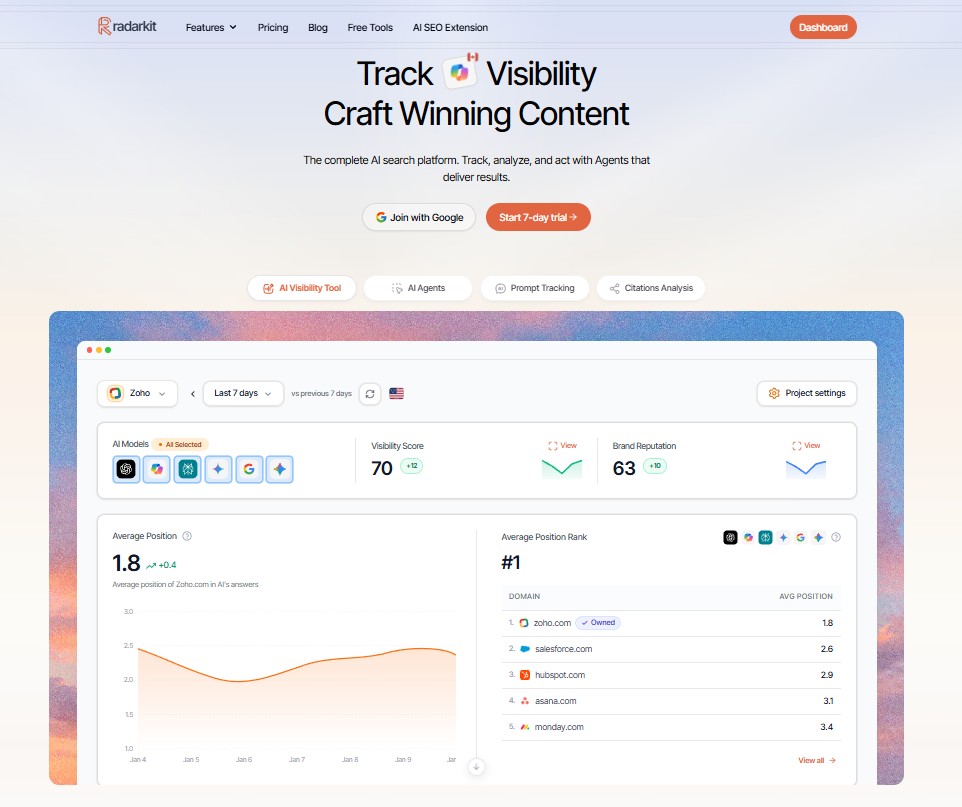
RadarKit brings AI-answer tracking, local recommendations, shopping intelligence, advertising data, and marketing agents into one platform. It runs prompts through consumer-facing AI interfaces and records the answers about your business and its competitors.
Its main advantage is the connection between the collected data and the work that follows. A strategy agent can identify gaps, a content agent can prepare an update, and an outreach agent can investigate sites influencing the answers.
Why It’s Strong
RadarKit’s agents have separate responsibilities and use brand context, tracked prompts, citations, and connected account data. They are designed around tasks such as planning content, researching third-party coverage, and reviewing relevant discussions.
Local Radar adds a dedicated view of business recommendations. It separates appearances in local answers from unrelated responses that would make a local score harder to interpret.
Key Features
-
AI monitoring: Tracks ChatGPT, Gemini, Perplexity, Microsoft Copilot, Google AI Mode, and Google AI Overviews. It submits prompts through the interfaces rather than using model APIs for its monitoring. All six are included across standard subscriptions.
-
Citation and query-fanout analysis: Records the pages referenced in answers and the background searches AI performs while developing a response. These findings can inform content research and show which external pages deserve closer review.
- Local appearance rate: Measures the share of monitored local answers that recommend your business, helping service providers review relevant recommendation questions separately from unrelated brand discussions.
- Recommendation positions: Records where a business appears within captured answers, showing whether it is consistently listed early or mentioned further down.
- Competitor details: Captures recommended businesses and compares their positions, ratings, review counts, and appearances across monitored questions.
- Citation and query analysis: Shows cited pages and background searches used while an AI system builds its answer, informing service-page research and outreach.
- Marketing agents: Content, Outreach, Reddit, and Chat agents support drafting, research, pitches, and conversations, with usage allowances varying by subscription.
- Connected reporting: Includes branded PDF reports, a Client Portal, Google Search Console, Google Analytics, WordPress, MCP, and API access; MCP connects compatible AI assistants to platform data.
- Query fanout capture: Records additional searches AI performs while preparing a response, giving more detail about the topics connected to a prompt.
- Plan Agent: Reads RadarKit data and connected Google Search Console information, identifies visibility gaps, and turns them into tasks for the right specialist agent.
- Content Agent: Uses tracked prompts, cited sources, entities, and query fanouts to improve existing content. WordPress integration supports the publishing workflow.
- Outreach Agent: Finds domains citing competitors, identifies contact details, and prepares outreach workflows using the brand’s context.
- Reddit Agent: Reviews Reddit discussions connected to tracked topics and shows where competitors appear, or where the brand is missing.
- Shopping Radar: Tracks product carousel appearances, position, price, rating, and the merchant receiving the placement.
- Ads Radar: Captures sponsored placements, advertisers, headlines, and the share of answers containing advertisements.
- MCP and API: Connects RadarKit data with compatible AI clients and custom workflows. MCP access is included across the standard plans.
- Agency reporting: Provides a client portal, historical data, branded PDF reports, and multi-project support.
Local Business Features Explained
Local Radar tracks whether AI recommends your business in answers to your local prompts. Its reporting answers three specific questions: how often you appear, where you rank in the answer, and which other businesses receive recommendations.
Appearance rate measures the share of relevant local AI answers that recommend your business. Unrelated answers are kept out of that local measurement, so the figure reflects the recommendation questions being monitored rather than every brand-related response.
Position tracking records your exact place in each answer. Average position summarizes those appearances, while the individual responses show how far your business sits from the first recommendation.
Monitoring runs automatically for your tracked prompts and captures the businesses AI recommends. Competitor comparisons include position, rating, review count, and number of appearances. This shows whether the same businesses recur and how their visible details compare with yours.
Local Radar uses residential IPs across 50+ countries. It also prompts AI interfaces directly rather than relying on model APIs. Its local workflow includes reading business recommendations in ChatGPT and Google’s AI search surfaces.
These are positions inside AI answers, not Google Maps grid rankings. Refresh frequency and geographic targeting depend on the subscription, with state- and city-level targeting included in Enterprise.
Pricing
-
Lite: $29/month for two projects, 15 prompts, a 72-hour refresh, and six Content Agent articles or optimizations monthly.
-
Growth: $79/month for five projects, 50 prompts, daily tracking, and 19 Content Agent articles or optimizations monthly.
-
Pro: $139/month for ten projects, 100 prompts, daily tracking, and 32 Content Agent articles or optimizations monthly.
MCP and API access are included on every plan.
Best For
Businesses and agencies wanting local recommendation reporting with strategy, content, and outreach support.
Local Dominator
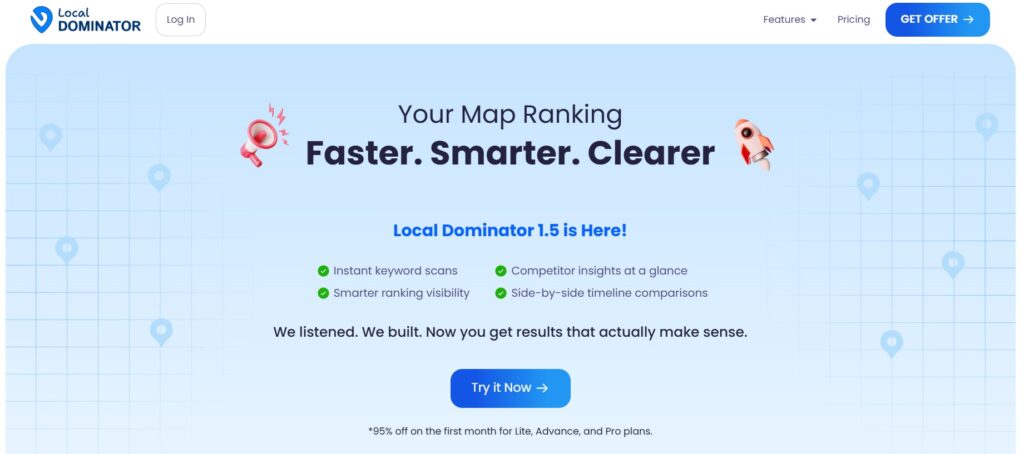
Local Dominator combines AI Tracker with GeoGrid scans, organic tracking, business-profile management, listings, reviews, and site auditing. AI Tracker covers ChatGPT, Gemini, Google AI Mode, Perplexity, Claude, and Grok.
Campaigns are built around a business, its topics, and a location setup. Users can review the generated prompts before scanning, then examine the actual answers and cited pages.
Why It’s Strong
Local Dominator makes it possible to investigate a visibility score at several levels. You can inspect an engine, open an individual prompt, read the response, review mentioned businesses, and compare two scan dates.
The wider local tools support profile maintenance and ranking work separately from the AI campaign.
Key Features
-
Topic and intent setup: Accepts up to ten starting topics and classifies questions by informational, transactional, commercial, or navigational intent. This gives the campaign a structure before scanning begins.
-
Editable prompt lists: Lets teams add, change, or remove generated questions. A campaign can therefore reflect actual services and customer language instead of retaining every suggested prompt.
-
Engine-level analysis: Breaks visibility down across six engines. Teams can see which platforms include the brand less often and inspect the relevant responses.
-
Full-answer review: Displays the question, returned response, brand mentions, average position, and sentiment. This helps explain the context behind a detected appearance.
-
Brands and Sources views: Lists competing businesses and aggregates cited pages across prompts and engines. Repeated directories, publications, and service pages can be investigated individually.
-
Opportunities and scan history: Highlights missing appearances and suggested investigations. Users can review one scan or compare two dates to examine changes.
-
Local operations: GeoGrid maps, side-by-side local comparisons, profile tools, listing checks, review monitoring, and review-velocity analysis cover tasks outside the AI report.
-
Shareable campaigns: Lets agencies share campaign results with clients without giving them access to the full working account.
Local Business Features Explained
The AI campaign workflow includes a business domain, topics, and location information, with country selection used in campaign setup. Its separate GeoGrid tools measure Google Maps and Local Pack performance across an area.
Those functions serve different purposes. The grid shows geographic ranking coverage, while AI Tracker analyzes generated answers. A Maps scan should not be interpreted as evidence that an AI response was collected through a city-specific residential IP.
AI scans and other credit-consuming tasks draw from a shared pool. Regular grid scans, AI monitoring, and additional campaign work therefore need to fit within the same allowance.
Pricing
Lite starts at $39/month with 5,000 monthly credits and on-demand AI scans. Annual billing costs $390, equivalent to $32.50 per month.
Automatic recurring AI scans and generated action plans cost an additional $49/month. A seven-day trial is available without a credit card. Business-profile capacity and other allowances vary by package.
Best For
Agencies managing AI campaigns, business profiles, reviews, and local rankings together.
Yext
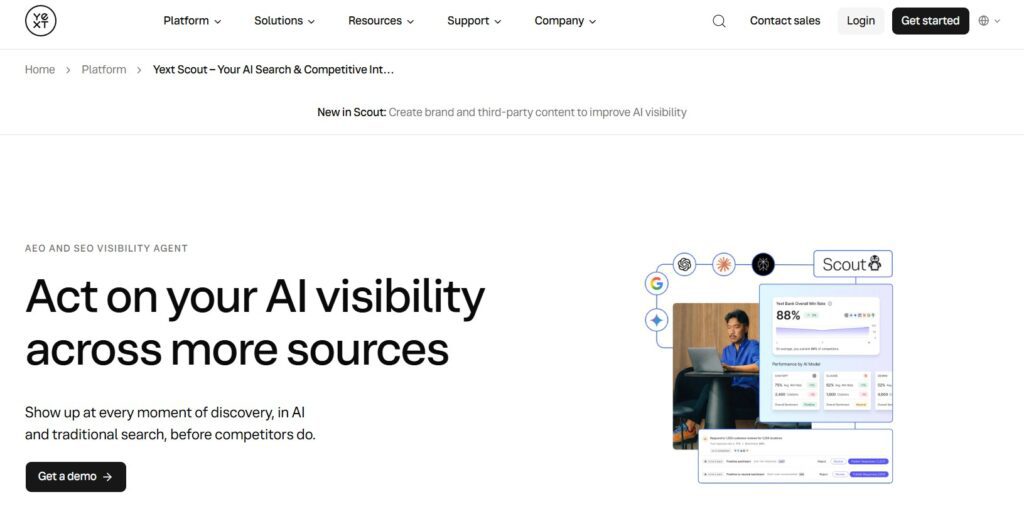
Yext connects Scout visibility intelligence with structured business information, listings, pages, reviews, and social workflows. It is designed to coordinate a brand’s presence across many locations.
Scout provides the competitive findings. The Knowledge Graph holds maintained business facts, while Action Center governs work performed across the products included in the contract.
Why It’s Strong
Yext connects location-level measurement with information management. A team can investigate a branch’s visibility and maintain the facts customers encounter across its connected channels.
Its approval controls also let different types of work follow different rules instead of treating every automated action alike.
Key Features
-
Brand and location monitoring: Covers Google Search, Google Maps, Google AI Overviews, ChatGPT, Gemini, Claude, and Perplexity, with trends by location and competitor.
-
Competitive win rates: Benchmarks performance against the 20 closest competitors for relevant brand and high-intent local searches. Teams can investigate locations and topics with weaker competitive results.
-
Citation intelligence: Identifies websites and content associated with brand mentions. It helps teams examine coverage beyond their own pages.
-
Sentiment themes: Groups recurring descriptions of the brand, including service-experience themes. These can be reviewed alongside business information and customer feedback.
-
Knowledge Graph: Maintains structured brand and location facts that support listings, pages, and other connected products. The wider publisher network covers more than 200 destinations.
-
Action Center governance: Controls which agent actions run automatically, which require approval, and what is logged. Review responses, profile updates, social work, and content tasks can follow separate rules.
-
Mobile access: Lets managers review location win rates and recommended priorities away from the desktop dashboard.
Local Business Features Explained
Yext supports a centrally managed location network. Branch facts can be maintained in the Knowledge Graph and distributed through the products included in the solution.
Scout reporting and the wider listings, pages, reviews, or social operation are separate contract considerations. Buying visibility intelligence does not automatically include every execution product.
This structure suits businesses with a central team responsible for maintaining consistent information across branches.
Pricing
Yext has custom pricing based on the selected solution, location or provider count, and contract term. Billing is typically annual, with other arrangements handled in the agreement.
Best For
Multi-location brands needing coordinated business information, competitive reporting, and controlled execution.
Peec AI
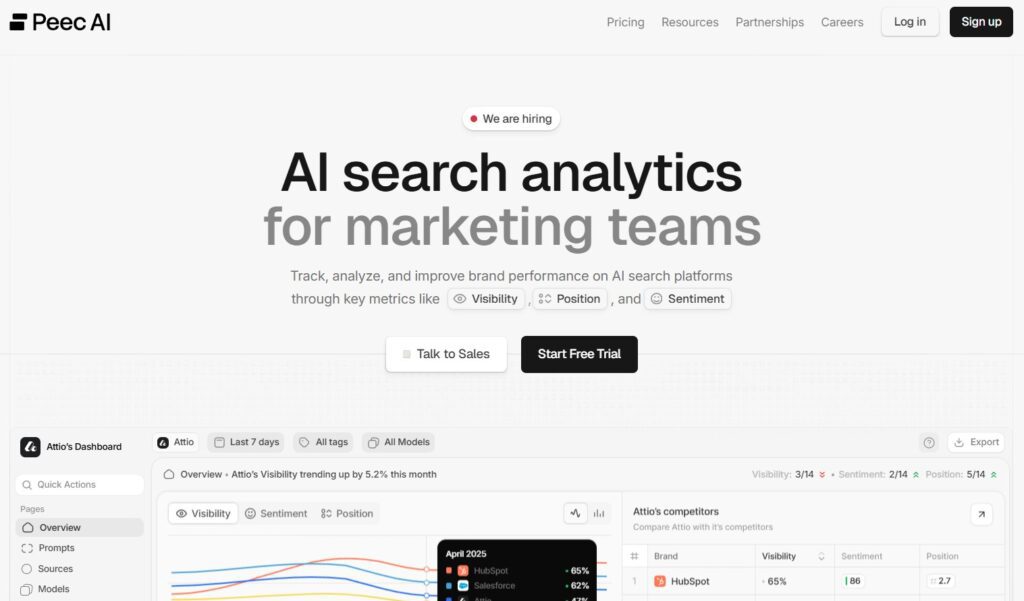
Peec AI measures brand visibility and examines the descriptions, claims, pages, and competitors behind the result. Its features extend into crawler analysis, shopping visibility, recommended actions, and project-enabled content optimization.
It separates whether a brand appears from how it is represented and which material supports the answer.
Why It’s Strong
Peec distinguishes retrieved pages from citations shown in the final response. Its brand-perception analysis adds another layer by examining attributes, objections, and factual claims.
A team can investigate whether the next task involves website content, external coverage, incorrect information, or crawler access.
Key Features
-
Daily competitive analytics: Measures visibility, position, sentiment, and share of voice. Topics, tags, geography, intent, and branded or non-branded classifications help organize monitored prompts.
-
Retrieval and citation detail: Separates pages accessed while forming an answer from visible citations. Domain, subdomain, and URL views provide different levels of detail.
-
Citation gaps: Finds frequently used pages that mention competitors but omit your business. Teams can investigate relevant editorial, directory, reference, and community coverage.
-
Brand Perception: Scores attributes associated with the brand and compares them with market prominence. It also groups recurring objections and connects them with influential pages.
-
Claim checking: Compares AI statements with business-supplied facts, classifying claims as supported, contradicted, or inconclusive. The feature requires activation for the project.
-
Agent Analytics: Uses connected logs or uploaded data to examine AI-bot visits, requested URLs, errors, and crawling patterns. Bots can be grouped by training, search, and user-query intent.
-
Shopping and rich-answer analysis: Measures product visibility, positions, win rates, and merchants. Response analysis can identify advertising, maps, shopping galleries, and local-business cards.
-
Action and content workflows: Supports recommended tasks, reusable skills, MCP, and API connections. Project-enabled content tools can rewrite passages and apply or dismiss suggested changes.
Local Business Features Explained
Peec can identify map-based answers and local-business cards, while citation research reveals the pages supporting monitored service questions. Topic and brand organization can keep different services or markets separate.
Map-card recognition is not a Google Local Pack grid. Branch-level work requires the appropriate Local GEO setup and geographic access.
Claim checking and content optimization also require project activation. Their availability should be included in the account setup rather than assumed from the core monitoring subscription.
Pricing
-
Starter: $95/month for 50 prompts, three selected models, and one project.
-
Pro: $245/month for 150 prompts, three selected models, and two projects.
-
Advanced: $495/month for 350 prompts, three selected models, five projects, and Looker Studio integration.
Enterprise has custom pricing. Standard brand subscriptions include daily tracking and unlimited users. Additional models cost extra, and annual billing offers a 15% discount.
The three models selected for a subscription are not the same as the platform’s complete supported-engine list.
Best For
Teams researching cited pages, AI brand descriptions, factual claims, and competitor coverage.
Otterly AI
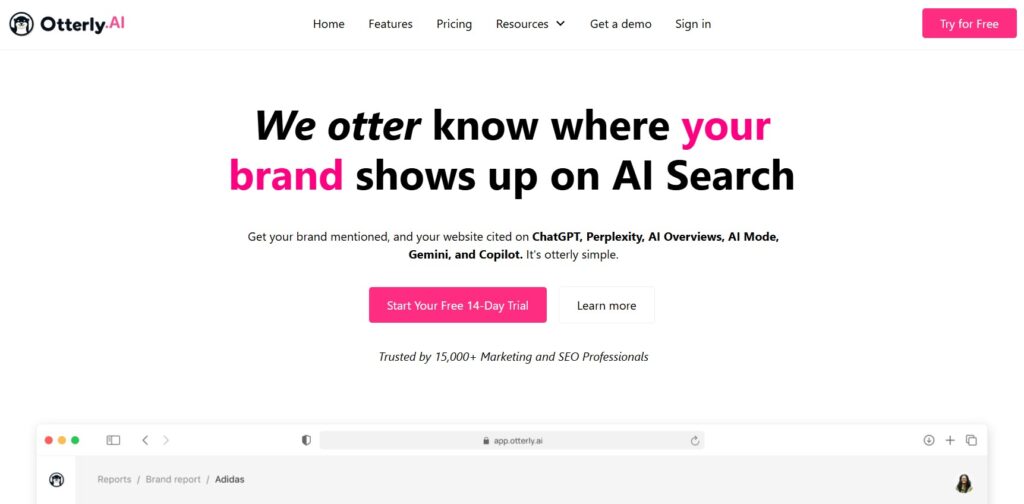
Otterly AI combines daily monitoring with Brand Profiling, citation research, content-readiness checks, and recommendations. Its content audit provides technical and editorial findings rather than automatically publishing changes.
The entry plan includes 15 prompts and unlimited team members, allowing a small team to share the reporting workflow.
Why It’s Strong
The content audit examines both server-delivered HTML and rendered content. It also reviews structure, entities, and schema, producing a more specific issue list than a general suggestion to improve a page.
After making changes, teams can run the audit again to review the same checks.
Key Features
-
Daily monitoring: Base plans cover ChatGPT, Google AI Overviews, Perplexity, and Microsoft Copilot. Additional engines are separate purchases.
-
Brand Profiling: Tracks visibility, sentiment, brand variations, and competitive presence. It helps teams examine how a business is described as well as whether it appears.
-
Citation analysis: Shows referenced domains and pages. Teams can investigate their own content and relevant directories, publications, or other third-party pages.
-
Static-versus-rendered checks: Examines content available before JavaScript runs and content that depends on rendering. The findings support specific discussions with the website team.
-
Content and structured-data auditing: Reviews clarity, page structure, entities, and schema. Re-auditing helps check whether the identified issues have been addressed.
-
Prioritized recommendations: Converts monitoring and audit findings into tasks. Lite includes three recommendations weekly, while higher standard tiers include unlimited recommendations.
-
Prompt and fanout research: Helps discover questions and explore related searches. A simulated fanout is research guidance, not a record of every search an AI engine actually performed.
-
Reporting and integrations: Includes shared brand reports, with wider workspace, API, MCP, and Agent Analytics allowances on Standard and Premium. Eligible agency partners receive additional benefits.
Local Business Features Explained
Otterly supports multi-country monitoring and questions about local services. Its audits can also examine service and location pages.
Country coverage does not establish city-specific residential-IP collection or Maps-grid measurement. Those are separate requirements from tracking questions that contain a place name.
The audit produces findings and recommendations. The business or its marketing team remains responsible for the edits and publication.
Pricing
-
Lite: $29/month for 15 prompts and one workspace.
-
Standard: $189/month for 100 prompts and unlimited workspaces.
-
Premium: $489/month for 400 prompts.
Google AI Mode, Gemini, and Claude are paid add-ons. On Lite, their monthly costs are $9, $9, and $29 respectively. Enterprise pricing is custom, starting from 1,000 prompts. Annual billing offers lower monthly equivalents.
Best For
Small teams wanting daily reporting alongside specific page-audit findings.
Profound
Profound combines audience-demand research, answer-engine analytics, regional reporting, traffic attribution, shopping intelligence, and reusable agents.
Its Sheets workflow can run agents across many pages, prompts, or topics, making it relevant to teams managing larger research and content programs.
Why It’s Strong
Profound connects research with execution at the row level. A spreadsheet can hold the inputs for a content refresh or brief, run agent steps, and return outputs for review.
Shared brand context supports those workflows without requiring the same business information to be entered for every task.
Key Features
-
Prompt Volumes: Uses real AI conversations to research audience questions and demand patterns. The findings can inform both monitoring and content planning.
-
Answer Engine Insights: Measures visibility, citations, sentiment, ranking, and competitive presence across purchased engines, with regional and topic analysis.
-
Context Manager: Stores positioning, product knowledge, and brand guidelines for AI Marketer and reusable agents. Teams can maintain shared business context across tasks.
-
Profound Sheets: Runs agents across rows of inputs and returns results to a table. Templates include briefs, refreshes, translations, FAQs, internal-link suggestions, and product-page optimization.
-
Agent Analytics: Separates crawler activity from human visits referred by AI platforms. Analytics connections can relate those visits to conversion events.
-
Shopping intelligence: Tracks ChatGPT Shopping placements, shopping-triggering questions, and merchants carrying the brand’s products.
-
Regional categories: Enterprise settings organize assets, competitors, prompts, regions, and languages by category. Available regions include countries, states or provinces, and cities.
Local Business Features Explained
A multi-market organization can assign relevant regions to service categories. Each category’s prompt allocation draws from the organization’s total capacity.
These controls apply to Enterprise, non-agency Analytics Setup. The purchased engines, workspace type, regions, and contract limits determine the setup.
This lets a central team organize regional reporting without treating every service and market as one undifferentiated brand result.
Pricing
Profound offers a free seven-day trial and custom Enterprise pricing. The trial runs 50 prompts daily across ChatGPT, Gemini, and Google AI Overviews in one region and language.
Trial prompts cannot be customized. Historical data, exports, and API access are not included in the trial. Enterprise adds ongoing daily tracking, tailored capacity, and broader regional coverage. Agent activity uses a separate credit allowance.
Best For
Enterprise teams coordinating regional research, attribution, and bulk agent workflows.
Rankability
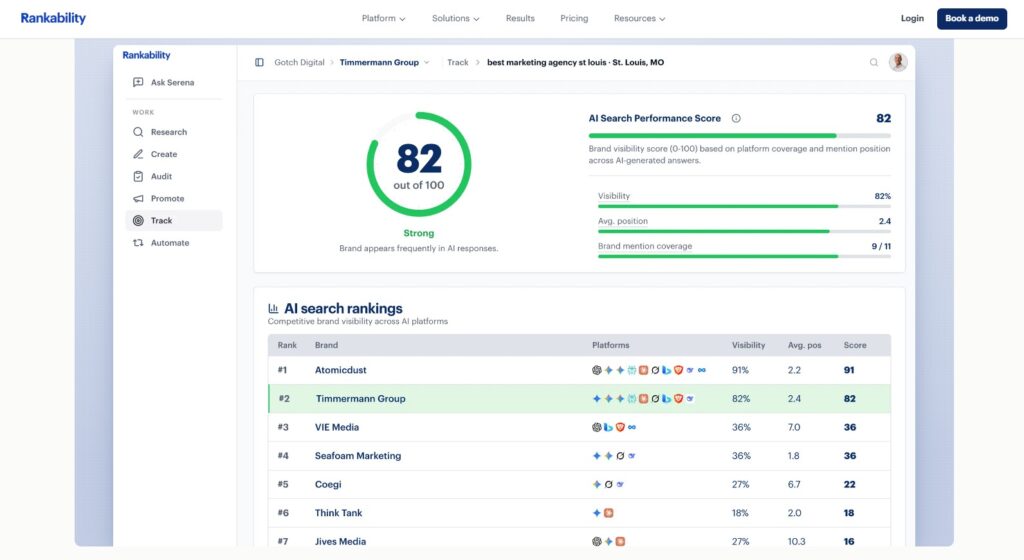
Rankability structures agency work around tracked queries, content projects, audits, local scans, and client reporting. Unlimited workspaces and team members share defined monthly allowances.
Its workflow covers production and approval as well as measurement, with business context retained for briefs and content work.
Why It’s Strong
Each content project represents a defined deliverable, including research, a brief, an outline, an assisted draft or refresh, optimization guidance, and export.
Tracking, scans, and audits have their own allowances. Agencies can plan those tasks separately instead of treating every action as the same unit of work.
Key Features
-
Eleven included platforms: Daily monitoring covers ChatGPT, Google AI Mode, Google AI Overviews, Claude, Perplexity, Gemini, Grok, Copilot, Brave AI, DeepSeek, and Meta AI across paid tiers.
-
Content projects and revisions: Each project includes two AI revisions. Saved work can still be manually edited, scored, and exported without creating another content project.
-
Client knowledge and voice: Stores business context, expertise, and tone for content work, supported by keyword and topic research.
-
Local and organic tracking: AI queries, Google keywords, and Local Pack scans use separate allowances. One standard local scan covers a keyword and business location across up to 25 grid points.
-
Audits: Provides page checks, technical site audits, and business-profile or brand-consistency audits. Audit capacity is separate from the content-project allowance.
-
Promotion research: Includes backlink profiles, referring domains, anchor-text review, and outreach-prospect research alongside production work.
-
Client acquisition and delivery: Supports branded prospect reports, client keyword approvals, and ongoing reporting. Lead-generation work uses the account’s existing allowances.
-
API and MCP: Connected assistants and automations share the same plan capacity rather than creating additional queries, audits, or content projects.
Local Business Features Explained
An agency can monitor AI appearances, inspect Local Pack coverage, audit business information, and prepare a service-page update within the same account.
The measurements remain separate. An AI position does not replace a Maps position, and a business-profile audit does not consume the same allowance as a recurring grid scan.
Unlimited workspaces also do not mean unlimited work. Capacity is shared across clients, so the monthly package must cover the agency’s combined delivery.
Pricing
-
Starter: $97/month for 100 AI queries, 20 content projects, 50 Google keywords, and ten Local Pack scans monthly.
-
Agency: $297/month for 300 AI queries, 80 content projects, 150 Google keywords, and 30 Local Pack scans monthly.
-
Agency Pro: $497/month for 500 AI queries, 160 content projects, 250 Google keywords, and 50 Local Pack scans monthly.
Annual prices are $970, $2,970, and $4,970. The seven-day trial requires a card and includes limited usage. Delivery allowances are shared across workspaces.
Best For
Agencies delivering AI reporting, local SEO checks, audits, and content projects.
Promptwatch
Promptwatch connects AI answers with cited pages, crawler requests, human visits, conversions, and content tasks. Agent Chat lets teams query those datasets and work on the findings.
The platform separates automated access from customer activity, which matters when interpreting whether a page was read by a crawler, cited in an answer, or visited by a person.
Why It’s Strong
Promptwatch links monitoring with website outcomes and content delivery. A team can investigate what a page lacks, examine the answers using competing material, and prepare an update through a content workflow.
This creates several separate evidence points rather than treating every bot request or mention as a business result.
Key Features
-
Consumer-interface monitoring: Collects responses from live AI interfaces with geographic settings. The supported platform set includes assistants, Google AI surfaces, and coding-agent experiences.
-
Selected-platform tracking: Brand plans actively monitor four selected platforms per project. The complete supported list is broader than the four running in that project.
-
Visitor and conversion analytics: Measures AI-referred human visits separately from bot activity and supports conversion tracking. Website outcomes can be reviewed alongside answer data.
-
Crawler logs: Connects requested URLs and status codes with citation research. Crawler-log access starts on Professional, while visitor analytics is a separate capability.
-
Paragraph-level gap analysis: Compares query-fanout requirements with an index of website content. This helps identify information missing from existing pages.
-
Knowledge Base and claim checking: Compares statements in AI answers with company information, including product and pricing facts. Teams can inspect the claim and supporting or contradictory material.
-
Off-site citation feeds: Separates relevant Reddit threads, YouTube videos, and other external coverage, helping teams investigate the pages and conversations influencing answers.
-
Content Agent and Actions: Supports drafts, refreshes, assignable tasks, and publishing connections to WordPress, Webflow, and Framer. Agent Chat, MCP, and API provide additional working interfaces.
Local Business Features Explained
Essential includes country-level tracking. Business includes country-, state-, and city-level geographic options, with collection settings configured for the required market.
A local website team can examine which service pages are accessed, cited, and visited, then use those separate findings to investigate a potential update.
Geographic depth, crawler capacity, selected platforms, and integration permissions need to be included in the subscription setup rather than inferred from the full product feature list.
Pricing
-
Essential: $95/month for one project, 50 prompts, 6,000 responses, and 500 agent credits. No AEO articles are included.
-
Professional: $245/month for two projects, 150 prompts, 18,000 responses, 1,500 agent credits, and five AEO articles monthly.
-
Business: $579/month for five projects, 350 prompts, 42,000 responses, 2,500 agent credits, and ten AEO articles monthly.
Enterprise has custom pricing and capacity. Model selection, geographic access, crawler volume, and integrations affect the working setup.
Best For
Teams connecting AI answers with traffic, conversions, technical investigation, and content delivery.
What You Should Look for in Local Falcon Alternatives
Local Recommendation Tracking
Look for reporting that distinguishes a business recommendation from a passing mention. You should be able to inspect the answer, see your position, and identify the other businesses recommended alongside yours.
Check how geographic settings work. Country selection, city-level collection, and a place name written into a prompt are different setups. A demonstration using your actual service area should show which method the platform uses.
AI Platform Coverage
Check which AI platforms your subscription monitors, not just the complete list the product supports. Some plans include several engines, while others require separate purchases or let you select only a limited number.
Review the collection method and refresh schedule too. Confirm whether the results come from consumer-facing interfaces or model APIs, and whether checks run daily, periodically, or only when requested.
Competitor and Citation Insights
A useful report should show which competitors appear for the same questions and preserve the responses behind those results. Positions, appearance frequency, and recurring descriptions help explain what the summary score represents.
Citation analysis should identify the pages referenced in an answer. Keep citations separate from recommendations, since a website can supply information without its business being selected as a provider.
Reporting and Follow-Up Features
Open a sample report and check whether it explains the monitored questions, locations, dates, and results clearly. Agencies may also need separate workspaces, branded exports, and client access.
Test one follow-up task, such as reviewing a service page or preparing an outreach draft. Establish what the software produces, what needs human review, and which integrations or permissions are required.
Clear Pricing and Usage Limits
Calculate the subscription around a normal month of work. Include the prompts, selected engines, locations, refresh frequency, reports, and agent tasks you expect to use.
Check whether allowances are shared across projects and clients. Also separate prompts, responses, grid scans, and agent credits in your estimate, since those units do not represent the same amount of work.
FAQs: Local Falcon Alternatives
Can an AI Visibility Tool Replace Local Falcon Completely?
That depends on which features you use. If you rely on Maps grids, local ranking history, and AI monitoring, the replacement needs to cover all three. A tool focused on brand mentions and citations may complement your local SEO setup rather than replace it.
Which Local Falcon Alternatives Include Local Rank Tracking?
Local Dominator and Rankability combine AI monitoring with separate local-ranking tools. Local Dominator includes GeoGrid tracking, while Rankability provides Local Pack grid scans. Keep those results separate from positions inside AI answers, since they measure different search experiences.
What Makes RadarKit Different From Local Falcon?
RadarKit combines Local Radar with specialist workflows for strategy, content, outreach, and Reddit research. It also includes shopping and advertising tracking. Its main appeal is the connection between recommendation data and marketing tasks, rather than a claim that one visibility score is more accurate than another.
Can You Track AI Visibility for Several Business Locations?
Yes, but location access and account structure vary. Some platforms support city-based collection on specific subscriptions, while others organize markets through categories, projects, or prompt settings. Ask to see separate results for two of your locations so you can understand how the reporting handles each branch.
Are Lower-Priced Alternatives Suitable for Small Businesses?
They can be, provided the entry plan includes the engines, locations, and update frequency you need. Compare the cost of that complete setup rather than the starting price alone. A smaller prompt allowance may be enough when it covers your main services and produces reports you can use consistently.
Final Thoughts
RadarKit is our top recommendation for businesses wanting a clear view of local AI recommendations alongside practical marketing workflows. Local Radar measures how often the business appears, its exact answer positions, and the other businesses receiving recommendations.
Competitor ratings, review counts, and appearances add context to that report. Plan, Content, Outreach, Reddit, and Chat workflows support different follow-up tasks, while MCP and API access are included across subscriptions.
Its residential-IP coverage spans 50+ countries, with state- and city-level targeting included in Enterprise. A focused prompt set and regular review of captured answers provide a useful foundation for the work your team chooses to carry out.